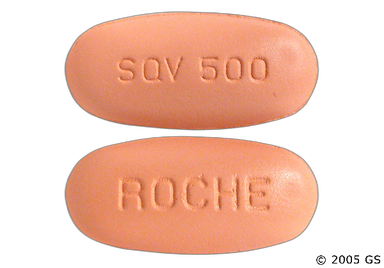
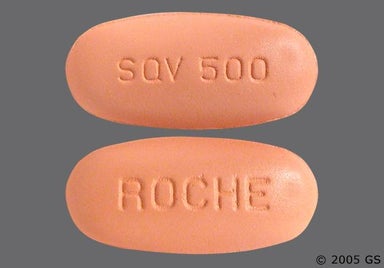
Invirase (saquinavir) is an oral tablet that's used as part of an antiretroviral (ARV) regimen to treat human immunodeficiency virus (HIV) in adults and children over 16 years of age. You'll also need to take ritonavir (Norvir) twice daily to help Invirase (saquinavir) work better against the virus. Invirase (saquinavir) belongs to a class of medications called protease inhibitors. Common side effects include nausea, diarrhea, and vomiting.
Treatment of HIV infection in people over 16 years old
How Invirase (saquinavir) works
Invirase (saquinavir) is a protease inhibitor, which means it blocks a protein called protease. Normally, protease helps to process viral proteins so that the HIV virus can infect healthy cells. By stopping protease from working, Invirase (saquinavir) prevents the virus from making copies of itself and spreading.
The following side effects may get better over time as your body gets used to the medication. Let your healthcare provider know immediately if you continue to experience these symptoms or if they worsen over time.
Common Side Effects
Nausea (11%)
Diarrhea (8%)
Vomiting (7%)
Stomach pain (6%)
Feeling tired (6%)
Pneumonia (5%)
Changes in fat (5%)
Side effects above were reported in adults taking this medication with ritonavir (Norvir).
Less Common Side Effects
Constipation
Fever
Back pain
Flu-like symptoms (congestion, cough)
Rash
Itching
Dry lips
Dry skin
High blood sugar
Invirase (saquinavir) serious side effects
Contact your healthcare provider immediately if you experience any of the following.
Serious liver problems: nausea, vomiting, not feeling hungry, pain in the right side of the stomach, yellowing of the whites of the eyes or skin, dark-colored urine, light-colored stool
The following Invirase (saquinavir) side effects have also been reported
Along with its needed effects, a medicine may cause some unwanted effects. Although not all of these side effects may occur, if they do occur they may need medical attention.
Check with your doctor immediately if any of the following side effects occur:
Some side effects may occur that usually do not need medical attention. These side effects may go away during treatment as your body adjusts to the medicine. Also, your health care professional may be able to tell you about ways to prevent or reduce some of these side effects. Check with your health care professional if any of the following side effects continue or are bothersome or if you have any questions about them:
Approved for use in adults and children over 16 years old
Safe to take for people with mild to moderate kidney problems
Available as a tablet taken by mouth twice daily
Cons
Might raise blood sugar, body fat, and cholesterol levels
Requires regular blood work and lab tests
Interacts with many medications
Pharmacist tips for Invirase (saquinavir)
Invirase (saquinavir) should be taken with ritonavir (Norvir)) and with food (within 2 hours of a meal). This combination helps to keep higher levels of Invirase (saquinavir) in the body, allowing it to work better for you.
Get your routine blood tests done on time while you’re taking Invirase (saquinavir). Lab work is important to make sure that the medication works against the virus, and that it isn't causing unwanted side effects.
Invirase (saquinavir) can interact with many medications. Some medications might need to be stopped or the dose changed before you start HIV ARV regimen. Let your provider or pharmacist know about all the medications you're taking.
Invirase (saquinavir) might raise your blood sugars, which can lead to or worsen diabetes. Talk to your provider to see if you need additional medications to help control your sugar levels during treatment.
Invirase (saquinavir) might cause changes to your heart rhythm. Let your provider know right away if you experience dizziness, fainting, or lightheadedness while taking this medication.
Talk to your provider before stopping Invirase (saquinavir) or any of your HIV medications. Doing so can cause the virus to spread and become harder to treat.
Risks and warnings for Invirase (saquinavir)
Invirase (saquinavir) can cause some serious health issues. This risk may be even higher for certain groups. If this worries you, talk to your doctor or pharmacist about other options.
Interactions with other medications
Some medications can interfere with how well your body gets rid of Invirase (saquinavir) from your system. This can affect the amount of Invirase (saquinavir) in your body, how well it works, and the risk of side effects.
Taking certain medications and supplements (like St. John's wort) can lower the amount of Invirase (saquinavir) in your body and make the HIV medication work less well.
Invirase (saquinavir) can also affect how your body gets rid of other medications. This can raise the levels of these medications in the body and raise your risk for side effects. For example, taking Invirase (saquinavir) with certain statins can raise your risk for serious muscle problems.
Because of the potential for serious interactions with Invirase (saquinavir) and various medications, tell your provider and pharmacist about all the medications you take or plan to take.
Heart rhythm problems
Risk factors: History of heart problems | Taking medications that affect heart rhythm | Low potassium or magnesium levels | Liver problems
Invirase (saquinavir) can sometimes affect your heart rhythm, which can be serious and life-threatening. Your risk is higher if you have certain conditions, including electrolyte levels that are out of balance and heart rhythm problems. Your risk might also be higher if you're taking other medications that cause heart rhythm problems, such as digoxin (Lanoxin) and beta-blockers, among others. In some instances, you might need to have your heart checked before starting this medication. Get medical attention right away if you feel your chest pounding, have trouble breathing, have chest pain, or feel faint or lightheaded while you're taking Invirase (saquinavir).
Some people taking protease inhibitor medications like Invirase (saquinavir) developed higher blood sugar levels, which has led to or worsened diabetes. In some cases, people needed to start taking a new medication or their current diabetes treatment plan needed changes to help keep blood sugar under control. If you have a history of diabetes, let your provider know before starting Invirase (saquinavir). Your provider might ask you to check your blood sugar at home to make sure this medication is safe for you.
Liver problems
Risk factors: Hepatitis B or C | History of liver problems | Alcoholism
Some people taking Invirase (saquinavir) have had liver problems, which were sometimes life-threatening. Your provider will order blood tests for you before and during treatment so they can make sure Invirase (saquinavir) is safe for your liver. Let your provider know if you experience signs and symptoms of liver damage, such as sleepiness, nausea, loss of appetite, light-colored stool, upper right stomach pain, yellowing of the skin or eyes, or dark urine.
Risk of bleeding in people with hemophilia
Some people with a bleeding condition called hemophilia have had more bleeding after starting protease inhibitors like Invirase (saquinavir). In about half of reported cases, people continued taking their protease inhibitor medication after the bleeding stopped. Let your provider know if you notice sudden bleeding or have bleeding that's difficult to stop.
Higher cholesterol levels
Taking Invirase (saquinavir) along with ritonavir (Norvir) can raise the amount of cholesterol and triglycerides (fats) in your blood. This can put you at higher risk for serious problems. Your provider will check your blood work before and during treatment to keep track of your levels. If your cholesterol levels are too high, you might need to take medications to help keep them under control. Keep in mind that you shouldn't take certain cholesterol medications, such as lovastatin and simvastatin (Zocor), with Invirase (saquinavir) because of the risk of serious muscle damage.
Potential harm if lactose intolerant
Invirase (saquinavir) oral tablets contain lactose. People with a history of certain genetic problems (e.g., galactose intolerance) are at high risk for diarrhea and other health problems because they can't process it well. For this reason, let your provider know before starting Invirase (saquinavir) if you've a history of genetic conditions.
Overactive immune system
Taking combination ARV therapy, such as Invirase (saquinavir) with other HIV medications, can cause changes to your immune system called immune reconstitution syndrome. This condition happens when your immune system becomes overly active after you start combination therapy. Your immune system begins to fight off different infections that it was too weak to fight off before you started treatment. In rare cases, your immune response might improve so much with treatment that it starts to attack normal cells in your body (autoimmune). You can develop immune reconstitution syndrome at any time during treatment. Tell your healthcare provider right away if you start having any new symptoms, such as fever, pain, hair loss, bulging eyes, or sweating, after starting Invirase (saquinavir).
Changes in body fat
Some people taking HIV medications such as Invirase (saquinavir) have experienced changes in body fat. These changes include fat buildup in the back of the neck, in the breast, and in other parts of the body. Some people also lost fat from the legs, arms, and face. It's not clear whether Invirase (saquinavir) causes these changes to body fat, why this happens, and whether it will affect your health in the future. Let your provider know if these changes occur while you're taking Invirase (saquinavir).
Invirase (saquinavir) dosage
The average cost for 30 tablets of 500mg of Invirase (saquinavir) is $344.47 with a free GoodRx coupon. This is 0.00% off the average retail price of $344.47.
Interactions between Invirase (saquinavir) and other drugs
Invirase (saquinavir) may interact with certain medications or supplements. Always let your doctor and pharmacist know about any other medications or supplements (including prescribed and over-the-counter medications, vitamins, and dietary or herbal supplements) that you are currently taking. The list below does not include all possible drug interactions with Invirase (saquinavir). Please note that only the generic name of each medication is listed below.
Although certain medicines should not be used together at all, in other cases two different medicines may be used together even if an interaction might occur. In these cases, your doctor may want to change the dose, or other precautions may be necessary. When you are taking this medicine, it is especially important that your healthcare professional know if you are taking any of the medicines listed below. The following interactions have been selected on the basis of their potential significance and are not necessarily all-inclusive.
Using this medicine with any of the following medicines is not recommended. Your doctor may decide not to treat you with this medication or change some of the other medicines you take.
Using this medicine with any of the following medicines is usually not recommended, but may be required in some cases. If both medicines are prescribed together, your doctor may change the dose or how often you use one or both of the medicines.
Using this medicine with any of the following medicines may cause an increased risk of certain side effects, but using both drugs may be the best treatment for you. If both medicines are prescribed together, your doctor may change the dose or how often you use one or both of the medicines.
Contraindications are specific health conditions or situations in which a person should not take a medication due to safety concerns. If you have any of the following conditions or if any of the following apply to you, let your healthcare provider know because Invirase (saquinavir) will not be safe for you to take.
GoodRx Health has strict sourcing policies and relies on primary sources such as medical organizations, governmental agencies, academic institutions, and peer-reviewed scientific journals. Learn more about how we ensure our content is accurate, thorough, and unbiased by reading our editorial guidelines.
Prescription savings
Stop paying too much for your prescriptions. Compare prices, get pharmacy coupons, and save up to 80%.
Take Invirase and ritonavir (Norvir) at the same time twice daily within 2 hours after a meal. And if you miss a dose of Invirase, you should take the next dose as soon as possible. Don't double up on tablets at your next scheduled dose since it can raise your risk for side effects.
Invirase is taken with ritonavir (Norvir), which acts as a "booster" to Invirase. This is because ritonavir (Norvir) slows the breakdown of Invirase, which allows Invirase to stay in your body longer so that it can work better. Without ritonavir (Norvir), Invirase might not work as well, which can cause the HIV virus to become harder to treat.
Invirase should be taken along with ritonavir (Norvir) twice daily within 2 hours after a meal. Studies show that a high fat meal can raise the amount of Invirase that your body absorbs, allowing it to work better for you.
Invirase interacts with certain medications, potentially causing serious problems. In some instances, Invirase can raise the levels of some medications in the body, leading to more side effects. In addition, antibiotics like clarithromycin and erythromycin are more likely to cause irregular heartbeat, and anxiolytics like midazolam and triazolam are more likely to cause serious breathing problems when taken with Invirase. To avoid these risks, tell your provider and pharmacist about all the medications you take or plan to take.
In general, it's recommended that pregnant people with HIV start treatment as soon as possible to lower the risk of transferring the virus to the unborn baby. But it's not entirely clear if Invirase is completely safe in pregnancy, so it should only be used if the benefit outweighs the risk. If you're pregnant and taking Invirase, you’re encouraged to enroll in the Antiretroviral Pregnancy Registry (APR). This registry collects information about your and your baby’s health during treatment with Invirase. Speak to your provider so you can discuss the benefits and risks of taking this medication while pregnant.