

7 Gemtesa (Vibegron) Side Effects and How to Manage Them
Read on to learn the side effects of Gemtesa for overactive bladder, including common and rare side effects, and how to manage them.
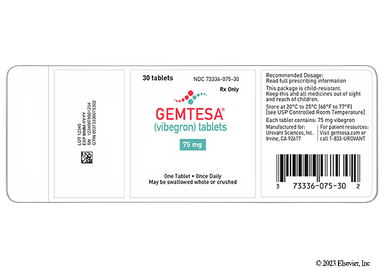
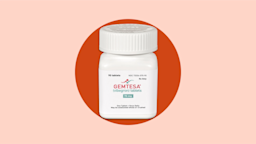
Gemtesa (vibegron) is used to treat overactive bladder (OAB) in adults. This includes OAB in people who are taking medications for benign prostatic hyperplasia (BPH). Gemtesa (vibegron) belongs to the drug class called beta-3 adrenergic agonists. It works to relax the bladder muscle. Gemtesa (vibegron) comes as a tablet that's taken by mouth once a day. Side effects aren't common but can include headache and cold symptoms. Gemtesa (vibegron) is only available as a brand-name medication; there's no generic version yet.

Gemtesa (vibegron) is a beta-3 adrenergic agonist. It acts on a protein in your bladder called beta-3 adrenergic receptor. This causes your bladder muscles to relax so that your bladder can hold more urine. It helps lessen the need to go to the bathroom as often.
| Common Brands | Gemtesa |
|---|---|
| Drug Class | Beta-3 adrenergic agonist |
| Controlled Substance Classification | Not a controlled medication |
| Generic Status | No lower-cost generic available |
| Availability | Prescription only |

The following side effects may get better over time as your body gets used to the medication. Let your healthcare provider know immediately if you continue to experience these symptoms or if they worsen over time.
Contact your healthcare provider immediately if you experience any of the following.
Side effects that you should report to your care team as soon as possible:
Side effects that usually do not require medical attention (report to your care team if they continue or are bothersome):




Gemtesa (vibegron) can cause some serious health issues. This risk may be even higher for certain groups. If this worries you, talk to your doctor or pharmacist about other options.
Some people who take Gemtesa (vibegron) might have problems urinating or emptying their bladder all the way. This is called urinary retention. The risk might be higher if you have a blockage in your bladder. It might also be higher if you take anticholinergic medications for overactive bladder.
It's important to tell your care team if you notice problems urinating. Holding urine in your bladder too long can lead to other problems. This can include a urinary tract infection (UTI), bladder damage, or kidney damage. Let your prescriber know if you can't urinate or if you feel like you still need to go even after you just went.
Angioedema can happen at any time while taking Gemtesa (vibegron). This can look like swelling of the face, lips, tongue, throat, or other parts of the body. More seriously, swelling of the throat or tongue can make it hard to breathe and can be life-threatening.
Get medical help right away if you notice swelling in your face, lips, eyelids, or the back of your hands or feet. Call 911 right away if you have swelling in your neck or tongue, any serious swelling, or trouble breathing.

 Tablet
| Dosage | Quantity | Price as low as | Price per unit |
|---|---|---|---|
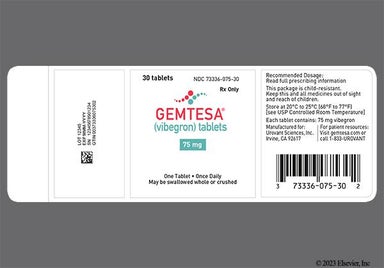
| 75mg | 30 tablets | $500.43 | $16.68 |
The typical dose is 75 mg by mouth once a day.






Prescription savings
Stop paying too much for your prescriptions. Compare prices, get pharmacy coupons, and save up to 80%.Resources
About GoodRx
 Find expert answers to your health questions so you can make the best decisions for yourself and your family.
Health conditions
Medications & treatment
Access & affordability
Well-being
Medication discounts

Gemtesa can start to work in as early as 2 weeks. But it can take about 3 months to get the full effects of the medication. Talk to your prescriber if you have concerns about how long it takes for Gemtesa to work.
It can take about 6 days for most of Gemtesa to leave your body after a single dose. This time frame is estimated based on the half-life of the medication. But even though the medication can stay in your system for about 6 days, you should still take it once every day. This helps keep the levels of Gemtesa high enough in your body to work well.
People who've previously had a severe allergic reaction to Gemtesa shouldn't take it. A severe allergic reaction can include swelling of the face or mouth or trouble breathing. In addition, speak with your prescriber first if you're taking mirabegron (Myrbetriq). Mirabegron (Myrbetriq) and Gemtesa belong to the same drug class, and taking them together might raise your risk for side effects. Also talk to your prescriber about whether you should continue taking Gemtesa if you have bothersome side effects from the medication.
Dry eyes isn't a typical side effect of Gemtesa. If you have dry eyes, you can try artificial tears. Contact your optometrist or ophthalmologist (eye specialist) if your dry eyes get too bothersome.
Hair loss wasn't a side effect that people who took Gemtesa reported in clinical trials. Contact your prescriber if you notice unusual hair loss while you're taking Gemtesa. They can examine what's causing this hair loss.
No. People who took Gemtesa during clinical trials didn't report having fatigue or tiredness. Speak with your primary care provider if you feel unusually tired while you're taking this medication.
No, Gemtesa doesn't typically cause weight gain. Let your primary care provider know if you experience unexpected weight gain. They can help figure out the cause.
Tell your healthcare team if you're pregnant or breastfeeding. They can discuss with you about the risks and benefits of taking Gemtesa. It's not clear whether this medication is safe for you and your baby. But animal studies show that it isn't expected to cause harm to babies.
