





What Is Serotonin Syndrome? What You Need to Know If You Take SSRIs
Serotonin syndrome is a reaction to commonly prescribed medications and supplements. Learn what serotonin syndrome is, what causes it, and how to treat it.
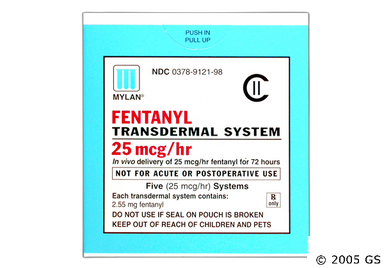
The fentanyl transdermal patch, previously known by the brand name Duragesic, is an opioid. It's a patch that's applied on the skin every 3 days to manage severe, long-term or chronic pain. The fentanyl patch is only approved for people who are "opioid tolerant" whose pain isn't controlled well enough with other treatment options. Fentanyl is a very powerful opioid, so the medication can be especially dangerous for those who aren't opioid tolerant because of their high risk for extremely slowed breathing and overdose. Some side effects include nausea, vomiting, and sleepiness.

The fentanyl patch is an opioid. It attaches to certain mu-opioid receptors in your brain to lower how much pain you feel.
| Common Brands | Duragesic |
|---|---|
| Drug Class | Opioid |
| Controlled Substance Classification | Schedule II |
| Generic Status | Lower-cost generic available |
| Availability | Prescription only |

Fentanyl patch can cause some serious health issues. This risk may be even higher for certain groups. If this worries you, talk to your doctor or pharmacist about other options.
 The fentanyl patch is a controlled substance that has a risk for misuse and addiction. This can lead to serious and possibly life-threatening consequences, such as dangerously slow breathing and overdose.
 Use the fentanyl patch exactly as prescribed. Don't place the patch in your mouth for any reason. Chewing or swallowing the patch or using the patch in any other way than prescribed is considered misuse. This can lead to choking, overdose, and death. Also don't change how much or how often you use the patches without talking to your prescriber first.
Because of the risk for misuse and addiction, the fentanyl patch is only available through a Risk Evaluation and Mitigation Strategy (REMS) program called the Opioid Analgesic REMS program. Your prescriber and pharmacy must register with the program, receive training on proper medication use, and discuss with you about how to take the fentanyl patch safely.
The fentanyl patch patch can cause serious, fatal slowed breathing (respiratory depression), even when they're used as recommended. Respiratory depression is a medical emergency that must be managed and treated right away. Call 911 as soon as possible if you or someone around you notices that you have shortness of breath, slow or shallow breathing, extreme tiredness or sleepiness, or confusion, or bluish skin or lips.
Avoid alcohol and medications that slow down brain function, such as benzodiazepines, other opioids, and muscle relaxants, while you're taking the fentanyl patch. These substances slow down your breathing even more and put you at even higher risk for serious respiratory depression, extreme sleepiness, and overdose.
To lower the risk for respiratory depression, your prescriber will work very closely with you to adjust your fentanyl patch dose depending on your needs. Your prescriber will recommend that you have naloxone (Narcan) with you at all times. Naloxone is a medication that can reverse slowed breathing from opioids. Use naloxone, call 911, and get medical help right away if you have signs or symptoms of dangerously slowed breathing.
Take the fentanyl patch exactly as prescribed. Taking too much, taking it more often than prescribed, or taking it any other way than prescribed can lead to a life-threatening overdose. Symptoms of an opioid overdose include not responding to sound or touch, extremely slow breathing, slow heartbeat, extreme sleepiness, and cold or clammy skin.
Be sure you and your loved ones know how to recognize an opioid overdose. Your prescriber will recommend getting naloxone (Narcan) — either by prescription or over the counter. Naloxone can help treat an opioid overdose. Carry naloxone with you at all times; use it and call 911 right away if an overdose happens.
It can be very dangerous if someone accidentally touches, uses, chews, or swallows the fentanyl patch. Accidental exposure to the medication can lead to seriously harmful consequences, such as extremely slowed breathing, overdose, and even death.
It's important to keep fentanyl patches out of reach from children, visitors, and pets to prevent accidental exposure and potential overdose. Also be sure to safely dispose used and unused patches to prevent people, especially children, from getting exposed to the medication by mistake. Used fentanyl patches still have medication left on them.
Exposing the fentanyl patch to heat or having areas of skin around your patch that's hot greatly raises the risk for potential overdose and death. High temperatures — including when you have a high fever or when you've exercised rigorously – cause more medication to get released from the patch and into the body, which can lead to overdose.
Don't use any external heat sources, like heating pads, electric blankets, heat or tanning lamps, heated beds or water beds, over the fentanyl patch and the area of skin around it. Also avoid sunbathing, hot baths, hot tubs, and saunas. Try to avoid extreme workouts, exercise, or movement that can make you get very hot. Contact a healthcare professional as soon as you can if you have a high fever for appropriate treatment. Call 911 right away if you have any symptoms of overdose, like extreme sleepiness or slowed breathing.
The fentanyl patch can cause extreme sleepiness and lower your ability to think, react, and focus. Don't drink alcohol with the fentanyl patch. Also don't take other medications that can cause sleepiness or "brain fog" (e.g., benzodiazepines, muscle relaxants, sleep medications). Otherwise, these side effects might be more intense.
Make sure you know how the fentanyl patch affects you before driving a car or doing activities that require your concentration. Talk to your prescriber right away if you feel too sleepy from the medication or if you're having a hard time thinking clearly.
When fentanyl patches are regularly used to treat chronic pain, the medication can cause physical dependence. This means that your body relies on the medication to function. And you might experience withdrawal if you lower your dose too quickly or suddenly stop using the medication. Withdrawal symptoms include anxiety, restlessness, irritability, runny nose, yawning, sweating, and chills.
Don't suddenly lower your dose or stop using the fentanyl patch suddenly without talking to your prescriber first. If needed, your prescriber will slowly lower your dose over time to prevent withdrawal symptoms. Talk to your prescriber if you have concerns about fentanyl patches because of the risk for withdrawal.
Long-term use of the fentanyl patch during pregnancy can cause your unborn baby to become dependent on the medication. This is because fentanyl can pass through the placenta to your unborn baby.
Once your baby is born, they can experience withdrawal symptoms, such as high-pitched crying, poor feeding behavior, trembling, abnormal sleep patterns, and even seizures. This condition is called neonatal opioid withdrawal syndrome and can be life-threatening if it isn't recognized and treated in time. Let your healthcare professional know if you've used the fentanyl patch during pregnancy or if you notice these symptoms in your baby.
The fentanyl patch can interact with several medications. Let your care team know what medications you're taking to make sure they're safe for you to take together. Also speak with your care team first before making any changes to your medications because sudden dose adjustments can be harmful.
Some medications can raise the fentanyl levels in your body, which can raise your risk for serious side effects like potentially life-threatening slowed breathing. Medications that can lead to this type of interaction include erythromycin and ritonavir (Norvir), among others.
Other interactions, such as with rifampin (Rifadin) or carbamazepine (Tegretol), can lower fentanyl levels in your body. This can cause the opioid medication to work less well to manage your pain. These interactions might also lead to withdrawal symptoms.
Using the fentanyl patch with other medications that raise the serotonin levels in your brain can put you at risk for a life-threatening condition called serotonin syndrome. Some of these medications include fluoxetine (Prozac), duloxetine (Cymbalta), amitriptyline (Elavil), sumatriptan (Imitrex), and trazodone (Desyrel). Let your prescriber or pharmacist know if you start a new medication to make sure it's safe to take with the fentanyl patch.
Symptoms of serotonin syndrome generally appear within a few hours or a few days of taking these medications together but can also start later. Call for emergency medical help right away, take off the fentanyl patch, and stop using the medication if you have symptoms of serotonin syndrome. These symptoms include nausea, vomiting, diarrhea, fever, sweating, shivering, distress, hallucinations, restlessness, fast heart rate, or stiff muscles.
The fentanyl patch patch can cause severely low blood pressure, including a drop in blood pressure when you stand from a sitting or lying position. This can lead to dizziness and fainting. Be careful as you stand up after sitting for some time. Make sure to sit back down or lie down if you feel faint or dizzy. The chances of low blood pressure are greater when you first start using fentanyl patch or with dose changes.
The fentanyl patch can also slow your heart rate, particularly when you start treatment. Let your care team know if you have any heart problems, like abnormal heart rate (arrhythmias), before you start treatment. Call your prescriber if you have unexplained fatigue, dizziness or lightheadedness that doesn't go away, shortness of breath, or chest pain while you're taking this medication. These might be symptoms of an unusually slow heart rate.
Some people taking opioids like the fentanyl patch had low adrenal hormone levels. This might be more likely to happen after taking opioids for longer than 1 month. Let your prescriber know if you have symptoms like tiredness, dizziness, weakness, not feeling hungry, nausea, and vomiting. If your adrenal hormone levels are too low, you might need to stop taking the fentanyl patch and get treated with corticosteroids.
If you've had a seizure in the past, opioids like the fentanyl patch can raise the risk of having seizures more often. The fentanyl patch can also put you at risk of seizure in certain situations. Get medical help if you have a seizure while you're taking this medication.

The following side effects may get better over time as your body gets used to the medication. Let your healthcare provider know immediately if you continue to experience these symptoms or if they worsen over time.
Contact your healthcare provider immediately if you experience any of the following.
Along with its needed effects, a medicine may cause some unwanted effects. Although not all of these side effects may occur, if they do occur they may need medical attention.
Check with your doctor immediately if any of the following side effects occur:
Less common
bloating or swelling of the face, arms, hands, lower legs, or feet
burning, crawling, itching, numbness, prickling, "pins and needles", or tingling feelings
confusion
decrease in urine volume
difficulty in breathing or swallowing
difficulty in passing urine (dribbling)
fast, irregular, pounding, or racing heartbeat or pulse
rapid weight gain
seeing, hearing, or feeling things that are not there
skin itching, rash, or redness
swelling of the face, throat, or tongue
unusual weight gain or loss
upper stomach pain
Rare
Bluish color of the fingernails, lips, skin, palms, or nail beds
burning, itching, redness, skin rash, swelling, or soreness at the application site
confusion about identity, place, and time
false or unusual sense of well-being
irregular, fast or slow, or shallow breathing
Incidence not known
Agitation
blurred vision
chest pain or discomfort
darkening of the skin
dizziness, faintness, or lightheadedness when getting up suddenly from a lying or sitting position
headache
lightheadedness, dizziness, or fainting
loss of appetite
mental depression
nervousness
overactive reflexes
poor coordination
pounding in the ears
restlessness
severe constipation
severe vomiting
shivering
sweating
talking or acting with excitement you cannot control
tightness in the chest
unusual tiredness or weakness
vomiting
Get emergency help immediately if any of the following symptoms of overdose occur:
Symptoms of overdose
Cold, clammy skin
drowsiness that is so severe you are not able to answer when spoken to or, if asleep, cannot be awakened
pinpoint (small) pupils in the eyes
seizures
slow heartbeat
very slow or troubled breathing
Some side effects may occur that usually do not need medical attention. These side effects may go away during treatment as your body adjusts to the medicine. Also, your health care professional may be able to tell you about ways to prevent or reduce some of these side effects. Check with your health care professional if any of the following side effects continue or are bothersome or if you have any questions about them:
Less common
feeling of constant movement of self or surroundings
feeling of crawling, tingling, or burning of the skin
lack or loss of strength
memory loss
sensation of spinning
unusual dreams
Rare
Abnormal ejaculation
decreased interest in sexual intercourse
decreased sexual performance or desire
inability to have or keep an erection
loss in sexual ability, desire, drive, or performance
muscle twitching
Other side effects not listed may also occur in some patients. If you notice any other effects, check with your healthcare professional.
Call your doctor for medical advice about side effects. You may report side effects to the FDA at 1-800-FDA-1088.



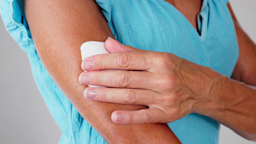
How to use the fentanyl patch:

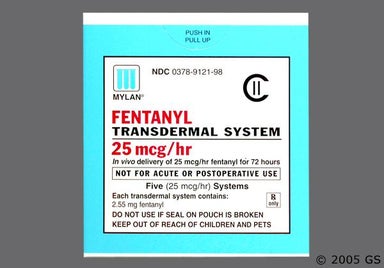
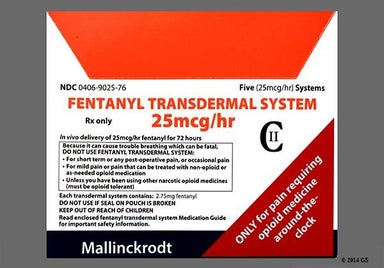
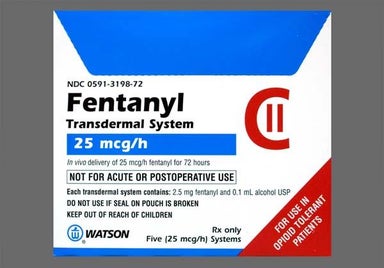
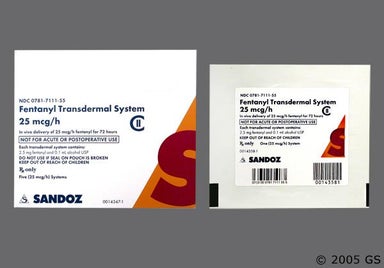
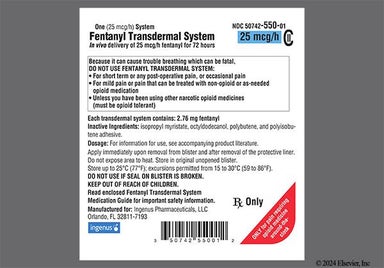
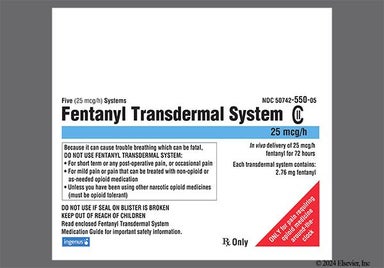
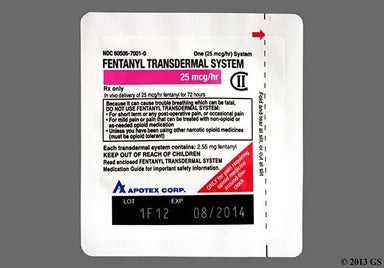
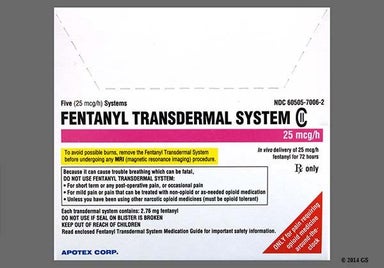
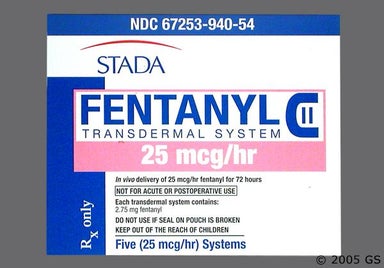
 Carton
| Dosage | Quantity | Price as low as | Price per unit |
|---|---|---|---|
| 5 patches of 100mcg/hr | 2 cartons | $81.41 | $40.71 |
| 5 patches of 12mcg/hr | 2 cartons | $46.31 | $23.16 |
| 5 patches of 25mcg/hr | 2 cartons | $39.79 | $19.90 |
| 5 patches of 50mcg/hr | 2 cartons | $53.93 | $26.97 |
| 5 patches of 75mcg/hr | 2 cartons | $68.06 | $34.03 |
| 5 patches of 37.5mcg/hr | 2 cartons | $175.05 | $87.53 |
| 5 patches of 62.5mcg/hr | 2 cartons | $250.51 | $125.26 |
| 5 patches of 87.5mcg/hr | 1 carton | $173.25 | $173.25 |

Although certain medicines should not be used together at all, in other cases two different medicines may be used together even if an interaction might occur. In these cases, your doctor may want to change the dose, or other precautions may be necessary. When you are taking this medicine, it is especially important that your healthcare professional know if you are taking any of the medicines listed below. The following interactions have been selected on the basis of their potential significance and are not necessarily all-inclusive.
Using this medicine with any of the following medicines is not recommended. Your doctor may decide not to treat you with this medication or change some of the other medicines you take.
Using this medicine with any of the following medicines is usually not recommended, but may be required in some cases. If both medicines are prescribed together, your doctor may change the dose or how often you use one or both of the medicines.


Contraindications are specific health conditions or situations in which a person should not take a medication due to safety concerns. If you have any of the following conditions or if any of the following apply to you, let your healthcare provider know because Fentanyl patch will not be safe for you to take.









Prescription savings
Stop paying too much for your prescriptions. Compare prices, get pharmacy coupons, and save up to 80%. Find expert answers to your health questions so you can make the best decisions for yourself and your family.
Health conditions
Medications & treatment
Access & affordability
Medication discounts

It can take several hours (at least about 12 hours) to start to feel the pain-relieving effects from the Fentanyl. But it can take a few days to feel the full effects of the medication. The Fentanyl helps manage chronic (long-term) pain. It isn't for short-term pain or breakthrough pain. Speak with your prescriber about your options for pain relief while you're waiting for the Fentanyl to start working or about options for breakthrough pain.
The effects of a Fentanyl lasts for 72 hours, or 3 days. Take off the patch you're wearing after 3 days. Fold the used Fentanyl in half so that the sticky sides come together and flush it down the toilet right away. Then, apply a new Fentanyl at a different spot from where you just took off the used patch.
It takes about 5 days for most of the fentanyl to leave your body after taking off the patch. This time frame is an estimation based on the half-life of the medication. The half-life can be longer in some people, such as older adults, people with kidney problems, and people with liver problems. This is because there are some conditions that affect how fast the body gets rid of the medication. Talk to your prescriber if you have concerns about how long fentanyl from the patch stays in the body.
Ask your prescriber about where to best place the Fentanyl on the body to make sure it's safe and it works well. For most adults, the patch gets applied to the chest, back, side of the waist, or upper arm. But for people of other ages, where to apply the patch can be different. Choose a different area to apply the new patch when it's time to replace the patch (every 3 days). Be sure to put the Fentanyl on an area of clean, dry skin that isn't hairy to make sure the patch sticks well (clip the hair if needed, but don't shave). Don't apply the patch to skin that's oily, broken, damaged, cut, scarred, or has rashes to avoid skin irritation.
No. Applying heat to the Fentanyl can make a lot of medication get released from the patch and get absorbed into the body. This can lead to a life-threatening fentanyl overdose. Never apply heat from any source to a Fentanyl patch. This includes things like heated blankets, heating pads, and tanning lamps. Also, don't take very hot showers or use hot tubs, saunas, or tanning beds while you're wearing the Fentanyl.
No. Never cut a Fentanyl. Cutting the patch can damage it and cause too much fentanyl to release from the patch and go into body too fast. This greatly raises your risk for a fentanyl overdose. Contact your prescriber if you have questions about applying the entire Fentanyl on the skin.
If your Fentanyl isn't sticking, you can use first-aid tape only on the edges of the patch to help it stick better. If that doesn't work, you can place a sticky, see-through dressing, like Bioclusive or Tegaderm, over the patch. Never cover the patch with any other tape or bandages. If your Fentanyl falls off before 3 days of use, fold it in half with the sticky sides together and flush it down the toilet. Then, apply a new patch on a different area of the skin and wear it for the next 3 days before replacing it. Call your prescriber to let them know the patch fell off. Ask your prescriber or pharmacist if you have questions about what to do for your specific situation.
Yes, you can shower or swim with the Fentanyl on your skin. But make sure to avoid hot baths or showers, hot tubs, a very heated pool, or saunas. Hot water over the patch or on the skin surrounding the patch can cause more medication from the patch to get absorbed into the body. This can raise your risk for serious consequences, like dangerously slowed breathing and potentially overdose.

