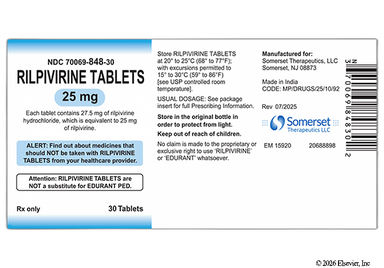
Edurant (rilpivirine) is a once-daily antiretroviral medication that's taken by mouth and is used to treat human immunodeficiency virus (HIV) infection. It's approved for use in adults and children. Edurant (rilpivirine) is taken with other antiretroviral medications when it's used for certain people who've never had HIV treatment before. Edurant (rilpivirine) can also be used for a short period of time before starting Cabenuva (cabotegravir / rilpivirine). Side effects of Edurant (rilpivirine) can include depression, headache, and trouble sleeping.
Treatment of HIV-1 infection in people 2 years and older, weighing at least 30 pounds, with an HIV viral load of less than 100,000 copies/mL and who haven't taken HIV medications before
Short-term treatment of HIV-1 infection in certain people ages 12 years and older, weighing at least 77 pounds, who are planning to start or planning to miss a dose of Cabenuva (cabotegravir / rilpivirine)
How Edurant (rilpivirine) works
Edurant (rilpivirine) is an HIV antiretroviral medication that's known as a non-nucleoside reverse transcriptase inhibitor (NNRTI). It blocks an enzyme called reverse transcriptase that helps HIV make copies of itself. By blocking this enzyme, the medication prevents HIV from spreading.
The following side effects may get better over time as your body gets used to the medication. Let your healthcare provider know immediately if you continue to experience these symptoms or if they worsen over time.
Liver injury—right upper belly pain, loss of appetite, nausea, light-colored stool, dark yellow or brown urine, yellowing skin or eyes, unusual weakness or fatigue
Taken by mouth once a day, so it's convenient for people with a busy schedule
Can use in people with mild-to-moderate kidney and liver problems
Safe to use during pregnancy
Cons
Can cause some allergic skin reactions
Must take with a meal
Only available as a brand-name medication
Pharmacist tips for Edurant (rilpivirine)
It's important to take Edurant (rilpivirine) around the same time every day with food. Taking it with food can help your body absorb this medication better.
If you accidentally forget to take Edurant (rilpivirine), take your missed dose as soon as possible and tell your care team. Missing doses often can make it easier for HIV to change form and cause Edurant (rilpivirine) to stop working.
Edurant (rilpivirine) is available in two different forms: Edurant tablets and Edurant Ped tablets for oral suspension. They can't be substituted for each other since the dosages don't match. Make sure that you or your child is taking the right one.
If you're switching from Edurant (rilpivirine) and Vocabria (cabotegravir) to Cabenuva (cabotegravir / rilpivirine) injections, follow your care team's instructions on how to make the transition. Typically, you can get your first injection of Cabenuva on the day that you take your last doses of Edurant (rilpivirine) and Vocabria (cabotegravir).
Be sure to get your routine blood tests done on time while you’re taking Edurant (rilpivirine). These blood tests help your HIV care team check that the medication is working for you and not causing side effects. Your care team will check your HIV viral load and for changes to your liver function.
Edurant (rilpivirine) might not always protect you from HIV. It also doesn't protect you from hepatitis or other sexually transmitted diseases (STDs). Always use a condom along with Edurant (rilpivirine) to help lower your risk of an infection.
Let your HIV specialist know if you experience symptoms of depression or worsening mood while you're taking Edurant (rilpivirine). In cases of serious depression, your HIV specialist might ask you to stop taking the medication and switch you to another.
Let your care team know what medications you're taking or planning to take. These include any prescription medications, over-the-counter products, and supplements. Since Edurant (rilpivirine) can interact with many medications, your care team can check to make sure your medications are safe to take together. Talk with your care team if you have any questions about interactions with this medication.
Tell your HIV specialist if you notice any changes in weight while you're taking Edurant (rilpivirine). Let your care team know if you have nausea, vomiting, or diarrhea that won’t go away since they can also lead to weight loss.
More tips for Edurant (rilpivirine) Peds:
Place the tablets for oral suspension in a cup and add 5 mL (1 teaspoon) of room temperature water. Don't crush the tablets. Swirl the cup gently for 1–2 minutes until the mixture looks cloudy.
Have your child drink the suspension immediately. If needed, you can add another 5 mL (1 teaspoon) of water, milk, orange juice, or applesauce to help. Swirl and have your child drink it right away, using a spoon if necessary.
Make sure your child takes the entire dose. If any medicine is left in the cup, add another 5 mL (1 teaspoon) of water (or other liquid or soft foods), swirl, and have them drink immediately.
Risks and warnings for Edurant (rilpivirine)
Edurant (rilpivirine) can cause some serious health issues. This risk may be even higher for certain groups. If this worries you, talk to your doctor or pharmacist about other options.
Severe skin reactions and allergic reactions
Edurant (rilpivirine) can sometimes cause rash and other severe skin reactions. In rare cases, these skin reactions can lead to hospitalization and other complications. Severe skin reactions can happen at any time while you're taking Edurant (rilpivirine), but they're most common within 4 to 6 weeks of starting treatment. Get medical care right away if you have a rash, blistering, peeling skin, mouth sores, swelling, or trouble breathing.
Note that certain severe allergic reactions, such as drug reaction with eosinophilia and systemic symptoms (DRESS), can happen with or without a rash. Although these reactions are rare, they can cause organ failure or blood problems. Get medical help as soon as possible if you have signs like sudden rash, mouth sores, fever, chills, body aches, or swollen lymph nodes.
Liver problems
Risk factor: Past liver problems | Hepatitis B or C
Some people have had liver problems while they were taking Edurant (rilpivirine). This risk might be higher if you've had past liver problems like hepatitis. Talk with your care team about your medical history before you start this medication to find the safest treatment option for you. You’ll need to get blood tests done while you take Edurant (rilpivirine) so your care team can check your liver health. Talk with your primary care provider or HIV specialist if you have signs and symptoms of liver damage, such as feeling sleepy, upper right stomach pain, yellowing of the skin or whites of the eyes, or dark urine.
Depression and suicidal thoughts
Some people have experienced depression, mood swings, and suicidal thoughts or attempt(s) while they were taking Edurant (rilpivirine). These mental health changes were mild or moderate during studies. Call your care team if you notice any mood changes. Your care team can try to see whether your symptoms are related to this medication. They'll also decide whether Edurant (rilpivirine) is still safe for you to continue taking. Call 911 right away if you or a loved one notices that you have suicidal thoughts or behavior.
Overactive immune system
Taking Edurant (rilpivirine) with other antiretroviral medications can cause changes to your immune system and lead to immune reconstitution syndrome. This medical condition happens when your immune system becomes more active after you start HIV treatment. Your immune system begins to fight off different infections that it was too weak to fight off before you started treatment.
In rare cases, your immune system might improve so much with treatment that it starts to attack normal cells in your body. This can lead to autoimmune problems, which can appear as early as during the first few weeks of starting treatment or many months later. Tell your care team right away if you start having any new symptoms, such as fever, pain, hair loss, bulging eyes, or sweating, after you start Edurant (rilpivirine).
Interaction with other medications
Edurant (rilpivirine) interacts with many medications. Some medications can cause the amount of Edurant (rilpivirine) in your body to drop. This can make the HIV medication work less well to treat your infection. Examples of medications to avoid because of this risk include certain medications for seizures (e.g., carbamazepine (Tegretol)), dexamethasone (more than one dose), St. John’s wort, and certain antibiotics (e.g., rifampin (Rifadin)).
Edurant (rilpivirine) can also raise the amount of other medications in your body when taken together. This raises your risk for side effects from those other medications. For example, taking Edurant (rilpivirine) with antibiotics like clarithromycin or erythromycin can put you at risk for serious heart problems.
Because of the potential for serious interactions with Edurant (rilpivirine) and various medications, let your care team know what other medications you’re taking or planning to take with Edurant (rilpivirine). Your care team can make sure your medications are safe to take together.
Edurant (rilpivirine) dosage
The average cost for 30 tablets of 25mg of of Edurant (rilpivirine) is $408.82 with a free GoodRx coupon. This is 67.86% off the average retail price of $1,272.11.
Contraindications are specific health conditions or situations in which a person should not take a medication due to safety concerns. If you have any of the following conditions or if any of the following apply to you, let your healthcare provider know because Edurant (rilpivirine) will not be safe for you to take.
There are a number of medications that your doctor can prescribe in place of Edurant (rilpivirine). Compare a few possible alternatives below.
Edurant (rilpivirine)
Used for:
Treatment of HIV-1 infection in people 2 years and older, weighing at least 30 pounds, with an HIV viral load of less than 100,000 copies/mL and who haven't taken HIV medications before
Short-term treatment of HIV-1 infection in certain people ages 12 years and older, weighing at least 77 pounds, who are planning to start or planning to miss a dose of Cabenuva (cabotegravir / rilpivirine)
GoodRx Health has strict sourcing policies and relies on primary sources such as medical organizations, governmental agencies, academic institutions, and peer-reviewed scientific journals. Learn more about how we ensure our content is accurate, thorough, and unbiased by reading our editorial guidelines.
Prescription savings
Stop paying too much for your prescriptions. Compare prices, get pharmacy coupons, and save up to 80%.
How long Edurant side effects last can differ depending on which side effects you're experiencing. For example, some people can have side effects like nausea, trouble sleeping, and fatigue; these side effects typically start to improve or go away after a few days or weeks of treatment. Keep in mind that not all side effects will go away on their own and you might sometimes need more medical attention (such as with side effects like depression or liver problems). Talk with your care team if you're struggling with a particular side effect of Edurant.
Avoid taking Edurant with certain heartburn medications, such as omeprazole (Prilosec). This is because proton pump inhibitors (PPIs), like omeprazole (Prilosec) and lansoprazole (Prevacid), raise how acidic your stomach gets. This can lower the amount of Edurant that gets absorbed into the body, which can cause the medication to work less well and worsen your HIV-1 infection. Speak with your HIV specialist or a pharmacist about alternative heartburn medications and how to safely take them with Edurant.
For those who haven't been treated with HIV before, Edurant is safe to use in children 2 years and older who weigh at least 30 pounds. For short-term treatment of HIV infection, the medication is approved for children 12 years and older who weigh at least 77 pounds. Tell your child's HIV care team if your child has any significant weight loss during treatment with Edurant. Also let the care team know if your child has nausea, vomiting, or diarrhea that won’t go away since severe cases of these side effects can contribute to weight loss.
Yes. It seems like Edurant doesn't raise the risk of harm to your unborn baby. If you become pregnant while taking Edurant, your HIV specialist might recommend continuing the medication at 25 mg by mouth once a day. In addition, you’re encouraged to enroll in the Antiretroviral Pregnancy Registry (APR). This registry monitors and collects information about your health and your baby's health while you're taking Edurant. Learn more about this registry by calling 1-800-258-4263.
Medications containing rilpivirine can cause serious skin and allergic reactions. Taking Edurant — the tablet form of rilpivirine — before you start getting injections of Cabenuva (cabotegravir / rilpivirine) can help your care team see how your body reacts to the ingredients of Cabenuva. If you have a reaction to rilpivirine, it's a lot easier for your body to get rid of the medication in the tablet form than in injection form (which lasts longer in the body). Your HIV specialist will typically prescribe Edurant for about a month before you start Cabenuva injections. Once you've started getting routine Cabenuva injections, you won't have to take any more daily Edurant tablets. Talk with your care team if you have questions about how to transition from the tablets to the injections.