


5 Outdated Migraine Medications You May Want to Upgrade
Some migraine medications have largely been replaced by safer or more effective options. Learn about the newer treatments available today with this guide.
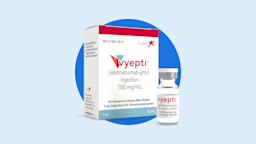
Vyepti (eptinezumab or eptinezumab-jjmr) is a medication that's used to prevent migraines in adults. The dose is given as an infusion through the veins at a provider's office or clinic every 3 months. Side effects aren't common, but they can include common cold symptoms, itching, and flushing. Vyepti (eptinezumab) is only available as a brand name.

Vyepti (eptinezumab) is a calcitonin gene-related peptide (CGRP) receptor blocker. It's a monoclonal antibody that blocks a protein in the brain and nervous system called CGRP. CGRP is thought to be involved with migraines and causing pain. By blocking CGRP, Vyepti (eptinezumab) helps block migraines from happening.
| Common Brands | Vyepti |
|---|---|
| Drug Class | CGRP receptor blocker |
| Controlled Substance Classification | Not a controlled medication |
| Generic Status | No lower-cost generic available |
| Availability | Prescription only |

The following side effects may get better over time as your body gets used to the medication. Let your healthcare provider know immediately if you continue to experience these symptoms or if they worsen over time.
Contact your healthcare provider immediately if you experience any of the following.
Side effects that you should report to your care team as soon as possible:
Side effects that usually do not require medical attention (report these to your care team if they continue or are bothersome):




Vyepti (eptinezumab) can cause some serious health issues. This risk may be even higher for certain groups. If this worries you, talk to your doctor or pharmacist about other options.
Vyepti (eptinezumab) can cause allergic reactions, such as hives, flushing in the face, rash, shortness of breath, and angioedema (swelling of the skin or lips). Most allergic reactions happen during the infusion and aren't serious. But it's possible that they can be serious and life-threatening (e.g., swelling of face and throat, sudden low blood pressure, dizziness, fainting).
Call your nurse over right away if you get any of these symptoms during your infusion. Call 911 as soon as possible if you have these symptoms after your Vyepti (eptinezumab) infusion and you've left the office or clinic center.

The typical dose is 100 mg or 300 mg infused through the veins (intravenously or IV) once every 3 months.





Prescription savings
Stop paying too much for your prescriptions. Compare prices, get pharmacy coupons, and save up to 80%. Find expert answers to your health questions so you can make the best decisions for yourself and your family.
Health conditions
Medications & treatment
Access & affordability
 Our monthly healthcare membership can help you save thousands on your prescription costs.
Resources

In studies, people with chronic migraines (15 or more headache days per month) had an average of about 8 fewer migraine days per month after taking Vyepti for 3 months. Study participants with episodic migraines (4 to 14 headache days per month) had an average of 4 fewer migraine days per month after taking the medication for 3 months.
Studies show that Vyepti starts to work right away, from day 1 of your dose. It only takes a few hours for Vyepti to reach the highest amount in the body after a single dose of medication.
Vyepti is given as a 30-minute infusion through the veins by a healthcare provider. This isn't a medication you can pick up and give to yourself at home. You'll need to see your provider at their office or clinic or go to an infusion center for each of your Vyepti infusions.
Before your infusion, make sure to drink plenty of water so you're well hydrated. Wear comfortable clothing to your appointments. During your infusion, a healthcare provider will keep an eye on you closely to make sure you're not having any allergic reactions to the medication.
Weight gain wasn't a side effect that people taking Vyepti reported in clinical studies. If you experience unexpected weight changes while you're taking Vyepti, speak with your provider to discuss possible causes.
Hair loss wasn't a side effect reported by people using Vyepti in clinical trials. But a study based on reports to the FDA suggests that CGRP blockers like Vyepti could possibly raise the risk for hair loss. More research is needed to find out whether there's a link. Speak with your provider if you experience any hair loss while you're taking Vyepti. They'll try to figure out what's causing it.
Both Vyepti and Emgality (galcanezumab) are CGRP receptor blockers that are FDA-approved for preventing migraines. But Emgality (galcanezumab) is also approved for cluster headaches, a severe and sudden headache that's typically felt on only one side of the head. In addition, Emgality (galcanezumab) is an injection under the skin that you can give to yourself at home every month, whereas Vyepti is an IV infusion that's given by a healthcare professional every 3 months. Both medications haven't been compared to each other in any head-to-head studies, so it's not clear whether one medication works better than the other. Speak with your provider to weigh the pros and cons of each medication.
