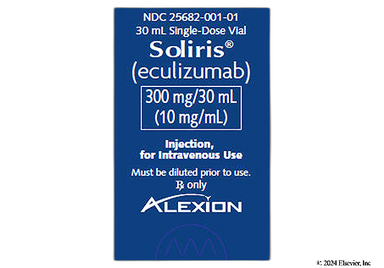
Used for Myasthenia Gravis, Neuromyelitis Optica Spectrum Disorder, Paroxysmal Nocturnal Hemoglobinuria
Used for Myasthenia Gravis, Neuromyelitis Optica Spectrum Disorder, Paroxysmal Nocturnal Hemoglobinuria
Soliris (eculizumab) is used to treat certain nerve problems, such as myasthenia gravis. It can also help with rare blood problems, like paroxysmal nocturnal hemoglobinuria and atypical hemolytic uremic syndrome. This medication is a monoclonal antibody known as a complement inhibitor. It's given as an infusion through the vein by a healthcare professional. Side effects include headache, nausea, and high blood pressure. There's also a risk of serious meningococcal infection. So, it's only available through a special program called the Soliris Risk Evaluation and Mitigation Strategy (REMS). Currenly, Soliris (eculizumab) is a brand-name medication only.
In some autoimmune problems, the complement system doesn't work as it should and becomes overly active. This causes the immune system to attack parts of your own body and lead to symptoms.
By blocking the complement system from working, Soliris (eculizumab) is thought to help relieve symptoms of certain autoimmune problems.
The following side effects may get better over time as your body gets used to the medication. Let your healthcare provider know immediately if you continue to experience these symptoms or if they worsen over time.
Contact your healthcare provider immediately if you experience any of the following.
Meningococcal infection: headache, stiff neck or back, muscle ache, nausea, vomiting, fever, flu-like symptoms, sensitivity to bright light, confusion, rash
Serious infusion reaction: chest pain; trouble breathing; shortness of breath; feeling faint or wanting to pass out; itchiness; swelling of the face, tongue, or throat
The following Soliris (eculizumab) side effects have also been reported
Along with its needed effects, a medicine may cause some unwanted effects. Although not all of these side effects may occur, if they do occur they may need medical attention.
Check with your doctor or nurse immediately if any of the following side effects occur:
itching, pain, redness, swelling, tenderness, or warmth on the skin
Some side effects may occur that usually do not need medical attention. These side effects may go away during treatment as your body adjusts to the medicine. Also, your health care professional may be able to tell you about ways to prevent or reduce some of these side effects. Check with your health care professional if any of the following side effects continue or are bothersome or if you have any questions about them:
Monitored by a healthcare professional for safety during and a little while after each infusion
Cons
Must be given as an infusion through the vein at a medical center
Need to get certain vaccines before starting treatment
Higher risk of serious infection
Pharmacist tips for Soliris (eculizumab)
Before starting Soliris (eculizumab), talk to your prescriber and pharmacist about the vaccinations you need. They can make sure you're up to date on all of your vaccinations. In particular, it's very important to get the meningococcal vaccine. This helps lower your risk of certain serious infections during treatment.
Your prescriber will give you a Soliris Patient Safety Information Card. Always keep this care with you so you know when to get emergency medical help. It's also helpful for all members of your care teams to know you're taking this medication. Keep carrying this card for 3 months after stopping the medication. You could still be at risk of getting infections.
Soliris (eculizumab) can raise your risk of serious infections, like meningitis and gonorrhea. Talk to your care team about how to best prevent infection. If you're at a higher risk of getting gonorrhea, get tested regularly while taking this medication.
If you get a meningococcal infection while taking Soliris (eculizumab), tell your prescriber right away. You should get the infection treated as soon as possible because it can get very serious. Your prescriber will decide if you should take a break from this medication while you're getting the infection treated.
Let your prescriber know about any infections you get while taking Soliris (eculizumab). This medication can raise the risk of infections. So your prescriber can give you the right treatment for the infection so it doesn't get worse.
After stopping Soliris (eculizumab), keep checking in with your prescriber. For certain conditions, you'll have to follow up with them for at least 2 to 3 more months. They can keep monitoring you in case you have any problems or complications.
Tell your prescriber if you're pregnant, planning to become pregnant, or breastfeeding. They can help you understand the risks and benefits of taking Soliris (eculizumab). It's not clear if the medication can harm an unborn baby or pass into your breast milk.
What to expect with Soliris (eculizumab) infusions:
Soliris (eculizumab) is given as an infusion through the vein at a medical center. How often you need infusions depends on your condition and your specific treatment plan. Ask your prescriber about your infusion schedule and make sure you write down when they are.
Plan enough time for your Soliris (eculizumab) infusions. For adults, each infusion is at least 35 minutes. And for children, each infusion can take 1 to 4 hours. Keep in mind that you might need extra time to get settled or for your care team to check for reactions to the infusion.
Tell your nurse if you feel unwell during your Soliris (eculizumab) infusion. Some people might have reactions like a racing heart, trouble breathing, itchiness, or chest pain. The nurse can slow or stop your infusion and treat these symptoms.
After each Soliris (eculizumab) infusion, you'll need to stay at the medical center for at least another hour. This is so the care team can continue to check for infusion reactions. If this happens, they can help manage these reactions quickly.
Risks and warnings for Soliris (eculizumab)
Soliris (eculizumab) can cause some serious health issues. This risk may be even higher for certain groups. If this worries you, talk to your doctor or pharmacist about other options.
Risk of serious meningococcal infections
Soliris (eculizumab) can raise the risk of meningococcal infection. This infection can be very serious and life-threatening. It can affect the brain and spinal cord and cause meningitis. It can also affect the blood and lead to septicemia.
Because of this risk, Soliris (eculizumab) is only available through a special safety program. Your care team will help you enroll in the Soliris Risk Evaluation and Mitigation Strategy (REMS) program. Your prescriber and the pharmacy you get the medication from must also enroll. This makes sure you and everyone involved in your care know about the dangers and steps to lower the risk.
At least 2 weeks before starting Soliris (eculizumab), you'll need to get vaccinated against meningococcal infection series. If you must start the medication right away, complete the vaccination series as soon as you can. In this case, you'll also need to take antibiotics to help protect you. Vaccines don't fully prevent infection, but they help lower the risk.
Soliris (eculizumab) can raise your risk of other serious infections. These can include bacterial infections like pneumococcal infection and gonorrhea. Certain fungal infections like aspergillosis are also possible. You're at higher risk of this fungal infection if you have a weak immune system or a low white blood cell count.
If your child is taking Soliris (eculizumab), they should be vaccinated to protect them from some infections. They should get the pneumococcal vaccine. They should also get vaccinated against Haemophilus influenzae type b (Hib). Children taking this medication are at higher risk of these infections. Talk to your child's prescriber about vaccinations.
Worsening of PNH after stopping treatment
For people with PNH, Soliris (eculizumab) helps stop red blood cells from breaking down too fast. But when you stop treatment, the effects of the medication could go away. This means your red blood cells can break down quickly again and cause problems.
Your care team will continue to check in with you for at least 2 months after you stop Soliris (eculizumab). Tell them if you feel unusually tired, dizzy, or weak. Also let them know if you feel your heart racing. These could be signs of problems from stopping the medication.
Worsening of aHUS after stopping treatment
For people with aHUS, stopping Soliris (eculizumab) can lead to clotting problems called thrombotic microangiopathy (TMA). When this happens, your body forms little blood clots in your smallest blood vessels. You can also have a low red blood cell count, low platelets, and other abnormal lab results.
Your prescriber will follow up with you for at least 3 more months after stopping Soliris (eculizumab). This can help them check for any problems you might experience afterwards. Be sure to tell your care team if you feel confused of breath or confused. Also let them know if you have chest pain, swelling in the arms or legs, a blood clot, or a seizure. These can be signs of problems from TMA.
Infusion reactions
Although rare, there's a risk of having a reaction to the Soliris (eculizumab) infusion. They can include life-threatening reactions like anaphylaxis.
To be safe, your nurse will keep an eye on you during your Soliris (eculizumab) infusion. But also let your nurse know right away if you feel your heart racing, have trouble breathing, or feel chest pain. If you have a reaction, the nurse might slow or stop your infusion and treat these symptoms.
Soliris (eculizumab) dosage
Typical dosage for Soliris (eculizumab)
Adults
PNH: The typical dose is 600 mg as an infusion through the vein (IV) every week for the first 4 weeks, 900 mg on week 5, then 900 mg every 2 weeks thereafter.
aHUS, gMG, or NMOSD: The typical dose is 900 mg IV every week for the first 4 weeks, 1,200 mg on week 5, then 1,200 mg every 2 weeks thereafter.
Children younger than 18 years old with aHUS or children 6 to 18 years old with gMG
Weigh 88 lbs or more: The typical dose is 900 mg IV every week for the first 4 weeks, 1,200 mg on week 5, then 1,200 mg every 2 weeks thereafter.
Weigh 66 lbs to less than 88 lbs: The typical dose is 600 mg IV every week for the first 2 weeks, 900 mg on week 3, then 900 mg every 2 weeks thereafter.
Weigh 44 lbs to less than 66 lbs: The typical dose is 600 mg IV every week for the first 3 weeks, then 600 mg every 2 weeks thereafter.
Weigh 22 lbs to less than 44 lbs: The typical dose is 600 mg IV on week 1, 300 mg on week 2, then 300 mg every 2 weeks thereafter.
Weigh 11 lbs to less than 22 lbs: The typical dose is 300 mg IV for the first 2 weeks, then 300 mg every 3 weeks thereafter.
Interactions between Soliris (eculizumab) and other drugs
Soliris (eculizumab) may interact with certain medications or supplements. Always let your doctor and pharmacist know about any other medications or supplements (including prescribed and over-the-counter medications, vitamins, and dietary or herbal supplements) that you are currently taking. The list below does not include all possible drug interactions with Soliris (eculizumab). Please note that only the generic name of each medication is listed below.
Although certain medicines should not be used together at all, in other cases two different medicines may be used together even if an interaction might occur. In these cases, your doctor may want to change the dose, or other precautions may be necessary. When you are receiving this medicine, it is especially important that your healthcare professional know if you are taking any of the medicines listed below. The following interactions have been selected on the basis of their potential significance and are not necessarily all-inclusive.
Using this medicine with any of the following medicines is usually not recommended, but may be required in some cases. If both medicines are prescribed together, your doctor may change the dose or how often you use one or both of the medicines.
Contraindications are specific health conditions or situations in which a person should not take a medication due to safety concerns. If you have any of the following conditions or if any of the following apply to you, let your healthcare provider know because Soliris (eculizumab) will not be safe for you to take.
GoodRx Health has strict sourcing policies and relies on primary sources such as medical organizations, governmental agencies, academic institutions, and peer-reviewed scientific journals. Learn more about how we ensure our content is accurate, thorough, and unbiased by reading our editorial guidelines.
Prescription savings
Stop paying too much for your prescriptions. Compare prices, get pharmacy coupons, and save up to 80%.
Soliris is given as an intravenous infusion. This means it's given as an injection through the vein. You need to go to a medical center so that a nurse can administer the medication to you. For adults, each infusion takes at least 35 minutes. And for children, the infusion can last 1 to 4 hours. Talk to your care team to learn more about what to expect with Soliris infusions.
The Soliris REMS, or Risk Evaluation and Mitigation Strategy, is a special safety program for this medication. This is because it has a risk of serious meningococcal infection. You, your prescriber, and the pharmacy must all sign up with this program. The REMS program helps make sure everyone involved in your care is aware of this danger. It also makes sure everyone knows about the dangerous, the signs to look out for, and ways to lower the risk. Soliris is only available through this restricted program. Talk to your prescriber to learn more about the Soliris REMS program.
Some people can call Soliris an immunosuppressant. The medication works to block a part of your immune system called the complement system. Normally, your immune system fights against germs. But when part of your immune system is blocked, your immune system might be weaker than usual. This can make it more likely for you to get serious infections. Tell your prescriber right away if you have signs of an infection while taking this medication. Look out for headaches, fever, stiff neck, muscle aches, flu-like symptoms, nausea, sensitivity to light, or confusion. This can be early signs of a serious infection called meningococcal infection.
In studies, some people with NMOSD who took Soliris reported hair loss. In general, it doesn't seem common though. If you notice hair shedding or thinning during treatment, talk to your care team. They can help figure out what might be going on.
During studies, people didn't report weight gain while taking Soliris. If you notice changes in weight that worry you during treatment, talk to your prescriber. For children, it's extra important to tell the prescriber about weight changes. The dose for children changes with weight, so the prescriber should check if the dose needs to be adjusted.
The pharmaceutical company Alexion Pharmaceuticals makes Soliris.
Get vaccinated against meningococcal infection at least 2 weeks before your first infusion of Soliris. If you need to start the medication right away and you haven't gotten vaccinated yet, you'll get prescribed antibiotics to take. Then, get vaccinated as soon as you can. These steps help prevent serious meningococcal infection. Children with aHUS or gMG will also need to get vaccinated against certain other germs before starting. They should get vaccinated against Hib bacteria and pneumococcal bacteria (which causes pneumonia). Talk to your prescriber to check what you need to do.
Soliris and Ultomiris (ravulizumab) are both monoclonal antibodies that work in the same way to treat the same health conditions. They're both infusions that are given through the vein. But you'll need to get Soliris infusions more often than Ultomiris infusions. For most people, Soliris is given every week for the first couple weeks, then every 2 weeks after that. Ultomiris is generally given every 8 weeks (or every 4 weeks for children of certain weight). Talk to your prescriber to compare and help you decide which is right for you.