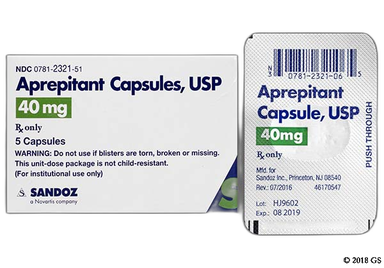
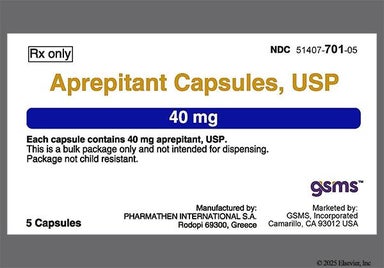
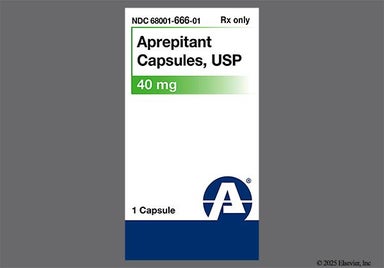
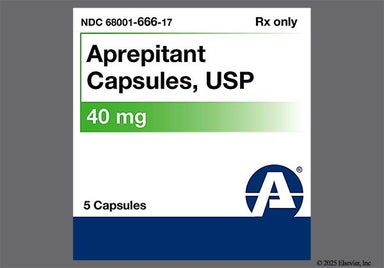
Emend (aprepitant) is a medication that's used to prevent nausea and vomiting caused by certain anti-cancer medications (chemotherapy). It's usually given an hour before your chemotherapy treatment on days 1 through 3. Emend (aprepitant) is available as capsules for people 12 years and older. It's also available as an oral solution for adults who can't swallow and for younger children. Common side effects of Emend (aprepitant) include feeling tired and diarrhea.
The following side effects may get better over time as your body gets used to the medication. Let your healthcare provider know immediately if you continue to experience these symptoms or if they worsen over time.
The following Emend (aprepitant) side effects have also been reported
Along with its needed effects, a medicine may cause some unwanted effects. Although not all of these side effects may occur, if they do occur they may need medical attention.
Check with your doctor immediately if any of the following side effects occur:
Some side effects may occur that usually do not need medical attention. These side effects may go away during treatment as your body adjusts to the medicine. Also, your health care professional may be able to tell you about ways to prevent or reduce some of these side effects. Check with your health care professional if any of the following side effects continue or are bothersome or if you have any questions about them:
You'll typically take Emend (aprepitant) on days 1, 2, and 3 of your chemotherapy, one hour before your treatment. If you don't have chemotherapy on days 2 and 3, you'll probably still take the medication in the morning on those days.
Before you take Emend (aprepitant), let your care team know what medications you're taking, including over-the-counter products and supplements. Emend (aprepitant) can interact with many medications, which can be dangerous. Talk with your provider or pharmacist if you have any questions about interactions with this medication.
For the Emend (aprepitant) capsules: Don't chew the capsules since this can alter how the medication gets absorbed into your body. Ask about the oral suspension formulation if you have trouble swallowing.
How to store the Emend (aprepitant) oral suspension: Your healthcare provider will prepare the oral suspension for you. Each dose is usually given to you in a prefilled dispenser. Store the prefilled dispenser in the refrigerator for up to 72 hours if you're not taking the medication right after it's prepared. Once the medication reaches room temperature, it needs to be taken within 3 hours.
How to take the Emend (aprepitant) oral suspension: Take off the cap of the prefilled dispenser and put the tip inside the mouth against the left or right cheek. Slowly push the plunger down. After you're done, throw away the dispenser and cap. Contact the provider if you or your child doesn't swallow the whole dose.
Ask your provider or pharmacist about other birth control options for you if you're taking hormonal birth control. Emend (aprepitant) can cause hormonal birth control to work less well. It's recommended to switch to a nonhormonal form of birth control or use a back-up method (e.g., condoms) during treatment and for a month after your last dose of Emend (aprepitant).
Risks and warnings for Emend (aprepitant)
Emend (aprepitant) can cause some serious health issues. This risk may be even higher for certain groups. If this worries you, talk to your doctor or pharmacist about other options.
Interactions with other medications
Before you take Emend (aprepitant) at the beginning of each chemotherapy cycle, make sure your care team is aware of all the other medications, vitamins, and supplements you're currently taking. Your providers can help check for any serious drug interactions with Emend (aprepitant).
Certain drug interactions with Emend (aprepitant) can raise the amount of your medications in your body. This can make it more likely for you to have harmful side effects. Other interactions can lower the amount of Emend (aprepitant) in your body and cause the antiemetic to work less well.
For example, Emend (aprepitant) can cause your body to absorb less warfarin (Coumadin). This can put you at risk for clots. If you take warfarin (Coumadin) long term, your provider will check your blood work (INR blood test) 7 to 10 days after you take Emend (aprepitant) during each chemotherapy cycle. This lab work makes sure that your blood thinner is working well for you.
In addition, Emend (aprepitant) might cause certain hormonal birth control to work less well. If you're taking hormonal birth control, make sure to use a different method of birth control or a back-up method, like condoms, for at least a month after your last dose of Emend (aprepitant).
Emend (aprepitant) dosage
The average cost for 1 capsule of 40mg of Emend (aprepitant) is $32.14 with a free GoodRx coupon. This is 58.33% off the average retail price of $77.13.
Interactions between Emend (aprepitant) and other drugs
Emend (aprepitant) may interact with certain medications or supplements. Always let your doctor and pharmacist know about any other medications or supplements (including prescribed and over-the-counter medications, vitamins, and dietary or herbal supplements) that you are currently taking. The list below does not include all possible drug interactions with Emend (aprepitant). Please note that only the generic name of each medication is listed below.
Although certain medicines should not be used together at all, in other cases two different medicines may be used together even if an interaction might occur. In these cases, your doctor may want to change the dose, or other precautions may be necessary. When you are taking this medicine, it is especially important that your healthcare professional know if you are taking any of the medicines listed below. The following interactions have been selected on the basis of their potential significance and are not necessarily all-inclusive.
Using this medicine with any of the following medicines is not recommended. Your doctor may decide not to treat you with this medication or change some of the other medicines you take.
Using this medicine with any of the following medicines is usually not recommended, but may be required in some cases. If both medicines are prescribed together, your doctor may change the dose or how often you use one or both of the medicines.
Using this medicine with any of the following medicines may cause an increased risk of certain side effects, but using both drugs may be the best treatment for you. If both medicines are prescribed together, your doctor may change the dose or how often you use one or both of the medicines.
Contraindications are specific health conditions or situations in which a person should not take a medication due to safety concerns. If you have any of the following conditions or if any of the following apply to you, let your healthcare provider know because Emend (aprepitant) will not be safe for you to take.
This medicine is White Capsule Imprinted With "Sz 525".White Sz 525 - Aprepitant 40mg CapsuleThis medicine is White And Yellow Capsule Imprinted With "40 Mg".White And Yellow 40 Mg - Aprepitant 40mg CapsuleThis medicine is White And Yellow Capsule Imprinted With "G 583".White And Yellow G 583 - Aprepitant 40mg CapsuleThis medicine is White And Yellow Capsule Imprinted With "G 583".White And Yellow G 583 - Aprepitant 40mg Capsule
GoodRx Health has strict sourcing policies and relies on primary sources such as medical organizations, governmental agencies, academic institutions, and peer-reviewed scientific journals. Learn more about how we ensure our content is accurate, thorough, and unbiased by reading our editorial guidelines.
Prescription savings
Stop paying too much for your prescriptions. Compare prices, get pharmacy coupons, and save up to 80%.
It can take between 2 to 3 days for most of Emend to leave your body. Keep in mind that this time frame is estimated based on the half-life of Emend. How long the medication stays in your system can also be affected by your health conditions and genetics, so it can be different for each individual person.
Let your provider know if you're having trouble swallowing capsules whole. Your provider can recommend alternative formulations of aprepitant that might be easier for you to take. These formulations include the aprepitant oral solution (Emend) that's taken by mouth or the aprepitant injection (Cinvanti) that's given into a vein by a healthcare provider. Please note that Cinvanti is approved in adults only, whereas the oral solution can be used in adults and children 6 months and older. Talk with your provider to see which formulation of aprepitant is a better option for you.
No, Emend isn't known to cause QT prolongation, a health condition that causes your heart to take longer to pump and then relax. Although it doesn't cause this side effect, Emend can interact with other medications and raise their risk of causing this heart problem. For example, you can't take Emend if you're also taking pimozide, a medication for Tourette syndrome. Taking these two medications together can cause your body to absorb more pimozide, which can raise your risk of QT prolongation (one of the side effects of pimozide).
Aprepitant and fosaprepitant are both medications that are used to prevent nausea and vomiting caused by chemotherapy. These two medications also go by the same brand name, Emend. But they do have a few differences. While Emend is a medication that's taken by mouth, fosaprepitant is injected through the veins by a healthcare provider. After fosaprepitant gets injected into the body, it breaks down into aprepitant. Clinical studies showed that both medications are bioequivalent to each other, which means that you can expect similar results from them in preventing nausea and vomiting, whether you take one or the other.
No, Emend can't treat symptoms of nausea and vomiting. The medication is only meant to help with preventing these symptoms before your chemotherapy cycle. Let your provider know if you feel nauseous after your treatment. Your provider can prescribe other medications to help ease nausea and vomiting.