Used for Diabetes Type 1, Diabetes Type 2, Gestational Diabetes
Used for Diabetes Type 1, Diabetes Type 2, Gestational Diabetes
Afrezza is an ultra rapid-acting inhaled insulin for adults with diabetes. It helps manage blood sugar levels from meals. You breathe in the medication through the mouth using the Afrezza inhaler usually at the start of meals. Common side effects are low blood sugar and cough. There's also a risk of bronchospasm (sudden narrowing of the airways), which can make it hard to breathe. So Afrezza (insulin) isn't for people with breathing problems like asthma or chronic obstructive pulmonary disease (COPD).
Afrezza (insulin) is an insulin. Insulin is a natural hormone your body makes to control blood sugar levels. It helps your body absorb and store sugar from the bloodstream after a meal. Insulin also stops your liver from making glucose (sugar).
People with diabetes either don't make enough insulin or their body doesn't use natural insulin effectively. So Afrezza (insulin) helps give them the insulin they need to control their blood sugar.
When does Afrezza (insulin) start working?Time passed since treatment started:
The following side effects may get better over time as your body gets used to the medication. Let your healthcare provider know immediately if you continue to experience these symptoms or if they worsen over time.
Ketoacidosis (high ketone levels in the blood): nausea, vomiting, stomach pain, thirsty, dry mouth, fruity breath, trouble breathing, deep and fast breaths, confusion
Very low potassium levels: weakness, dizziness, muscle cramps or twitches, constipation, irregular heartbeat
Severe allergic reactions: rash; hives; swelling of face, tongue, or throat; trouble breathing
When do Afrezza (insulin) possible side effects begin and end?
A good choice for people who don't want to use injectable insulin
Can help people with either Type 1 or Type 2 diabetes manage blood sugar
Starts to work in about 12 minutes and lasts between 1.5 and 3 hours, depending on your dose
Cons
Might need to use more than one cartridge of insulin for your dose (if you need more than 12 units of insulin)
Not for people who smoke or for people with breathing problems (e.g., asthma, COPD)
Not approved for children
Pharmacist tips for Afrezza (insulin)
Only use the Afrezza (insulin) inhaler with the Afrezza (insulin) cartridges.
Inhale Afrezza (insulin) at the beginning of a meal. If you're not planning to eat, skip your Afrezza (insulin) dose unless your prescriber told you to.
Each package of Afrezza (insulin) contains two individually wrapped inhalers. You can use each inhaler for 15 days. Then, you'll need to throw away the inhaler and use a new one. Use one inhaler at a time. You can use the same inhaler for all the different types of cartridges of insulin. Use the chart on the back of the inhaler box to help you remember when to switch out your inhaler.
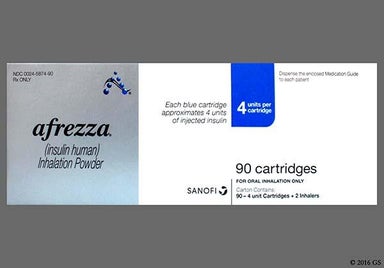
Depending on your dose, you might need to use more than one Afrezza (insulin) cartridge. They come in different colors for different insulin amounts: blue (4 units of insulin), green (8 units of insulin), and yellow (12 units of insulin). Make sure you know your dose, which color cartridges you need, and how many to use to get the right amount of insulin. Always throw away used cartridges before getting a new one.
Ask your prescriber when to check your blood sugar while you're using Afrezza (insulin). Keep a log of your blood sugar readings and bring it to your follow-up appointments. This helps you and your care team see how well Afrezza (insulin) is working and if you need dose adjustments.
It's important that you and your loved ones know how to recognize and treat low blood sugar. Common symptoms include shakiness, anxiety, thirst, and hunger. Always keep fast-acting sugar, like glucose tablets, with you to get your blood sugar back up if it gets too low. Follow the "15-15 rule" to treat low blood sugar levels (below 70 mg/dL).
If you need to use different insulins, check the labels to make sure you're using the right one at the right time. Talk to your care team about when to use each type. Let them know if you change your diet, meal patterns, exercise, or other medications. These changes can affect your blood sugar so you might need dose adjustments.
Your care team should train you on how to properly use Afrezza (insulin). Make sure you know how to use it to avoid accidentally hurting yourself or wasting the medication. Review the instructions for use that comes with Afrezza (insulin). Ask your diabetes care team if you have any questions.
How to store the cartridges: Keep unopened foil packages in the refrigerator until their expiration date. After opening the package, store unopened blister cards and strips of cartridges in the refrigerator for up to 1 month. You can also keep them at room temperature for up to 10 days. Opened strips can stay at room temperature, you have to use them within 3 days. Don't put anything back in the refrigerator after they reach room temperature.
When it's time for your dose: Let the cartridges and inhaler reach room temperature by leaving it out for 10 minutes. Don't try to warm up them any other way, like using a microwave or putting them out in the sun. Otherwise, you might damage them.
How to load a cartridge: Hold the inhaler straight with the white mouthpiece on the top and the purple base on the bottom. Open the inhaler by lifting up the white mouthpiece. Insert the cartridge with the cup facing down and close the mouthpiece down. Once loaded, keep the inhaler level and don't shake the inhaler or turn it upside down.
How to inhale the medication: Take off the purple mouthpiece cover. Fully exhale away from the inhaler. Then, put your lips tightly around the mouthpiece and tilt the inhaler down towards your chin. Inhale deeply. Hold your breath for as long as you comfortably can as you take the inhaler away from the mouth. Then, exhale.
After you use a cartridge, put the mouthpiece back on. Open the inhaler to remove cartridge. Throw away used cartridges in your regular household trash or recycle bin.
Afrezza (insulin) can cause some serious health issues. This risk may be even higher for certain groups. If this worries you, talk to your doctor or pharmacist about other options.
Inhaled medications like Afrezza (insulin) can cause bronchospasm, or a muscle spasm in your lungs. This can make it hard to breathe and cause wheezing, cough, and chest discomfort. Using Afrezza (insulin) might also make your lung function worse over time.
Your prescriber will check your medical history before you start Afrezza (insulin). You'll also do lung function tests before and during treatment to make sure your lungs are healthy. People with asthma or COPD can't take Afrezza (insulin) because of the risk of sudden breathing problems.
Get medical help right away if you have trouble breathing, wheezing, or coughing after using Afrezza (insulin). Your care team can check if your lungs are okay.
Low blood sugar levels (hypoglycemia)
Risk factors: Changes in your diet | Changes to the level of exercise you do | Drinking alcohol | Changes to the other medications you take | Taking other diabetes medications with Afrezza (insulin) | Not using Afrezza (insulin) as directed
A common side effect of insulins like Afrezza (insulin) is low blood sugar (hypoglycemia). When your blood sugar gets too low, it can make it hard to focus and react. This can lead to accidents. If it drops too much and isn't treated in time, it can be very dangerous and even life-threatening.
Low blood sugar can happen suddenly. So, it's important to know the symptoms of hypoglycemia. These can include shaking, feeling nervous, sweating, and feeling dizzy or weak. Always keep fast-acting sugars, such as glucose tablets, with you to treat hypoglycemia. If your blood sugar doesn't improve after taking fast-acting sugars, get medical help right away.
Changes in blood sugar levels with changes to your insulin routine
Risk factors: Changes in diet | Changes to the level of exercise you do | Drinking alcohol | Switching to Afrezza (insulin) from a different type of insulin | | Changes in insulin strength
Changes to your insulin or insulin routine can affect how your body responds to insulin. This can lead to changes to your blood sugar levels. They might get too high or too low, depending on the direction of the change.
Don't change your Afrezza (insulin) dose or insulin routine without talking to your diabetes care team first. If they tell you to make any changes, it's a good idea to check your blood sugar levels more often to see how the changes affect you.
In clinical trials, more people with Type 1 diabetes who used Afrezza (insulin) had diabetic ketoacidosis (DKA) than those who used other insulins. But it was still quite rare. DKA happens when blood sugar levels get too high. This causes too many ketones to build up in the blood and make it too acidic. It can be dangerous if not treated right away. People with Type 1 diabetes should use Afrezza (insulin) with a long-acting insulin that works all day.
You might be at risk for DKA if you're sick or if you've missed some insulin doses. In these cases, it's a good idea to check your blood sugar more often. Ask your prescriber about other times you might be at risk and what to do. Get medical help right away if you feel very thirsty, have a very dry mouth, breathe deep and fast, have fruity-smelling breath, or feel confused. These could be signs of DKA.
Low potassium levels
Risk factors: Taking other medications that lower potassium levels
Afrezza (insulin) can lower the amount of potassium in your blood, which can be dangerous. You're at greater risk if you take other medications that lower potassium, like thiazide or loop diuretics.
If you're at risk, your care team will check your potassium levels regularly. Watch for signs of low potassium, like weakness, dizziness, muscle cramps, constipation, or an irregular heartbeat. Talk to your care team if you have these symptoms while using Afrezza (insulin).
Swelling from fluid buildup and risk of heart failure when taken with certain diabetes medications
Risk factors: Taking glitazones together with insulin | History of heart failure
Taking Afrezza (insulin) with medications called glitazones (also known as thiazolidinediones), like pioglitazone (Actos), can cause your body to hold onto fluid. This can lead to or worsen heart failure because the additional fluid can put stress on the heart.
Call your prescriber if you have symptoms of fluid buildup or heart failure. Look for swelling in the ankles or feet, sudden weight gain, trouble breathing, and tiredness. Your prescriber might need to make changes to your diabetes treatment.
Afrezza (insulin) dosage
The average cost for 1 kit of 90 cartridges of 4 units of Afrezza (insulin) is $35.00 with a free GoodRx coupon. This is 93.66% off the average retail price of $551.81.
Contraindications are specific health conditions or situations in which a person should not take a medication due to safety concerns. If you have any of the following conditions or if any of the following apply to you, let your healthcare provider know because Afrezza (insulin) will not be safe for you to take.
GoodRx Health has strict sourcing policies and relies on primary sources such as medical organizations, governmental agencies, academic institutions, and peer-reviewed scientific journals. Learn more about how we ensure our content is accurate, thorough, and unbiased by reading our editorial guidelines.
Prescription savings
Stop paying too much for your prescriptions. Compare prices, get pharmacy coupons, and save up to 80%.
No, Afrezza is still available. Talk to your prescriber or pharmacist if you have questions about the availability of this medication.
Afrezza is an ultra rapid-acting insulin. It starts to work after about 12 minutes. The effects last for about 1.5 hours to 3 hours, depending on the dose.
Use Afrezza before your meals so that it can help lower your blood sugar after you eat. Don't use Afrezza if you don't plan to eat food though. This can put you at risk for dangerously low blood sugar.
Yes. Afrezza is FDA approved for adults with Type 1 diabetes (T1D). Keep in mind that it hasn't been studied in children with Type 1 diabetes.
No, Afrezza isn't recommended if you smoke or quit smoking within the last 6 months. It's not known how safe Afrezza is or how well the medication will work for you. But studies suggest that smoking can change how your body absorbs inhaled insulin and how it responds to it. This means that it's possible for smoking to put you at risk for very low or very high blood sugar when using Afrezza. If you need insulin, make sure to tell your prescriber if you smoke or have recently quit smoking. Using an injectable insulin rather than Afrezza might be a safer option.
Storeunopened foil packages of Afrezza cartridges in the refrigerator. They'll last until the expiration date written on the package. After opening, keep sealed blister cards and strips in the refrigerator for up to 1 month. You can also keep them at room temperature for up to 10 days. Keep opened strips of cartridges at room temperature; use them within 3 days. Once they reach room temperature, don't put blister cards or strips back in the refrigerator. Afrezza inhalers can stay at room temperature. Ask your prescriber or pharmacist if you have storage questions.




 Inhaled medications like Afrezza (insulin) can cause
 Your prescriber will check your medical history before you start Afrezza (insulin). You'll also do