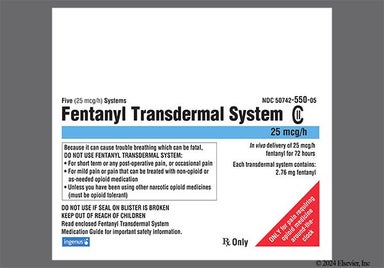
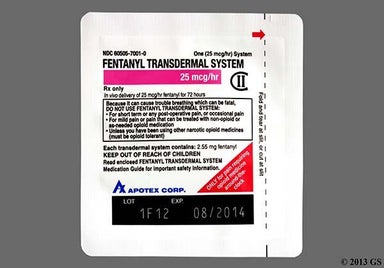
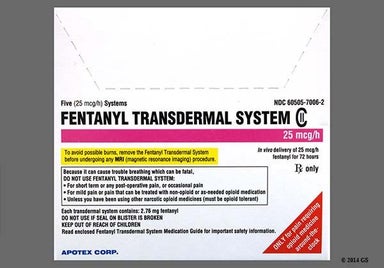
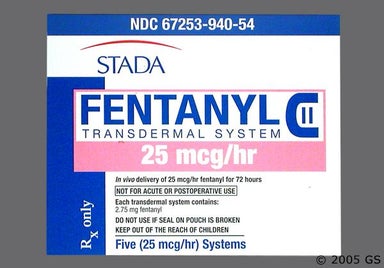
The fentanyl transdermal patch, previously known by the brand name Duragesic, is an opioid. It's a patch that's applied on the skin every 3 days to manage severe, long-term or chronic pain. The fentanyl patch is only approved for people who are "opioid tolerant" whose pain isn't controlled well enough with other treatment options. Fentanyl is a very powerful opioid, so the medication can be especially dangerous for those who aren't opioid tolerant because of their high risk for extremely slowed breathing and overdose. Some side effects include nausea, vomiting, and sleepiness.
Fentanyl patch is a controlled substance, which means that it's more likely to be misused or cause dependence. There are federal and state laws that limit the amount of medication that can be prescribed or dispensed within a certain period of time.
Fentanyl patch can cause some serious health issues. This risk may be even higher for certain groups. If this worries you, talk to your doctor or pharmacist about other options.
Potential for misuse and addiction
Risk factors: Personal or family history of substance or alcohol abuse | History of mental health conditions | Not storing, using, or disposing the fentanyl patch properly
The fentanyl patch is a controlled substance that has a risk for misuse and addiction. This can lead to serious and possibly life-threatening consequences, such as dangerously slow breathing and overdose.
Use the fentanyl patch exactly as prescribed. Don't place the patch in your mouth for any reason. Chewing or swallowing the patch or using the patch in any other way than prescribed is considered misuse. This can lead to choking, overdose, and death. Also don't change how much or how often you use the patches without talking to your prescriber first.
Because of the risk for misuse and addiction, the fentanyl patch is only available through a Risk Evaluation and Mitigation Strategy (REMS) program called the Opioid Analgesic REMS program. Your prescriber and pharmacy must register with the program, receive training on proper medication use, and discuss with you about how to take the fentanyl patch safely.
Risk factors: First starting the fentanyl patch | Dose changes | High doses | Children | Age 65 years or older | Weak or frail people | People who aren't opioid tolerant | Medical conditions that cause breathing problems (e.g., COPD, asthma, sleep apnea, head injury) | Taking other medications that slow down brain function
The fentanyl patch patch can cause serious, fatal slowed breathing (respiratory depression), even when they're used as recommended. Respiratory depression is a medical emergency that must be managed and treated right away. Call 911 as soon as possible if you or someone around you notices that you have shortness of breath, slow or shallow breathing, extreme tiredness or sleepiness, or confusion, or bluish skin or lips.
Avoid alcohol and medications that slow down brain function, such as benzodiazepines, other opioids, and muscle relaxants, while you're taking the fentanyl patch. These substances slow down your breathing even more and put you at even higher risk for serious respiratory depression, extreme sleepiness, and overdose.
To lower the risk for respiratory depression, your prescriber will work very closely with you to adjust your fentanyl patch dose depending on your needs. Your prescriber will recommend that you have naloxone (Narcan) with you at all times. Naloxone is a medication that can reverse slowed breathing from opioids. Use naloxone, call 911, and get medical help right away if you have signs or symptoms of dangerously slowed breathing.
Risk for opioid overdose
Risk factors: History of opioid use disorder | Previous opioid overdose | Taking high doses of the fentanyl patch | Taking more opioids than prescribed | Alcohol use
Take the fentanyl patch exactly as prescribed. Taking too much, taking it more often than prescribed, or taking it any other way than prescribed can lead to a life-threatening overdose. Symptoms of an opioid overdose include not responding to sound or touch, extremely slow breathing, slow heartbeat, extreme sleepiness, and cold or clammy skin.
Be sure you and your loved ones know how to recognize an opioid overdose. Your prescriber will recommend getting naloxone (Narcan) — either by prescription or over the counter. Naloxone can help treat an opioid overdose. Carry naloxone with you at all times; use it and call 911 right away if an overdose happens.
Life-threatening risks with accidental exposure
It can be very dangerous if someone accidentally touches, uses, chews, or swallows the fentanyl patch. Accidental exposure to the medication can lead to seriously harmful consequences, such as extremely slowed breathing, overdose, and even death.
It's important to keep fentanyl patches out of reach from children, visitors, and pets to prevent accidental exposure and potential overdose. Also be sure to safely dispose used and unused patches to prevent people, especially children, from getting exposed to the medication by mistake. Used fentanyl patches still have medication left on them.
Life-threatening risks with patch exposure to high temperatures (e.g., heat, high fever)
Risk factors: Exposing the fentanyl patch to external heat sources | High fever of 104 degrees Fahrenheit or greater | Very rigorous movement or exercise (leading to a high body temperature)
Exposing the fentanyl patch to heat or having areas of skin around your patch that's hot greatly raises the risk for potential overdose and death. High temperatures — including when you have a high fever or when you've exercised rigorously – cause more medication to get released from the patch and into the body, which can lead to overdose.
Don't use any external heat sources, like heating pads, electric blankets, heat or tanning lamps, heated beds or water beds, over the fentanyl patch and the area of skin around it. Also avoid sunbathing, hot baths, hot tubs, and saunas. Try to avoid extreme workouts, exercise, or movement that can make you get very hot. Contact a healthcare professional as soon as you can if you have a high fever for appropriate treatment. Call 911 right away if you have any symptoms of overdose, like extreme sleepiness or slowed breathing.
Difficulty concentrating and extreme sleepiness
Risk factors: Taking high doses of the fentanyl patch | Age 65 years or older | Drinking alcohol | Taking other medications that can cause sleepiness
The fentanyl patch can cause extreme sleepiness and lower your ability to think, react, and focus. Don't drink alcohol with the fentanyl patch. Also don't take other medications that can cause sleepiness or "brain fog" (e.g., benzodiazepines, muscle relaxants, sleep medications). Otherwise, these side effects might be more intense.
Make sure you know how the fentanyl patch affects you before driving a car or doing activities that require your concentration. Talk to your prescriber right away if you feel too sleepy from the medication or if you're having a hard time thinking clearly.
Physical dependence and withdrawal
Risk factors: Long-term treatment with fentanyl patches
When fentanyl patches are regularly used to treat chronic pain, the medication can cause physical dependence. This means that your body relies on the medication to function. And you might experience withdrawal if you lower your dose too quickly or suddenly stop using the medication. Withdrawal symptoms include anxiety, restlessness, irritability, runny nose, yawning, sweating, and chills.
Don't suddenly lower your dose or stop using the fentanyl patch suddenly without talking to your prescriber first. If needed, your prescriber will slowly lower your dose over time to prevent withdrawal symptoms. Talk to your prescriber if you have concerns about fentanyl patches because of the risk for withdrawal.
Harm to newborn babies
Long-term use of the fentanyl patch during pregnancy can cause your unborn baby to become dependent on the medication. This is because fentanyl can pass through the placenta to your unborn baby.
Once your baby is born, they can experience withdrawal symptoms, such as high-pitched crying, poor feeding behavior, trembling, abnormal sleep patterns, and even seizures. This condition is called neonatal opioid withdrawal syndrome and can be life-threatening if it isn't recognized and treated in time. Let your healthcare professional know if you've used the fentanyl patch during pregnancy or if you notice these symptoms in your baby.
Drug interactions
The fentanyl patch can interact with several medications. Let your care team know what medications you're taking to make sure they're safe for you to take together. Also speak with your care team first before making any changes to your medications because sudden dose adjustments can be harmful.
Some medications can raise the fentanyl levels in your body, which can raise your risk for serious side effects like potentially life-threatening slowed breathing. Medications that can lead to this type of interaction include erythromycin and ritonavir (Norvir), among others.
Other interactions, such as with rifampin (Rifadin) or carbamazepine (Tegretol), can lower fentanyl levels in your body. This can cause the opioid medication to work less well to manage your pain. These interactions might also lead to withdrawal symptoms.
Serotonin syndrome
Risk factors: Using the fentanyl patch with medications that raise serotonin levels
Symptoms of serotonin syndrome generally appear within a few hours or a few days of taking these medications together but can also start later. Call for emergency medical help right away, take off the fentanyl patch, and stop using the medication if you have symptoms of serotonin syndrome. These symptoms include nausea, vomiting, diarrhea, fever, sweating, shivering, distress, hallucinations, restlessness, fast heart rate, or stiff muscles.
Low blood pressure and slow heart rate
Risk factors: Age 65 years or older | History of low blood pressure | History of slow heart rate or heart problems | Dehydration | Starting the fentanyl patch or have dose changes | Taking other medications that lower blood pressure
The fentanyl patch patch can cause severely low blood pressure, including a drop in blood pressure when you stand from a sitting or lying position. This can lead to dizziness and fainting. Be careful as you stand up after sitting for some time. Make sure to sit back down or lie down if you feel faint or dizzy. The chances of low blood pressure are greater when you first start using fentanyl patch or with dose changes.
The fentanyl patch can also slow your heart rate, particularly when you start treatment. Let your care team know if you have any heart problems, like abnormal heart rate (arrhythmias), before you start treatment. Call your prescriber if you have unexplained fatigue, dizziness or lightheadedness that doesn't go away, shortness of breath, or chest pain while you're taking this medication. These might be symptoms of an unusually slow heart rate.
Low adrenal hormone levels
Risk factors: Taking the fentanyl patch for longer than 1 month
Some people taking opioids like the fentanyl patch had low adrenal hormone levels. This might be more likely to happen after taking opioids for longer than 1 month. Let your prescriber know if you have symptoms like tiredness, dizziness, weakness, not feeling hungry, nausea, and vomiting. If your adrenal hormone levels are too low, you might need to stop taking the fentanyl patch and get treated with corticosteroids.
Seizures
Risk factors: History of seizures | Taking other medications or having health conditions that raise your risk of seizures
If you've had a seizure in the past, opioids like the fentanyl patch can raise the risk of having seizures more often. The fentanyl patch can also put you at risk of seizure in certain situations. Get medical help if you have a seizure while you're taking this medication.
The following side effects may get better over time as your body gets used to the medication. Let your healthcare provider know immediately if you continue to experience these symptoms or if they worsen over time.
The following Fentanyl patch side effects have also been reported
Along with its needed effects, a medicine may cause some unwanted effects. Although not all of these side effects may occur, if they do occur they may need medical attention.
Check with your doctor immediately if any of the following side effects occur:
drowsiness that is so severe you are not able to answer when spoken to or, if asleep, cannot be awakened
pinpoint (small) pupils in the eyes
seizures
slow heartbeat
very slow or troubled breathing
Some side effects may occur that usually do not need medical attention. These side effects may go away during treatment as your body adjusts to the medicine. Also, your health care professional may be able to tell you about ways to prevent or reduce some of these side effects. Check with your health care professional if any of the following side effects continue or are bothersome or if you have any questions about them:
Not intended to use as needed, for short-term pain, or for mild pain
Pharmacist tips for Fentanyl patch
Keep fentanyl patches out of reach from children, visitors, and pets to lessen the risk for accidental overdose and medication misuse. Choose a drug take-back option to get rid of the patches safely if you don't need them anymore.
The fentanyl patch can make you sleepy. It can also make it harder for you to think, react, and focus. Don't drive or do activities that you need to focus for until you know how this medication affects you.
Don't drink alcohol while you're taking this medication. Alcohol can make side effects, like sleepiness and trouble focusing, worse. It can raise your risk for dangerously slowed breathing, accidental injuries, and overdose.
Use the fentanyl patch exactly as your prescriber instructed you to. Don't change the dose (or the number of patches you wear) or stop taking the medication without talking to your prescriber first. Your prescriber will work with you to lower your dose slowly over time before you can completely stop the medication. This lowers your risk for withdrawal symptoms like muscle aches, chills, and trouble sleeping.
Always have naloxone (Narcan) with you at all times. Naloxone helps reverse the effects of fentanyl in situations like an accidental overdose. Teach your loved ones about how to give naloxone to you if you can't do it yourself. Call 911 if you need to use naloxone because its effects are temporary.
Let your prescriber know if you're pregnant before you start using fentanyl patches or if you become pregnant while you're using this medication. Opioids like fentanyl aren't recommended while pregnant because of the risk of harmful complications.
Speak with your care team about alternative options if you're breastfeeding. It's typically recommended to avoid opioids, including fentanyl from the patch, because they can get into breast milk. This raises the risk for your baby to have serious side effects like being very sleepy or limp or breathing very slowly.
Apply the fentanyl patch at any time of the day that works best for your schedule. Just be sure to change out the patch every 3 days at about the same time to keep the levels of the medication in your body steady.
Don't open the pouch and take out the fentanyl patch until you're ready to use it. If you're using scissors to cut the pouch open, make sure you don't accidentally cut the patch. Cutting the patch can affect how much and how fast medication gets released from the patch and into your body.
Before you place the fentanyl patch onto the skin, clean the area of skin with water only and pat completely dry. Don't put any lotion, oils, soap, or alcohol on the skin before you stick the patch on. These products can irritate your skin and affect how well the patch sticks to your skin.
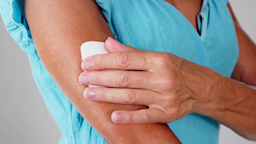
For most adults, apply the fentanyl patch to the chest, back, side of the waist, or upper arm. For people of other ages, ask your prescriber about where to best place the patch on the body to make sure it's safe and it works well. Choose a different area of skin when you replace the patch.
Apply the fentanyl patch on a flat area of your skin that has no hair. Body hair might make the patch not stick as well. Don't shave to get rid of any body hair in the area you chose to apply the patch. Instead, clip the hair as close to your skin as possible to avoid irritation. Also avoid placing the patch onto skin that's sensitive, very oily, burned, cut, irritated, or damaged.
Avoid touching the sticky side of the fentanyl patch with your fingers after you peel off the clear plastic liners. This can make patch become less sticky. And for people helping you put the patch on who accidentally touch the sticky side, it can expose them to the medication accidentally and put them at risk for serious side effects.
When you apply the fentanyl patch, press and hold the patch against your skin for at least 30 seconds to make sure that it sticks well. Wash your hands right away after handling the patch.
When you replace your fentanyl patch, remove the used patch. Fold the used patch in half so that the sticky sides are together, and flush it down the toilet right away.
Fentanyl patch dosage
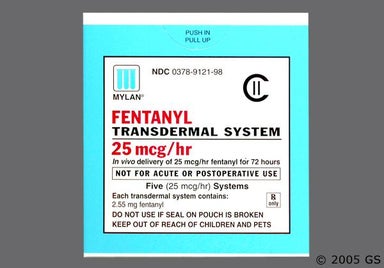
The average cost for 2 cartons of 5 patches of 25mcg/hr of Fentanyl patch is $39.79 with a free GoodRx coupon. This is 77.50% off the average retail price of $176.83.
Interactions between Fentanyl patch and other drugs
Fentanyl patch may interact with certain medications or supplements. Always let your doctor and pharmacist know about any other medications or supplements (including prescribed and over-the-counter medications, vitamins, and dietary or herbal supplements) that you are currently taking. The list below does not include all possible drug interactions with Fentanyl patch. Please note that only the generic name of each medication is listed below.
Although certain medicines should not be used together at all, in other cases two different medicines may be used together even if an interaction might occur. In these cases, your doctor may want to change the dose, or other precautions may be necessary. When you are taking this medicine, it is especially important that your healthcare professional know if you are taking any of the medicines listed below. The following interactions have been selected on the basis of their potential significance and are not necessarily all-inclusive.
Using this medicine with any of the following medicines is not recommended. Your doctor may decide not to treat you with this medication or change some of the other medicines you take.
Using this medicine with any of the following medicines is usually not recommended, but may be required in some cases. If both medicines are prescribed together, your doctor may change the dose or how often you use one or both of the medicines.
Contraindications are specific health conditions or situations in which a person should not take a medication due to safety concerns. If you have any of the following conditions or if any of the following apply to you, let your healthcare provider know because Fentanyl patch will not be safe for you to take.
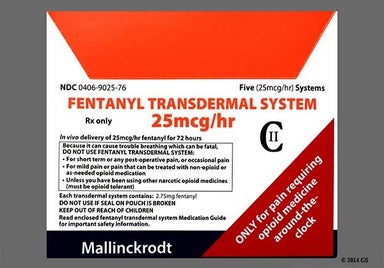
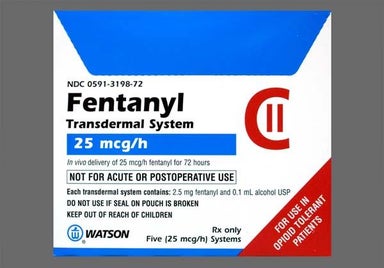
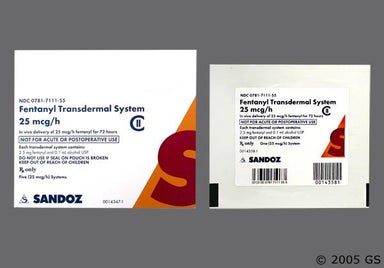
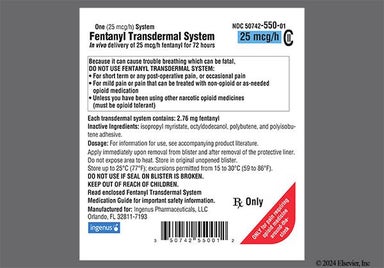
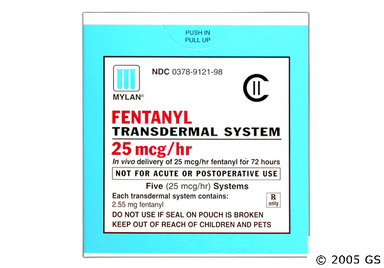
This medicine is Colorless, Rectangular Carton.Rectangular - Fentanyl 25mcg/hr Transdermal PatchThis medicine is Colorless, Rectangular Carton.Rectangular - Fentanyl 25mcg/hr Transdermal PatchThis medicine is Colorless, Rectangular Carton.Rectangular - Fentanyl 25mcg/hr Transdermal PatchThis medicine is Colorless, Rectangular Carton.Rectangular - Fentanyl 25mcg/hr Transdermal PatchThis medicine is Colorless, Rectangular Carton.Rectangular - Fentanyl 25mcg/hr Transdermal PatchThis medicine is Colorless, Rectangular Carton.Rectangular - Fentanyl 25mcg/hr Transdermal PatchThis medicine is Colorless, Square Carton.Square - Fentanyl 25mcg/hr Transdermal PatchThis medicine is Colorless, Square Carton.Square - Fentanyl 25mcg/hr Transdermal PatchThis medicine is Beige, Pink, Rectangular Carton.Beige, Pink Rectangular - Fentanyl 25mcg/hr Transdermal Patch
GoodRx Health has strict sourcing policies and relies on primary sources such as medical organizations, governmental agencies, academic institutions, and peer-reviewed scientific journals. Learn more about how we ensure our content is accurate, thorough, and unbiased by reading our editorial guidelines.
Prescription savings
Stop paying too much for your prescriptions. Compare prices, get pharmacy coupons, and save up to 80%.
It can take several hours (at least about 12 hours) to start to feel the pain-relieving effects from the Fentanyl. But it can take a few days to feel the full effects of the medication. The Fentanyl helps manage chronic (long-term) pain. It isn't for short-term pain or breakthrough pain. Speak with your prescriber about your options for pain relief while you're waiting for the Fentanyl to start working or about options for breakthrough pain.
The effects of a Fentanyl lasts for 72 hours, or 3 days. Take off the patch you're wearing after 3 days. Fold the used Fentanyl in half so that the sticky sides come together and flush it down the toilet right away. Then, apply a new Fentanyl at a different spot from where you just took off the used patch.
It takes about 5 days for most of the fentanyl to leave your body after taking off the patch. This time frame is an estimation based on the half-life of the medication. The half-life can be longer in some people, such as older adults, people with kidney problems, and people with liver problems. This is because there are some conditions that affect how fast the body gets rid of the medication. Talk to your prescriber if you have concerns about how long fentanyl from the patch stays in the body.
Ask your prescriber about where to best place the Fentanyl on the body to make sure it's safe and it works well. For most adults, the patch gets applied to the chest, back, side of the waist, or upper arm. But for people of other ages, where to apply the patch can be different. Choose a different area to apply the new patch when it's time to replace the patch (every 3 days). Be sure to put the Fentanyl on an area of clean, dry skin that isn't hairy to make sure the patch sticks well (clip the hair if needed, but don't shave). Don't apply the patch to skin that's oily, broken, damaged, cut, scarred, or has rashes to avoid skin irritation.
No. Applying heat to the Fentanyl can make a lot of medication get released from the patch and get absorbed into the body. This can lead to a life-threatening fentanyl overdose. Never apply heat from any source to a Fentanyl patch. This includes things like heated blankets, heating pads, and tanning lamps. Also, don't take very hot showers or use hot tubs, saunas, or tanning beds while you're wearing the Fentanyl.
No. Never cut a Fentanyl. Cutting the patch can damage it and cause too much fentanyl to release from the patch and go into body too fast. This greatly raises your risk for a fentanyl overdose. Contact your prescriber if you have questions about applying the entire Fentanyl on the skin.
If your Fentanyl isn't sticking, you can use first-aid tape only on the edges of the patch to help it stick better. If that doesn't work, you can place a sticky, see-through dressing, like Bioclusive or Tegaderm, over the patch. Never cover the patch with any other tape or bandages. If your Fentanyl falls off before 3 days of use, fold it in half with the sticky sides together and flush it down the toilet. Then, apply a new patch on a different area of the skin and wear it for the next 3 days before replacing it. Call your prescriber to let them know the patch fell off. Ask your prescriber or pharmacist if you have questions about what to do for your specific situation.
Yes, you can shower or swim with the Fentanyl on your skin. But make sure to avoid hot baths or showers, hot tubs, a very heated pool, or saunas. Hot water over the patch or on the skin surrounding the patch can cause more medication from the patch to get absorbed into the body. This can raise your risk for serious consequences, like dangerously slowed breathing and potentially overdose.




 The fentanyl patch is a
 Use the fentanyl patch exactly as prescribed. Don't place the patch in your mouth for any reason. Chewing or swallowing the patch or using the patch in any other way than prescribed is considered