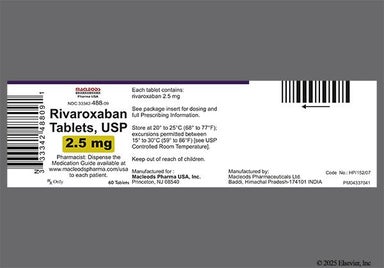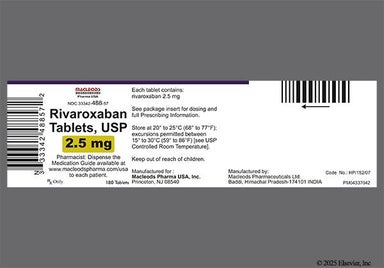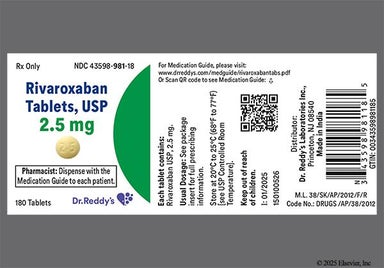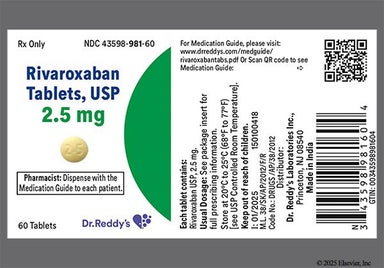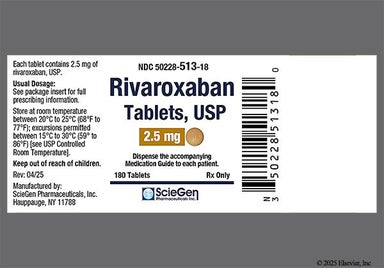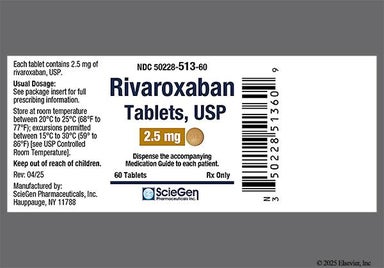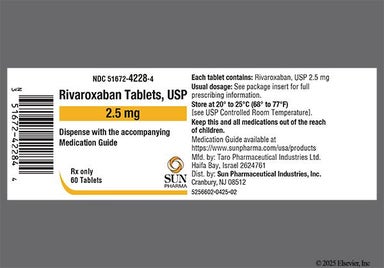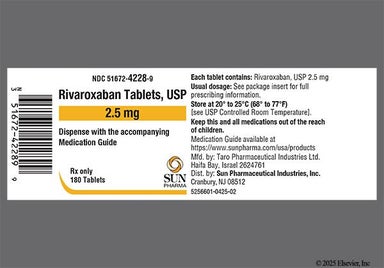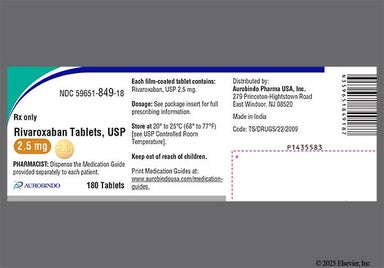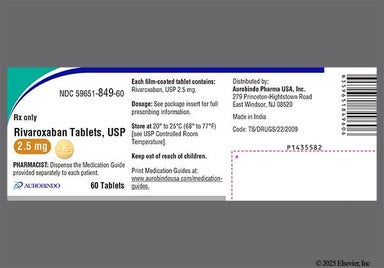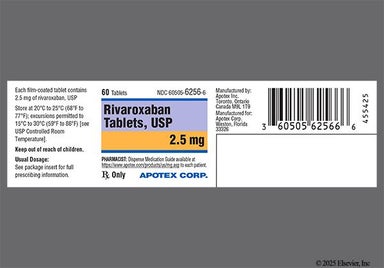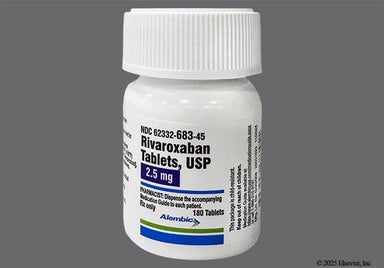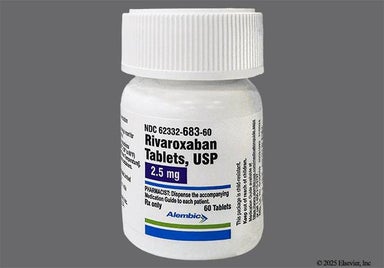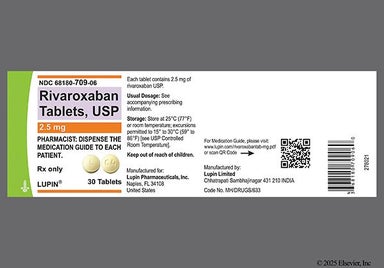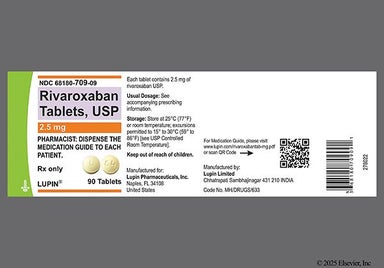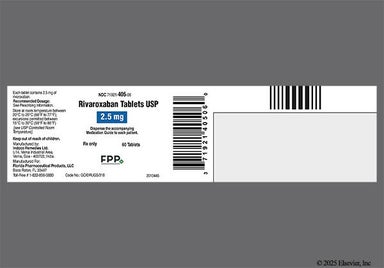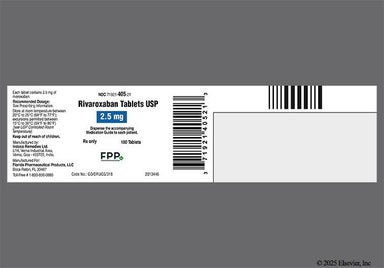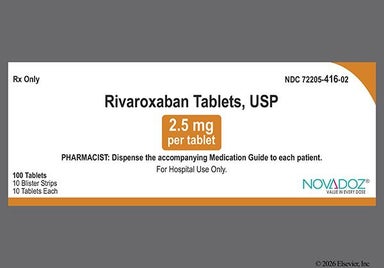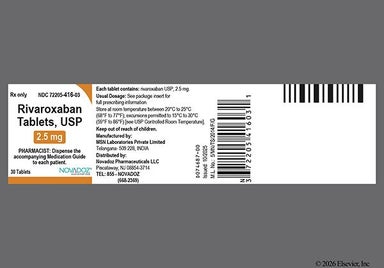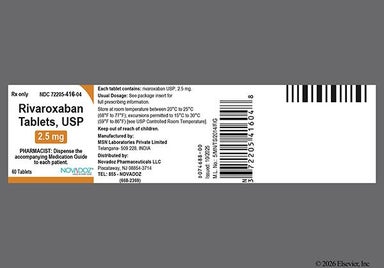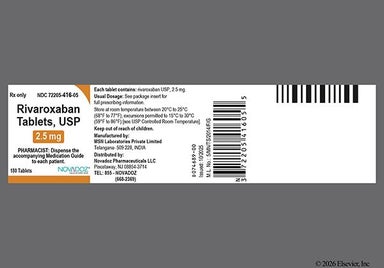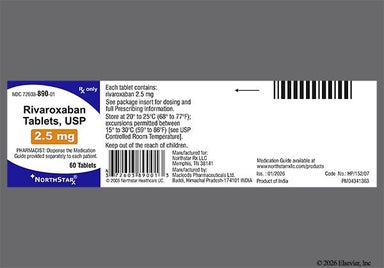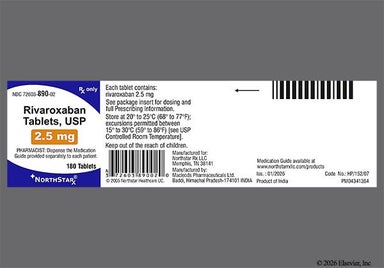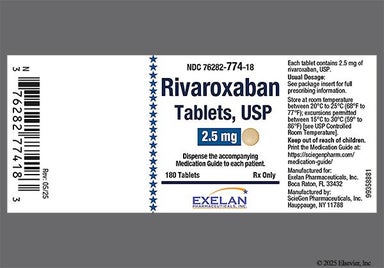

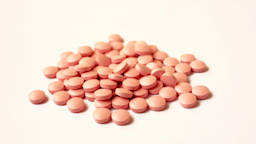
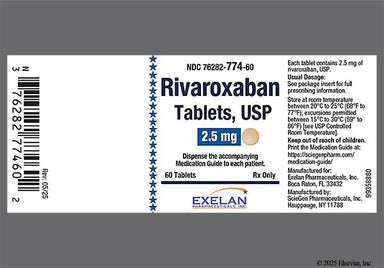
Rivaroxaban Coupon - Rivaroxaban 2.5mg of  tablet

rivaroxaban

Generic Xarelto
Used for Atrial Fibrillation, Coronary Artery Disease, Deep Vein Thrombosis, Peripheral Artery Disease, Pulmonary Embolism

Xarelto (rivaroxaban) is a prescription blood thinner used to prevent and treat blood clots. It can lower the risk of serious problems like stroke, deep vein thrombosis (DVT), or pulmonary embolism (PE). It's comes as a tablet or liquid and is taken by mouth. Your dose depends on why you're taking it, so it could be once or twice a day. The most common side effect is bleeding, which can sometimes be serious or life-threatening. Xarelto (rivaroxaban) is available as both a brand-name and a generic medication.

Reviewed by:Last reviewed on June 2, 2025
basics-icon

What is Xarelto (rivaroxaban)?

What is Xarelto (rivaroxaban) used for?

Adults:

Children:

How Xarelto (rivaroxaban) works

Xarelto (rivaroxaban) is a direct-acting oral anticoagulant (DOAC) that works by blocking factor Xa, a protein your body uses to form clots. By stopping this protein, Xarelto (rivaroxaban) helps thin your blood and prevent clots from forming or getting bigger.

Drug facts

Common BrandsXarelto
Drug ClassDirect-acting oral anticoagulant (DOAC)
Controlled Substance ClassificationNot a controlled medication
Generic StatusLower-cost generic available
AvailabilityPrescription only
side-effects-icon

Side effects of Xarelto (rivaroxaban)

The following side effects may get better over time as your body gets used to the medication. Let your healthcare provider know immediately if you continue to experience these symptoms or if they worsen over time.

Common Side Effects

Adults

  • Any bleeding (Up to 28%)

Children

  • Any bleeding (36%)
  • Cough (16%)
  • Vomiting (14%)
  • Stomach virus (13%)
  • Rash (9%)

Less Common Side Effects

  • Stomach pain
  • Tiredness
  • Pain in the arms and legs
  • Muscle pain and spasm
  • Dizziness
  • Anxiety
  • Trouble sleeping
  • Itchy skin

Xarelto (rivaroxaban) serious side effects

Contact your healthcare provider immediately if you experience any of the following.

  • Serious bleeding: bleeding that won’t stop, blood in the urine or stool, coughing or vomiting blood, unexplained bruises, bruises that get bigger, dizziness
  • Bleeding around the spine (spinal or epidural hematoma): back pain, weakness, difficulty walking, loss of bowel or bladder control, paralysis

Source: DailyMed

The following Xarelto (rivaroxaban) side effects have also been reported

Along with its needed effects, a medicine may cause some unwanted effects. Although not all of these side effects may occur, if they do occur they may need medical attention.

Check with your doctor immediately if any of the following side effects occur:

More common

Back pain

bleeding gums

bloody stools

bowel or bladder dysfunction

burning, crawling, itching, numbness, prickling, "pins and needles", or tingling feelings

coughing up blood

difficulty with breathing or swallowing

dizziness

headache

increased menstrual flow or vaginal bleeding

leg weakness

nosebleeds

numbness

paralysis

prolonged bleeding from cuts

red or black, tarry stools

red or dark brown urine

vomiting of blood or material that looks like coffee grounds

Less common

Fainting

pain in the arms or legs

wound secretion

Rare

Burning feeling while urinating

difficult or painful urination

Incidence not known

Blistering, peeling, or loosening of the skin

blurred vision

chills

clay-colored stools

cough

dark urine

diarrhea

fast or irregular heartbeat

fever with or without chills

general feeling of tiredness or weakness

hives, itching, or skin rash

hoarseness

joint or muscle pain

loss of appetite

lower back or side pain

nausea

puffiness or swelling of the eyelids or around the eyes, face, lips, or tongue

red skin lesions, often with a purple center

red, irritated eyes

severe headache

sore throat

sores, ulcers, or white spots in the mouth or on the lips

stomach pain or swelling

tightness in the chest

unpleasant breath odor

unusual bleeding or bruising

unusual tiredness or weakness

vomiting

yellow eyes or skin

Some side effects may occur that usually do not need medical attention. These side effects may go away during treatment as your body adjusts to the medicine. Also, your health care professional may be able to tell you about ways to prevent or reduce some of these side effects. Check with your health care professional if any of the following side effects continue or are bothersome or if you have any questions about them:

Less common

Blisters

muscle spasm

Other side effects not listed may also occur in some patients. If you notice any other effects, check with your healthcare professional.

Call your doctor for medical advice about side effects. You may report side effects to the FDA at 1-800-FDA-1088.

prices-container

Get your GoodRx coupon

Avg retail price
$615.99(Save 91.93%)
GoodRx discount
$49.72
See prices
pros-and-cons-icon

Pros and cons of Xarelto (rivaroxaban)

Pros

  • No regular blood monitoring required
  • Available as a tablet or liquid that's taken by mouth
  • Approved for both children and adults

Cons

  • Most common side effect is bleeding
  • Not easily reversible in life-threatening bleeds
  • Can interact with many medications
pharmacist-tips-icon

Pharmacist tips for Xarelto (rivaroxaban)

pharmacist
  • Never stop taking Xarelto (rivaroxaban) unless your prescriber tells you to. Stopping the medication too early can lead to dangerous blood clots that might be life-threatening.
  • If you take the 15 mg or 20 mg Xarelto (rivaroxaban) tablet, always take it with food at around the same time each day. Food helps your body absorb the medication so it can work better. Other doses can be taken with or without food.
  • If you or your child misses a dose of Xarelto (rivaroxaban), talk to your prescriber or pharmacist. What to do can depend on your specific dose and schedule. Don’t double up without guidance.
  • If you have trouble swallowing Xarelto (rivaroxaban) tablets, you can crush them and mix with a small amount of applesauce just before taking the medication by mouth. Additionally, Xarelto (rivaroxaban) comes in a liquid form you can drink.
  • Tell your care team if you're taking Xarelto (rivaroxaban) before any procedure, even dental work. They might need to make changes to your treatment plan to help prevent bleeding problems during or after the procedure.
  • Let your care team know right away if you notice unusual bleeding or bruising while taking Xarelto (rivaroxaban). This medication can make it take longer for bleeding to stop, and you might bruise or bleed more easily than usual.
  • Xarelto (rivaroxaban) can interact with many medications. Tell your care team if you're taking any prescription, over-the-counter medications, or supplements during treatment.
  • If you have CAD or PAD, you'll likely take Xarelto (rivaroxaban) with low-dose aspirin (75 mg to 100 mg) to lower your risk of heart attack, stroke, or other serious problems. Ask your prescriber if this combination is right for you.
  • Store the Xarelto (rivaroxaban) liquid at room temperature. Only use the syringe that comes with it to measure each dose to make sure you get the correct amount of medication every time.
  • If your child vomits or spits up Xarelto (rivaroxaban) within 30 minutes of taking it, give the full dose again. If it’s been more than 30 minutes, don't repeat the dose — just wait until the next scheduled one. If vomiting keeps happening, call their prescriber right away.
  • Xarelto (rivaroxaban) can raise the risk of heavy uterine bleeding. If you're planning to become pregnant, talk to your prescriber before starting this medication.
  • Xarelto (rivaroxaban) has been found in breast milk. But it's not clear how it affects a breastfed baby. If you're nursing or planning to nurse, talk to your prescriber about the risks and benefits of taking this medication.
educational-icon

How to save using GoodRx

Compare Prices
1. Compare PricesSpecify your dosage and quantity to find out exactly how much you can save.
Select your free coupon
2. Select your free couponYou can use the displayed coupon, or compare prices at other pharmacies near you.
Show coupon to your pharmacist
3. Show coupon to your pharmacistPresent your printed or electronic coupon when you pick up your prescription.
Get free couponLearn more
faq-icon

Common questions about Xarelto (rivaroxaban)

Since Xarelto is a blood thinner, bleeding is the most common side effect when taking it. You may be at a greater risk of bleeding if you have a history of bleeding, have medical conditions such as high blood pressure, kidney disease, or diabetes, take other medications that make bleeding more likely, such as aspirin or certain antidepressants, or are over the age of 65. Bleeding from Xarelto is usually mild. Nose bleeds, light bruising, or bleeding from the gums while brushing your teeth are examples of mild bleeding. It’s best to let your prescriber know if you experience mild bleeding symptoms. They may decide to monitor you more often. Sometimes, bleeding from Xarelto can be severe or even life-threatening. Signs of serious bleeding include bleeding that doesn’t stop, bruising that happens without a known cause or covers a large area, blood in your urine, blood in your stool (either bright red or black, tarry stool), coughing up blood, or vomiting blood (may look like coffee grounds). Seek medical attention immediately if you experience any of these symptoms. There are treatments available to help reverse life-threatening bleeding, such as Andexxa (andexanet alfa). These treatments are given in a hospital setting.Learn more

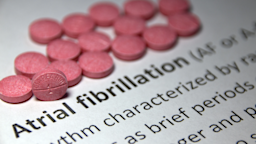
Xarelto (rivaroxaban) is a blood thinner that treats and prevents blood clots. It works by blocking Factor Xa — a special protein in the blood that plays an important role in the clotting process. It's a popular alternative to older blood thinners, such as warfarin (Coumadin, Jantoven). Healthcare professionals prescribe it for blood clots in the legs (deep venous thrombosis), blood clots in the lungs (pulmonary embolism), people who are at increased risk of blood clots, and stroke prevention in people who have atrial fibrillation.Learn more

No, Xarelto isn't the same as Eliquis. They're both direct-acting oral anticoagulants (DOACs), but they're different medications. Eliquis and Xarelto are both first-choice treatment options for treating and preventing different types of blood clots. In general, one isn’t recommended over another but one might be better in specific situations. For example: Eliquis may be the better choice if you have kidney problems. If you have trouble remembering to take your medications, a DOAC that you can take once a day (like Xarelto) may be a better option than a DOAC that’s taken twice a day (like Eliquis). Your healthcare professional will determine which is right for you based on your medical history, current medications, preferences, and other factors.Learn more

Xarelto (rivaroxaban) can interact with other medications that raise your bleeding risk. This includes other blood thinners, nonsteroidal anti-inflammatory drugs (NSAIDs), and some antidepressants. It’s best to avoid taking Xarelto with these medications unless your prescriber OKs it. Other Xarelto interactions include ketoconazole, Norvir (ritonavir), and Paxlovid (nirmatrelvir / ritonavir). These medications can increase Xarelto levels in the body, which can raise your risk of bleeding. Some anti-seizure medications and supplements like St. John’s wort can make Xarelto less effective, which can raise your risk of blood clots.Learn more

Xarelto is considered a safe medication for most people when taken as directed. But, like all medications, there are still side effects and risks to consider when you’re taking it. Xarelto’s main risk is that it raises the chance of bleeding. But in studies, Xarelto had a lower risk of serious and fatal bleeding than warfarin. Your bleeding risk may be higher with Xarelto if you have liver or kidney disease, take other medications that make bleeding more likely (such as aspirin or certain antidepressants), or are age 65 or older. Let your prescriber know if you notice signs of mild bleeding while taking Xarelto. These include nose bleeds, light bruising, or bleeding from the gums while brushing your teeth. You should seek medical attention right away if you notice signs of severe bleeding, such as bleeding that doesn’t stop, blood in your urine, blood in your stool (can be bright red or black, tarry stool), coughing up blood, or vomiting blood (may look like coffee grounds).Learn more
warnings-icon

Risks and warnings for Xarelto (rivaroxaban)

Xarelto (rivaroxaban) can cause some serious health issues. This risk may be even higher for certain groups. If this worries you, talk to your doctor or pharmacist about other options.

Higher risk of blood clots if stopped too early

  • Risk factors: Certain heart conditions

Black Box Warning Don't stop taking Xarelto (rivaroxaban) unless your prescriber tells you to. Stopping too soon can raise your risk of serious blood clots. If you need to stop for any reason other than bleeding or finishing treatment, your prescriber might have you start on another blood thinner to help keep you protected.

Paralysis in the spine

  • Risk factors: Spinal surgery or spinal tap | Use of indwelling epidural catheter | Anesthesia in the spine (epidural)

Black Box Warning If you’re taking Xarelto (rivaroxaban) and need spinal or epidural anesthesia (numbing around your spine) or a spinal tap, you might have a higher risk of bleeding near your spine. This type of bleeding, called a spinal or epidural hematoma, is rare but can cause long-term or permanent paralysis. Your care team will explain how to safely stop Xarelto (rivaroxaban) before the procedure to help lower this risk. Call your prescriber right away if you notice back pain, weakness, numbness, difficulty walking, or a loss of bowel or bladder control.

Bleeding

  • Risk factors: Taking other blood thinners or NSAIDs | People who are hospitalized with a high risk of bleeding | People with liver or kidney problems | Taking medications that can cause bleeding

Since Xarelto (rivaroxaban) is a blood thinner, it can raise your risk of bleeding, including serious and life-threatening bleeding. You might bruise more easily, and bleeding might take longer to stop. Your risk of bleeding is higher if you have certain other medical conditions or take other medications that cause bleeding. Get medical help right away if you or your child have bleeding that doesn't stop, blood in your urine or stool, coughing or vomiting blood, or feel dizzy or lightheaded.

There are medications, such as Andexxa (andexanet alfa), that can reverse the effects of Xarelto (rivaroxaban) in an emergency. But these reversal medications are given through a vein (intravenously, IV) and are usually only available in the hospital. It's very important that all healthcare professionals, including emergency responders, know you're taking Xarelto (rivaroxaban). Wearing a medical alert bracelet that lists this medication can help keep you safe.

Interactions with other medications

Some medications can change how much Xarelto (rivaroxaban) is in your body. This can lead to more side effects or bleeding (like with ketoconazole, ritonavir), or make the medication not work as well (like with carbamazepine or rifampin). Be sure to tell your prescriber and pharmacist about all prescription, over-the-counter medications, and supplements you're currently taking or have recently stopped.

Risk of pregnancy-related bleeding

Xarelto (rivaroxaban) can cause uterine bleeding, which can be a problem if you're pregnant. Tell your care team right away if you’re pregnant or planning to become pregnant while taking this medication. You should only keep taking it if the benefits are greater than the risks. Let them know immediately if you have signs of bleeding, like feeling weak, having low blood pressure, or if there are any concerns about your baby.

Not recommended in people with prosthetic heart valves

Xarelto (rivaroxaban) isn't recommended for people with prosthetic heart valves. Studies have shown that people with a certain type of heart valve procedure had a higher risk of serious side effects, like bleeding and death, when taking this medication. If you have an artificial heart valve, talk to your care team about safer treatment options.

Not recommended in people with antiphospholipid syndrome

Xarelto (rivaroxaban) isn't recommended for people with triple-positive antiphospholipid syndrome (APS) because it's been linked to a higher chance of blood clots coming back. If you have APS, your prescriber will likely recommend a different medication to help reduce your risk for clots.

dosage-icon

Xarelto (rivaroxaban) dosage

The average cost for 60 tablets of 2.5mg of Xarelto (rivaroxaban) is $49.72 with a free GoodRx coupon. This is 91.93% off the average retail price of $615.99.
bottle of oral suspensionBottle of oral suspension
DosageQuantityPrice as low asPrice per unit
155mg of 1mg/ml1 bottle$143.49$143.49
tabletTablet
DosageQuantityPrice as low asPrice per unit
2.5mg60 tablets$49.72$0.83

Typical dosage for Xarelto (rivaroxaban)

Adults:

The dose and how long you take Xarelto (rivaroxaban) will depend on why you're taking it. Your dose might be lower if you have kidney problems.

  • Lower the risk of a stroke in AFib: The typical dose is 20 mg by mouth once a day in the evening with a meal.
  • Treat DVT or PE: The typical dose is to start with 15 mg by mouth with food twice a day for 21 days, then switch to 20 mg once a day with food.
  • Lower the risk of DVT or PE coming back: The typical dose is 10 mg by mouth once a day.
  • Prevent DVT or PE in people with recent surgery or hospitalization:
    • Hip replacement surgery: The typical dose is 10 mg by mouth once a day for 35 days.
    • Knee replacement surgery: The typical dose is 10 mg by mouth once a day for 12 days.
    • Hospitalization: The typical dose is 10 mg by mouth once a day starting in the hospital and continuing after discharge for a total of 31 to 39 days.
  • Lower the risk of serious heart-related problems in CAD and PAD: The typical dose is 2.5 mg twice daily by mouth, plus aspirin (75 to 100 mg) once a day by mouth.

Children:

The dose is based on your child's weight. Depending on their weight and the condition being treated, the medication is taken by mouth 1 to 3 times a day.

interactions-icon

Interactions between Xarelto (rivaroxaban) and other drugs

Xarelto (rivaroxaban) may interact with certain medications or supplements. Always let your doctor and pharmacist know about any other medications or supplements (including prescribed and over-the-counter medications, vitamins, and dietary or herbal supplements) that you are currently taking. The list below does not include all possible drug interactions with Xarelto (rivaroxaban). Please note that only the generic name of each medication is listed below.

Although certain medicines should not be used together at all, in other cases two different medicines may be used together even if an interaction might occur. In these cases, your doctor may want to change the dose, or other precautions may be necessary. When you are taking this medicine, it is especially important that your healthcare professional know if you are taking any of the medicines listed below. The following interactions have been selected on the basis of their potential significance and are not necessarily all-inclusive.

Using this medicine with any of the following medicines is not recommended. Your doctor may decide not to treat you with this medication or change some of the other medicines you take.

  • Defibrotide

Using this medicine with any of the following medicines is usually not recommended, but may be required in some cases. If both medicines are prescribed together, your doctor may change the dose or how often you use one or both of the medicines.

Using this medicine with any of the following medicines may cause an increased risk of certain side effects, but using both drugs may be the best treatment for you. If both medicines are prescribed together, your doctor may change the dose or how often you use one or both of the medicines.

cost-icon

How much does Xarelto (rivaroxaban) cost?

To access savings, use a GoodRx coupon and pay just a fraction of the retail price.
contraindications-icon

Xarelto (rivaroxaban) contraindications

Contraindications are specific health conditions or situations in which a person should not take a medication due to safety concerns. If you have any of the following conditions or if any of the following apply to you, let your healthcare provider know because Xarelto (rivaroxaban) will not be safe for you to take.

  • Active bleeding
alternatives-icon

What are alternatives to Xarelto (rivaroxaban)?

There are a number of medications that your doctor can prescribe in place of Xarelto (rivaroxaban). Compare a few possible alternatives below.
Xarelto (rivaroxaban)
Used for:

Adults:

Children:

$49.72Lowest GoodRx priceView prices
Used for:
  • Prevention and treatment blood clots in the veins
  • Prevention and treatment blood clots linked to atrial fibrillation (AFib) or heart valve replacement
  • Prevention of more blood clots and to lower risk of death after a heart attack
$4.00Lowest GoodRx priceView prices
Used for:

Adults:

Children:

  • Treat blood clots and lower the risk of new clots in children from birth and older
$340.99Lowest GoodRx priceView prices
latest-news-icon

News about Xarelto (rivaroxaban)

Xarelto is a blood thinner that many people with atrial fibrillation (AFib) are taking instead of warfarin. Learn from GoodRx to help you decide which is better for you.
Xarelto vs. Warfarin: What Is the Best Blood Thinner for Atrial Fibrillation (AFib)?
Xarelto is a blood thinner that many people with atrial fibrillation (AFib) are taking instead of warfarin. Learn from GoodRx to help you decide which is better for you.
Xarelto stays in your system for 1 to 2 days after you stop taking it. Learn more about how Xarelto works and other frequently asked questions with GoodRx.
How Long Does Xarelto Stay in Your System? Plus 6 More Xarelto FAQs
Xarelto stays in your system for 1 to 2 days after you stop taking it. Learn more about how Xarelto works and other frequently asked questions with GoodRx.
Xarelto can help treat and prevent blood clots. The most common side effect is unwanted bleeding, but here are some other side effects to look out for.
7 Xarelto Side Effects You Should Know About
Xarelto can help treat and prevent blood clots. The most common side effect is unwanted bleeding, but here are some other side effects to look out for.
The cost of blood thinners varies by medication, dosage, and other factors. Learn more about blood thinner prices with this savings guide from GoodRx.
A GoodRx Savings Guide to 4 Types of Blood Thinner Medications
The cost of blood thinners varies by medication, dosage, and other factors. Learn more about blood thinner prices with this savings guide from GoodRx.
Xarelto (rivaroxaban) is a medication that helps prevent blood clots. Here’s how you can save on Xarelto with generic options, insurance, and savings cards.
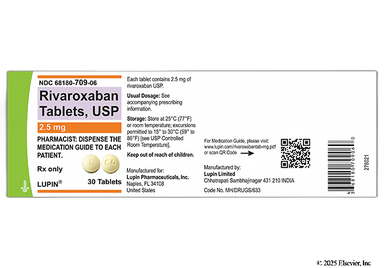
7 Ways to Save on Xarelto: Generic Option, Savings Card, And More
Xarelto (rivaroxaban) is a medication that helps prevent blood clots. Here’s how you can save on Xarelto with generic options, insurance, and savings cards.
Xarelto is a medication that treats blood clots in kids and adults. Learn about Xarelto dosages and making adjustments here.
Xarelto Dosages for Kids and Adults: Your GoodRx Guide
Xarelto is a medication that treats blood clots in kids and adults. Learn about Xarelto dosages and making adjustments here.
What to know about Xarelto interactions and how they may impact on your health.
St. John’s Wort, Paxlovid, and More: 8 Xarelto Interactions to Be Aware Of
What to know about Xarelto interactions and how they may impact on your health.
Deep vein thrombosis causes blood clots to form, normally in the leg. Learn more about the treatments used to ease and prevent this condition.
What Are the Best Deep Vein Thrombosis (DVT) Treatments and Medications?
Deep vein thrombosis causes blood clots to form, normally in the leg. Learn more about the treatments used to ease and prevent this condition.
Blood thinners like Eliquis and Xarelto are the preferred drug of choice for treating atrial fibrillation (AFib). Learn about how they work, plus other alternatives, here.
Blood Thinners for Atrial Fibrillation (AFib): Which Is Best?
Blood thinners like Eliquis and Xarelto are the preferred drug of choice for treating atrial fibrillation (AFib). Learn about how they work, plus other alternatives, here.
You can exercise on blood thinners. In fact, it’s often encouraged. But it’s important to take some precautions. Learn more with GoodRx.
Curious About Exercising on Blood Thinners? Here Are Answers to Common Questions
You can exercise on blood thinners. In fact, it’s often encouraged. But it’s important to take some precautions. Learn more with GoodRx.
images-icon

Xarelto (rivaroxaban) images

Yellow Round J 7 - Rivaroxaban 2.5mg Tablet
This medicine is Yellow, Round Tablet Imprinted With "J 7".Yellow Round J 7 - Rivaroxaban 2.5mg Tablet
Yellow Round J 7 - Rivaroxaban 2.5mg Tablet
This medicine is Yellow, Round Tablet Imprinted With "J 7".Yellow Round J 7 - Rivaroxaban 2.5mg Tablet
Yellow Round 2.5 - Rivaroxaban 2.5mg Tablet
This medicine is Yellow, Round Tablet Imprinted With "2.5".Yellow Round 2.5 - Rivaroxaban 2.5mg Tablet
Yellow Round 2.5 - Rivaroxaban 2.5mg Tablet
This medicine is Yellow, Round Tablet Imprinted With "2.5".Yellow Round 2.5 - Rivaroxaban 2.5mg Tablet
Beige Round 513 - Rivaroxaban 2.5mg Tablet
This medicine is Beige, Round Tablet Imprinted With "513".Beige Round 513 - Rivaroxaban 2.5mg Tablet
Beige Round 513 - Rivaroxaban 2.5mg Tablet
This medicine is Beige, Round Tablet Imprinted With "513".Beige Round 513 - Rivaroxaban 2.5mg Tablet
Yellow Round 2.5 And Logo - Rivaroxaban 2.5mg Tablet
This medicine is Yellow, Round Tablet Imprinted With "2.5" And "Logo".Yellow Round 2.5 And Logo - Rivaroxaban 2.5mg Tablet
Yellow Round 2.5 And Logo - Rivaroxaban 2.5mg Tablet
This medicine is Yellow, Round Tablet Imprinted With "2.5" And "Logo".Yellow Round 2.5 And Logo - Rivaroxaban 2.5mg Tablet
Orange Round 2.5 And M - Rivaroxaban 2.5mg Tablet
This medicine is Orange, Round Tablet Imprinted With "2.5" And "M".Orange Round 2.5 And M - Rivaroxaban 2.5mg Tablet
Orange Round 2.5 And M - Rivaroxaban 2.5mg Tablet
This medicine is Orange, Round Tablet Imprinted With "2.5" And "M".Orange Round 2.5 And M - Rivaroxaban 2.5mg Tablet
Yellow Round R 2.5 - Rivaroxaban 2.5mg Tablet
This medicine is Yellow, Round Tablet Imprinted With "R 2.5".Yellow Round R 2.5 - Rivaroxaban 2.5mg Tablet
Yellow Round 9 And C - Rivaroxaban 2.5mg Tablet
This medicine is Yellow, Round Tablet Imprinted With "C" And "9".Yellow Round 9 And C - Rivaroxaban 2.5mg Tablet
Yellow Round 9 And C - Rivaroxaban 2.5mg Tablet
This medicine is Yellow, Round Tablet Imprinted With "C" And "9".Yellow Round 9 And C - Rivaroxaban 2.5mg Tablet
Yellow Round C4 And L - Rivaroxaban 2.5mg Tablet
This medicine is Yellow, Round Tablet Imprinted With "C4" And "L".Yellow Round C4 And L - Rivaroxaban 2.5mg Tablet
Yellow Round C4 And L - Rivaroxaban 2.5mg Tablet
This medicine is Yellow, Round Tablet Imprinted With "C4" And "L".Yellow Round C4 And L - Rivaroxaban 2.5mg Tablet
Yellow Round 7C - Rivaroxaban 2.5mg Tablet
This medicine is Yellow, Round Tablet Imprinted With "7C".Yellow Round 7C - Rivaroxaban 2.5mg Tablet
Yellow Round 7C - Rivaroxaban 2.5mg Tablet
This medicine is Yellow, Round Tablet Imprinted With "7C".Yellow Round 7C - Rivaroxaban 2.5mg Tablet
Beige Round 513 - Rivaroxaban 2.5mg Tablet
This medicine is Beige, Round Tablet Imprinted With "513".Beige Round 513 - Rivaroxaban 2.5mg Tablet

Get savings updates for Xarelto (rivaroxaban)

Receive price alerts, news, and other messages from GoodRx about Xarelto (rivaroxaban) and other healthcare topics and relevant savings offers.

By providing your email, you consent to receive marketing communications from GoodRx, which may include content and/or data related to men's health, women's health, reproductive care, or sexual health. You agree to the GoodRx Terms of Use and acknowledge the Privacy Policy. You can unsubscribe at any time.

References

Best studies we found

Brown, M. A., et al. (2013). Coagulation factor Xa. Handbook of Proteolytic Enzymes.

Janssen Pharmaceuticals, Inc. (2025). Xarelto- rivaroxaban tablet, film coated; rivaroxaban tablet, film coated; rivaroxaban kit; rivaroxaban granule, for suspension [package insert]. DailyMed.

Khairat, A., et al. (2023). Epidural Hematoma. StatPearls.

GoodRx Health has strict sourcing policies and relies on primary sources such as medical organizations, governmental agencies, academic institutions, and peer-reviewed scientific journals. Learn more about how we ensure our content is accurate, thorough, and unbiased by reading our editorial guidelines.

Was this page helpful?