Used for Psoriatic Arthritis, Rheumatoid Arthritis
Used for Psoriatic Arthritis, Rheumatoid Arthritis
Orencia (abatacept) is an injectable biologic medication used for different types of autoimmune arthritis (joint inflammation), including rheumatoid arthritis (RA) and psoriatic arthritis (PsA). It's given as an injection under the skin once a week or as an infusion through the veins (IV) in the clinic once a month. Common side effects include infection, headache, and dizziness.
Orencia (abatacept) is a biologic disease-modifying anti-rheumatic drug (DMARD). It blocks certain proteins and processes in cells, which lowers inflammation. This prevents specific types of arthritis from getting worse.
The following side effects may get better over time as your body gets used to the medication. Let your healthcare provider know immediately if you continue to experience these symptoms or if they worsen over time.
Common Side Effects
Headache (18%)
Sore throat, runny nose, or other cold-like symptoms (12%)
Dizziness (9%)
Cough (8%)
Back pain (7%)
High blood pressure (7%)
Upset stomach (6%)
Pain while urinating and other symptoms of an urinary tract infection (6%)
Please note: The side effects above were reported by adults who received Orencia (abatacept) for rheumatoid arthritis. The side effects you experience might be different if you're taking Orencia (abatacept) for a different condition or if you're injecting it under the skin.
Less Common Side Effects
Rash
Pain in the hands and feet
Orencia (abatacept) serious side effects
Contact your healthcare provider immediately if you experience any of the following.
The following Orencia (abatacept) side effects have also been reported
Along with its needed effects, a medicine may cause some unwanted effects. Although not all of these side effects may occur, if they do occur they may need medical attention.
Check with your doctor or nurse immediately if any of the following side effects occur:
large, hive-like swelling on the face, eyelids, lips, tongue, throat, hands, legs, feet, or sex organs
sores, welts, blisters
Some side effects may occur that usually do not need medical attention. These side effects may go away during treatment as your body adjusts to the medicine. Also, your health care professional may be able to tell you about ways to prevent or reduce some of these side effects. Check with your health care professional if any of the following side effects continue or are bothersome or if you have any questions about them:
More common
Belching
bleeding, blistering, burning, coldness, discoloration of the skin, feeling of pressure, hives, infection, inflammation, itching, lumps, numbness, pain, rash, redness, scarring, soreness, stinging, swelling, tenderness, tingling, ulceration, or warmth at the injection site
Clinic infusions are available for people who don't like to give themselves injections and are generally given only once a month
SQ injections are given once weekly and IV infusions are given once monthly
Cons
Raises your risk for infections because it weakens your immune system
Can't be used with other biologic medications because higher risk of infection
Can take 3 to 6 months to notice an improvement in your symptoms (for arthritis)
Only treats the symptoms and isn't a cure for inflammatory problems
Pharmacist tips for Orencia (abatacept)
Make sure to mark your appointments on your calendar to see your provider and receive your Orencia (abatacept) dose if you're receiving it as an IV infusion. This will help make sure you're properly being monitored and won't miss any doses.
If you're receiving the Orencia (abatacept) IV infusion, let your provider know if you have diabetes and check your blood sugar at home. This is because Orencia (abatacept) can interfere with certain blood sugar test strips, which can cause falsely high blood sugar readings.
Tips for using the Orencia (abatacept) prefilled syringes or autoinjectors at home:
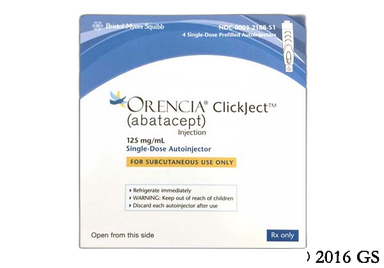
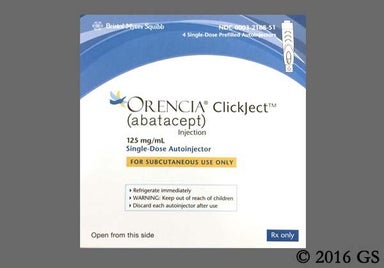
Your provider will likely have you give yourself your first dose of Orencia (abatacept) in their office or clinic to make sure you know how to give yourself the medication correctly. Refer to the instructions for use for the prefilled syringe or the ClickJect Autoinjector and contact your provider or pharmacist if you have any questions.
Store Orencia (abatacept) prefilled syringes or autoinjectors in the refrigerator and in its original packaging to protect it from light. When it's time for your dose, take a dose out of the refrigerator and lay it on a flat surface to warm up to room temperature. This will take about 30 minutes. Don't try to warm up the medication any other way (e.g., microwave, under hot water) because you might damage it.
Before you inject Orencia (abatacept), always check to make sure the liquid is clear and colorless to a pale yellow. If your medication is cloudy, discolored, or has specks floating in it, don't use it. Contact your provider or pharmacist to get a replacement.
Inject Orencia (abatacept) under the skin in the front of your middle thighs, lower part of your stomach, or your outer upper arms if someone else is giving you the injection. If you choose to inject into the stomach, inject 2 inches away from your belly button. Never inject into a muscle or vein.
To lower the risk of bruising and irritation, rotate between different injection sites each time so that the same area isn't used repeatedly. Don't inject Orencia (abatacept) into skin that's tender, red, bruised, scaly, hard, or has scars or stretch marks.
Throw away used syringes and needles in a sharps container or something made of heavy-duty plastic (e.g., empty milk carton, laundry detergent bottle) to lower the risk of needlestick injuries. Don't throw them away in your trash can.
Each Orencia (abatacept) prefilled syringe and autoinjector provides a single dose of medication. You must throw away any leftover medication after each use, even if there's still some remaining in the syringe.
Risks and warnings for Orencia (abatacept)
Orencia (abatacept) can cause some serious health issues. This risk may be even higher for certain groups. If this worries you, talk to your doctor or pharmacist about other options.
Risk of serious infections
Risk factors: Active, chronic (long-term), or recurrent infection | Other conditions that raise your risk of infection | Taking medications that weaken your immune system
Orencia (abatacept) can make it more difficult for your body to fight off infections. This raises your risk of bacterial, viral, or fungal infections. The risk is higher for people who are taking or have recently taken other medications that weaken the immune system. Additionally, Orencia (abatacept) might reactivate (wake up) certain viruses that are already in your body, such as tuberculosis (TB) or hepatitis B. If you develop an infection, your provider will likely ask you to stop taking Orencia (abatacept) until your body fights off the infection. Let your provider know if you experience symptoms of these infections, such as fever, cough, difficulty breathing, or weakness.
Severe allergic reactions
Severe allergic reactions to Orencia (abatacept) are possible, including life-threatening reactions like facial swelling, shock, and anaphylaxis (closing of the throat). If you notice dizziness, a choking sensation, nausea, swelling around your eyes, swelling of the lips or tongue, or difficulty breathing after using Orencia (abatacept), get medical attention right away.
Vaccines
There's limited information available on the effects of Orencia (abatacept) on your body's response to vaccines, including live vaccines. Make sure your shots are up-to-date before starting Orencia (abatacept). Talk with your prescriber before you receive any vaccines while receiving Orencia (abatacept) treatment. Avoid getting live vaccines while you're taking Orencia (abatacept), and for at least 3 months after the last dose, because there's a risk that you can get sick from them.
Worsening breathing problems
In clinical trials, adults with chronic obstructive pulmonary disease (COPD) who were treated with Orencia (abatacept) had more COPD-related side effects. If you have COPD, make sure you monitor your symptoms, such as shortness of breath and cough. Let your provider know if they get worse while taking Orencia (abatacept).
Falsely high blood sugars
Risk factors: Using Orencia (abatacept) IV infusion | Type 1 or type 2 diabetes | Using insulin | Using glucose meters that use GDH-PQQ
The Orencia (abatacept) IV infusion contains maltose, which is a type of sugar that can cause your blood sugar readings to be falsely high if you use certain blood sugar monitors that use a substance called GDH-PQQ to detect blood sugar. This raises your risk for low blood sugar (hypoglycemia) if you give yourself insulin to correct this falsely high blood sugar. Contact your local pharmacist or the manufacturer of the glucose monitor test you use if you're not sure if it can be used with products that have maltose in them.
Orencia (abatacept) dosage
The average cost for 1 carton of 4 clickject autoinjectors of 125mg/ml of Orencia (abatacept) is $5,539.00 with a free GoodRx coupon. This is 25.50% off the average retail price of $7,434.83.
Rheumatoid arthritis and psoriatic arthritis in adults
Intravenous (IV): Your provider will calculate the dose based on your body weight. The typical dose ranges from 500 mg to 1,000 mg infused IV every 2 weeks for 3 doses, then every month after that.
Under the skin injection: The typical dose is 125 mg injected under the skin once weekly.
Juvenile idiopathic arthritis
Intravenous (IV): Your child's provider will calculate the dose based on their body weight. The typical dose is 10 mg/kg infused IV every 2 weeks for 2 doses, then every month after that. Children weighing 75 kg or more will be given the adult dose for arthritis.
Under the skin injection: Your child's provider will calculate the dose based on your child's body weight. The typical dose is injected under the skin once weekly.
Children weighing 10 kg to less than 25 kg: 50 mg
Children weighing 25 kg to less than 50 kg: 87.5 mg
Children weighing 50 kg or more: 125 mg
Prevention graft-versus-host disease
Your provider will calculate the dose based on your body weight and age. The typical dose ranges from 10 mg/kg to 15 mg/kg infused through the veins the day before transplant, then on Day 5, 14, and 28 after transplant.
Interactions between Orencia (abatacept) and other drugs
Orencia (abatacept) may interact with certain medications or supplements. Always let your doctor and pharmacist know about any other medications or supplements (including prescribed and over-the-counter medications, vitamins, and dietary or herbal supplements) that you are currently taking. The list below does not include all possible drug interactions with Orencia (abatacept). Please note that only the generic name of each medication is listed below.
Although certain medicines should not be used together at all, in other cases two different medicines may be used together even if an interaction might occur. In these cases, your doctor may want to change the dose, or other precautions may be necessary. When you are taking this medicine, it is especially important that your healthcare professional know if you are taking any of the medicines listed below. The following interactions have been selected on the basis of their potential significance and are not necessarily all-inclusive.
Using this medicine with any of the following medicines is usually not recommended, but may be required in some cases. If both medicines are prescribed together, your doctor may change the dose or how often you use one or both of the medicines.
Using this medicine with any of the following medicines may cause an increased risk of certain side effects, but using both drugs may be the best treatment for you. If both medicines are prescribed together, your doctor may change the dose or how often you use one or both of the medicines.
Drugs and Lactation Database (LactMed). (2023). Abatacept. National Institute of Child Health and Human Development.
GoodRx Health has strict sourcing policies and relies on primary sources such as medical organizations, governmental agencies, academic institutions, and peer-reviewed scientific journals. Learn more about how we ensure our content is accurate, thorough, and unbiased by reading our editorial guidelines.
Prescription savings
Stop paying too much for your prescriptions. Compare prices, get pharmacy coupons, and save up to 80%.
In clinical studies of people with RA, those who received IV Orencia, sometimes along with other RA medications, typically started to feel better in about 3 to 6 months. But everyone responds differently to medications, so it's possible Orencia might work slower or faster for you. Contact your provider if you're not sure if Orencia is helping your symptoms.
If you've been taking Orencia for RA, it might take anywhere between over a month to close to 5 months for most of this medication to leave your body after you stop treatment. Keep in mind that this time frame is estimated based on the half-life of Orencia. It can also be affected by your health conditions, so it can be different for each individual person. Discuss with your healthcare provider if you have questions about how long the medication stays in your body.
No, Orencia isn't the same as methotrexate. Methotrexate is another medication that can prevent RA from worsening, but it works differently than Orencia. If you have RA, your provider might prescribe both medications to treat your symptoms. In fact, research shows that for people who still have RA symptoms with methotrexate, adding Orencia to the treatment might improve their symptoms. Talk with your provider if you've more questions about Orencia or methotrexate.
No, weight gain wasn't a reported side effect of Orencia during clinical trials.
No. While some people experience hair loss with some other arthritis medications, such as methotrexate or adalimumab (Humira), hair loss isn't a side effect reported by people who took Orencia in clinical trials.
There's limited research regarding whether Orencia is safe to take during pregnancy. Available data from animal studies show that Orencia didn't cause birth defects. But results in animal studies might not always apply to people. If you're pregnant or thinking of getting pregnant, talk to your provider about the risks and benefits of using Orencia.
There isn't much information about how Orencia might affect breastfeeding. A single report showed that very little of this medication gets into breast milk and doesn't cause side effects for the breastfed baby. But to be safe, don't breastfeed your baby while taking Orencia without talking to your provider first.
Orencia is a brand-name medication manufactured by Bristol-Myers Squibb. It's not available as a generic, so only Bristol-Myers Squibb produces it.Learn more