
Key takeaways:
Naproxen (Aleve, Naprosyn) and ibuprofen (Advil, Motrin) are nonsteroidal anti-inflammatory drugs (NSAIDs) that are available over the counter (OTC). They’re commonly used for pain and inflammation.
Naproxen and ibuprofen work in similar ways. They also have similar risks and side effects.
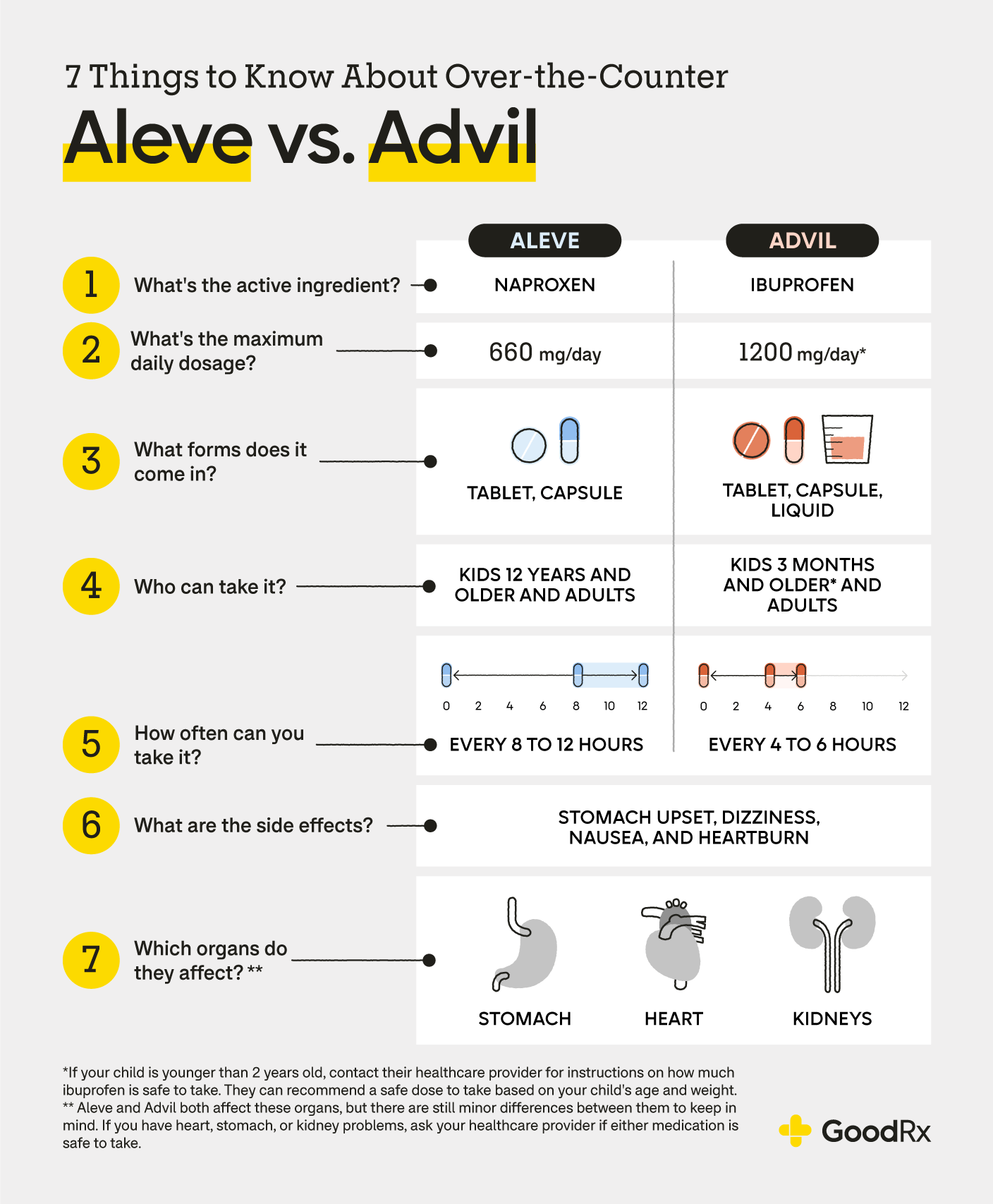
Naproxen and ibuprofen both start working for pain in about 30 minutes. But naproxen lasts longer than ibuprofen. One dose of naproxen lasts for up to 12 hours. You may need to take ibuprofen every 4 to 6 hours for continued relief.
Naproxen and ibuprofen are available OTC as brand-name and generic medications. If a healthcare professional writes you a prescription for one of them, GoodRx could help make your medication more affordable.
Save on related medications
Naproxen (Aleve, Naprosyn) and ibuprofen (Advil, Motrin) are two common medication choices for muscle aches, joint pain, and inflammation from conditions such as osteoarthritis. Like many other nonsteroidal anti-inflammatory drugs (NSAIDs), both are also readily available over the counter (OTC) in pharmacy and retail store aisles. So when it comes to naproxen versus ibuprofen, how do they compare? Let’s take a look at seven factors to keep in mind.
1. Naproxen and ibuprofen work similarly
Naproxen and ibuprofen are NSAIDs. They work in similar ways to relieve pain and inflammation.
Both medications block an enzyme (protein) called cyclooxygenase in the body. This protein helps create certain chemicals that contribute to inflammation. By blocking cyclooxygenase, NSAIDs such as naproxen and ibuprofen reduce the amount of those inflammatory chemicals.
Search and compare options
Ibuprofen or naproxen can be used to treat several symptoms and conditions, including:
Fever
Muscle or joint pain
Headaches or migraines
Osteoarthritis pain
Certain autoimmune disorders, such as rheumatoid arthritis
2. Naproxen and ibuprofen come in OTC and prescription versions
Naproxen and ibuprofen are readily available OTC at lower doses. But higher doses are also available with a prescription. OTC naproxen and ibuprofen are meant for self-treating fever or mild aches and pains. The prescription forms are intended for moderate pain relief or managing chronic conditions.
Keep in mind that in some cases healthcare professionals will tell people to take OTC naproxen or ibuprofen at prescription doses. You shouldn’t do this on your own. If you’re self-treating, be sure to follow the instructions on your product’s OTC label.
The table below highlights the available OTC and prescription versions of naproxen and ibuprofen.
| Brand names | OTC dosage forms | Prescription dosage forms | |
|---|---|---|---|
| Naproxen | OTC brand name: Aleve Prescription brand names: Anaprox DS, Naprelan, Naprosyn |
Immediate-release tablets:
Delayed-release tablets:
Extended-release tablets:
125 mg/5 mL oral suspension (liquid) | |
| Ibuprofen | OTC brand names: Advil, Motrin There is no longer a prescription brand-name version available. |
|
|
Good to know: Naproxen and ibuprofen are common active ingredients included in many prescription and OTC combination products. These products can help with multiple types of symptoms. Examples include Sudafed Pressure and Pain (naproxen / pseudoephedrine) for cold symptoms and Advil Dual Action (acetaminophen / ibuprofen) for pain.
3. Naproxen and ibuprofen both start working within about 30 minutes
Both naproxen and ibuprofen work quickly to address symptoms. With either, you may notice pain relief as soon as 30 minutes after a dose, but it could take a few hours to feel the full effects.
However, keep in mind that lessening chronic inflammation takes longer than improving pain. So if you're taking ibuprofen or naproxen to treat a condition such as rheumatoid arthritis, improvement in symptoms like warmth in the joints and swelling may take a couple of weeks.
4. Naproxen lasts longer than ibuprofen
Naproxen stays active up to 12 hours in the body. So, for full 24-hour coverage, you only need to take naproxen twice a day (about every 12 hours). There’s also an extended-release version of naproxen that is available by prescription only and lasts an entire day.
Ibuprofen, on the other hand, is shorter-acting. Its effects last about 4 to 6 hours in the body, so you have to take it every 4 to 6 hours to experience all-day coverage.

Read more like this
Explore these related articles, suggested for readers like you.



5. Ibuprofen is usually preferred for children under age 12
If you look at the label of OTC packages of naproxen and ibuprofen, you’ll notice a difference in the recommended dosage section. Some OTC ibuprofen products provide dosages for children as young as 6 months old. But OTC naproxen labels only provide instructions for people ages 12 and older.
This is partially because ibuprofen has been studied more than naproxen in children under age 12. Though, in some cases, your child’s pediatrician may recommend naproxen.
Often, the primary reason ibuprofen is the go-to NSAID for kids is because of the available dosage forms. For kids under age 12, the recommended dosages for naproxen and ibuprofen are based on body weight. And it’s much easier to give an appropriate dose of OTC ibuprofen because it comes as an oral liquid and chewable tablet. Liquid naproxen is available by prescription only. And naproxen chewable tablets aren’t commercially available at all.
6. Naproxen and ibuprofen have similar side effects
Because naproxen and ibuprofen are both NSAIDs, they have similar side effects and risks. Common side effects include:
Upset stomach
Nausea
Heartburn
Dizziness
Fluid buildup and swelling
Less common, but more severe, side effects include:
Increased risk of heart attack
7. Naproxen and ibuprofen affect similar organs
While naproxen and ibuprofen share similar risks overall, there are a few notable differences. Below, we’ll explore stomach, kidney, and heart-related risks of NSAIDs and whether naproxen or ibuprofen is preferred in certain situations.
Does naproxen or ibuprofen come with a higher risk of ulcers and bleeding?
Ibuprofen may carry a lower risk of causing ulcers and gastrointestinal (GI) bleeding compared to naproxen. Still, these risks are possible with all NSAIDs. That’s why it’s best to take the lowest effective dose and avoid using NSAIDs long term when possible.
If you have to take an NSAID for more than a few days, talk to your prescriber or pharmacist. They may recommend taking a proton pump inhibitor (PPI) medication along with your NSAID to help protect your upper GI tract, which includes the stomach and upper part of the small intestine. Examples of PPIs include omeprazole (Prilosec) and pantoprazole (Protonix).
Some studies, however, show that taking an NSAID and PPI can increase your risk of problems in the lower part of your GI tract. This could mean issues with your intestines or rectum.
Depending on your overall risk of GI problems, your prescriber can let you know if they recommend taking a PPI with your NSAID.
Is naproxen or ibuprofen worse for the kidneys?
If taken occasionally and as directed, NSAIDs are generally safe. But NSAIDs can cause acute kidney injury. And your risk may be higher if you:
Are age 65 or older
Take diuretics (water pills) with an angiotensin-converting enzyme (ACE) inhibitor, such as lisinopril (Zestril, Qbrelis), or an angiotensin II receptor blocker (ARB), such as losartan (Cozaar)
Have preexisting kidney or liver problems, heart failure, or another chronic condition where blood flow is reduced
Some research shows that ibuprofen may have a lower risk of causing kidney problems than naproxen. But kidney damage is possible with any NSAID.
Is naproxen or ibuprofen worse for the heart?
Although all NSAIDs — except aspirin — can increase your risk of heart attack or stroke, the overall risk is low. And data is conflicting on whether one NSAID carries a greater risk of contributing to a cardiovascular event than others.
Some research suggests that naproxen has a lower risk of causing heart attacks than other NSAIDs. In one analysis of several studies, for example, even high-dose naproxen didn’t increase the risk of heart attack or death in people with existing heart problems. But another analysis of several studies showed that all NSAIDs increase the risk of heart attack, especially with higher daily doses. The likelihood of experiencing a heart attack was highest in the first 30 days of starting an NSAID.
So what does this mean for you? If you have existing heart disease or risk factors for heart disease, it’s a good idea to be more cautious when taking NSAIDs. And under any circumstances, you should try to use the lowest effective dose for the shortest amount of time possible.
How to save on naproxen or ibuprofen
Naproxen and ibuprofen are both available as brand-name OTC pain relievers. They also both have generic options, which can help you save money. And if a healthcare professional writes you a prescription for naproxen or ibuprofen, GoodRx could help you save money, too.
The price for 30 tablets of OTC naproxen 220 mg at certain pharmacies may be as low as $9.87 with a free GoodRx discount. The price for 30 tablets of OTC ibuprofen 200 mg at certain pharmacies may be as low as $8.86 with a free GoodRx discount.
Frequently asked questions
Naproxen and ibuprofen work similarly well to treat pain and inflammation. One is not considered “stronger” than the other. But you may find that one works better for you. The choice between naproxen and ibuprofen may come down to how frequently you need to take the medication, your age, and personal preference.
No, you shouldn’t take ibuprofen and naproxen together. Both medications are NSAIDs and work in similar ways. Combining them doesn’t have any added benefit, but it raises your risk of side effects. This includes serious side effects, such as kidney damage and GI bleeding. Acetaminophen (Tylenol) is a safer option to combine with ibuprofen or naproxen.
Check with your healthcare team before taking NSAIDs, including naproxen and ibuprofen, if you:
Have kidney disease
Have heart disease, heart failure, or other cardiovascular problems
Are pregnant
Are age 65 or older
Have a history of stomach ulcers or bleeding
Take blood thinners, such as warfarin (Coumadin, Jantoven)
Have Type 2 diabetes
Have inflammatory bowel disease
These aren’t the only reasons you may not be able to take naproxen or ibuprofen. Check with a healthcare professional before taking either medication, even though they’re available OTC.
Naproxen and ibuprofen work similarly well to treat pain and inflammation. One is not considered “stronger” than the other. But you may find that one works better for you. The choice between naproxen and ibuprofen may come down to how frequently you need to take the medication, your age, and personal preference.
No, you shouldn’t take ibuprofen and naproxen together. Both medications are NSAIDs and work in similar ways. Combining them doesn’t have any added benefit, but it raises your risk of side effects. This includes serious side effects, such as kidney damage and GI bleeding. Acetaminophen (Tylenol) is a safer option to combine with ibuprofen or naproxen.
Check with your healthcare team before taking NSAIDs, including naproxen and ibuprofen, if you:
Have kidney disease
Have heart disease, heart failure, or other cardiovascular problems
Are pregnant
Are age 65 or older
Have a history of stomach ulcers or bleeding
Take blood thinners, such as warfarin (Coumadin, Jantoven)
Have Type 2 diabetes
Have inflammatory bowel disease
These aren’t the only reasons you may not be able to take naproxen or ibuprofen. Check with a healthcare professional before taking either medication, even though they’re available OTC.
The bottom line
When comparing naproxen (Aleve, Naprosyn) versus ibuprofen (Advil, Motrin), there are multiple factors to consider. They’re similarly effective and safe. And they both can start working within 30 minutes. But naproxen lasts for up to 12 hours, while ibuprofen only lasts about 4 to 6 hours. Both medications are available in over-the-counter and prescription forms.
Naproxen and ibuprofen can both cause side effects like nausea, upset stomach, and heartburn. While rare, they can also cause more severe side effects, such as stomach bleeding, heart problems, and kidney damage. Taking the lowest dose of naproxen or ibuprofen for the shortest amount of time possible can help decrease the risk of side effects from the medication.

Why trust our experts?




References
A-S Medication Solutions. (2026). Naproxen - naproxen tablet [package insert].
Acella Pharmaceuticals. (2026). Naproxen suspension [package insert]. DailyMed.
American Sales Company. (2025). CareOne Ibuprofen Children’s - ibuprofen suspension [package insert]. DailyMed.
Angiolillo, D. J., et al. (2017). Clinical pharmacology and cardiovascular safety of naproxen. American Journal of Cardiovascular Drugs.
Arthritis Foundation. (n.d.). NSAIDs.
Aurobindo Pharma. (2025). Ibuprofen tablet [package insert]. DailyMed.
Aurobindo Pharma. (2025). Naproxen tablet, delayed release [package insert]. DailyMed.
Bally, M., et al. (2017). Risk of acute myocardial infarction with NSAIDs in real world use: Bayesian meta-analysis of individual patient data. BMJ.
Bayer HealthCare. (2025). Aleve caplets - naproxen sodium tablet [package insert]. DailyMed.
Bayer HealthCare. (2025). Aleve - naproxen sodium capsule, liquid filled [package insert]. DailyMed.
Castellsague, J., et al. (2012). Individual NSAIDs and upper gastrointestinal complications: A systematic review and meta-analysis of observational studies (the SOS project). Drug Safety.
Dangi-Garimella, S. (2015). FDA warning on NSAIDs: Consider the risk-benefit ratio, advise experts. American Journal of Managed Care.
De Martino, M., et al. (2017). Working towards an appropriate use of ibuprofen in children: An evidence-based appraisal. Drugs.
Drożdżal, S., et al. (2021). Kidney damage from nonsteroidal anti-inflammatory drugs — myth or truth? Review of selected literature. Pharmacology Research & Perspectives.
Ghlichloo, I., et al. (2023). Nonsteroidal anti-inflammatory drugs (NSAIDs). StatPearls.
Gwee, K. A., et al. (2018). Coprescribing proton-pump inhibitors with nonsteroidal anti-inflammatory drugs: Risks versus benefits. Journal of Pain Research.
Haleon US Holdings. (2024). Junior Strength Advil - ibuprofen tablet, coated [package insert]. DailyMed.
Haleon US Holdings. (2025). Advil - ibuprofen capsule, liquid filled [package insert]. DailyMed.
Haleon US Holdings. (2025). Advil - ibuprofen sodium tablet, coated [package insert]. DailyMed.
Hopkins, S., et al. (2025). Choosing a nonsteroidal anti-inflammatory drug for pain. Australian Prescriber.
Kenvue Brands. (2025). Children’s Motrin - ibuprofen tablet, chewable [package insert]. DailyMed.
Kenvue Brands. (2025). Infants’ Motrin - ibuprofen suspension/drops [package insert]. DailyMed.
Ray, W. A., et al. (2009). Cardiovascular risks of nonsteroidal antiinflammatory drugs in patients after hospitalization for serious coronary heart disease. Circulation: Cardiovascular Quality and Outcomes.
Upsher-Smith Laboratories. (2026). Naprelan - naproxen sodium tablet, film coated, extended release [package insert]. DailyMed.
Wan, E. Y. F., et al. (2021). Comparative risks of nonsteroidal anti-inflammatory drugs on CKD. Clinical Journal of the American Society of Nephrology.