
Key takeaways:
Allergy medicines, such as corticosteroid (steroid) nasal sprays, are the first-choice treatment for people with persistent allergy symptoms. Some of them take time to work, while others have a faster onset.
Consider several factors when selecting an allergy medication, including your symptoms, how quickly you need relief, and side effects.
Antihistamines, a popular class of allergy medicines, can cause drowsiness. But some have fewer sedating effects.
There are ways to save on your allergy medications. Many options are available over the counter and as lower-cost generics. GoodRx can help make your medication more affordable.
Save on related medications
Sneezing, runny nose, and itchy eyes — these are all telltale signs of allergies. And whether you have them seasonally or year-round, they can make you feel pretty miserable. Allergy medicine can help keep your symptoms in check.
But with so many choices, there’s a chance you could be taking the wrong one and not getting enough allergy relief. Here are some questions to consider before popping more allergy pills. This way, you can find one that best meets your needs.
What are the best allergy medicines to take?
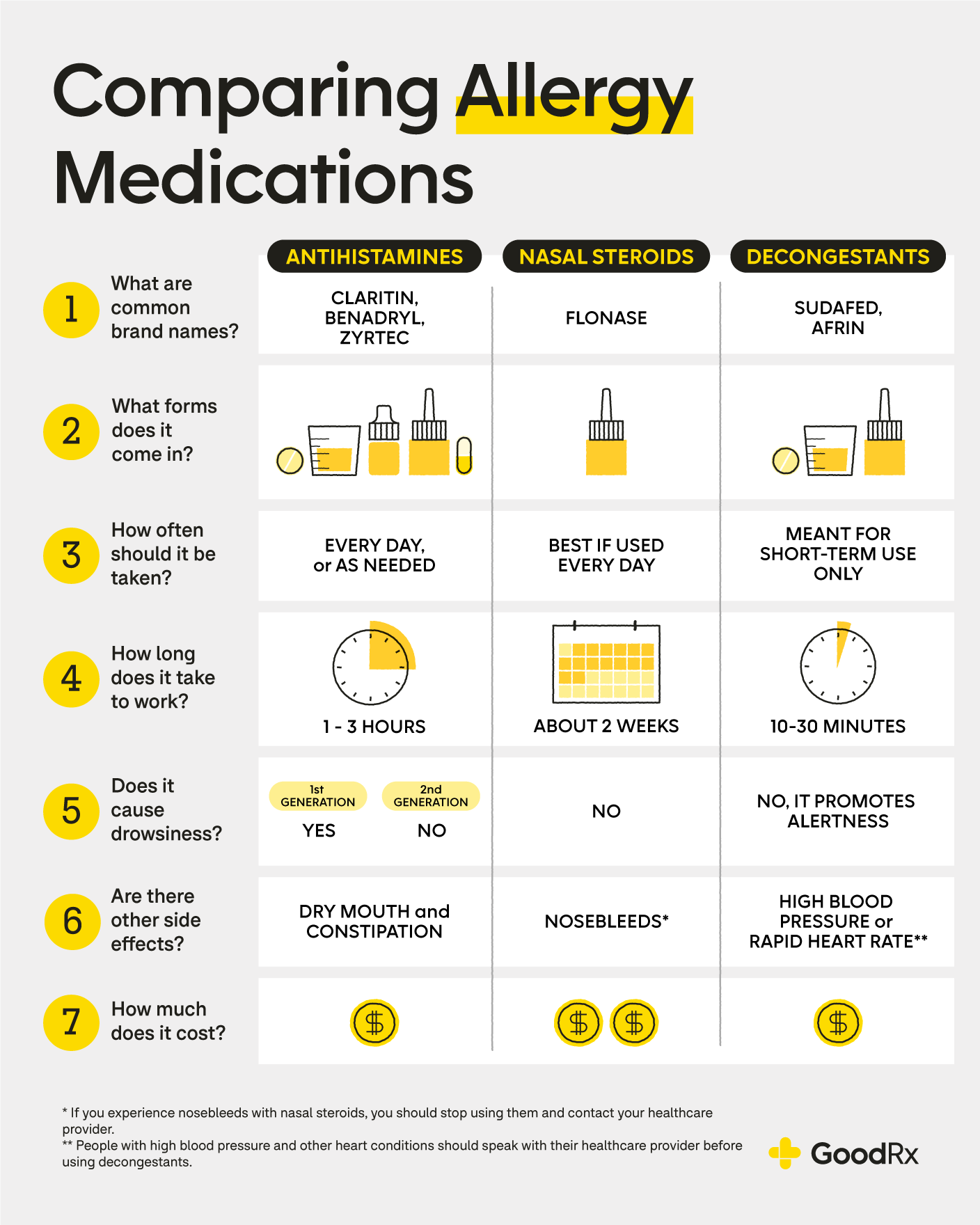
Depending on how long your allergy symptoms last, certain allergy medicines will likely work better than others. Here are the four most common kinds of allergy medicines people use.
Promotion Disclosure: GoodRx provides visitors with access to select third party offers. The placement of these offers is managed independently from our editorial coverage. GoodRx may receive compensation if you engage with an offer, but making an offer available does not influence the content our editorial staff provides. At GoodRx Health, providing accurate and trusted information and resources is our first priority. Article and video content is written and reviewed by our editorial staff with medical, healthcare policy and pricing experience. GoodRx does not endorse or recommend any product or service in connection with providing access to an offer.
Antihistamines
If your allergies only appear sporadically — say, when the pollen count is high or you have that random encounter with your friend’s cat — oral antihistamines may be your best bet. Many of these are readily available over the counter (OTC). And they typically start working within a few hours of your first dose.
Examples of oral OTC antihistamines include:
Benadryl (diphenhydramine)
Claritin (loratadine)
Allegra (fexofenadine)
Zyrtec (cetirizine)
Xyzal (levocetirizine)
There’s also an OTC antihistamine nasal spray available: Astepro (azelastine). It works much faster than oral antihistamines — within 15 to 30 minutes. And some studies have found that antihistamine nasal sprays may work better than antihistamine pills for nasal allergy symptoms, such as congestion.
Is there a “strongest” oral antihistamine? Not really. However, a review of multiple studies suggests that Allegra may work better for eye-related symptoms and Xyzal may help with sneezing and nasal itching more than others. Claritin seems to be slightly less effective overall.
Histamine is a chemical our immune system releases when we come into contact with something we’re allergic to. It then triggers allergy symptoms, such as a runny nose or itchy eyes. Antihistamines work by blocking areas of your body where histamine would normally attach to cause these symptoms.
While some people take antihistamines as needed for allergy symptoms, daily use is expert-recommended and may be an option for people looking to prevent symptoms.
In the case of seasonal allergies, you can take antihistamines before you’re exposed to an allergy trigger — such as pollen. Starting the medication at least 2 weeks before allergy season typically begins can help you get the best results. This can be particularly helpful if you have frequent or persistent seasonal allergy symptoms.
Steroid nasal sprays
If you experience daily or year-round allergies, you’ll want to look into corticosteroid (steroid) nasal sprays. They can also be helpful if your seasonal allergy symptoms tend to last for several weeks or months. Experts recommend trying steroid nasal sprays before other allergy medicines, as they tend to be the most effective option.
OTC steroid nasal sprays include:
Nasacort (triamcinolone)
Flonase Allergy Relief (fluticasone propionate)
Flonase Sensimist (fluticasone furoate)
Rhinocort (budesonide)
Nasonex (mometasone)
As with antihistamines, there’s no “strongest” steroid nasal spray. However, a review of multiple studies suggests that Nasonex may be the most effective for seasonal allergies. The same review found Rhinocort to be the most effective for year-round allergies.
Steroid nasal sprays generally take longer to work than antihistamines. But healthcare professionals consider them to be the most effective for keeping nasal allergy symptoms in check over time. As a group, they may also be more effective at preventing nasal congestion compared with oral antihistamines.
Here’s how they’re thought to work: When you have allergies, a complicated series of reactions occurs in your immune system between the moment you sense an allergen and when you get that runny nose. Steroid nasal sprays act early on in these reactions — even before histamine is made — and prevent the processes that lead to a full-blown allergic response.
Decongestants
Decongestants help improve symptoms by relieving nasal and sinus congestion. They typically work quicker than other allergy medicines. This makes them an attractive option for fast relief.
Decongestants available without a prescription include:
Sudafed (pseudoephedrine), which is kept behind the pharmacy counter
Afrin (oxymetazoline)
Neo-Synephrine (phenylephrine nasal spray)
Some allergy medicines, such as Allegra-D (fexofenadine / pseudoephedrine) and Claritin-D (loratadine / pseudoephedrine), combine both decongestants and antihistamines into the same pill so that they can target congestion and other allergy symptoms at the same time.
Decongestants can help you breathe a little easier if you’re stuffed up, but you shouldn’t take them long term. Also, it’s important to know that decongestant nasal sprays, such as Afrin, can make your congestion worse if they’re used for more than a few days (called rebound congestion). So it’s best to use them sparingly.
You also shouldn’t take oral decongestants, such as Sudafed, if you have certain heart conditions, including high blood pressure. If you have these health conditions, talk to a pharmacist or other healthcare professional first before giving them a try.
Mast cell stabilizers
Mast cell stabilizers are another allergy medicine option. But they’re not a good option for quick relief, as they take longer to start working. NasalCrom (cromolyn sodium nasal spray) is the only OTC mast cell stabilizer nasal spray available.
Mast cell stabilizers work by preventing certain cells (called mast cells) from releasing histamine. They’re generally less effective than other allergy medicines, especially for seasonal allergies. But they could be an option if you have year-round allergies. And they’re considered one of the safest allergy medicines to use during pregnancy.
What is the best allergy medicine?
The short answer is — it depends. There are a few things to consider when selecting the right allergy medicine for you:
How quickly you need relief
How long the medication lasts
Your symptoms
Side effects
Cost
Fast-acting medications, such as decongestants and antihistamines, work quickly if you’re experiencing symptoms. But while you can take antihistamines daily, you should only take decongestants as needed in the short term.
Antihistamines and steroid nasal sprays can be good options for preventing symptoms if taken daily starting before allergy season hits. The American Academy of Allergy, Asthma & Immunology recommends steroid nasal sprays as the first-choice treatment for people with persistent symptoms. If your symptoms only happen every now and then, an oral or intranasal antihistamine would be a good first choice.
Keep in mind that not all antihistamines are created equal — certain ones have a higher risk of drowsiness. But all antihistamines can potentially make you sleepy. So it’s best to see how you respond to them before engaging in activities that require alertness or concentration.
Allergy medicines at a glance
The table below shows what each type of allergy medicine works best for and how each one works.
| Allergy medicine types | Example brand names | Best for | How they work |
|---|---|---|---|
| Antihistamines |
|
|
Block histamine (a chemical that causes allergy symptoms) |
| Steroid nasal sprays |
|
|
Calm immune system reactions that contribute to allergy symptoms |
| Decongestants |
|
|
Tighten blood vessels in and around the nose, which reduces swelling |
| Mast cell stabilizers |
|
|
Help prevent certain cells from releasing histamine |
How long will it take for your allergy medicine to work?
When you’re experiencing allergy symptoms, you want to feel better — and fast. But each product type works differently and treats specific symptoms. So you should select the allergy medicine that will help you the most.
Decongestants: These offer the fastest relief. Nasal spray options should work within about 10 minutes, and oral options work within 30 to 60 minutes.
Oral antihistamines: These are another quick-relief option. Many work within about 1 to 2 hours.
Antihistamine nasal sprays: These also start working fast, about 15 to 30 minutes after using them.
Steroid nasal sprays: These take longer to start working — a few days to 2 weeks for full effects.
Mast cell stabilizers: These take the longest to work, about 2 to 6 weeks.
What are the side effects of allergy medicine?
Like all medications, allergy medicines can have side effects. This can include drowsiness, depending on which type of medication you take. Below, we’ve broken down the potential side effects that different allergy medicines can cause.
Steroid nasal spray side effects
Steroid nasal sprays have a low risk of side effects compared with allergy medicines that you take by mouth. And most are limited to the area around the nose and throat. Fully-body side effects are rare.
Mild steroid nasal spray side effects include:
Dryness, burning, or stinging in the nose shortly after use
Sneezing
Throat irritation
Headache
Correctly using your nasal spray can help reduce or prevent these side effects.
Sometimes, steroid nasal sprays can cause nosebleeds. If this happens, contact a healthcare professional. Many times, this is due to nasal dryness. But it can also be a symptom of nasal ulcers (sores) or perforations (tears), two rare but serious side effects. Your healthcare professional can help determine the cause of your nosebleeds, especially if they’re frequent or intense.
Steroid nasal sprays also carry a risk for slowed growth in children. This is usually a concern with long-term use. But it’s why OTC steroid nasal sprays have instructions to only use them for children for up to 2 months per year (unless a pediatrician OKs it for longer).
Decongestant side effects
Decongestants have different side effects, depending on if you’re taking an oral form or using a nasal spray. The table below highlights the common side effects for each type.
| Oral decongestants, such as Sudafed | Decongestant nasal sprays, such as Afrin | |
|---|---|---|
| Common side effects |
|
|
| Rare side effects |
|
|
Antihistamine side effects
Antihistamines (both oral formulations and nasal sprays) can cause several side effects. Although older, oral antihistamines have the highest risk. Common antihistamine side effects include:
Drowsiness
Dizziness
Headache
Dry mouth
Constipation
Blurry vision
Additionally, antihistamine nasal sprays, such as Astepro, can cause bitter taste, nasal discomfort, and nosebleeds.
Rare but serious antihistamine side effects include:
Higher risk of falls for older adults
Worsening of certain types of glaucoma
Trouble urinating
Severe itching when trying to stop certain newer antihistamines
Confusion
Abnormal heart rhythms with certain older antihistamines
Hyperactivity in children
Mast cell stabilizer side effects
NasalCrom (the only OTC mast cell stabilizer nasal spray) is well tolerated. But it may cause side effects, such as:
Stuffy nose
Sneezing
Nasal itching
Nosebleeds
Headache
Serious side effects with NasalCrom are very rare.
Take our quiz: Allergy medications
Prescription vs. OTC allergy medicines
Many allergy medicines are available OTC. But you need a prescription to purchase some of them. These are examples of prescription allergy medicines:
Clarinex (desloratadine) — an oral antihistamine
Vistaril (hydroxyzine pamoate) — an oral antihistamine
Olopatadine — an antihistamine nasal spray
Flunisolide — a steroid nasal spray
Qnasl (beclomethasone) — a steroid nasal spray
Omnaris (ciclesonide) — a steroid nasal spray
Ryaltris (olopatadine / mometasone) — a nasal spray that contains an antihistamine and a steroid
Prescription allergy medicines aren’t necessarily better than OTC options. Experts generally don’t recommend specific medications within a class for allergy symptoms.
However, some prescription-only medications have other uses besides allergies. For instance, Vistaril can be prescribed for itching or anxiety. So, if you have allergies and certain nonallergy symptoms, your prescriber may recommend a medication that can treat both.
There are also prescription combination nasal sprays, such as Ryaltris. These can be more convenient if you’re using both a steroid and an antihistamine nasal spray. But there’s also some evidence that combination sprays start working faster than either component would by itself. And they can provide additional relief if one medication isn’t working well enough on its own.
How to save on your allergy medicine
There are many ways to save on your allergy medicine. GoodRx can help you navigate your options. You can find allergy medications for as low as $3 with a free GoodRx coupon. And if a healthcare professional writes you a prescription for an OTC allergy medicine, you can apply a GoodRx coupon to it.
The table below lists some common OTC allergy medicines and how much you might save if you use GoodRx.
Medication name | Type of allergy medicine | Savings with GoodRx |
Allegra (fexofenadine) | Oral antihistamine | As low as $8.33 for 30 tablets of the generic version |
Benadryl (diphenhydramine) | Oral antihistamine | As low as $5.05 for 30 capsules of the generic version |
Claritin (loratadine) | Oral antihistamine | As low as $7.77 for 30 tablets of the generic version |
Xyzal (levocetirizine) | Oral antihistamine | As low as $10.08 for 30 tablets of the generic version |
Zyrtec (cetirizine) | Oral antihistamine | As low as $6.07 for 30 tablets of the generic version |
Astepro (azelastine) | Antihistamine nasal spray | As low as $17.54 per bottle for the generic version |
Flonase Allergy Relief (fluticasone propionate) | Steroid nasal spray | As low as $19.85 for a 1-month supply of the generic version |
Flonase Sensimist (fluticasone furoate) | Steroid nasal spray | As low as $22.74 for a 1-month supply of the brand-name version (generic version not available) |
Nasacort (triamcinolone) | Steroid nasal spray | As low as $15.33 per bottle for the generic version |
Nasonex (mometasone) | Steroid nasal spray | As low as $39.20 per bottle for the generic version |
Rhinocort (budesonide) | Steroid nasal spray | As low as $11.13 per bottle for the generic version |
Afrin (oxymetazoline) | Decongestant nasal spray | As low as $6.91 per bottle for the generic version |
Neo-Synephrine (phenylephrine) | Decongestant nasal spray | As low as $11.42 per bottle for the generic version |
Nasalcrom (cromolyn sodium) | Mast cell stabilizer | As low as $13.29 per bottle for the generic version |
Frequently asked questions
Experts typically recommend steroid nasal sprays, such as Flonase, for persistent or severe allergies. Oral or intranasal antihistamines can be a good option if your symptoms only happen from time to time.
Most people can safely take oral antihistamine pills every day. Popular oral OTC antihistamines include Claritin, Zyrtec, and Benadryl. But not all allergy pills are safe to take long term. Avoid taking oral decongestants, such as Sudafed, for longer than 7 days in a row. Long-term use can raise your risk of side effects, such as raised blood pressure or heart rate.
Experts don’t recommend either Claritin or Zyrtec over the other for seasonal allergies. Both work similarly well for treating most allergy symptoms. But some studies suggest that Claritin may be slightly less effective than other oral antihistamines for some people. However, Zyrtec is more likely to cause drowsiness than Claritin.
Most oral antihistamines, such as Claritin, are safe to take during pregnancy. But older antihistamines, such as Benadryl, while safe, can cause dizziness or drowsiness (which you might already be experiencing as pregnancy symptoms). Most steroid nasal sprays, such as Rhinocort, are also safe to use while expecting. And NasalCrom has the longest safety record when it comes to allergy medications and pregnancy.
Each person’s risks during pregnancy are unique. Always ask your prenatal care team before starting any new treatments.
Drinking plenty of water can help relieve allergy symptoms. It’s common to have thick mucus with seasonal allergies, and water can help thin it out. There’s also some evidence that stinging nettle may be helpful for some people with allergies. Stinging nettle can be prepared as a tea.
The research on vitamin C and allergies is limited. But small studies suggest that it might be helpful for managing allergy symptoms. For most people, it’s a low-risk option to try. Vitamin C is available as a supplement. But it’s also found naturally in certain foods, such as citrus fruits, strawberries, and broccoli.
Experts typically recommend steroid nasal sprays, such as Flonase, for persistent or severe allergies. Oral or intranasal antihistamines can be a good option if your symptoms only happen from time to time.
Most people can safely take oral antihistamine pills every day. Popular oral OTC antihistamines include Claritin, Zyrtec, and Benadryl. But not all allergy pills are safe to take long term. Avoid taking oral decongestants, such as Sudafed, for longer than 7 days in a row. Long-term use can raise your risk of side effects, such as raised blood pressure or heart rate.
Experts don’t recommend either Claritin or Zyrtec over the other for seasonal allergies. Both work similarly well for treating most allergy symptoms. But some studies suggest that Claritin may be slightly less effective than other oral antihistamines for some people. However, Zyrtec is more likely to cause drowsiness than Claritin.
Most oral antihistamines, such as Claritin, are safe to take during pregnancy. But older antihistamines, such as Benadryl, while safe, can cause dizziness or drowsiness (which you might already be experiencing as pregnancy symptoms). Most steroid nasal sprays, such as Rhinocort, are also safe to use while expecting. And NasalCrom has the longest safety record when it comes to allergy medications and pregnancy.
Each person’s risks during pregnancy are unique. Always ask your prenatal care team before starting any new treatments.
Drinking plenty of water can help relieve allergy symptoms. It’s common to have thick mucus with seasonal allergies, and water can help thin it out. There’s also some evidence that stinging nettle may be helpful for some people with allergies. Stinging nettle can be prepared as a tea.
The research on vitamin C and allergies is limited. But small studies suggest that it might be helpful for managing allergy symptoms. For most people, it’s a low-risk option to try. Vitamin C is available as a supplement. But it’s also found naturally in certain foods, such as citrus fruits, strawberries, and broccoli.
The bottom line
There are many allergy medicines available. Decongestants, such as Sudafed (pseudoephedrine), provide the fastest relief, but you shouldn’t take them long term. Antihistamines, such as Claritin (loratadine), can provide quick relief and help prevent symptoms if taken every day. Steroid nasal sprays, such as Flonase (fluticasone propionate), are among the most effective allergy medicines but can take up to 2 weeks to fully work.
Talk to your primary care provider or pharmacist about which allergy medicine would be the best option for you. They can help ensure that you take them properly for the best results.

Why trust our experts?



References
Derendorf, H., et al. (2008). Molecular and clinical pharmacology of intranasal corticosteroids: Clinical and therapeutic implications. Allergy.
Dykewicz, M. S., et al. (2020). Rhinitis 2020: A practice parameter update. The Journal of Allergy and Clinical Immunology.
Emeryk, A., et al. (2019). New guidelines for the treatment of seasonal allergic rhinitis. Advances in Dermatology and Allergology.
FamilyDoctor.org. (2025). Decongestants: OTC relief for congestion.
Farzam, K., et al. (2025). Antihistamines. StatPearls.
Fried, M. P. (2025). Perforations of the septum. Merck Manual.
Greisner, W. A., 3rd. (2004). Onset of action for the relief of allergic rhinitis symptoms with second-generation antihistamines. Allergy and Asthma Proceedings.
Haleon US Holdings. (2024). Flonase Sensimist Allergy Relief- fluticasone furoate spray, metered [package insert]. DailyMed.
Hong, D., et al. (2023). Efficacy of different oral H1 antihistamine treatments on allergic rhinitis: A systematic review and network meta-analysis of randomized controlled trials. Brazilian Journal of Otorhinolaryngology.
Mann, R. D., et al. (2000). Sedation with ‘non-sedating’ antihistamines: Four prescription-event monitoring studies in general practice. The BMJ.
MedlinePlus. (2025). Nasal corticosteroid sprays.
Minutello, K., et al. (2024). Cromolyn sodium. StatPearls.
Patel, R. H., et al. (2023). Biochemistry, histamine. StatPearls.
Scadding, G. K., et al. (2017). BSACI guideline for the diagnosis and management of allergic and non-allergic rhinitis (revised edition 2017; first edition 2007). Clinical & Experimental Allergy.
Seidman, M. D., et al. (2015). Clinical practice guideline: Allergic rhinitis. Otolaryngology-Head and Neck Surgery.
Soe, K. K., et al. (2023). Comparative efficacy and acceptability of licensed dose intranasal corticosteroids for moderate-to-severe allergic rhinitis: A systematic review and network meta-analysis. Frontiers in Pharmacology.
Sur, D. K. C., et al. (2015). Treatment of allergic rhinitis. American Family Physician.