Velphoro
Velphoro (sucroferric oxyhydroxide) helps lower phosphate levels in the blood for people with chronic kidney disease (CKD) on dialysis. It's easy to take, since it's a chewable tablet.


What is Velphoro (sucroferric oxyhydroxide)?
What is Velphoro (sucroferric oxyhydroxide) used for?
- High blood phosphate levels in people with advanced kidney disease on dialysis
How Velphoro (sucroferric oxyhydroxide) works
Velphoro (sucroferric oxyhydroxide) is a phosphate binder. It works like a magnet to pull phosphates from the food you eat and get rid of it in your stool.
Drug facts
| Common Brands | Velphoro |
|---|---|
| Drug Class | Phosphate binder |
| Controlled Substance Classification | Not a controlled medication |
| Generic Status | No lower-cost generic available |
| Availability | Prescription only |

Side effects of Velphoro (sucroferric oxyhydroxide)
The following side effects may get better over time as your body gets used to the medication. Let your healthcare provider know immediately if you continue to experience these symptoms or if they worsen over time.
Common Side Effects
- Dark stool (12%)
- Diarrhea (6%)
Less Common Side Effects
- Nausea
- Skin rash
- Discolored teeth (a change in color of your teeth)
The following Velphoro (sucroferric oxyhydroxide) side effects have also been reported
Along with its needed effects, a medicine may cause some unwanted effects. Although not all of these side effects may occur, if they do occur they may need medical attention.
Some side effects may occur that usually do not need medical attention. These side effects may go away during treatment as your body adjusts to the medicine. Also, your health care professional may be able to tell you about ways to prevent or reduce some of these side effects. Check with your health care professional if any of the following side effects continue or are bothersome or if you have any questions about them:
Less common
Change in taste
Incidence not known
Skin rash
tooth discoloration
Other side effects not listed may also occur in some patients. If you notice any other effects, check with your healthcare professional.
Call your doctor for medical advice about side effects. You may report side effects to the FDA at 1-800-FDA-1088.

Pros and cons of Velphoro (sucroferric oxyhydroxide)
Pros
- May only need to chew 1 tablet of Velphoro (sucroferric oxyhydroxide) per meal, whereas similar phosphate binder medications need up to 4 pills per meal to work
- Tablets taste like berries
- People find Velphoro (sucroferric oxyhydroxide) as chewable as Tums and easier to chew than lanthanum (Fosrenol)
Cons
- Must be taken with meals, so you can't replace a dose that you miss. If you miss a dose, take it the next time you eat.
- Can cause dark stools and stain your teeth
- Can interact with many other medications. Tell your provider or pharmacist about all the medications you take, including vitamins and supplements.

Pharmacist tips for Velphoro (sucroferric oxyhydroxide)

- Velphoro (sucroferric oxyhydroxide) tablets must be chewed and not swallowed whole. If you have trouble chewing and swallowing the tablets, try crushing them first.
- Velphoro (sucroferric oxyhydroxide) is taken three times a day with meals. Try keeping the medication bottle in the kitchen to help you remember.
- It's normal for medications containing iron like Velphoro (sucroferric oxyhydroxide) to make your stool become darker in color. Don't be alarmed if you notice your stools are darker than usual.
- Velphoro (sucroferric oxyhydroxide) only works when you eat a meal or snack. If you miss a dose, don't try to replace the dose you missed. Just remember to take Velphoro (sucroferric oxyhydroxide) the next time you eat.

Risks and warnings for Velphoro (sucroferric oxyhydroxide)
Velphoro (sucroferric oxyhydroxide) can cause some serious health issues. This risk may be even higher for certain groups. If this worries you, talk to your doctor or pharmacist about other options.
Possible high iron risk
- Risk factors: History of peritonitis (swelling of your stomach lining) | History of stomach problems or major stomach surgery | History of liver disease | History of iron build-up in the body
People with peritonitis, stomach problems, liver disease, or issues with high iron levels weren't studied in clinical studies with Velphoro (sucroferric oxyhydroxide). If you have any of these conditions, your provider will regularly check your iron levels, since high iron levels can be dangerous.
Drug interactions
- Risk factors: Taking levothyroxine (Synthroid) | Taking doxycycline
Taking Velphoro (sucroferric oxyhydroxide) with certain medications can affect how they work. Let your provider or pharmacist know about all the medications you are taking, including vitamins and supplements. This is especially important if you take levothyroxine (Synthroid) for your thyroid, since you'll need to take levothyroxine (Synthroid) at least 4 hours before Velphoro (sucroferric oxyhydroxide). If you take the antibiotic doxycycline with Velphoro (sucroferric oxyhydroxide), make sure it's at least 1 hour before your Velphoro (sucroferric oxyhydroxide) dose.

Velphoro (sucroferric oxyhydroxide) dosage
 Bottle
| Dosage | Quantity | Price as low as | Price per unit |
|---|---|---|---|
| 90 chewable tablets of 500mg | 1 bottle | $1,552.25 | $1,552.25 |

Interactions between Velphoro (sucroferric oxyhydroxide) and other drugs
Although certain medicines should not be used together at all, in other cases two different medicines may be used together even if an interaction might occur. In these cases, your doctor may want to change the dose, or other precautions may be necessary. When you are taking this medicine, it is especially important that your healthcare professional know if you are taking any of the medicines listed below. The following interactions have been selected on the basis of their potential significance and are not necessarily all-inclusive.
Using this medicine with any of the following medicines is usually not recommended, but may be required in some cases. If both medicines are prescribed together, your doctor may change the dose or how often you use one or both of the medicines.
- Erdafitinib

How much does Velphoro (sucroferric oxyhydroxide) cost?
$1,552.25

What are alternatives to Velphoro (sucroferric oxyhydroxide)?

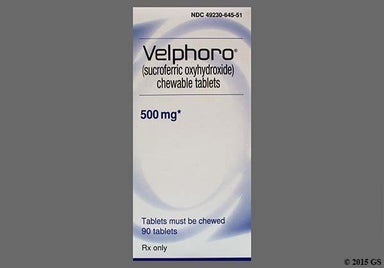
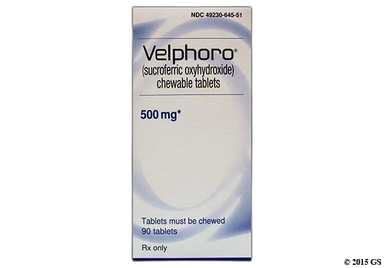
Velphoro (sucroferric oxyhydroxide) images