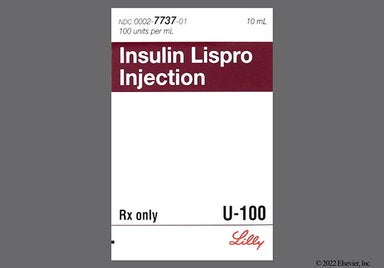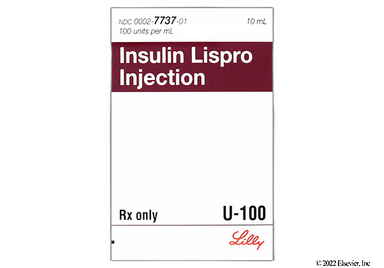
insulin lispro
Humalog (insulin lispro) is a fast-acting insulin for adults and children with diabetes. It helps prevent and treat high blood sugar from meals. This medication lowers your blood sugar levels by moving the sugar from your blood and into your body. Humalog (insulin lispro) is typically given as an injection under the skin. In certain situations, it's injected into the veins by a healthcare provider. Humalog (insulin lispro) is available as vials and ready-to-use prefilled pens. Side effects include headache and low blood sugar (hypoglycemia).


What is Humalog (insulin lispro)?
What is Humalog (insulin lispro) used for?
- Type 1 diabetes in adults and children
- Type 2 diabetes in adults
How Humalog (insulin lispro) works
Humalog (insulin lispro) is an insulin, which is a natural hormone your body normally makes to lower glucose (sugar) levels in the blood. It helps your body absorb sugar from your bloodstream after you eat a meal and store it for energy. Insulins also stop your liver from making glucose.
Drug facts



Side effects of Humalog (insulin lispro)
The following side effects may get better over time as your body gets used to the medication. Let your healthcare provider know immediately if you continue to experience these symptoms or if they worsen over time.
Common Side Effects
Type 1 diabetes:
- Flu-like symptoms (35%)
- Sore throat (33%)
- Runny nose (25%)
- Headache (30%)
- Pain (20%)
- Cough (17%)
- Infection (14%)
Type 2 diabetes:
- Headache (12%)
- Pain (11%)
- Infection (10%)
Less Common Side Effects
- Weight gain
- Swelling
- Reactions at the injection site (e.g., redness, swelling, itching)
Humalog (insulin lispro) serious side effects
Contact your healthcare provider immediately if you experience any of the following.
- Severely low blood sugar: dizziness, shakiness, feeling confused, feeling irritable or anxious, feeling faint, sweating, extreme hunger, not able to think clearly
- Ketoacidosis (high ketone levels in the blood): nausea, vomiting, stomach pain, tiredness, thirsty, dry mouth, fruity breath, trouble breathing
- Severely low potassium levels: weakness, muscle cramps or twitches, constipation, abnormal heartbeat, tiredness, trouble breathing
- Severe allergic reactions: rash; hives; swelling of face, tongue, and throat; trouble breathing
More on Humalog (insulin lispro) side effects

The following Humalog (insulin lispro) side effects have also been reported
Along with its needed effects, a medicine may cause some unwanted effects. Although not all of these side effects may occur, if they do occur they may need medical attention.
Check with your doctor immediately if any of the following side effects occur:
More common
Anxious or nervous feeling
behavior change similar to being drunk
blurred vision
chills
cold sweats
confusion or difficulty thinking
dizziness or lightheadedness
drowsiness
excessive hunger
fast heartbeat
headache
irritability or abnormal behavior
lower back or side pain
nightmares
painful or difficult urination
restless sleep
seizures
shakiness
slurred speech
tingling in the hands, feet, lips, or tongue
Less common
Dry, red, hot, or irritated skin
Rare
Depression of the skin at the injection site
dryness of the mouth
fast or weak pulse
itching, redness, or swelling at the injection site
muscle cramps or pain
skin rash or itching over the whole body
sweating
thickening of the skin at the injection site
trouble breathing
unusual tiredness or weakness
vomiting
Incidence not known
Bloating or swelling of the face, arms, hands, lower legs, or feet
decreased urine
difficulty with swallowing
dizziness, faintness, or lightheadedness when getting up suddenly from a lying or sitting position
fast, pounding, or irregular heartbeat or pulse
puffiness or swelling of the eyelids or around the eyes, face, lips, or tongue
redistribution or accumulation of body fat
tightness in the chest
unusual weight gain or loss
Some side effects may occur that usually do not need medical attention. These side effects may go away during treatment as your body adjusts to the medicine. Also, your health care professional may be able to tell you about ways to prevent or reduce some of these side effects. Check with your health care professional if any of the following side effects continue or are bothersome or if you have any questions about them:
More common
Body aches or pain
congestion
tender, swollen glands in the neck
unusual tiredness or weakness
voice changes
Incidence not known
Redness, swelling, or itching at the injection site
Other side effects not listed may also occur in some patients. If you notice any other effects, check with your healthcare professional.
Call your doctor for medical advice about side effects. You may report side effects to the FDA at 1-800-FDA-1088.

Get your GoodRx coupon

Pros and cons of Humalog (insulin lispro)
Pros
- Starts to work within 15 minutes to lower blood sugar levels
- Dose can be easily adjusted to make a treatment plan that's tailored to your specific needs
- Available as a prefilled pen for easier and convenient use
- Can use at home after proper training
- Can use in children as young as 3 years old with Type 1 diabetes
Cons
- Given multiple times a day (before each meal)
- Must give as an injection
- Might be hard for some people to take properly
- Risk of low blood sugar
- Can cause weight gain

Pharmacist tips for Humalog (insulin lispro)

- You should get training from your provider or pharmacist on how to use Humalog (insulin lispro) properly and safely. This is important to avoid accidentally hurting yourself or wasting the medication. Read the instructions on how to use the U-100 vial, KwikPen U-100, KwikPen U-200, or Junior KwikPen U-100. Contact your provider or pharmacist if you have any questions.
- Don't mix Humalog (insulin lispro) with other insulins (except NPH insulin) within the same syringe. Check with your provider or pharmacist about mixing Humalog (insulin lispro) with NPH insulin.
- Don't use Humalog (insulin lispro) if you plan to skip a meal, unless your provider specifically told you to do so. Using Humalog (insulin lispro) without a meal raises your risk for hypoglycemia (dangerously low blood sugar).
- Ask your provider when you should check your blood sugar during the day as you use Humalog (insulin lispro). Keep a log of your blood sugar readings and share it with your provider at your office visits. This helps you and your provider keep track of how well you're responding to the medication and whether you need dose adjustments.
- Make sure you and your family members know how to recognize and treat low blood sugar, like shakiness, anxiety, and hunger. Keep fast-acting sugar, such as glucose tablets, with you at all times so you can take it if your blood sugar level drops too low. Follow the "15-15 rule" to treat low blood sugar levels (below 70 mg/dL).
Tips on how to store Humalog (insulin lispro):
- Store unopened vials and pens in the refrigerator until the expiration date. You can also keep them at room temperature for up to 28 days.
- Store opened vials in the refrigerator or at room temperature for up to 28 days. Keep opened pens at room temperature for up to 28 days; don't put them in the refrigerator.
Tips for the Humalog (insulin lispro) pens:
- Be sure you know your dose and double check the concentration (strength) of your Humalog (insulin lispro) pens before using the medication. There are two strengths: U-100 (contains 100 units/mL) and U-200 (contains 200 units/mL). Call your provider right away if you think you have pens with the wrong strength.
- Prime the Humalog (insulin lispro) pen each time before you inject the medication. This prepares the pen for your dose by getting rid of air bubbles to make sure your dose is accurate. Follow your pen's instructions to prime it properly.
Tips on how to use Humalog (insulin lispro):
- For under-the-skin injections: Inject Humalog (insulin lispro) within 15 minutes before a meal or right after a meal. Inject the medication under the skin in the stomach area, buttocks, upper legs (thighs), or upper arms. Choose a different injection site each time to prevent hard lumps from forming in your skin.
- For continuous infusion pumps: Be sure to infuse into an area of the body recommended by the manufacturer of the pump. Rotate injection sites to prevent skin irritation. Change the medication in the pump at least once per week or according to the user manual, whichever is shorter. Also replace any Humalog (insulin lispro) in the pump that's been exposed to temperatures above 98.6°F.
- Always use a new needle for each injection to help prevent infections and blocked needles. Don't reuse or share your injection supplies with other people to avoid spreading infections.
- After injecting the medication, throw the needle or syringe away in a sharps container or something made of heavy-duty plastic (e.g., empty milk carton, laundry detergent bottle). This helps lower the risk of needle-stick injuries. Don't throw away needles or syringes in your trash can. Visit the FDA's website for guidance on how to throw away your sharps container safely in your specific state.



Common questions about Humalog (insulin lispro)
Yes, Humalog (insulin lispro) is a fast-acting (or rapid-acting) insulin. It starts to work within 15 minutes after it's injected. Because it works so quickly, make sure to inject Humalog (insulin lispro) within only 15 minutes before a meal so that it works well to keep the food from making your blood sugar too high.
The blood sugar-lowering effects of Humalog (insulin lispro) last for about 2 to 4 hours after a dose. This is why Humalog (insulin lispro) is typically given multiple times per day (that is, with each meal).
No. Humalog (insulin lispro) and NovoLog (insulin aspart) are both rapid-acting insulins that share a lot of similarities, but they're two completely different medications. One of the main differences is that Humalog (insulin lispro) can be used in children at least 3 years old with Type 1 diabetes, whereas Novolog (insulin aspart) can be used in children at least 2 years old with Type 1 diabetes. Another main difference is that you typically inject Humalog (insulin lispro) within 15 minutes of a meal, whereas Novolog (insulin aspart) is injected within 5 to 10 minutes before a meal.
No, Humalog (insulin lispro) and Humulin R (insulin regular) are two completely different types of insulins. Both can be used at mealtimes to manage your blood sugar after eating. The main difference is how fast they start to work and how long they last. Humalog (insulin lispro) is a rapid-acting insulin that starts to work within 15 minutes and lasts 2 to 4 hours. On the other hand, Humulin R (insulin regular) is a short-acting insulin that starts to work within 30 minutes and lasts 3 to 6 hours. This means that you can inject Humulin R (insulin regular) a little bit longer before meals than Humalog (insulin lispro), and it lasts longer than Humalog (insulin lispro).
It depends on whether you've opened Humalog (insulin lispro) or not. It's preferred that you store unopened vials and pens in the refrigerator because you'll be able to use them until their expiration dates. You can keep them at room temperature too, but only for up to 28 days before you need to throw them out. You can keep opened vials either in the refrigerator or at room temperature. And opened pens should only be stored at room temperature; don't put the pens back in the refrigerator after opening. Ask your provider or pharmacist if you're not sure whether you need to store Humalog (insulin lispro) in the refrigerator or whether you can keep it at room temperature.
In general, Humalog (insulin lispro) is good for 28 days after opening. Make sure to write down the expiration date, which is 28 days after you open the medication. Don't use Humalog (insulin lispro) past this date, even if there's still some medication left. This time frame might be different in certain situations, such as when Humalog (insulin lispro) needs to be diluted. Ask your provider or pharmacist if you're not sure how long Humalog (insulin lispro) is good for after opening.
There isn't a maximum amount of Humalog (insulin lispro) you can take in a day. Everyone's insulin requirements will be different; some people need very low doses, while others might need very high doses. Your provider will work with you to find a dosing plan that works best for you. It typically depends on many things, like whether you have Type 1 or Type 2 diabetes, your blood sugar levels, and how they respond to insulin. The most important and safest thing to do is to always follow your provider's instructions on how much Humalog (insulin lispro) to use. If you feel that your dose isn't enough based on your blood sugar readings, don't use extra doses of Humalog (insulin lispro) because this can raise your risk for low blood sugar (hypoglycemia). Instead, call your provider to discuss your blood sugar results and ask whether you need any dose adjustments.
You can take Humalog (insulin lispro) and Lantus (insulin glargine) at the exact same time if that's how your provider prescribed it to you. Both medications help control your blood sugar but for different reasons. Lantus (insulin glargine) is a long-acting insulin that helps control your blood sugar all day long. Humalog (insulin lispro) can be given along with Lantus (insulin glargine) to help balance your blood sugar levels after your meal. Talk with your provider to come up with a dosing schedule that works best for you if you're taking both Humalog (insulin lispro) and Lantus (insulin glargine).

How to save using GoodRx



Risks and warnings for Humalog (insulin lispro)
Humalog (insulin lispro) can cause some serious health issues. This risk may be even higher for certain groups. If this worries you, talk to your doctor or pharmacist about other options.
Spread of infections from sharing injection supplies
Never share Humalog (insulin lispro) pens, syringes, needles, or cartridges with anyone else. Sharing Humalog (insulin lispro) and injection supplies with someone can raise the risk of spreading very dangerous infections to other people (including yourself).
Low blood sugar (hypoglycemia)
- Risk factors: Changes in diet and exercise | Switching to Humalog (insulin lispro) from a different type of insulin | Drinking alcohol | Taking other medications for diabetes together with Humalog (insulin lispro) | Liver or kidney problems
Using Humalog (insulin lispro) alone or together with other blood sugar medications can cause your blood sugar levels to drop too low, which can be life-threatening. Always check the medication labels of all your diabetes medications to make sure you're taking the right one, especially if you're injecting more than one type of insulin.
Make sure you and your loved ones know how to recognize symptoms of low blood sugar, such as feeling shaky; being nervous, anxious, or confused; or feeling very hungry. Check your blood sugar if you have any of these symptoms.
It's important to know how to treat low blood sugar. Carry some form of fast-acting sugar (e.g., glucose tablets, hard candy, fruit juice) with you at all times while you're taking this medication. You can use these to raise your blood sugar quickly if it becomes too low.
Low blood potassium levels
- Risk factors: Taking other medications that lower potassium levels
Humalog (insulin lispro) can lower the levels of potassium in your blood, which can sometimes be dangerous. You're at risk if you're already taking medications that lower your potassium, like certain diuretics (water pills). Your provider will check your potassium levels regularly and might give you medications to keep your potassium in the normal range. Tell your provider if you have symptoms of low potassium, such as weakness, muscle cramps or twitches, nausea, vomiting, or abnormal heartbeats.
Swelling from fluid buildup and risk of heart failure when taken with certain blood sugar medications
- Risk factors: Taking glitazones together with Humalog (insulin lispro) | History of heart failure
Taking Humalog (insulin lispro) with medications called glitazones (also known as thiazolidinediones), like pioglitazone (Actos), can cause your body to hold onto fluid. This can worsen or lead to heart failure. Let your provider know if you've noticed sudden weight gain or if you have symptoms of heart failure, such as trouble breathing, tiredness, or headache. Your provider might need to make changes to your blood sugar medications.
Dangerously high blood sugar levels or buildup of ketones (for people who use insulin pump)
- Risk factors: Insulin pump not working properly
If you're using an insulin pump to inject Humalog (insulin lispro), check that your pump is working properly and that you know how to use it correctly. When the pump isn't work properly, you're at risk of having extremely high blood sugar levels or a serious complication of diabetes called ketoacidosis. Call your provider right away if you can't fix your pump quickly. Your provider might recommend that you inject Humalog (insulin lispro) in other ways in the meantime. Tell your provider as soon as possible if you have symptoms of ketoacidosis, such as tiredness, fruity-smelling breath, or vomiting.

Humalog (insulin lispro) dosage
 Carton
| Dosage | Quantity | Price as low as | Price per unit |
|---|---|---|---|
| five 3ml kwikpens of 100 units/ml | 1 carton | $162.63 | $162.63 |
| five 3ml junior kwikpens of 100 units/ml | 1 carton | $82.21 | $82.21 |
 Kwikpen
| Dosage | Quantity | Price as low as | Price per unit |
|---|---|---|---|
| 3ml of 100 units/ml | 5 kwikpens | $158.97 | $31.79 |
 Vial
Vial| Dosage | Quantity | Price as low as | Price per unit |
|---|---|---|---|
| 10ml of 100 units/ml | 1 vial | $33.36 | $33.36 |
Typical dosage for Humalog (insulin lispro)
Your healthcare provider will work with you to find the dose that works best for you. Your dose depends on many things, such as whether you have Type 1 or Type 2 diabetes, your blood sugar levels and how they change with insulin, and how you're injecting the medication (under the skin, into the vein, using an insulin pump).
- For injections under the skin: Inject Humalog (insulin lispro) under the skin in the stomach, thigh, upper arm, or buttocks area within 15 minutes before a meal or right after a meal.
- For injections through the vein: Insulin lispro 100 units/mL (Humalog U-100) can be given as an injection into the vein by a healthcare provider. The dose depends on the type of diabetes you have and your weight.
- For continuous insulin pumps: Use the insulin pump according to your provider's instructions. Follow the directions from your insulin pump manufacturer to set up and use the pump.

Interactions between Humalog (insulin lispro) and other drugs
More on Humalog (insulin lispro) interactions
Although certain medicines should not be used together at all, in other cases two different medicines may be used together even if an interaction might occur. In these cases, your doctor may want to change the dose, or other precautions may be necessary. When you are taking this medicine, it is especially important that your healthcare professional know if you are taking any of the medicines listed below. The following interactions have been selected on the basis of their potential significance and are not necessarily all-inclusive.
Using this medicine with any of the following medicines is usually not recommended, but may be required in some cases. If both medicines are prescribed together, your doctor may change the dose or how often you use one or both of the medicines.
- Balofloxacin
- Besifloxacin
- Chloroquine
- Ciprofloxacin
- Enoxacin
- Fleroxacin
- Flumequine
- Gatifloxacin
- Gemifloxacin
- Hydroxychloroquine
- Lanreotide
- Levofloxacin
- Liraglutide
- Lomefloxacin
- Macimorelin
- Metoclopramide
- Metreleptin
- Moxifloxacin
- Nadifloxacin
- Norfloxacin
- Octreotide
- Ofloxacin
- Pasireotide
- Pazufloxacin
- Pefloxacin
- Pioglitazone
- Pramlintide
- Prulifloxacin
- Rosiglitazone
- Rufloxacin
- Sparfloxacin
- Thioctic Acid
- Tosufloxacin
Using this medicine with any of the following medicines may cause an increased risk of certain side effects, but using both drugs may be the best treatment for you. If both medicines are prescribed together, your doctor may change the dose or how often you use one or both of the medicines.
- Acebutolol
- Albiglutide
- Atenolol
- Betaxolol
- Bisoprolol
- Bitter Melon
- Carteolol
- Carvedilol
- Celiprolol
- Dulaglutide
- Esmolol
- Exenatide
- Fenugreek
- Furazolidone
- Glucomannan
- Guar Gum
- Iproniazid
- Isocarboxazid
- Labetalol
- Levobunolol
- Linezolid
- Lixisenatide
- Methylene Blue
- Metipranolol
- Metoprolol
- Moclobemide
- Nadolol
- Nebivolol
- Nialamide
- Oxprenolol
- Penbutolol
- Phenelzine
- Pindolol
- Practolol
- Procarbazine
- Propranolol
- Psyllium
- Rasagiline
- Safinamide
- Saxagliptin
- Selegiline
- Sotalol
- Timolol
- Tranylcypromine

How much does Humalog (insulin lispro) cost?

Humalog (insulin lispro) contraindications
Contraindications are specific health conditions or situations in which a person should not take a medication due to safety concerns. If you have any of the following conditions or if any of the following apply to you, let your healthcare provider know because Humalog (insulin lispro) will not be safe for you to take.
- When you have low blood sugar (hypoglycemia)

What are alternatives to Humalog (insulin lispro)?

News about Humalog (insulin lispro)







Humalog (insulin lispro) images