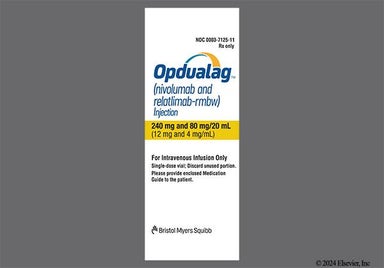
Opdualag
Opdualag is a pre-mixed combination of two medications: nivolumab and relatlimab (or relatlimab-rmbw). Both are immunotherapy medications that work to treat advanced and metastatic melanoma skin cancer by activating your immune system to fight cancer cells. Opdualag (nivolumab / relatlimab) is given through the vein (IV, intravenously) at a doctor’s office or infusion center, typically once every 4 weeks. Possible side effects of this medication include rash, diarrhea, and muscle pain.


What is Opdualag (nivolumab / relatlimab)?
What is Opdualag (nivolumab / relatlimab) used for?
- Melanoma skin cancer that has spread or can’t be removed by surgery (people ages 12 years and older)
How Opdualag (nivolumab / relatlimab) works
Our immune system plays an important role in our body, for example, to fight infections. The immune system can also attack and kill cancer cells it recognizes as abnormal. Some cancer cells can hide from the immune system by using the programmed-death-1 (PD-1) or the lymphocyte activation gene-3 (LAG3) pathway. When a cancer cell uses one or both of these pathways, it stops our immune cells from attacking the cancer cell. This allows cancer to grow.
Opdualag (nivolumab / relatlimab) is a combination medication that blocks both the PD-1 (nivolumab) and LAG3 (relatlimab) pathways. When these pathways are blocked, the immune system is activated to attack cancer cells. As a result, the immune system can kill cancer cells and stop cancer cells from growing.
Drug facts
| Common Brands | Opdualag |
|---|---|
| Drug Class | PD-1 and LAG-3 inhibitor |
| Controlled Substance Classification | Not a controlled medication |
| Generic Status | No lower-cost generic available |
| Availability | Prescription only |
More on Opdualag (nivolumab / relatlimab) essentials


Side effects of Opdualag (nivolumab / relatlimab)
The following side effects may get better over time as your body gets used to the medication. Let your healthcare provider know immediately if you continue to experience these symptoms or if they worsen over time.
Common Side Effects
- Muscle pain (45%)
- Tiredness (39%)
- Lower red blood cell count (37%)
- Lower white blood cell count (32%)
- Higher liver enzymes in blood (up to 30%)
- Rash (28%)
- Itching (25%)
- Diarrhea (24%)
- Lower sodium level in blood (24%)
Less Common Side Effects
- Headache
- Nausea
- Lower appetite
- Cough
Opdualag (nivolumab / relatlimab) serious side effects
Contact your healthcare provider immediately if you experience any of the following.
- Serious immune-related side effects: rash, diarrhea, trouble breathing, severe stomach pain, chest pain
- Serious reaction during infusion: itching, trouble breathing, fast heart beat, feeling warm or hot
The following Opdualag (nivolumab / relatlimab) side effects have also been reported
Side effects that you should report to your care team as soon as possible:
- Allergic reactions—skin rash, itching, hives, swelling of the face, lips, tongue, or throat
- Dry cough, shortness of breath or trouble breathing
- Eye pain, redness, irritation, or discharge with blurry or decreased vision
- Heart muscle inflammation—unusual weakness or fatigue, shortness of breath, chest pain, fast or irregular heartbeat, dizziness, swelling of the ankles, feet, or hands
- Hormone gland problems—headache, sensitivity to light, unusual weakness or fatigue, dizziness, fast or irregular heartbeat, increased sensitivity to cold or heat, excessive sweating, constipation, hair loss, increased thirst or amount of urine, tremors or shaking, irritability
- Infusion reactions—chest pain, shortness of breath or trouble breathing, feeling faint or lightheaded
- Kidney injury (glomerulonephritis)—decrease in the amount of urine, red or dark brown urine, foamy or bubbly urine, swelling of the ankles, hands, or feet
- Liver injury—right upper belly pain, loss of appetite, nausea, light-colored stool, dark yellow or brown urine, yellowing skin or eyes, unusual weakness or fatigue
- Pain, tingling, or numbness in the hands or feet, muscle weakness, change in vision, confusion or trouble speaking, loss of balance or coordination, trouble walking, seizures
- Rash, fever, and swollen lymph nodes
- Redness, blistering, peeling, or loosening of the skin, including inside the mouth
- Sudden or severe stomach pain, bloody diarrhea, fever, nausea, vomiting
Side effects that usually do not require medical attention (report these to your care team if they continue or are bothersome):
- Bone, joint, or muscle pain
- Diarrhea
- Fatigue
- Loss of appetite
- Nausea
- Skin rash

Pros and cons of Opdualag (nivolumab / relatlimab)
Pros
- Recommended treatment for people with advanced melanoma skin cancer
- Includes two medications in a single infusion, so more convenient
- Doesn’t typically cause side effects like hair loss or vomiting that are commonly seen with traditional chemotherapy
Cons
- Given as an infusion through an IV, which requires using a needle
- Might cause certain immune-related side effects such as rash and diarrhea
- Might require treatment with corticosteroids to manage side effects

Pharmacist tips for Opdualag (nivolumab / relatlimab)

- Contact your provider right away if you have immune-related side effects such as a new skin rash, diarrhea, or trouble breathing. These can be signs that your immune system has become too active as a result of Opdualag (nivolumab / relatlimab) treatment.
- If you have immune-related side effects such as new skin rash or diarrhea, don’t take over-the-counter medications to treat it without contacting your provider first. Over-the-counter medications you might use, like loperamide (Imodium-AD) for diarrhea, for example, won’t work as well. Usually, these side effects need to be quickly treated with a corticosteroid, such as prednisone.
- Some immune-related side effects, like liver and kidney changes, usually won’t cause symptoms. Instead, these side effects can be detected in the results of your lab tests. It’s important that you keep up with recommended lab work so your provider can follow the results and monitor you for these side effects.
- The typical treatment for immune-related side effects is a corticosteroid such as prednisone. If your prescriber gives you a corticosteroid to take, don’t stop taking it suddenly because doing so can cause uncomfortable side effects, such as weakness and nausea. When it’s time to stop the steroid medication, your provider will give you a plan to do so slowly and safely (tapering) to avoid these symptoms.
- Opdualag (nivolumab / relatlimab) can cause harm to an unborn baby. If you’re a female who can have children, make sure to use effective birth control while receiving Opdualag (nivolumab / relatlimab) and for 5 months after the last dose. Let your provider know if you become pregnant during or after treatment.
- Females who are taking Opdualag (nivolumab / relatlimab) shouldn’t breastfeed. Opdualag (nivolumab / relatlimab) hasn’t been studied in human milk, but because of the possible risks to a baby, it’s best to avoid nursing if you’re taking Opdualag (nivolumab / relatlimab) and for 5 months after the last dose.

Risks and warnings for Opdualag (nivolumab / relatlimab)
Opdualag (nivolumab / relatlimab) can cause some serious health issues. This risk may be even higher for certain groups. If this worries you, talk to your doctor or pharmacist about other options.
Immune-related side effects
Side effects from immunotherapy are typically called immune-related adverse events (irAEs). They happen when the immune system becomes too active and doesn’t just attack cancer cells; it attacks healthy cells, too. These side effects can happen anywhere in your body. They can be mild or very serious. And, they can happen at any time during treatment. Some of these side effects, like changes in lab values that show how well your liver and kidneys are working, might not cause noticeable symptoms. You’ll need blood tests done often so your provider can monitor for those side effects closely. But you might notice certain other immune-related side effects, like diarrhea, skin rash, or shortness of breath. Call your provider right away if you experience any of these symptoms. You might need to pause or stop Opdualag (nivolumab / relatlimab) and take a corticosteroid depending on how severe your symptoms are.
Infusion reactions
Rarely, people taking Opdualag (nivolumab / relatlimab) have experienced severe reactions during their infusion. If you feel itchy or warm, have trouble breathing, feel nauseous, or suddenly have a fast heart rate while receiving Opdualag (nivolumab / relatlimab), let your nurse know right away. Most of the time, giving the infusion slower can help. But sometimes, having a serious reaction means that you shouldn’t take Opdualag (nivolumab / relatlimab) again to avoid having another one in the future.
Stem cell transplant complications
Risk factors: People who’ve received a stem cell (bone marrow) transplant
Some people who’ve taken immunotherapy medications like Opdualag (nivolumab / relatlimab) and who’ve also had a stem cell transplant have experienced serious problems like graft-versus-host-disease. If you’ve taken an immunotherapy medication like Opdualag (nivolumab / relatlimab) and have also had a stem cell transplant, your provider will follow up with you closely for signs and symptoms of these problems, such as nausea, vomiting, stomach pain, and rash.
Harm to unborn baby
Risk factors: Pregnancy
Opdualag (nivolumab / relatlimab) might harm an unborn baby or raise the risk for miscarriage (pregnancy loss) when taken during pregnancy. Because of these risks, if you’re a female who can get pregnant, you should use birth control while taking Opdualag (nivolumab / relatlimab) and for 5 months after the last dose. Let your provider know right away if you become pregnant while taking Opdualag (nivolumab / relatlimab).

Opdualag (nivolumab / relatlimab) dosage
Typical dosage for Opdualag (nivolumab / relatlimab)
People ages 12 years and older (who weigh at least 40 kg):
- The typical dose of Opdualag is 480 mg of nivolumab and 160 mg of relatlimab every 4 weeks. It’s given as an intravenous (IV) infusion that includes both medications given at the same time.

What are alternatives to Opdualag (nivolumab / relatlimab)?

Opdualag (nivolumab / relatlimab) images