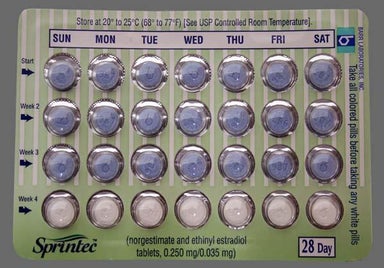
Sprintec is a type of combined oral contraceptive (COC), or birth control, that contains both estrogen and progesterone hormones. It's a monophasic birth control, meaning all active tablets contain the same doses of hormones. Sprintec works well to prevent pregnancy if it's taken daily at the same time every day.
Sprintec is a combination medication that contains 2 hormones: norgestimate (a progestin) and ethinyl estradiol (an estrogen). These 2 hormones work together to prevent pregnancy by:
Preventing your ovaries from releasing eggs
Changing the mucus in your cervix to make it harder for the sperm to enter the uterus (womb)
Changing the lining of the uterus so it's more difficult for a fertilized egg to implant
The following side effects may get better over time as your body gets used to the medication. Let your healthcare provider know immediately if you continue to experience these symptoms or if they worsen over time.
Common Side Effects
Changes in menstrual bleeding (up to 34%)
Headache/migraine (33%)
Stomach pain (8%)
Vaginal infection (8%)
Genital discharge (7%)
Breast pain, discharge, or swelling (6%)
Mood changes (5%)
Passing gas (3%)
Nervousness (3%)
Rash (3%)
Less Common Side Effects
Urinary tract infection
Anxiety
Sleeping problems
Dizziness
Vision problems
Fast heart rate
Stomach upset
Skin problems
Muscle pain
Sprintec serious side effects
Contact your healthcare provider immediately if you experience any of the following.
The following Sprintec side effects have also been reported
Along with its needed effects, a medicine may cause some unwanted effects. Although not all of these side effects may occur, if they do occur they may need medical attention.
Check with your doctor immediately if any of the following side effects occur:
Some side effects may occur that usually do not need medical attention. These side effects may go away during treatment as your body adjusts to the medicine. Also, your health care professional may be able to tell you about ways to prevent or reduce some of these side effects. Check with your health care professional if any of the following side effects continue or are bothersome or if you have any questions about them:
Take Sprintec at the same time every day. Talk to your provider if you missed your dose. Depending on how many tablets you missed and the week that you're on, you might have to take extra tablets on the same day or throw away your current pack and start a new pack.
Talk to your provider if you experience symptoms of depression or worsening depression while taking Sprintec. Your provider might take you off this medication if you have serious depression.
If you're taking Sprintec after having a baby and haven't had a period yet, use another form of birth control (if you're having sex) for the first 7 days of starting this medication. To lower your risk for blood clots, make sure it's been at least 4 weeks after delivering your baby before you start your birth control.
Speak to your provider before starting Sprintec if you are breastfeeding your child. Sprintec can lessen the amount of milk you produce so your provider might recommend another kind of birth control for you.
Let your provider know if you are taking any medications for your thyroid. Sprintec can affect how well some thyroid medications work, so your provider might need to raise your dose.
If you have a rare, swelling condition called hereditary angioedema, medications with estrogens, such as Sprintec, might cause or worsen the symptoms of swelling in your body.
Females who have a history of a skin condition that causes the skin pigmentation to darken (chloasma gravidarum) can experience spots of darkened skin while taking COCs. If you're more prone to getting hyperpigmentation, avoid exposing your skin to the sun or ultraviolet radiation (e.g. tanning booths, sun lamps) while you're taking Sprintec. Use sunscreen when going outside.
Risks and warnings for Sprintec
Sprintec can cause some serious health issues. This risk may be even higher for certain groups. If this worries you, talk to your doctor or pharmacist about other options.
Cigarette smoking and serious heart problems
Risk factors: Females over 35 years old who smoke cigarettes
Smoking cigarettes while taking combined oral contraceptives (COCs), like Sprintec, can raise the risk of serious heart problems. The risk gets higher as you get older, especially if you're over 35 years old, and with the number of cigarettes smoked. Females over 35 years old who smoke shouldn't take Sprintec because of this risk.
Blood clots and strokes
Risk factors: Females over 35 years old who smoke | Females over 40 years old who don't smoke | Recent surgery with a long period of bed rest | Starting Sprintec less than a month after childbirth | High blood pressure | People identified as obese | High cholesterol | Diabetes | Higher dose of estrogen
Sprintec raises your risk of blood clots. These clots can occur anywhere in your body, including your lungs (pulmonary embolism or PE), legs (deep vein thrombosis or DVT), brain (stroke), and heart (heart attack). Get emergency help right away if you have any signs of a blood clot:
Brain: weakness or numbness in your arms, legs, or face on one side of the body, trouble speaking, blurred vision, dizziness, loss of balance, trouble walking, or confusion
Eyes: trouble seeing, bulging eye, double vision
Heart: chest pain, sweating, nausea, or dizziness
Lungs: trouble breathing, chest pain, or cough
Legs: cramps, swelling, pain, or muscle tightness
If you need to have surgery, tell your provider you're taking Sprintec. They might have you stop taking it 4 weeks before until 2 weeks after your surgery to lower your risk of blood clots. If you recently delivered a baby, you shouldn't start Sprintec until 4 weeks after delivery if you're not breastfeeding your child.
Irregular bleeding
People who take Sprintec can sometimes experience irregular bleeding and spotting, especially during the first 3 months of taking this medication. Irregular bleeding can vary from slight staining to bleeding similar to a regular period. This problem might be temporary, so continue taking your medication as directed. Let your provider know if the bleeding is a problem for you and they can change your birth control. Some people might not have any bleeding while taking or after stopping Sprintec. If you missed your period(s), contact your provider or get a pregnancy test to make sure you're not pregnant.
High blood pressure
Risk factors: Older age | Using COCs for a long time | High blood pressure | Kidney problems
Sprintec can raise your blood pressure, so make sure you check your blood pressure while you're taking this medication. The risk is higher in females who are older and have been taking birth control for a long period of time. Sprintec can't be taken by females who have high blood pressure that's not under control or high blood pressure with blood vessel problems. Speak to your provider if this medication raises your blood pressure and they can help pick a different method of birth control that's safer for you.
High blood sugar and cholesterol
Risk factors: Prediabetes or diabetes | High triglycerides
Sprintec can raise your blood sugar and cholesterol levels. Females who have high triglycerides (a type of cholesterol) might have a higher risk of experiencing pancreatitis (inflammation of the pancreas) when taking COCs. Speak with your provider before starting Sprintec if you have diabetes, prediabetes, or high cholesterol. If you choose to take Sprintec with those health conditions, your provider will monitor you regularly.
Headache
Let your provider know if you experience new or worsening migraines or headaches while taking Sprintec. You will have to stop your medication if your migraine or headache doesn't go away or becomes severe.
Breast and cervical cancer
Risk factors: History of breast or cervical cancer | Taking COCs for a long time
Don't take Sprintec if you currently have or have had breast cancer because some types of breast cancer grow faster in the presence of estrogen, a hormone in this medication. The risk of developing breast cancer might be slightly higher in females who currently take COCs, have taken them within the past 6 months, or are taking them for a long time (8 years or more). You can examine your breasts regularly at home or get yearly breast exams with your healthcare provider to help with early breast cancer detection. Let your provider know if you notice any new or abnormal lumps, pain, or swelling in your breasts.
Make sure you follow up with your provider to get proper screenings for cervical cancer. Report any signs of vaginal bleeding or discharge that's not normal.
Liver problems
Risk factors: Taking COCs for a long time | Hepatitis C treatment
Don't take Sprintec if you have liver problems, such as sudden liver infection caused by a virus, severe (decompensated) scarring of the liver, or liver tumors. Although rare, Sprintec can raise your risk of benign liver tumors. If you experience signs of liver problems, you should stop taking Sprintec and ask your provider for a different type of birth control. Signs of liver problems can include jaundice (yellowing of the skin or eyes), along with fever, tiredness, loss of appetite, or dark colored urine.
Talk to your provider before starting Sprintec if you are taking Viekira Pak (dasabuvir / ombitasvir / paritaprevir / ritonavir) to treat hepatitis C. This medication can cause liver problems if you are taking it together with a COC. Stop taking Sprintec and discuss other birth control options with your provider if you need to start your treatment for hepatitis C. You can restart Sprintec 2 weeks after your Viekira Pak treatment is complete.
The average cost for 1 package of 28 tablets of 0.25mg/0.035mg of Sprintec is $9.00 with a free GoodRx coupon. This is 0.00% off the average retail price of $9.00.
Sprintec may interact with certain medications or supplements. Always let your doctor and pharmacist know about any other medications or supplements (including prescribed and over-the-counter medications, vitamins, and dietary or herbal supplements) that you are currently taking. The list below does not include all possible drug interactions with Sprintec. Please note that only the generic name of each medication is listed below.
Although certain medicines should not be used together at all, in other cases two different medicines may be used together even if an interaction might occur. In these cases, your doctor may want to change the dose, or other precautions may be necessary. When you are taking this medicine, it is especially important that your healthcare professional know if you are taking any of the medicines listed below. The following interactions have been selected on the basis of their potential significance and are not necessarily all-inclusive.
Using this medicine with any of the following medicines is not recommended. Your doctor may decide not to treat you with this medication or change some of the other medicines you take.
Using this medicine with any of the following medicines is usually not recommended, but may be required in some cases. If both medicines are prescribed together, your doctor may change the dose or how often you use one or both of the medicines.
Using this medicine with any of the following medicines may cause an increased risk of certain side effects, but using both drugs may be the best treatment for you. If both medicines are prescribed together, your doctor may change the dose or how often you use one or both of the medicines.
Contraindications are specific health conditions or situations in which a person should not take a medication due to safety concerns. If you have any of the following conditions or if any of the following apply to you, let your healthcare provider know because Sprintec will not be safe for you to take.
Women over 35 years old who smoke
Current or history of blood clots
Health condition that makes it more likely for your blood to clot
A history of heart attack or stroke
Heart valve problems or irregular heart beat that raises the risk of having blood clots
High blood pressure that's not under control
Diabetes with kidney, eye, nerve, or blood vessel problems
Certain kinds of severe migraine headaches with aura, numbness, weakness, or vision changes
Any migraine headaches for women over 35 years old
Liver problems, including liver tumors or cancer
Unexplained vaginal bleeding that hasn't been diagnosed
Pregnancy
Current or history of breast cancer
Taking hepatitis C medication with ombitasvir, paritaprevir, and ritonavir, with or without dasabuvir
What are alternatives to Sprintec?
There are a number of medications that your doctor can prescribe in place of Sprintec. Compare a few possible alternatives below.
Plans start at $9.99/mo. (when paid yearly). Terms apply.
Common questions about Sprintec
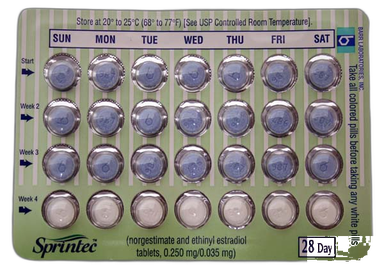
Sprintec is considered a monophasic birth control because all of the active tablets contain the same amount of estrogen and progesterone. Sprintec contains 21 active tablets that are the same color, along with 7 inactive (hormone-free) tablets in a different color.
Sprintec, Tri-Sprintec, and Tri-Lo-Sprintec all have the same ingredients, but they differ in the amount of hormones in the active tablets. As mentioned in the question above, Sprintec is a monophasic birth control. Tri-Sprintec and Tri-Lo-Sprintec are triphasic birth controls, meaning they have three different phases of hormones that try to mimic (copy) the rise and fall of hormones in the menstrual cycle. Tri-Lo-Sprintec has a lower amount of estrogen hormone compared to Tri-Sprintec. All three medications are effective in preventing pregnancy if taken as directed. Speak to your provider to determine which type of birth control is right for you.
If you're starting hormonal birth control for the first time, you can start Sprintec on the first day of your period or the first Sunday after your period starts. If you start on the Sunday after your period starts, use another non-hormonal method of birth control, such as condoms or foam, for 7 days to prevent pregnancy. If you're switching from a different hormonal birth control, such as a different birth control pill, transdermal patch, vaginal ring, or injection, you can start Sprintec on the day when you're supposed to start a new pack or application of your previous birth control. If you're switching from a birth control device, such as intrauterine device (IUD) or implant, you can start Sprintec on the day of removal of those devices. Talk with your provider if you've any questions about when you can start Sprintec and whether you need to use a backup form of birth control during the first week.
If you vomit or have diarrhea within 3 to 4 hours after taking an active tablet of Sprintec, this medication might not be absorbed completely into your body. This should be considered as a missed dose, and you should take another active tablet as soon as possible. Continue taking 1 tablet a day until the pack is finished, and start your new pack the day after you finish your current pack. If you experience vomiting or diarrhea for more than 1 day, let your provider know and use another non-hormonal method of birth control, such as condoms or foam, in the meantime.
No, don't skip Sprintec even if you don't have sex often. This medication isn't meant to be used "as needed." You need to continue taking Sprintec at the same time every day without missing any pills for it to work well. If taken as directed, the chance of you becoming pregnant is about 1%. The more pills you miss, the more likely it is for you to become pregnant.
Sprintec is a combination medication that contains 2 hormones: norgestimate (a progestin) and ethinyl estradiol (an estrogen). These 2 hormones work together to prevent pregnancy by: Preventing your ovaries from releasing eggs Changing the mucus in your cervix to make it harder for the sperm to enter the uterus (womb) Changing the lining of the uterus so it's more difficult for a fertilized egg to implantLearn more





 Smoking cigarettes while taking combined oral contraceptives (COCs), like Sprintec, can raise the risk of serious heart problems. The risk gets higher as you get older, especially if you're over 35 years old, and with the number of cigarettes smoked. Females over 35 years old who smoke shouldn't take Sprintec because of this risk.