


7 Topical Treatment Options for Scalp Psoriasis
Scalp psoriasis can’t be cured, but there are treatments to help manage your symptoms. Learn more about the topical options for scalp psoriasis with GoodRx.
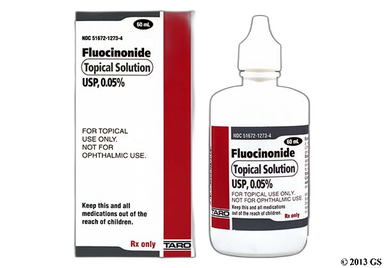
Fluocinonide is a strong topical steroid that's applied on the skin. It treats rashes and skin irritation in adults and children. The medication comes as a cream, ointment, gel, and topical solution. All topical forms come as generics, but the cream is also available under the brand name Vanos. You apply fluocinonide to the affected skin one to four times a day, depending on the formulation. This medication isn't meant for long-term use because of potential side effects like skin thinning and changes in skin color.

Fluocinonide is a topical corticosteroid. It works by blocking inflammatory chemicals that cause redness and swelling in the skin. This helps relieve skin irritation and itching due to certain skin problems.
| Common Brands | Vanos |
|---|---|
| Drug Class | Corticosteroid |
| Controlled Substance Classification | Not a controlled medication |
| Generic Status | Lower-cost generic available |
| Availability | Prescription only |

The following side effects may get better over time as your body gets used to the medication. Let your healthcare provider know immediately if you continue to experience these symptoms or if they worsen over time.
Along with its needed effects, a medicine may cause some unwanted effects. Although not all of these side effects may occur, if they do occur they may need medical attention.
Check with your doctor immediately if any of the following side effects occur:
Incidence not known
Blistering, burning, crusting, dryness, or flaking of the skin
irritation
itching, scaling, severe redness, soreness, or swelling of the skin
redness and scaling around the mouth
thinning of the skin with easy bruising, especially when used on the face or where the skin folds together (e.g. between the fingers)
thinning, weakness, or wasting away of the skin
Some side effects may occur that usually do not need medical attention. These side effects may go away during treatment as your body adjusts to the medicine. Also, your health care professional may be able to tell you about ways to prevent or reduce some of these side effects. Check with your health care professional if any of the following side effects continue or are bothersome or if you have any questions about them:
Incidence not known
burning and itching of the skin with pinhead-sized red blisters
burning, itching, and pain in hairy areas, or pus at the root of the hair
increased hair growth on the forehead, back, arms, and legs
lightening of normal skin color
lightening of treated areas of dark skin
reddish purple lines on the arms, face, legs, trunk, or groin
softening of the skin
Other side effects not listed may also occur in some patients. If you notice any other effects, check with your healthcare professional.
Call your doctor for medical advice about side effects. You may report side effects to the FDA at 1-800-FDA-1088.




Fluocinonide can cause some serious health issues. This risk may be even higher for certain groups. If this worries you, talk to your doctor or pharmacist about other options.
Fluocinonide is a steroid that can act like cortisol, a stress hormone your body makes. If you use too much fluocinonide, use it for too long, or put it on large areas of skin, it can change your cortisol levels.
In these cases, using fluocinonide can also cause the body to make less of its own natural cortisol. This can make you feel weak or unwell. Although rare, using the medication too much or using it for too long might also cause symptoms like high blood sugar.
To stay safe, use the smallest amount of fluocinonide for the shortest time possible. Don't use more of the medication or for longer than what your prescriber told you. The 1% cream shouldn't be used for more than 2 weeks at a time. Talk to your prescriber if you need to use the medication for a longer period of time or on large areas of skin.
Some people might have skin reactions while using fluocinonide. These can include burning, itching, irritation, dry skin, rash, or swollen hair follicles. Other reactions can be thin or fragile skin, stretch marks, spider veins, skin color changes, or skin infections.
These problems are more likely if you use too much fluocinonide or use it longer than prescribed. The risk is also higher if you cover the area with a tight bandage.
Use only a small amount of fluocinonide and for the shortest time needed to treat your symptoms.
Topical steroids like fluocinonide can sometimes make skin infections worse. They can also sometimes slow healing. Tell your care team if you think you have a skin infection while using fluocinonide. Look for signs like redness, pain, swelling, or pus.
If you have a skin infection, your care team might give you other medication, such as a topical antibiotic or antifungal, to treat it. If the infection doesn't get better, tell your care team. You might need to stop using fluocinonide until the infection goes away.
Skin irritation that doesn't go away can be an early sign that you're allergic to fluocinonide. Tell your care team if any skin irritation doesn't get better.

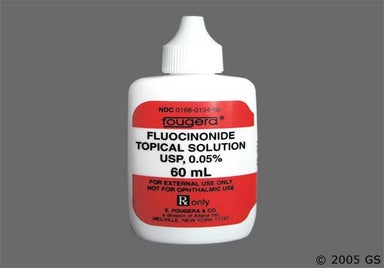
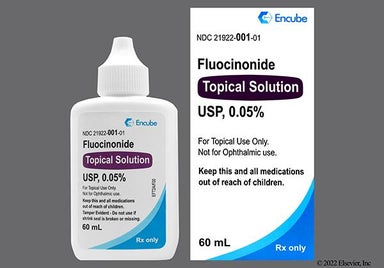
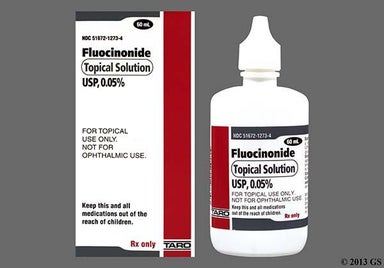
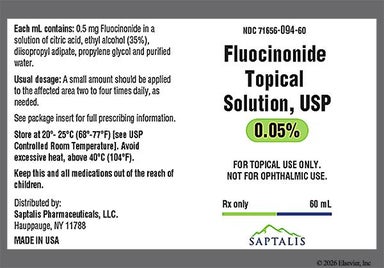
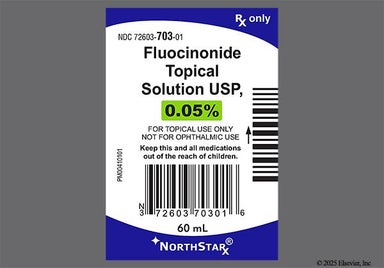
 Bottle of topical solution
| Dosage | Quantity | Price as low as | Price per unit |
|---|---|---|---|
| 60ml of 0.05% | 1 bottle | $24.22 | $24.22 |
| 20ml of 0.05% | 3 bottles | $23.72 | $7.91 |
 Tube of cream
| Dosage | Quantity | Price as low as | Price per unit |
|---|---|---|---|
| 120g of 0.05% | 1 tube | $43.09 | $43.09 |
| 15g of 0.05% | 1 tube | $15.23 | $15.23 |
| 30g of 0.05% | 1 tube | $23.26 | $23.26 |
| 60g of 0.05% | 1 tube | $28.41 | $28.41 |
| 120g of 0.1% | 1 tube | $25.07 | $25.07 |
| 30g of 0.1% | 1 tube | $15.01 | $15.01 |
| 60g of 0.1% | 1 tube | $20.35 | $20.35 |

Although certain medicines should not be used together at all, in other cases two different medicines may be used together even if an interaction might occur. In these cases, your doctor may want to change the dose, or other precautions may be necessary. Tell your healthcare professional if you are taking any other prescription or nonprescription (over-the-counter [OTC]) medicine.






Prescription savings
Stop paying too much for your prescriptions. Compare prices, get pharmacy coupons, and save up to 80%.Resources
About GoodRx
 Find expert answers to your health questions so you can make the best decisions for yourself and your family.
Health conditions
Medications & treatment
Access & affordability
Well-being
Medication discounts

Yes, Fluocinonide is a steroid. It comes in topical forms like a cream that you put on your skin to help with swelling and itching. Fluocinonide is called a "high-potency" or "super potent" steroid. This means that it's much stronger than over-the-counter options like topical hydrocortisone.
No, Fluocinonide isn't an antifungal medication. It's a steroid medication. Steroids don't kill the fungus like antifungal creams can. But they can help relieve symptoms of a fungal skin infection, like redness and swelling.
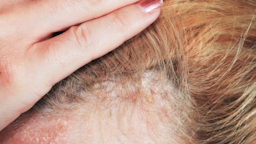
Yes, you can use the Fluocinonide topical solution on the scalp. But be careful to use the smallest amount needed and not get it in your eyes. Follow your prescriber's instructions on where you can apply the Fluocinonide topical solution.
During studies, hair loss wasn't a common side effect of Fluocinonide that people had. If you notice more hair falling out than usual, speak with your primary care provider. They can help you figure out what's going on.
Don't use Fluocinonide on your face, underarms, or groin unless a healthcare professional says it's okay. These areas have thin, sensitive skin and can have side effects there more easily. Also keep the medication away from your vagina, nose, and eyes because it can cause irritation.
Fluocinonide usually isn't prescribed for the face. But in some cases, a skin specialist might have you use the lower strength (0.05%) on your face for a very short time and then check in with them occasionally. The higher strength of Fluocinonide (0.1%) shouldn't be used on the face. The skin on your face can be sensitive. So, it can get irritated or become more fragile with medication use there. Talk to your prescriber about the safest way to treat skin problems on your face.
In general, it's best to use Fluocinonide for only 2 weeks at a time. You shouldn't use it every day for long periods, like months or years. Using it too long without a break can make it more likely for your skin to become thin or fragile. Talk to your prescriber about how long you should use Fluocinonide for your skin problem.
Triamcinolone and Fluocinonide are both topical steroids. They're both used on the skin to help with itchiness and inflammation. But they have different potencies. Triamcinolone is a "medium-potent" steroid. Fluocinonide is in the "super-potent" or "highly-potent" group, depending on the strength. This means that Fluocinonide is generally a stronger steroid than triamcinolone. Talk to a healthcare professional to compare the two and see which is right for you.
