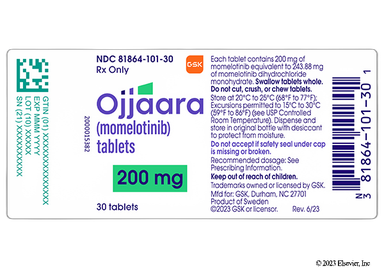
Ojjaara (momelotinib) is FDA approved to treat a rare type of blood cancer called myelofibrosis (MF) in adults with anemia. It works as a JAK inhibitor to help stop abnormal blood cells from growing out of control. Ojjaara (momelotinib) comes as a tablet that you take by mouth once a day. But the medication can cause side effects like bleeding, diarrhea, and tiredness. It also has a risk of infection and liver problems.
Ojjaara (momelotinib) is a JAK inhibitor. It blocks proteins in the body called Janus kinase, or JAK. In people with myelofibrosis, these proteins don’t work properly and cause abnormal blood cells to grow.
By blocking JAK, Ojjaara (momelotinib) helps stop abnormal blood cells from growing out of control. The medication can also help your body make healthy red blood cells.
The following side effects may get better over time as your body gets used to the medication. Let your healthcare provider know immediately if you continue to experience these symptoms or if they worsen over time.
Blood clot—pain, swelling, or warmth in the leg, shortness of breath, chest pain
Heart attack—pain or tightness in the chest, shoulders, arms, or jaw, nausea, shortness of breath, cold or clammy skin, feeling faint or lightheaded
Infection—fever, chills, cough, sore throat, wounds that don't heal, pain or trouble when passing urine, general feeling of discomfort or being unwell
Liver injury—right upper belly pain, loss of appetite, nausea, light-colored stool, dark yellow or brown urine, yellowing skin or eyes, unusual weakness or fatigue
Redness, blistering, peeling, or loosening of the skin, including inside the mouth
Stroke—sudden numbness or weakness of the face, arm, or leg, trouble speaking, confusion, trouble walking, loss of balance or coordination, dizziness, severe headache, change in vision
Can cause side effects such as bleeding and diarrhea
Not recommended during pregnancy or while breastfeeding
Pharmacist tips for Ojjaara (momelotinib)
You can take Ojjaara (momelotinib) with or without food. Swallow tablets whole, and don’t cut, crush, or chew them.
If you miss a dose of Ojjaara (momelotinib), don’t take an extra dose to make up for it. Just skip it and take your scheduled dose the next day.
Ojjaara (momelotinib) can make it easier for you to bleed or bruise. Watch out for unexpected bruising or bleeding that might take longer to stop. You could also get nosebleeds more often or have bleeding gums when you floss or brush your teeth. Get medical help right away if bleeding doesn’t stop or if you have blood in your urine or stool. These could be signs of serious bleeding that needs medical care.
Ojjaara (momelotinib) can lower your white blood cell counts and make it easier to get sick. Call your care team if your temperature is 100.4ºF or higher. This means you have a fever and could be sick. It’s important for your care team to know so they can help treat the infection.
You might have diarrhea while taking Ojjaara (momelotinib). If this happens, make sure to drink plenty of fluids to stay hydrated. But avoid sugary sports drinks because they can make diarrhea worse. If diarrhea gets worse or doesn’t go away, talk to your care team for more options. For example, they might suggest over-the-counter medications like loperamide (Imodium A-D) to help.
Make sure you get your blood tests done when your care team instructs you to while taking Ojjaara (momelotinib). This helps them check your blood cell counts. It also helps them check your liver, which can be affected by the medication but might not cause symptoms.
Don’t stop taking Ojjaara (momelotinib) without talking to your oncologist or hematologist first. Stopping too suddenly can make your symptoms come back. It could also cause fever, trouble breathing, or other serious problems. If stopping is the right choice, your prescriber will slowly lower your dose and monitor you to help keep you safe.
Ask your care team about the best way to handle and discard Ojjaara (momelotinib) safely. Anticancer medications can be harmful to other people. To keep everyone safe, store the medication in a high place or in a locked cabinet where children and pets can’t get to it.
If you can become pregnant: Be sure to use reliable birth control while taking Ojjaara (momelotinib) and for at least 1 week after your last dose. This medication might harm an unborn baby. If you get pregnant during treatment, tell your oncologist or hematologist. They can help decide if the benefits are greater than the risks to your baby.
Risks and warnings for Ojjaara (momelotinib)
Ojjaara (momelotinib) can cause some serious health issues. This risk may be even higher for certain groups. If this worries you, talk to your doctor or pharmacist about other options.
Risk of infections
Some people taking Ojjaara (momelotinib) can have bacterial and viral infections. Some can be serious and possibly life-threatening. It might also make certain viral infections like hepatitis B come back or get worse.
Before starting Ojjaara (momelotinib), tell your care team if you have an active infection. Most times, you’ll have to wait until your infection goes away or gets treated to start the medication. Also tell your care team if you have hepatitis B. Your oncologist or hematologist can talk with you about the risks and benefits of taking Ojjaara (momelotinib). You might need antiviral medications to keep your hepatitis B in check.
Be aware of signs of infection while you’re taking Ojjaara (momelotinib). These include fever, cough, trouble breathing, muscle aches, chills, or severe tiredness. If you have chronic hepatitis B, also look out for signs like nausea, low appetite, yellow skin or eyes, and dark urine. If you notice any signs of infection, get urgent care right away.
Low platelets and low white blood cells
Ojjaara (momelotinib) can cause low platelet levels. Since your platelets help clot blood, having low levels can put you at risk of easy bleeding and bruising. Get medical help if you have any unexplained bruising, bleeding that’s hard to stop, frequent nosebleeds, or blood in your urine or stool.
Ojjaara (momelotinib) can also cause you to have a low white blood cell count. Your white blood cells usually help fight infection. So when they’re low, you might get sick more easily. Reach out to your care team if you think you’re sick. Look for signs like a fever over 100.4ºF, body aches, chills, severe tiredness, or cough.
To help keep you safe, your care team will check your blood count with a blood test. It's done before you start Ojjaara (momelotinib) and as needed during treatment. If your blood counts are too low, you might need to take a break from the medication or take a lower dose.
Liver problems
Ojjaara (momelotinib) can sometimes cause higher liver enzyme levels. These lab results can be a sign of liver damage or irritation. It’s usually mild or moderate and rarely severe.
Because of this risk, let your oncologist or hematologist know if you have any liver problems before you start Ojjaara (momelotinib). They can make sure that it’s safe for you. You might need to take a lower dose of the medication to start with.
During treatment with Ojjaara (momelotinib), your oncologist or hematologist will keep checking your liver. They’ll check every month for the first 6 months and then as needed. If your test results are abnormal, you might need to take a break from Ojjaara (momelotinib) or take a lower dose.
If you notice yellowing of your skin, yellowing of the whites of your eyes, or new belly pain, let your care team know. These can be signs of liver problems.
Severe skin reactions
Some people taking Ojjaara (momelotinib) have had severe skin reactions. This has included toxic epidermal necrolysis, or TEN. It can look like dark-red, purple, or brown patches of skin that can be painful. It can turn into skin peeling and painful sores in the mouth. Other symptoms that might come with the skin reaction are fever and body aches. If this happens, get medical help right away. If it’s related to Ojjaara (momelotinib), you’ll have to stop the medication completely.
Possible serious health outcomes, like heart-related death, heart attack, and stroke
Risk factors: Risks for cardiovascular disease | Current or past smoker
People with rheumatoid arthritis (RA) who took a similar JAK inhibitor had a higher risk of serious health problems. These included heart-related death, heart attack, and stroke.
It’s important to know about this risk, even though Ojjaara (momelotinib) isn’t used for RA. Tell your oncologist or hematologist about all your medical conditions and if you’ve smoked before. They can help decide if Ojjaara (momelotinib) is safe for you. Talk to your oncologist or hematologist if you have concerns about this risk.
Call 911 right away if you have any signs of a heart attack or stroke. A heart attack can look like sudden chest pain, nausea, or sweating. And a stroke can cause a droopy face, sudden weakness on one side of the body, a sudden headache, or trouble walking or talking.
Although Ojjaara (momelotinib) isn’t used for RA, it works in a similar way and might have the same risk. Watch for symptoms of a blood clot like swelling or tenderness in one arm or leg, sudden chest pain, or trouble breathing. If this happens, get medical help right away.
New cancers
Risk factors: Cancer | Current or past smoker
Some people with rheumatoid arthritis (RA) who took a different JAK inhibitor have had a higher risk of developing new cancers, such as lymphoma. This risk appears to be highest in people who smoke.
Ojjaara (momelotinib) isn’t approved for RA. But it’s important to be aware of the risk of possible new cancers during treatment. Tell your care team if you have cancer, are a smoker, or are a past smoker. They can discuss with you about the risks and benefits of taking Ojjaara (momelotinib). Talk with your oncology or hematology care team if you’re worried about the risk of a new cancer.
Worsening of symptoms after pausing or stopping treatment
Don’t pause or stop taking Ojjaara (momelotinib) without talking to your oncologist or hematologist. Your MF symptoms can get worse if you stop. This can include fever, breathing problems, low blood pressure, or other serious problems.
Your oncologist or hematologist can help decide if pausing or stopping Ojjaara (momelotinib) is right for you. If it’s needed for other reasons besides serious side effects, your care team can tell you how to do this in a safe way. They'll lower your dose slowly before you can stop.
Ojjaara (momelotinib) dosage
Typical dosage for Ojjaara (momelotinib)
The typical dose is 200 mg by mouth once a day.
If you have severe liver problems, your oncologist or hematologist might recommend starting at a lower dose of 150 mg once a day.
Based on your side effects from the medication, your oncologist or hematologist will lower the dose to help keep you safe.
What are alternatives to Ojjaara (momelotinib)?
There are a number of medications that your doctor can prescribe in place of Ojjaara (momelotinib). Compare a few possible alternatives below.
GoodRx Health has strict sourcing policies and relies on primary sources such as medical organizations, governmental agencies, academic institutions, and peer-reviewed scientific journals. Learn more about how we ensure our content is accurate, thorough, and unbiased by reading our editorial guidelines.
Prescription savings
Stop paying too much for your prescriptions. Compare prices, get pharmacy coupons, and save up to 80%.
No, Ojjaara isn’t a traditional chemotherapy medication. It’s a type of targeted therapy called a JAK inhibitor. Ojjaara works by blocking a specific protein in the body called JAK. This helps stop signals that tell abnormal blood cells to grow in people with myelofibrosis. The way it works is different from traditional chemotherapy, which destroys all fast-growing cells in the body.
The most common side effect of Ojjaara is bleeding. People with myelofibrosis often already have low platelets, and Ojjaara can lower them even more. Platelets help your blood clot, so low levels can make it easier to bleed. Keep an eye out for bruises that show up for no reason or cuts that take longer to stop bleeding. You might also have more nosebleeds or your gums might bleed when you brush or floss your teeth. Get medical help right away if bleeding won’t stop or if you see blood in your urine or stool. These can be signs of serious bleeding. Also check with your oncologist or hematologist before any surgery or dental work (like having a tooth pulled).
Ojjaara and Jakafi are both used to treat a type of blood cancer called myelofibrosis. Both can help shrink an enlarged spleen and improve myelofibrosis symptoms. But Jakafi can sometimes make your red blood cell counts lower and lead to anemia. Ojjaara doesn’t appear to have a risk of anemia. In fact, it can help people who already have anemia by helping the body make more red blood cells. The medications are both pills that are taken by mouth. But while Ojjaara is taken once a day, Jakafi is taken twice a day. Talk to your oncologist or hematologist to compare and see which best fits your needs.
It’s not clear how safe Ojjaara is during pregnancy. But there’s a risk that it could harm an unborn baby based on animal studies. If you become pregnant while taking this medication, let your oncologist or hematologist know right away. You should only take Ojjaara during pregnancy if the benefits are greater than the risks to your baby. Your prescriber can talk with you about your options and help you choose what’s safest for you.
Don’t breastfeed while taking Ojjaara and for 1 week after your last dose. We don’t know if the medication can pass into breast milk. We also don’t know what effects this could have on your milk supply or on your breastfed baby. But there are potential risks of side effects to your baby. Talk to your oncologist, hematologist, or a lactation expert about safer ways to feed your baby.