

How Much Are Eye Drops After Cataract Surgery, and How Can I Save?
Steroid, NSAID, and antibiotic eye drops can fight dryness and inflammation after eye surgery. Learn how to save on eye drops after cataract surgery here.
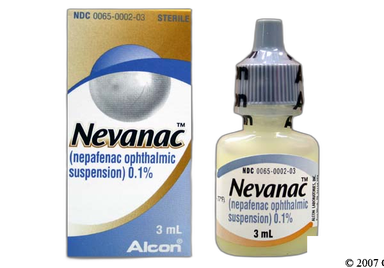
Nevanac, also known by its generic name nepafenac 0.1%, is an eye drop medication that's used to relieve pain and inflammation from cataract surgery. This medication is a non-steroidal anti-inflammatory drug (NSAID) eye drop that both adults and children who need cataract surgery can use. The Nevanac (nepafenac) eye drop is placed in the affected eye(s) three times per day for up to 2 weeks after the surgery. Some side effects include changes in vision and feeling like there's something in your eye.

Nevanac (nepafenac) is a non-steroidal anti-inflammatory drug (NSAID) that's given as an eye drop. The medication works by blocking a protein that plays a role in causing inflammation called cyclooxygenase (COX). When Nevanac (nepafenac) is placed into the eye, the medication helps lessen inflammation, pain, and swelling there.
| Common Brands | Nevanac |
|---|---|
| Drug Class | NSAID |
| Controlled Substance Classification | Not a controlled medication |
| Generic Status | No lower-cost generic available |
| Availability | Prescription only |

The following side effects may get better over time as your body gets used to the medication. Let your healthcare provider know immediately if you continue to experience these symptoms or if they worsen over time.
Along with its needed effects, a medicine may cause some unwanted effects. Although not all of these side effects may occur, if they do occur they may need medical attention.
Check with your doctor immediately if any of the following side effects occur:
More common
Blurred vision
change in vision
decrease in vision
loss of vision
Some side effects may occur that usually do not need medical attention. These side effects may go away during treatment as your body adjusts to the medicine. Also, your health care professional may be able to tell you about ways to prevent or reduce some of these side effects. Check with your health care professional if any of the following side effects continue or are bothersome or if you have any questions about them:
More common
Feeling of having something in the eye
sticky sensation of the eyelids
Less common
Change in color vision
crusting in the corner of the eye
difficulty seeing at night
dizziness
headache
increased sensitivity of the eyes to sunlight
nausea or vomiting
nervousness
pounding in the ears
seeing flashes or sparks of light
seeing floating spots before the eyes, or a veil or curtain appearing across part of vision
slow or fast heartbeat
stuffy or runny nose
tenderness around the eyes and cheekbones
tightness of the chest or wheezing
troubled breathing
Other side effects not listed may also occur in some patients. If you notice any other effects, check with your healthcare professional.
Call your doctor for medical advice about side effects. You may report side effects to the FDA at 1-800-FDA-1088.




Nevanac (nepafenac) can cause some serious health issues. This risk may be even higher for certain groups. If this worries you, talk to your doctor or pharmacist about other options.
Nevanac (nepafenac) can raise your risk of bleeding after eye surgery. Let your prescriber know if you have a history of bleeding problems or if you take any medications that can make you more likely to bleed, such as blood thinners. Call your ophthalmologist if you notice blood spots on your eye or any concerning redness in the eye, especially if you just had eye surgery.
Nevanac (nepafenac) can slow down the healing process, especially if you're also using corticosteroid eye drops like prednisolone to help with eye inflammation even more after cataract surgery. Make sure to go to any scheduled follow-up appointments so your ophthalmologist can check how well your eye is healing from your cataract surgery.
Nevanac (nepafenac) can cause inflammation of the cornea, or the outermost, clear layer of the eye — this inflammation is called keratitis. Nevanac (nepafenac) can also damage the cornea. These problems can affect your eyesight.
Let your ophthalmologist know if you've had problems with your cornea before or if you've had many eye surgeries within a short period of time. Your risk for these cornea problems might be higher. Contact your optometrist or ophthalmologist as soon as possible if you notice changes in your vision or more eye pain or discomfort. Use Nevanac (nepafenac) exactly as prescribed, and don't use it for longer than prescribed after your cataract surgery.
Take your contact lenses out each time before you apply Nevanac (nepafenac) into your eye(s) if you wear contacts. This medication contains a preservative called benzalkonium chloride, which can damage contacts. Ask your ophthalmologist when it's safe for you to wear contact lenses again after your cataract surgery.

 Eye dropper
| Dosage | Quantity | Price as low as | Price per unit |
|---|---|---|---|
| 3ml of 0.1% | 1 eye dropper | $322.20 | $322.20 |
The typical dose is 1 drop into the affected eye(s) three times per day.
The eye drops are typically used the day before cataract surgery, on the day of surgery, and for two weeks after the surgery.

Although certain medicines should not be used together at all, in other cases two different medicines may be used together even if an interaction might occur. In these cases, your doctor may want to change the dose, or other precautions may be necessary. When you are taking this medicine, it is especially important that your healthcare professional know if you are taking any of the medicines listed below. The following interactions have been selected on the basis of their potential significance and are not necessarily all-inclusive.
Using this medicine with any of the following medicines is not recommended. Your doctor may decide not to treat you with this medication or change some of the other medicines you take.
Using this medicine with any of the following medicines is usually not recommended, but may be required in some cases. If both medicines are prescribed together, your doctor may change the dose or how often you use one or both of the medicines.
Using this medicine with any of the following medicines may cause an increased risk of certain side effects, but using both drugs may be the best treatment for you. If both medicines are prescribed together, your doctor may change the dose or how often you use one or both of the medicines.


Contraindications are specific health conditions or situations in which a person should not take a medication due to safety concerns. If you have any of the following conditions or if any of the following apply to you, let your healthcare provider know because Nevanac (nepafenac) will not be safe for you to take.


Prescription savings
Stop paying too much for your prescriptions. Compare prices, get pharmacy coupons, and save up to 80%. Find expert answers to your health questions so you can make the best decisions for yourself and your family.
Health conditions
Medications & treatment
Access & affordability
 Our monthly healthcare membership can help you save thousands on your prescription costs.
Resources

Each bottle of Nevanac contains 3 mL of medication. And each mL of medication is about 20 drops. So a bottle has about 60 drops. The number of days that a bottle lasts for you depends on whether you're having cataract surgery in only one eye or both eyes. It also depends on how often you miss your eye by mistake when you're trying to place the drop in your eye. Contact a member of your care team if you notice that your Nevanac bottle is starting to get empty before you've completed your treatment course.
No, Nevanac isn't a steroid; it's a non-steroidal anti-inflammatory drug (NSAID). Steroid and NSAID eye drops both lower eye inflammation and pain, but they work differently. You might be prescribed both a steroid and NSAID eye drop to use together after your cataract surgery. If so, be sure to wait at least 5 minutes between each eye drop so that both medications get completely absorbed into the eye.
No, Nevanac isn't the same as bromfenac (Prolensa), but they're similar. The two medications are both NSAID eye drops that are used to treat eye inflammation and pain after cataract surgery. But Nevanac eye drops are used three times per day, and bromfenac (Prolensa) eye drops are used just once a day. Additionally, bromfenac (Prolensa) is only approved for adults, whereas Nevanac is approved for people 10 years and older.
No. Ketorolac (Acular) and Nevanac share some similarities, but they're not the same. The two medications are both NSAID eye drops that are used a few times per day to lower eye pain and inflammation from cataract surgery. But some ketorolac eye drops (Acular) can also be used for cornea refractive surgery and others for itchy eyes from allergies. In addition, Nevanac is used for people ages 10 years and older. On the other hand, ketorolac (Acular) can be used for people aged 2 or 3 years and older, depending on what the medication is used for. Ask your ophthalmologist if you have more questions about the differences between the two medications.
After cataract surgery, you'll typically need to use Nevanac for 2 weeks to help relieve eye inflammation and pain from the procedure. Note that it's possible for your ophthalmologist or optometrist to recommend you to use Nevanac for a different period of time, depending on how much eye inflammation and pain you have. Let your prescriber know if you still have eye inflammation, pain, or redness after you use Nevanac for the prescribed amount of time.
No, there's no generic version of Nevanac available yet. Nevanac is currently available by brand name only.
