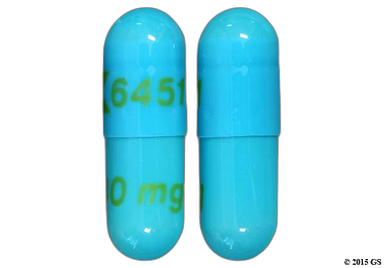
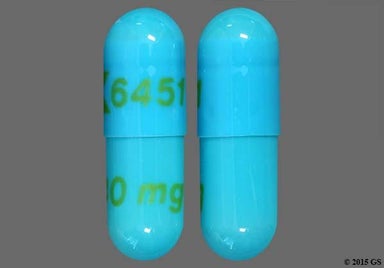
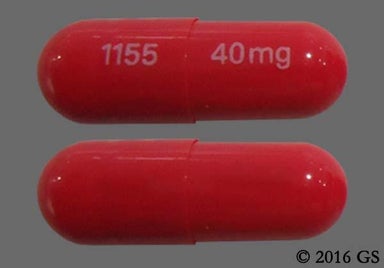
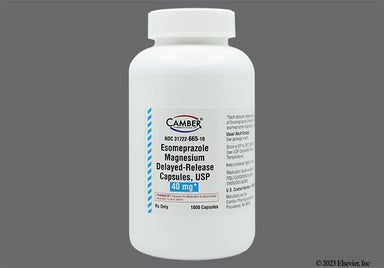
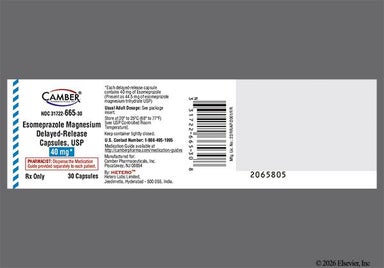
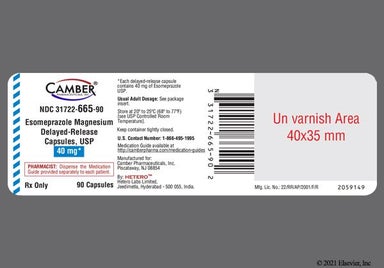
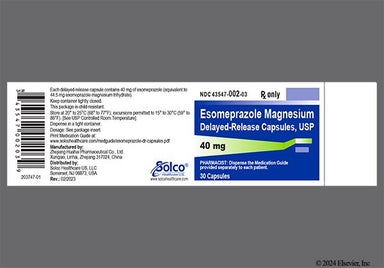
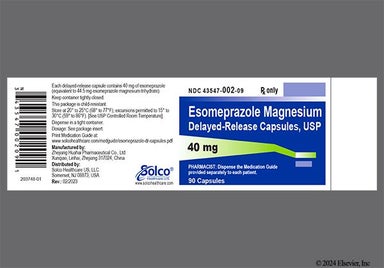
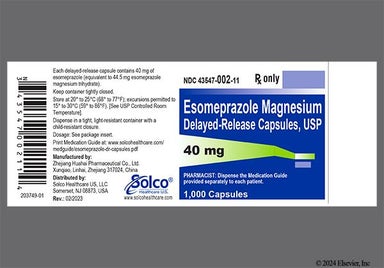
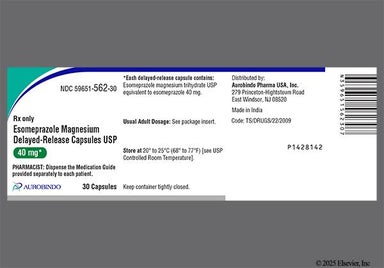
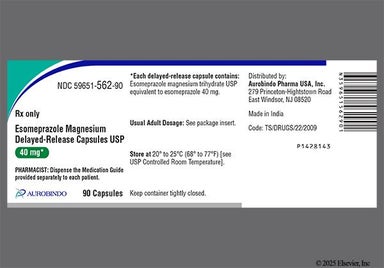
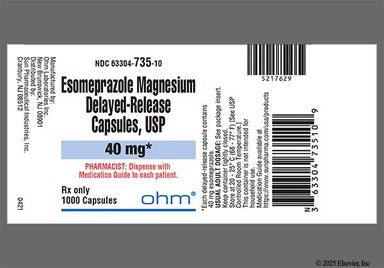
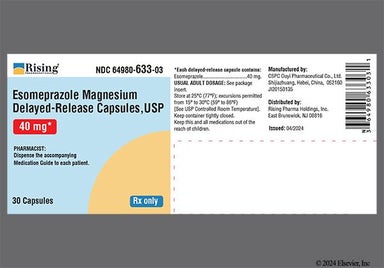
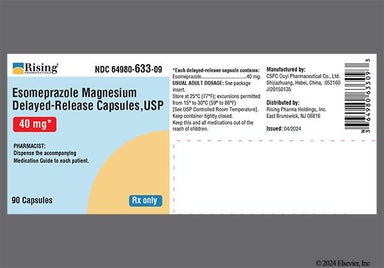
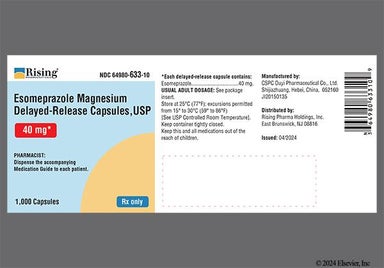
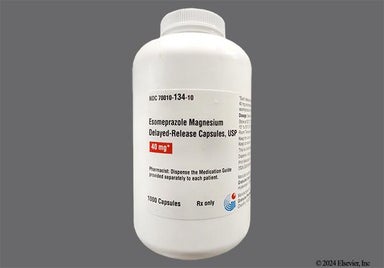
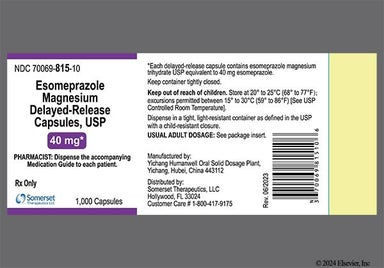
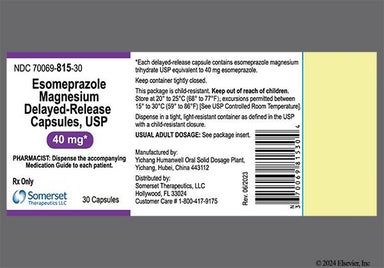
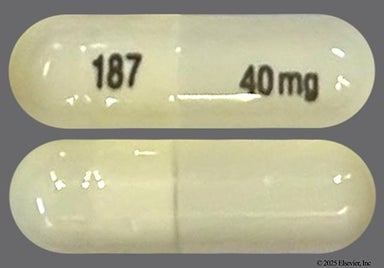
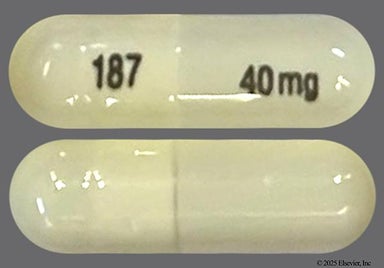
Esomeprazole Coupon - Esomeprazole 40mg capsule

esomeprazole

Generic Nexium
Used for Duodenal Ulcer, Gastric Ulcer, GERD, Heartburn

Esomeprazole (Nexium) is a medication used to treat conditions that are caused by too much stomach acid, such as heartburn or acid reflux. It's available both with a prescription and over the counter (OTC). Take esomeprazole (Nexium) an hour before a meal so that it can start working before you eat. It can take a couple days for you to feel its full effects, so consider taking other quick-acting antacids in the meantime until the medication effect kicks in.

Reviewed by:Last reviewed on February 5, 2023
basics-icon

What is Esomeprazole (Nexium)?

What is Esomeprazole (Nexium) used for?

For adults only:

  • Heartburn — OTC only
  • Lower the risk of stomach ulcer due to nonsteroidal anti-inflammatory drugs (NSAID)
  • Lower the risk of duodenal ulcer caused by Helicobacter pylori (H. pylori) infection
  • Other medical conditions that cause too much stomach acid (e.g., Zollinger-Ellison syndrome)

For adults and children:

  • Gastroesophageal reflux disease (GERD)
  • Inflamed esophagus due to GERD

How Esomeprazole (Nexium) works

Esomeprazole (Nexium) is a proton pump inhibitor (PPI). It lowers the amount of acid in your stomach by blocking the final step of stomach acid production. This helps relieve heartburn and other stomach problems.

When does Esomeprazole (Nexium) start working?Time passed since treatment started:
HOURS
Initial effect
DAYS
Full effect
WEEKS
MONTHS

Drug facts

Common BrandsNexium
Drug ClassPPI
Controlled Substance ClassificationNot a controlled medication
Generic StatusLower-cost generic available
AvailabilityPrescription or over-the-counter
side-effects-icon

Side effects of Esomeprazole (Nexium)

The following side effects may get better over time as your body gets used to the medication. Let your healthcare provider know immediately if you continue to experience these symptoms or if they worsen over time.

Common Side Effects

  • Headache (4-8%)
  • Belly pain (3-4%)
  • Diarrhea (2-4%)
  • Nausea (2%)
  • Passing gas (more than 1%)
  • Constipation (more than 1%)
  • Dry mouth (more than 1%)

Less Common Side Effects

  • Large belly
  • Feeling weak
  • Back pain
  • Chest pain
  • Swelling
  • Hot flushes
  • Feeling tired
  • Flu-like symptoms (e.g., stuffy nose, cough)
  • Fast heart beat
  • Acid reflux
  • Ringing in the ear or ear pain
  • Changes in weight
  • Trouble sleeping
  • Migraine
  • Loss of taste

Esomeprazole (Nexium) serious side effects

Contact your healthcare provider immediately if you experience any of the following.

  • Severe stomach pain or diarrhea
  • Kidney problems: urinating more or less than usual, fever, poor appetite
  • Lupus symptoms: joint pain, skin rash on arms or cheeks that gets worse in the sunlight
  • Serious skin reactions: blistering, peeling, or bleeding skin, fever, chills

Source: DailyMed

The following Esomeprazole (Nexium) side effects have also been reported

Along with its needed effects, a medicine may cause some unwanted effects. Although not all of these side effects may occur, if they do occur they may need medical attention.

Check with your doctor immediately if any of the following side effects occur:

Incidence not known

Blistering, peeling, or loosening of the skin

bloating

chills

constipation

cough

darkened urine

difficulty with swallowing

dizziness

drowsiness

fast heartbeat

fever

indigestion

joint or muscle pain

loss of appetite

mood or mental changes

muscle spasms (tetany) or twitching

nausea

pains in the stomach, side, or abdomen, possibly radiating to the back

puffiness or swelling of the eyelids or around the eyes, face, lips, or tongue

red skin lesions, often with a purple center

red, irritated eyes

seizures

skin rash, hives, itching

sore throat

sores, ulcers, or white spots in the mouth or on the lips

tightness in the chest

trembling

unusual tiredness or weakness

vomiting

yellow eyes or skin

Some side effects may occur that usually do not need medical attention. These side effects may go away during treatment as your body adjusts to the medicine. Also, your health care professional may be able to tell you about ways to prevent or reduce some of these side effects. Check with your health care professional if any of the following side effects continue or are bothersome or if you have any questions about them:

More common

Bad, unusual, or unpleasant (after) taste

change in taste

Less common

Sleepiness or unusual drowsiness

Rare

Acne

back pain

Incidence not known

Agitation

dry mouth

excess air or gas in the stomach or bowels

full feeling

hair loss or thinning of the hair

muscular weakness

passing gas

seeing, hearing, or feeling things that are not there

swelling of the breasts or breast soreness in both females and males

swelling or inflammation of the mouth

swollen joints

Other side effects not listed may also occur in some patients. If you notice any other effects, check with your healthcare professional.

Call your doctor for medical advice about side effects. You may report side effects to the FDA at 1-800-FDA-1088.

prices-container

Get your GoodRx coupon

Avg retail price
$282.05(Save 95.26%)
GoodRx discount
$13.37
See prices
pros-and-cons-icon

Pros and cons of Esomeprazole (Nexium)

Pros

  • Can continue to use with antacids, such as calcium carbonate
  • Provides longer-lasting relief than some other heartburn medications
  • Available as over-the-counter and lower-cost generic options
  • Granules or pellets inside the capsules can be mixed with water or applesauce, so convenient for people with difficulty swallowing pills

Cons

  • Takes 1 to 4 days for the medication to fully kick in, so not the best choice for immediate heartburn relief
  • Significant interaction with clopidogrel (Plavix), which can raise the risk of blood clot
  • Long-term use might weaken bones and raise the risk of bone fracture
  • Can lower magnesium and vitamin B12 levels
pharmacist-tips-icon

Pharmacist tips for Esomeprazole (Nexium)

pharmacist
  • You should take esomeprazole (Nexium) an hour before your meal. If you're taking the medication twice daily, take your first dose before breakfast and your second dose before dinner. Ask your provider or pharmacist if you have questions about the best time to take esomeprazole (Nexium).
  • Swallow the esomeprazole (Nexium) pills whole. Don't chew or crush the pills. Doing so can change how the medication gets absorbed into your body.
  • Esomeprazole (Nexium) capules: If you can't swallow the capsules, you can open the capsule and sprinkle the pellets inside onto one tablespoon of applesauce. Once mixed, swallow the applesauce right away without chewing or crushing the pellets. You can drink some water afterwards to make sure you've swallowed all the medication. Don't save any of the mixture for later, since the medication might not work as well anymore.
  • Esomeprazole (Nexium) granules: Mix and stir the granules with water. You need 15 mL of water for each packet of granules. Wait 2 to 3 minutes to allow the mixture to thicken. Then, stir and drink the entire dose within 30 minutes of mixing. If there's still some medication clinging to the side of your cup, add more water to the cup and swirl, and then drink.
  • Esomeprazole (Nexium) can interact with many medications. Let your provider or pharmacist know what medications you take or plan to take. These medications include over-the-counter products and supplements. Talk with your provider or pharmacist if you have any questions about interactions with this medication.

Over-the-counter esomeprazole (Nexium 24HR)

  • Before using esomeprazole (Nexium), ask your provider if this medication is right for you. This is especially true if you experience the following: heartburn for more than 3 months, frequent wheezing, weight loss, nausea, vomiting, or stomach pain. These could be signs of a serious problem that your provider should check out.
  • Stop taking esomeprazole (Nexium) and speak with a provider if you need this heartburn medication for more than 14 days or if you need more than one course of treatment every 4 months. Also do so if you have the following: heartburn gets worse, rash, joint pain, or diarrhea. There might be some other problem going on that your provider can help you with.
  • Get medical help right away if you experience trouble or pain swallowing, bloody vomit, bloody or black stools, heartburn with lightheadedness or sweating, shoulder pain with shortness of breath, or chest pain. These can be symptoms of serious medical conditions, such as stomach bleeding or heart attack, which need to be treated as soon as possible.
faq-icon

Common questions about Esomeprazole (Nexium)

Esomeprazole (Nexium) and omeprazole (Prilosec) are both PPIs used to treat similar stomach conditions. They're both available OTC and by prescription from your provider; both have lower-cost generics available as well. Both medications have similar chemical structures, so you shouldn't take both at the same time because they're doing the same thing to lessen the production of stomach acid. The American College of Gastroenterology doesn't recommend one over another when it comes to treating GERD symptoms.

Esomeprazole (Nexium) works best if you take it at least an hour before meals. This medication needs to be activated in your stomach before it can start working.

Yes, you can take esomeprazole (Nexium) if you have a weak immune system, but check with your provider first before you use any medications. In addition, if you take a medication for human immunodeficiency virus (HIV) that contains rilpivirine (e.g., Edurant, Complera), avoid taking esomeprazole (Nexium). Doing so can cause your HIV medication to not work as well and worsen your viral infection. If you're taking a medication that contains rilpivirine, ask your healthcare provider about other medications you can take to relieve your heartburn.

You shouldn't take esomeprazole (Nexium) with clopidogrel (Plavix). Doing so can cause clopidogrel (Plavix) to not work as well, which raises your risk of blood clots. According to some studies, certain PPIs like omeprazole (Prilosec) and esomeprazole (Nexium) can cause clopidogrel (Plavix) to break down more quickly in your body. This can lead to greater risk of heart attack and stroke. If you take clopidogrel (Plavix), talk to your provider about the benefits and risks of taking esomeprazole (Nexium).

Maybe. Some studies showed that esomeprazole (Nexium) can lower how much calcium your body absorbs in the short-term, but it's not clear whether this can lead to weak bone or osteoporosis in the long-term. Other studies showed that certain PPIs, such as esomeprazole (Nexium) and rabeprazole (Aciphex), have a higher risk of causing osteoporosis than other PPIs. Keep in mind that more information is still needed to determine the risk of bone fracture with each PPI. Make sure to take esomeprazole (Nexium) as instructed by your provider and only take it within the amount of time your provider directed.

No, esomeprazole (Nexium) has not been discontinued. However, esomeprazole strontium, a similar PPI medication with a different salt form than esomeprazole (Nexium) was discontinued in 2019 and is no longer available in the United States. Esomeprazole (Nexium) is not the same medication as esomeprazole strontium, although both are used to treat similar stomach conditions. If you have questions on the differences between esomeprazole (Nexium) and esomeprazole strontium, or whether esomeprazole (Nexium) is an option for you, talk to your provider or pharmacist.

educational-icon

How to save using GoodRx

Compare Prices
1. Compare PricesSpecify your dosage and quantity to find out exactly how much you can save.
Select your free coupon
2. Select your free couponYou can use the displayed coupon, or compare prices at other pharmacies near you.
Show coupon to your pharmacist
3. Show coupon to your pharmacistPresent your printed or electronic coupon when you pick up your prescription.
Get free couponLearn more
warnings-icon

Risks and warnings for Esomeprazole (Nexium)

Esomeprazole (Nexium) can cause some serious health issues. This risk may be even higher for certain groups. If this worries you, talk to your doctor or pharmacist about other options.

Risk of hiding symptoms of a more serious problem

Frequent episodes of heartburn can be a symptom of stomach cancer. If your heartburn gets worse or comes back after taking esomeprazole (Nexium), let your provider know. Also contact your provider if you have poor appetite, unexplained weight loss, or weakness along with your heartburn. They can check if there are other serious medical problems going on.

Sudden kidney problems

Some people taking PPIs like esomeprazole (Nexium) reported sudden kidney problems. These problems can happen at any point during treatment. Talk with your provider if you're having symptoms of kidney problems, such as urinating more or less than usual, feel nauseous or weak, or have a fever, rash, or joint pain.

Severe infectious diarrhea

  • Risk factors: Older adults | Recent stay at a hospital or nursing home | People with a weakened immune system

Some clinical studies showed that PPIs, such as esomeprazole (Nexium), can raise the risk of getting a bacterial infection called Clostridioides difficile (C. diff). This infection can cause severe diarrhea. Your risk is higher if you're over 65 years old, have recently stayed at a hospital or nursing home, or have a weakened immune system. To lower your risk of C. diff diarrhea, take the lowest possible dose of esomeprazole (Nexium) for the shortest amount of time that works well for you. If you experience severe or watery diarrhea, fever, belly pain, loss of appetite, or nausea, let your provider know right away.

Bone fractures

  • Risk factors: Taking high doses of esomeprazole (Nexium) | Taking esomeprazole (Nexium) for longer than a year | Risk for osteoporosis

PPIs like esomeprazole (Nexium) might raise the risk of bone fractures in the hip, wrist, or spine. Your risk is higher if you take more than one dose of esomeprazole (Nexium) per day or if you take it for more than a year. To prevent the risk of bone fracture(s), take the lowest possible dose of esomeprazole (Nexium) for the shortest amount of time needed to treat your symptoms. If you've had bone fractures before or have osteoporosis (weak bones), talk to your provider about your risk before starting this medication.

Skin reactions

PPIs, such as esomeprazole (Nexium), have rarely caused serious skin reactions. These reactions include Stevens-Johnson syndrome (SJS) and toxic epidermal necrolysis (TEN). Symptoms can include fever, body aches, rash, peeling skin, painful blisters, and swelling of the face. If you notice any of these symptoms, get medical help right away.

Lupus

Some people taking PPIs like esomeprazole (Nexium) developed new or worsening lupus, a condition where your immune system attacks your own body. Lupus symptoms can occur any time during treatment with esomeprazole (Nexium). Some typical symptoms include joint pain or rash, but they often improve within 1 to 3 months of stopping this medication. If you experience any lupus symptoms while taking esomeprazole (Nexium), stop the medication and contact your provider.

Low vitamin B12 and magnesium levels

  • Risk factor: Taking medications to lower stomach acid for longer than 1 year | Taking medications that can lower magnesium levels

Using acid-lowering medications like esomeprazole (Nexium) for a long period of time can cause your vitamin B12 levels to drop. Esomeprazole (Nexium) lowers the amount of acid in your stomach, which is needed for vitamin B12 absorption. If you've been taking this medication for longer than 3 years, or if you have symptoms of vitamin B12 deficiency (e.g., dizziness, muscle weakness, pale skin, tiredness, tingling in arms or legs), talk to your provider.

Taking esomeprazole (Nexium) can also lower your magnesium levels. This can happen 3 months after taking esomeprazole (Nexium), but it's more likely after a year of treatment. Low magnesium levels can sometimes lead to other electrolyte problems. You're at risk for low magnesium levels if you take other medications that can affect electrolyte levels, such as digoxin (Lanoxin) or water pills. Your provider might check your blood during treatment with esomeprazole (Nexium) to make sure your electrolyte levels are in the normal range. Watch for symptoms of electrolyte problems like irregular heart rate, muscle cramps, and tremors. Let your provider know right away if they occur.

Interaction with other medications

Some medications can interfere with how your body gets rid of esomeprazole (Nexium). Depending on if they boost or block how esomeprazole (Nexium) gets removed, the medications can affect the amount of esomeprazole (Nexium) in your body, how well it works, and the risk of side effects. For example, St. John’s Wort and rifampin (Rifadin) can lower the amount of esomeprazole (Nexium) in your body and cause the medication to not work as well. Avoid these medications while taking esomeprazole (Nexium).

Esomeprazole (Nexium) can also interfere with how other medications work. An important medication to avoid with esomeprazole (Nexium) is clopidogrel (Plavix). Esomeprazole (Nexium) causes clopidogrel (Plavix) to not work as well, which raises the risk of blood clots. In addition, esomeprazole (Nexium) can raise the risk of methotrexate toxicity when taken together with methotrexate. Make sure to tell your provider and pharmacist about all the medications you're taking before using esomeprazole (Nexium).

dosage-icon

Esomeprazole (Nexium) dosage

The average cost for 30 capsules of 40mg of Esomeprazole (Nexium) is $13.37 with a free GoodRx coupon. This is 95.26% off the average retail price of $282.05.
capsuleCapsule
DosageQuantityPrice as low asPrice per unit
20mg90 capsules$25.94$0.29
40mg30 capsules$13.37$0.45
cartonCarton
DosageQuantityPrice as low asPrice per unit
30 packets of 10mg1 carton$77.12$77.12
30 packets of 20mg1 carton$74.02$74.02
30 packets of 40mg1 carton$87.62$87.62
30 packets of 2.5mg1 carton$79.42$79.42
30 packets of 5mg1 carton$79.42$79.42

Typical dosage for Esomeprazole (Nexium)

The dosing for adults is listed below. Dosing for children will depend on the child’s weight, age, and the reason they're taking the medication. In general, your child's provider will determine the dosage your child needs to take.

OTC dosing (adults):

OTC-strength esomeprazole is available as capsules and tablets.

  • Heartburn: The typical recommended dose is 20 mg by mouth once daily for 14 days.

Prescription dosing (adults):

Prescription-strength esomeprazole is available as capsules and liquid suspension.

  • Stomach or duodenal ulcer (caused by NSAIDs): The typical recommended dose is 20 mg or 40 mg by mouth once daily. The recommended length of treatment is 6 months.
  • Gastroesophageal reflux disease (GERD): The typical recommended dose is 20 mg by mouth once daily for up to 4 weeks. Your provider might consider another 4 weeks of treatment for you if you still have symptoms.
  • Treatment of inflamed esophagus due to GERD: The typical recommended dose is 20 mg or 40 mg by mouth once daily for 4 to 8 weeks.
  • Maintenance of healing of inflamed esophagus due to GERD: The typical recommended dose is 20 mg by mouth once daily. The recommended length of treatment is 6 months.
  • H. pylori triple therapy: The typical recommended dose is 40 mg by mouth once daily for 10 days. It's usually taken together with amoxicillin and clarithromycin. Your dose might differ if you have liver problems.
  • Medical conditions that cause too much stomach acid: The typical recommended starting dose is 40 mg by mouth twice daily.

Esomeprazole (Nexium) is also available as an injection that's administered into the veins by a provider in a healthcare setting. This intravenous (IV) form is typically used in certain situations (e.g., unable to take an oral form to treat some GERD complications, risk reduction of ulcer rebleeds after a procedure).

interactions-icon

Interactions between Esomeprazole (Nexium) and other drugs

Esomeprazole (Nexium) may interact with certain medications or supplements. Always let your doctor and pharmacist know about any other medications or supplements (including prescribed and over-the-counter medications, vitamins, and dietary or herbal supplements) that you are currently taking. The list below does not include all possible drug interactions with Esomeprazole (Nexium). Please note that only the generic name of each medication is listed below.

Although certain medicines should not be used together at all, in other cases two different medicines may be used together even if an interaction might occur. In these cases, your doctor may want to change the dose, or other precautions may be necessary. When you are taking this medicine, it is especially important that your healthcare professional know if you are taking any of the medicines listed below. The following interactions have been selected on the basis of their potential significance and are not necessarily all-inclusive.

Using this medicine with any of the following medicines is not recommended. Your doctor may decide not to treat you with this medication or change some of the other medicines you take.

  • Rilpivirine

Using this medicine with any of the following medicines is usually not recommended, but may be required in some cases. If both medicines are prescribed together, your doctor may change the dose or how often you use one or both of the medicines.

Using this medicine with any of the following medicines may cause an increased risk of certain side effects, but using both drugs may be the best treatment for you. If both medicines are prescribed together, your doctor may change the dose or how often you use one or both of the medicines.

cost-icon

How much does Esomeprazole (Nexium) cost?

To access savings, use a GoodRx coupon and pay just a fraction of the retail price.
contraindications-icon

Esomeprazole (Nexium) contraindications

Contraindications are specific health conditions or situations in which a person should not take a medication due to safety concerns. If you have any of the following conditions or if any of the following apply to you, let your healthcare provider know because Esomeprazole (Nexium) will not be safe for you to take.

alternatives-icon

What are alternatives to Esomeprazole (Nexium)?

There are a number of medications that your doctor can prescribe in place of Esomeprazole (Nexium). Compare a few possible alternatives below.
Esomeprazole (Nexium)
Used for:

For adults only:

  • Heartburn — OTC only
  • Lower the risk of stomach ulcer due to nonsteroidal anti-inflammatory drugs (NSAID)
  • Lower the risk of duodenal ulcer caused by Helicobacter pylori (H. pylori) infection
  • Other medical conditions that cause too much stomach acid (e.g., Zollinger-Ellison syndrome)

For adults and children:

  • Gastroesophageal reflux disease (GERD)
  • Inflamed esophagus due to GERD
$13.37Lowest GoodRx priceView prices
Used for:
$9.84Lowest GoodRx priceView prices
Used for:

For adults only:

For adults and children:

  • Gastroesophageal reflux disease (GERD)
  • Inflamed esophagus due to GERD
$8.60Lowest GoodRx priceView prices
latest-news-icon

News about Esomeprazole (Nexium)

Omeprazole (Prilosec) is a common treatment for gastroesophageal reflux disease (GERD). Learn about omeprazole alternatives like Carafate, Nexium, and Tums.
Exploring 9 Alternatives to Omeprazole, From H2 Blockers to Natural Products
Omeprazole (Prilosec) is a common treatment for gastroesophageal reflux disease (GERD). Learn about omeprazole alternatives like Carafate, Nexium, and Tums.
GoodRx breaks down the most common acid reflux medications, including what they do, how and when to take them, potential side effects and more.
Best Acid Reflux Medicine: Comparing Antacids, H2 Blockers, and Proton Pump Inhibitors
GoodRx breaks down the most common acid reflux medications, including what they do, how and when to take them, potential side effects and more.
A dry cough can be caused by asthma, infections, or even acid reflux. Read on for the most common causes of a dry cough and how to treat it.
The 10 Most Common Causes of a Persistent Dry Cough — and How to Get Rid of It
A dry cough can be caused by asthma, infections, or even acid reflux. Read on for the most common causes of a dry cough and how to treat it.
What works fastest for heartburn? Over-the-counter (OTC) medications are available when you need quick relief. Explore OTC heartburn medications, including Tums and Rolaids, with GoodRx.
The 3 Best OTC Options for Heartburn and GERD
What works fastest for heartburn? Over-the-counter (OTC) medications are available when you need quick relief. Explore OTC heartburn medications, including Tums and Rolaids, with GoodRx.
Discover foods and drinks that help heartburn — and those to avoid. Learn the best and worst options and tips for soothing acid reflux symptoms.
The Best Foods and Drinks for Heartburn — and What to Avoid
Discover foods and drinks that help heartburn — and those to avoid. Learn the best and worst options and tips for soothing acid reflux symptoms.
Acid rebound happens when acid production increases after stopping acid-suppressing medications. Learn the symptoms of acid rebound and which medications can cause it.
Is Your Reflux Medication Causing Acid Rebound? Here’s How to Know
Acid rebound happens when acid production increases after stopping acid-suppressing medications. Learn the symptoms of acid rebound and which medications can cause it.
Esomeprazole and omeprazole are both PPIs that treat GERD. How are they different? And which one should you take? Click here to compare side effects and more.
Esomeprazole (Nexium) vs. Omeprazole (Prilosec): 7 Things to Know When Comparing These PPIs
Esomeprazole and omeprazole are both PPIs that treat GERD. How are they different? And which one should you take? Click here to compare side effects and more.
Discover common Nexium side effects with GoodRx’s guide, and take charge of your acid reflux treatment with confidence.
9 Nexium Side Effects You Should Know About
Discover common Nexium side effects with GoodRx’s guide, and take charge of your acid reflux treatment with confidence.
Depression is a side effect of many medications, including opioids and corticosteroids. Read about 11 medications that cause depression and when to seek help.
11 Medications That Can Cause Depression as a Side Effect
Depression is a side effect of many medications, including opioids and corticosteroids. Read about 11 medications that cause depression and when to seek help.
Proton pump inhibitors (PPIs) effectively treat gastroesophageal reflux disease (GERD). Read answers to FAQs about PPIs and their side effects and interactions.
10 FAQs About Proton Pump Inhibitors (PPIs), Including How PPIs Work
Proton pump inhibitors (PPIs) effectively treat gastroesophageal reflux disease (GERD). Read answers to FAQs about PPIs and their side effects and interactions.
images-icon

Esomeprazole (Nexium) images

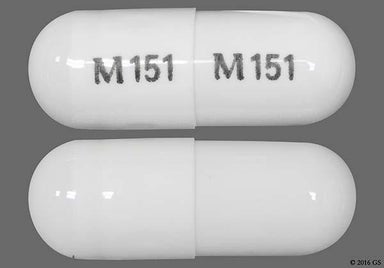
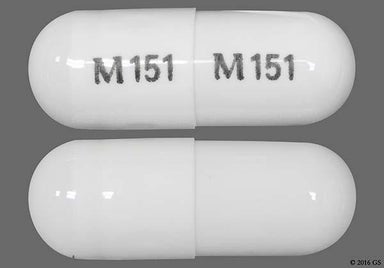
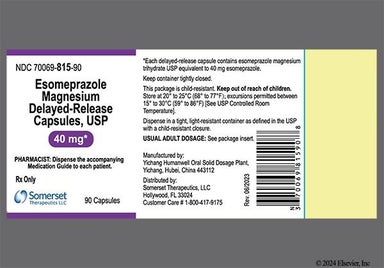
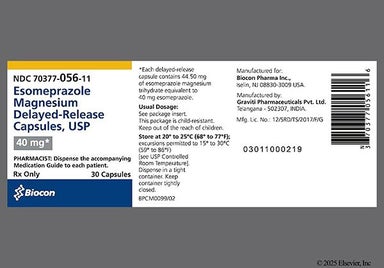
White M151 M151 - Esomeprazole Magnesium 40mg Delayed-Release Capsule
This medicine is White Capsule Imprinted With "M151 M151".White M151 M151 - Esomeprazole Magnesium 40mg Delayed-Release Capsule
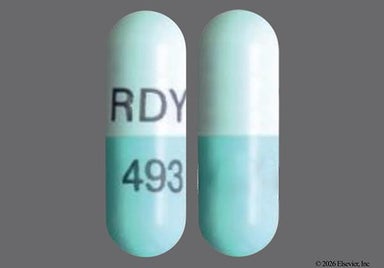
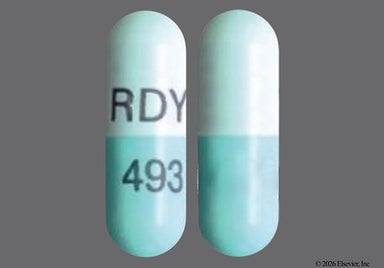
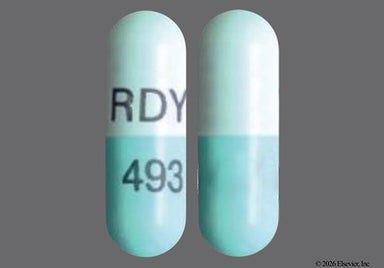
Blue Rdy 493 - Esomeprazole Magnesium 40mg Delayed-Release Capsule
This medicine is Blue Capsule Imprinted With "Rdy 493".Blue Rdy 493 - Esomeprazole Magnesium 40mg Delayed-Release Capsule
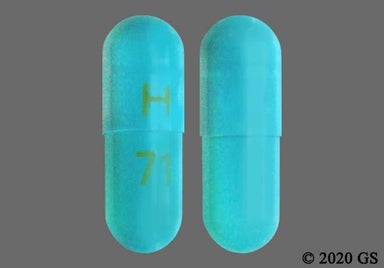
Blue H 71 - Esomeprazole Magnesium 40mg Delayed-Release Capsule
This medicine is Blue Capsule Imprinted With "H 71".Blue H 71 - Esomeprazole Magnesium 40mg Delayed-Release Capsule
White H E3 - Esomeprazole Magnesium 40mg Delayed-Release Capsule
This medicine is White Capsule Imprinted With "H E3".White H E3 - Esomeprazole Magnesium 40mg Delayed-Release Capsule
White H E3 - Esomeprazole Magnesium 40mg Delayed-Release Capsule
This medicine is White Capsule Imprinted With "H E3".White H E3 - Esomeprazole Magnesium 40mg Delayed-Release Capsule
White H E3 - Esomeprazole Magnesium 40mg Delayed-Release Capsule
This medicine is White Capsule Imprinted With "H E3".White H E3 - Esomeprazole Magnesium 40mg Delayed-Release Capsule
Black And Pink S002 40Mg - Esomeprazole Magnesium 40mg Delayed-Release Capsule
This medicine is Black And Pink Capsule Imprinted With "S002 40Mg".Black And Pink S002 40Mg - Esomeprazole Magnesium 40mg Delayed-Release Capsule
Black And Pink S002 40Mg - Esomeprazole Magnesium 40mg Delayed-Release Capsule
This medicine is Black And Pink Capsule Imprinted With "S002 40Mg".Black And Pink S002 40Mg - Esomeprazole Magnesium 40mg Delayed-Release Capsule
Black And Pink S002 40Mg - Esomeprazole Magnesium 40mg Delayed-Release Capsule
This medicine is Black And Pink Capsule Imprinted With "S002 40Mg".Black And Pink S002 40Mg - Esomeprazole Magnesium 40mg Delayed-Release Capsule
White I82 - Esomeprazole Magnesium 40mg Delayed-Release Capsule
This medicine is White Capsule Imprinted With "I82".White I82 - Esomeprazole Magnesium 40mg Delayed-Release Capsule
White I82 - Esomeprazole Magnesium 40mg Delayed-Release Capsule
This medicine is White Capsule Imprinted With "I82".White I82 - Esomeprazole Magnesium 40mg Delayed-Release Capsule
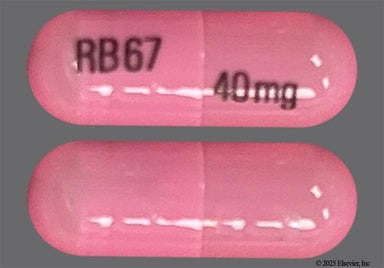
Pink Rb67 40 Mg - Esomeprazole Magnesium 40mg Delayed-Release Capsule
This medicine is Pink Capsule Imprinted With "Rb67 40 Mg".Pink Rb67 40 Mg - Esomeprazole Magnesium 40mg Delayed-Release Capsule
Pink Rb67 40 Mg - Esomeprazole Magnesium 40mg Delayed-Release Capsule
This medicine is Pink Capsule Imprinted With "Rb67 40 Mg".Pink Rb67 40 Mg - Esomeprazole Magnesium 40mg Delayed-Release Capsule
Blue Oe A96 Oe A96 40Mg 40Mg - Esomeprazole Magnesium 40mg Delayed-Release Capsule
This medicine is Blue Capsule Imprinted With "Oe A96 Oe A96 40Mg 40Mg".Blue Oe A96 Oe A96 40Mg 40Mg - Esomeprazole Magnesium 40mg Delayed-Release Capsule
Blue Oe A96 Oe A96 40Mg 40Mg - Esomeprazole Magnesium 40mg Delayed-Release Capsule
This medicine is Blue Capsule Imprinted With "Oe A96 Oe A96 40Mg 40Mg".Blue Oe A96 Oe A96 40Mg 40Mg - Esomeprazole Magnesium 40mg Delayed-Release Capsule
Blue Oe A96 Oe A96 40Mg 40Mg - Esomeprazole Magnesium 40mg Delayed-Release Capsule
This medicine is Blue Capsule Imprinted With "Oe A96 Oe A96 40Mg 40Mg".Blue Oe A96 Oe A96 40Mg 40Mg - Esomeprazole Magnesium 40mg Delayed-Release Capsule
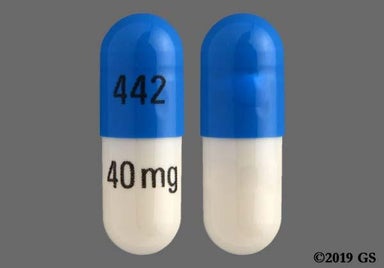
White And Blue 442 40 Mg - Esomeprazole Magnesium 40mg Delayed-Release Capsule
This medicine is White And Blue Capsule Imprinted With "442 40 Mg".White And Blue 442 40 Mg - Esomeprazole Magnesium 40mg Delayed-Release Capsule
White G 60 - Esomeprazole Magnesium 40mg Delayed-Release Capsule
This medicine is White Capsule Imprinted With "G 60".White G 60 - Esomeprazole Magnesium 40mg Delayed-Release Capsule

Get savings updates for Esomeprazole (Nexium)

Receive price alerts, news, and other messages from GoodRx about Esomeprazole (Nexium) and other healthcare topics and relevant savings offers.

By providing your email, you consent to receive marketing communications from GoodRx, which may include content and/or data related to men's health, women's health, reproductive care, or sexual health. You agree to the GoodRx Terms of Use and acknowledge the Privacy Policy. You can unsubscribe at any time.

References

Best studies we found

GoodRx Health has strict sourcing policies and relies on primary sources such as medical organizations, governmental agencies, academic institutions, and peer-reviewed scientific journals. Learn more about how we ensure our content is accurate, thorough, and unbiased by reading our editorial guidelines.

Was this page helpful?