Key takeaways:
Birth control pills contain the hormone progestin with or without estrogen. They vary in dosages, brands, and cost.
Side effects can happen with any type of birth control pill. They usually resolve on their own after a few months of use.
With so many available options, it can be difficult to choose a birth control pill. A healthcare professional can help you decide which is best for you, based on your preferences and medical history.
Save on related medications
Birth control pills are a common option for contraception. When taken properly, they can be very effective at preventing unplanned pregnancies in both teens and adults. There are many options available, which may make it difficult to choose a pill that’s right for you.
Here, we’ll discuss the different types of birth control pills available and the pros and cons of each. This way, you can decide which type or brand of birth control pill might be best for you. And if you decide the pill isn’t right for you, see this birth control guide, which includes information about other birth control methods.
How do birth control pills work?
Birth control pills contain hormones that work to prevent pregnancy in three ways:
They prevent ovulation (egg release from the ovary).
They form a thick plug of cervical mucus at the uterus opening, or the cervix, to prevent sperm from entering the uterus.
They cause the lining of the uterus to thin out. This prevents a fertilized egg from properly implanting in the uterus.
Birth control pills typically contain either estrogen and progestin or progestin alone. Adding estrogen to progestin improves ovulation prevention, making the pill more effective.
But there are some things to be aware of with estrogen-containing pills:
Risk of blood clots: Depending on your health and medical history, estrogen may raise your risk for certain medical complications like stroke or blood clots.
Risk of breakthrough bleeding: Medical professionals like to start with a low dose of estrogen to decrease the risk of complications. But lower doses of estrogen can make breakthrough bleeding or spotting more likely.
What are the different types of birth control pills?
There are two main types of birth control pills. These include:
Combination pills, containing both estrogen and progestin
Progestin-only pills, also referred to as the “minipill”
Let’s take a look at the pros and cons of each below. We’ve also included the lowest GoodRx price available for each type of pill at certain pharmacies. All pricing is for 1 pack of pills, unless otherwise specified.
Combination pills
Most birth control pills fall into this category. The dose of estrogen and progestin can change throughout the month or pack.
Monophasic pills

These are the most common types of birth control pills. They provide a steady dose of hormones — typically for 21 days, followed by 7 inactive (“placebo”) pills that don’t contain any hormones. These inactive pills are included to help you stay on track, so you know when to start your next pack. It’s common to experience bleeding similar to menstruation while taking them.
Here are the pros, cons, and some examples:
Pros: They help lighten or shorten the menstrual cycle and reduce cramps.
Cons: They can cause changes to menstrual cycles, missed periods, and breakthrough bleeding or spotting.
Examples: Aviane ($19.08), Junel Fe 1/20 ($12.46), Apri ($12.88)
Biphasic pills
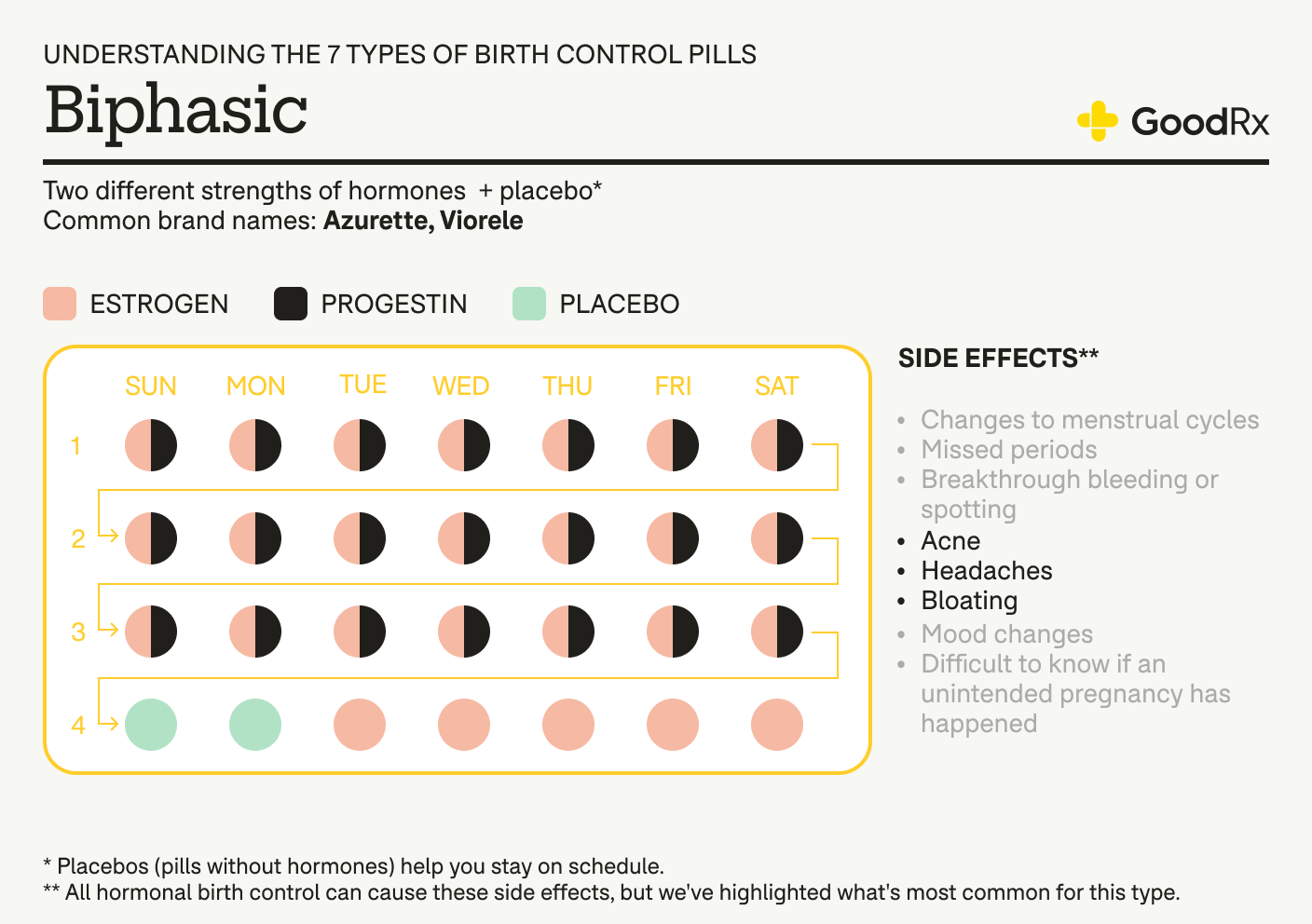
These come in packs containing 3 sets of pills at different doses, which you take in this order:
You start with 21 active pills that contain both hormones.
Next, you take 2 inactive pills.
Finally, you take 5 pills that contain only estrogen.
Here are the pros, cons, and some examples:
Pros: They reduce the likelihood of menstrual changes and breakthrough bleeding.
Cons: There’s a higher chance of side effects like headaches and bloating than monophasic pills.
Triphasic pills
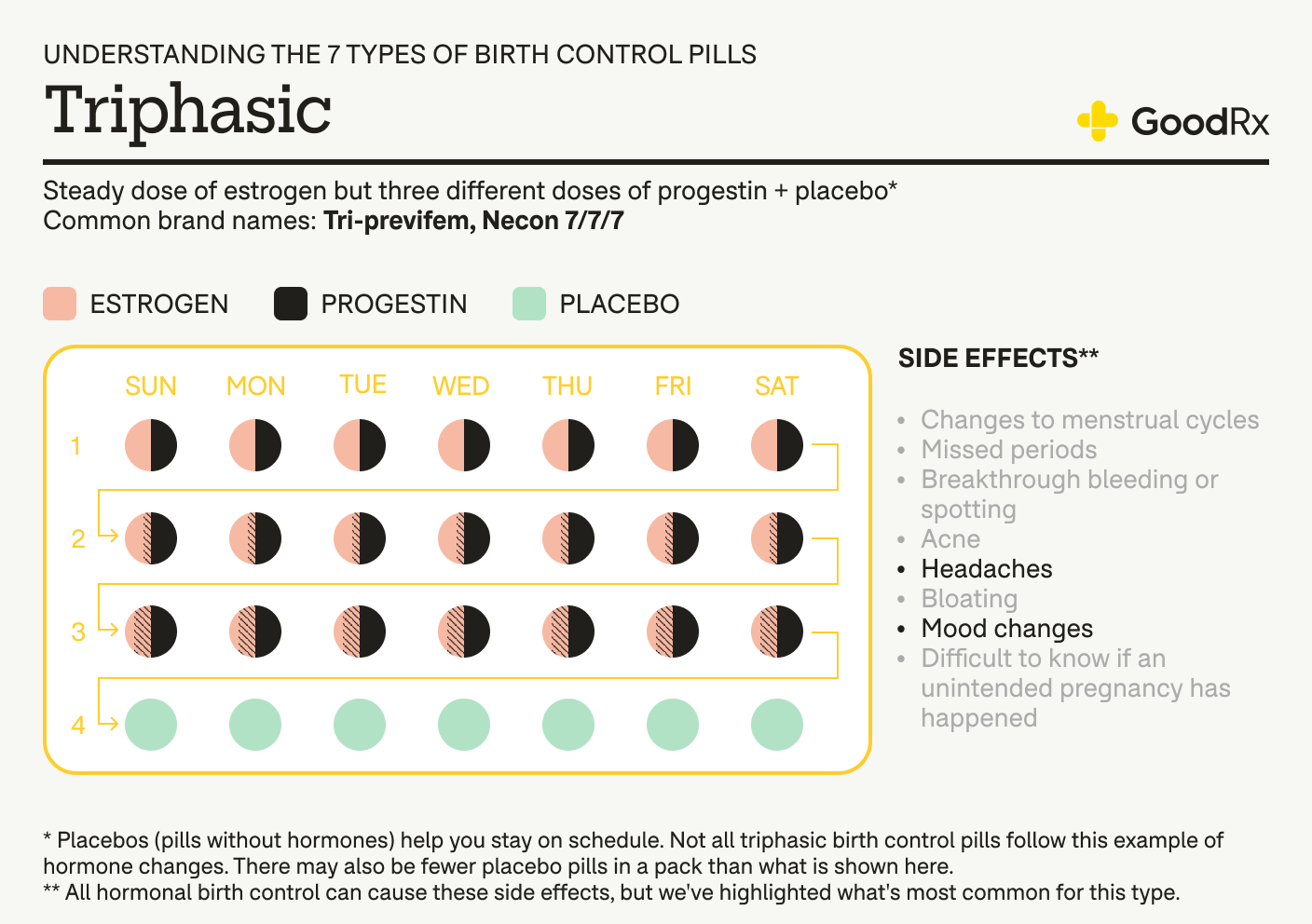
These provide changing doses of estrogen and progestin throughout the month, similar to what the body does naturally. The most common pattern is 7 days of one strength, 7 days of another strength, 7 days of a third strength, and then 7 days of inactive pills.
Here are the pros, cons, and some examples:
Pros: There’s a very low chance of menstrual changes and breakthrough bleeding.
Cons: They’re most likely to cause side effects, like mood changes and headaches.
Examples: Tri-Previfem ($15.28)
Quadriphasic pills

These contain four different strengths of hormones, also intended to mimic hormones throughout a cycle. Estrogen gradually decreases in strength throughout the month, and progestin increases.
Here are the pros, cons, and some examples:
Pros: Side effects and breakthrough bleeding are least likely.
Cons: Missed pills are very hard to correct, which means that women are more likely to get pregnant by accident if they miss a dose.
Examples: Natazia ($246.40) is a common brand, but it may not be an affordable option for everyone.
Extended cycle pills
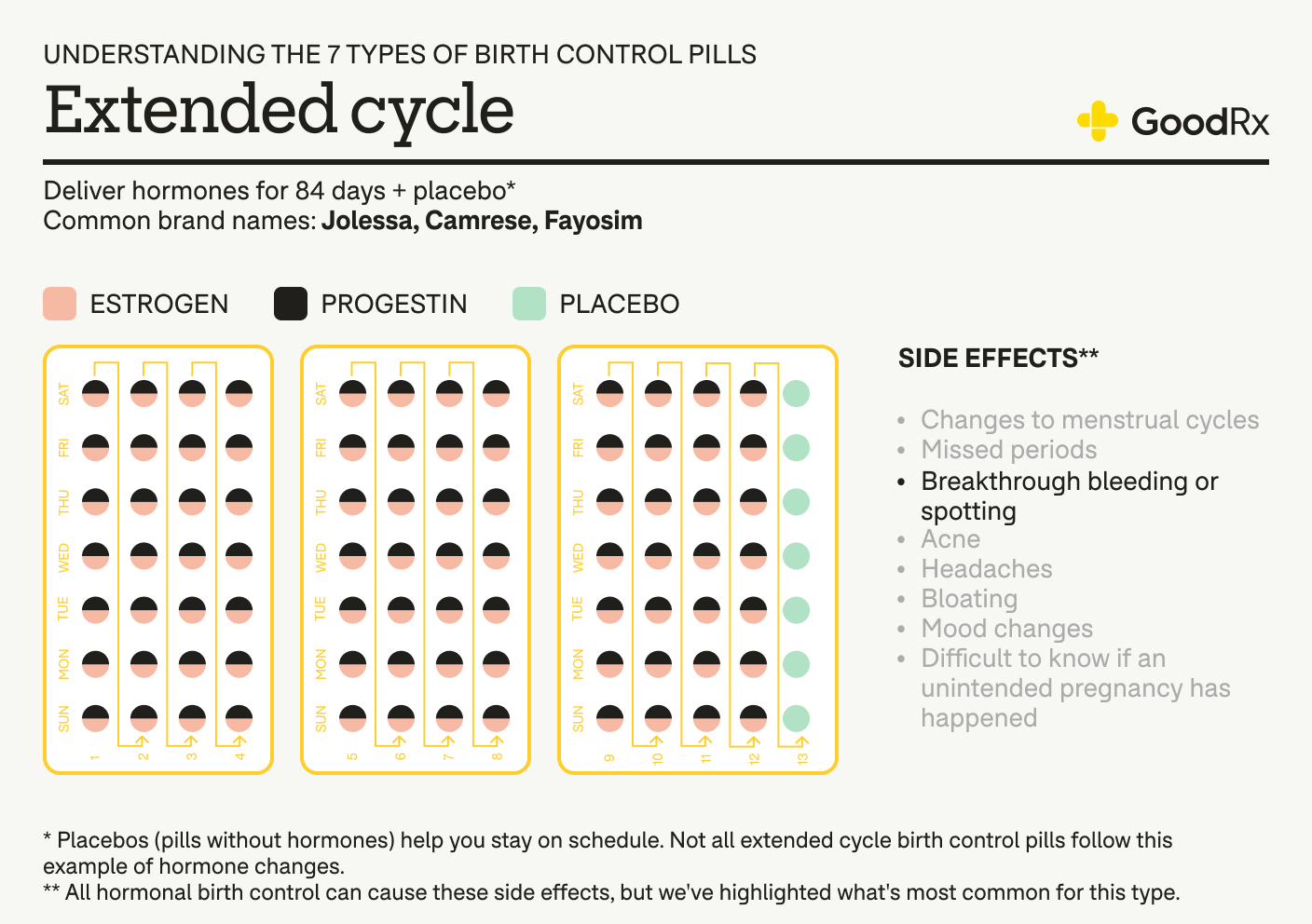
These are designed to deliver hormones for 84 days so women only have 4 periods a year. They usually come as monophasic pills (a steady dose of hormones that doesn’t change) but there are a few biphasic options as well.
Here are the pros, cons, and some examples:
Pros: These are a good option if you want fewer periods (for personal or health reasons) or want to adjust your periods for life events.
Cons: There’s a greater likelihood of breakthrough bleeding or spotting.
Continuous cycle pills

These are similar to extended cycle pills, except there are no inactive pills at all.
Here are the pros, cons, and some examples:
Pros: They virtually eliminate menstrual periods and reduce cramps.
Cons: These are extremely likely to cause breakthrough bleeding or spotting. Plus, the lack of a period can also make it difficult to know if an unintended pregnancy has happened.
Examples: There’s only one generic available — Amethyst ($49.99).
Progestin-only pill
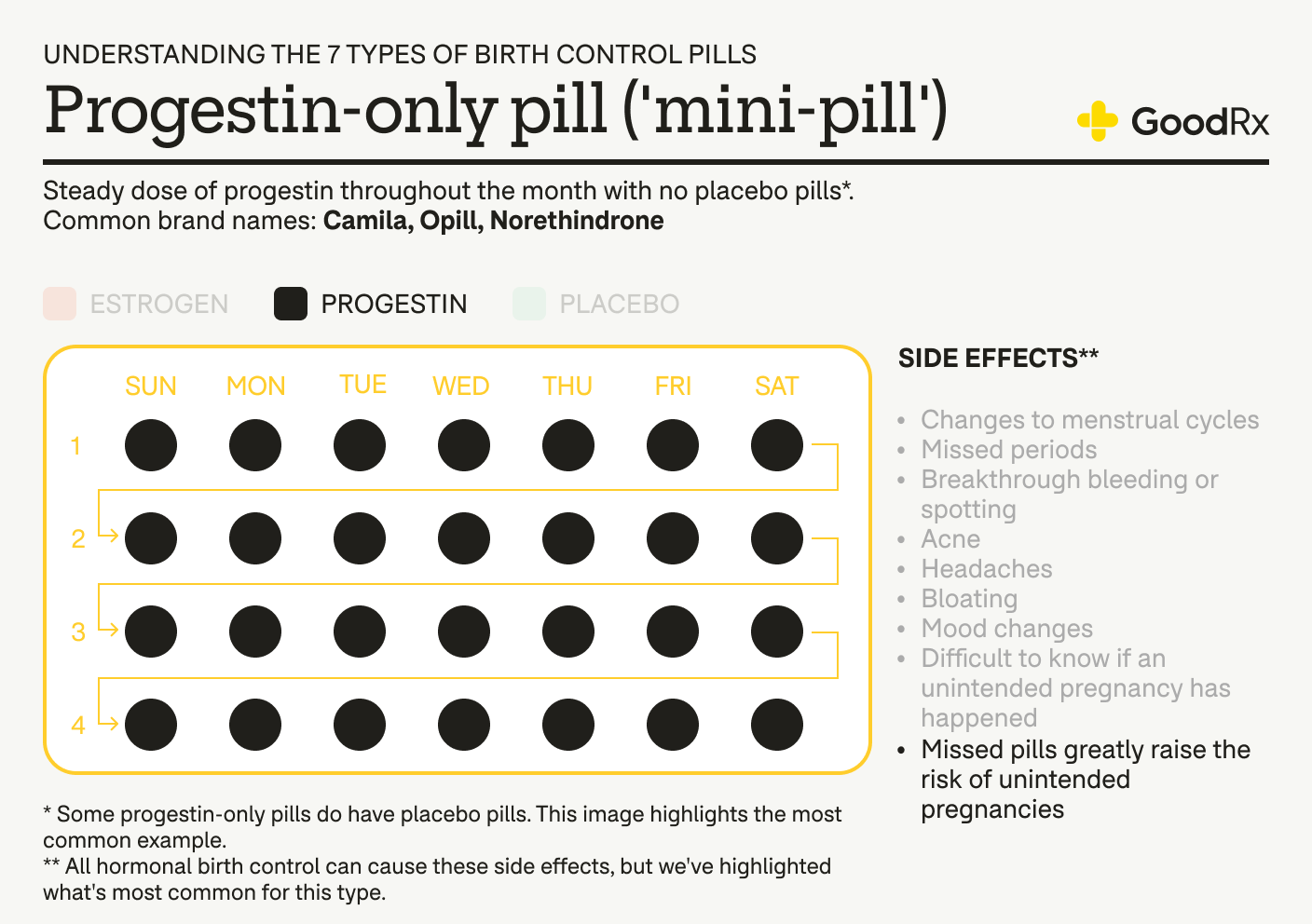
This is commonly referred to as the “minipill.” It provides a steady dose of progestin throughout the month. It doesn’t contain estrogen. Most brands have no inactive pills. And you don’t take a break between packs. The exception is Slynd, a brand-name pill that has four inactive pills in a 28-day pack.
Here are the pros, cons, and some examples:
Pros: This is the safest choice for smokers, especially smokers over age 35, women with a history of strokes or heart problems, and breastfeeding women.
Cons: The minipill is generally unforgiving: You must take it at the exact same time every day. If you miss a dose by 3 hours or more, you’re very likely to have breakthrough bleeding, and there’s a risk of pregnancy. Slynd is the only minipill that has a 24-hour missed pill window. It doesn’t have a generic version available yet, so affordability can be an issue.
Examples: Camila ($22.97), Jencycla ($14.88), and norethindrone ($9.00). Opill ($49.99 for 3 packs) is the first FDA-approved, over-the-counter pill. It’s also an example of a progestin-only pill.
How to choose the best birth control pill by name
In general, birth control pill brands can be a bit confusing if you don’t know what you’re looking for. But sometimes, their names offer clues. For example:
Loestrin provides a lower amount of estrogen compared to many other brands.
Tri-Previfem and Tri-Sprintec are triphasic pills.
With Seasonale and Seasonique, women get only four periods a year (once every season).
Junel 1/20 contains 1 mg progestin and 20 mcg estrogen.
Necon 7/7/7 increases the strength of hormones every 7 days in a pack.
The “Fe” in the name, such as with Junel Fe 24, means that the pill includes a small amount of iron (symbol Fe) in the inactive pills of the pack. This can help prevent temporary anemia in women who become iron-deficient during their menstrual period.
What are the side effects of birth control pills?
Side effects from the pill are common, regardless of the type. Minipills are more likely to cause bleeding irregularities than combination pills, but otherwise they’re pretty similar. Contrary to popular belief, birth control pills don’t usually cause weight gain.
| Combination pill side effects | Progestin-only (minipill) side effects |
|---|---|
|
|
The good news is side effects tend to improve or resolve after a few months of use. But if side effects remain a problem, speak with your healthcare team. They may recommend switching types or brands, or trying an alternative to the pill. Each person responds differently to hormones and different dosages, so a trial-and-error period may be necessary.
Take our quiz: Types of birth control
How do healthcare professionals decide which birth control pill to prescribe?
Before determining which birth control pill might be the best option for you, your prescriber will need to know your medical history. This is because estrogen may not be safe for everyone. So their recommendations can depend on:
Your age
What your menstrual cycle is like
Other medical conditions like diabetes, hypertension, lupus, or migraines
Any history of blood clots, or breast or uterine cancer
Whether you’re breastfeeding or have any hormone-related issues, like acne or premenstrual dysphoric disorder (PMDD)
Any other medications you may be taking
The best birth control pill for you is the one that will be the most effective with the least amount of risk based on your medical history.
Frequently asked questions
This can’t be answered for two reasons. First, people respond differently to birth control pills, so what works great for you might not be great for your friend. Second, there aren’t enough head-to-head trials of different pills to compare side effect profiles. While self-reported, observational data is helpful, it’s not strong enough to draw conclusions.
That depends on how good you are about taking them every day. With perfect use, the pill is 99% effective. But no one’s perfect, so it’s more like 91% (meaning there’s a 9 in 100 chance of getting pregnant). The instructions for the minipill are especially strict: You have to take it at the same time every day within a 3-hour window. There’s a bit more flexibility with combination pills, but not much.
This refers to the amount of hormones in each pill. You can find the dosage on the box or pill pack. In theory, low-dose pills may be safer, but there’s no evidence to support this. Low-dose pills are more likely to result in breakthrough or irregular bleeding.
This can’t be answered for two reasons. First, people respond differently to birth control pills, so what works great for you might not be great for your friend. Second, there aren’t enough head-to-head trials of different pills to compare side effect profiles. While self-reported, observational data is helpful, it’s not strong enough to draw conclusions.
That depends on how good you are about taking them every day. With perfect use, the pill is 99% effective. But no one’s perfect, so it’s more like 91% (meaning there’s a 9 in 100 chance of getting pregnant). The instructions for the minipill are especially strict: You have to take it at the same time every day within a 3-hour window. There’s a bit more flexibility with combination pills, but not much.
This refers to the amount of hormones in each pill. You can find the dosage on the box or pill pack. In theory, low-dose pills may be safer, but there’s no evidence to support this. Low-dose pills are more likely to result in breakthrough or irregular bleeding.
The bottom line
When taken properly, birth control pills are an effective option for contraception. There are many different and affordable options available, so choosing one might feel overwhelming. Your healthcare team can help you find one that works for you, based on your medical history, potential side effects, and cost.

Why trust our experts?




References
American College of Obstetricians and Gynecologists. (2023). Combined hormonal birth control: Pill, patch, and ring.
American College of Obstetricians and Gynecologists. (2024). Progestin-only hormonal birth control: Pill and injection.
Gallo, M. F., et al. (2013). 20 µg versus >20 µg estrogen combined oral contraceptives for contraception. Cochrane Database of Systematic Reviews.
Teal, S., et al. (2021). Contraception selection, effectiveness, and adverse effects a review. JAMA.