Key takeaways:
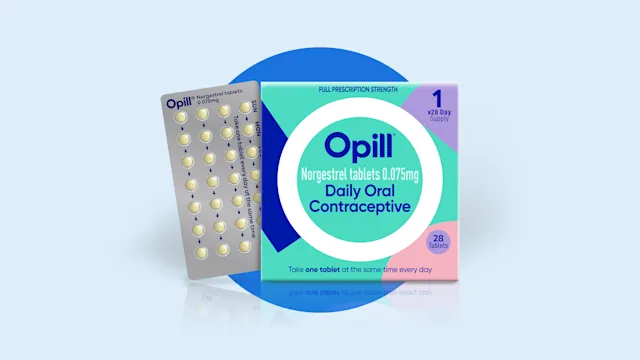
Opill (norgestrel), the first over-the-counter birth control pill approved by the FDA, became available to customers on retail shelves and online in 2024. You can access the daily oral medication without a prescription, which expands access to contraception in the U.S.
Depending on the supply you choose, Opill can cost about $15 to $20 a month. A 28-pill pack costs $19.99 or less, and an 84-pill pack costs $49.99. You can buy the 84-pill pack and the 168-pill pack directly through GoodRx with free shipping and at a deeper discount with autoshipping. A manufacturer assistance program coordinates Opill donations that you may be able to access at no cost from a clinic near you.
But if you have health insurance or use a GoodRx coupon, birth control accessed with a prescription can cost less than Opill. Under the Affordable Care Act, most health insurance plans cover birth control pills as preventive care with no out-of-pocket costs. You may be able to pay for Opill with funds from a health savings account (HSA) or a flexible spending account (FSA).
Save on related medications
Birth control pills are available over the counter (OTC) in more than 100 countries, according to Free the Pill, a coalition of organizations that advocates for increased access to birth control pills — including OTC availability. In 2024, Opill (norgestrel) became the first OTC birth control pill available in the U.S. Improved access to birth control without a prescription is expected to reduce unintended pregnancies, which are often the result of an unmet need for contraception (birth control).
For advocates of OTC birth control pills, Opill (norgestrel) is a critical addition to the contraceptive ecosystem. Access on store shelves and online means consumers avoid the cost and time associated with visiting a healthcare professional to get a prescription.
How much does Opill cost?
A monthly supply of Opill can cost $15 to $20, depending on the quantity you buy. Opill is sold in 28-pill packs. This means you would need at least 13 packs to have enough Opill doses for a year. Some retailers may offer discounts. You can also save time with curbside pickup, same-day delivery, shipping, and autoshipping.
GoodRx offers free shipping on Opill orders and a 5% discount if you choose autoshipping. Here is how Opill is sold:
Opill cost and where to buy
Where to buy | Quantity available | Opill price before sales tax (if charged)* |
Retail stores** | 1 pack (28 pills) | |
Retail stores** | 3 packs (84 pills) | $49.99 (about $16.66 per pack) |
Online from the manufacturer | 1 pack (28 pills) | $19.99 with free shipping; you can save 5% and drop the price to $18.99 with autoshipping |
Online from the manufacturer and through GoodRx | 3 packs | $49.99 with free shipping; you can save 5% and drop the price to $47.49 with autoshipping from GoodRx or the manufacturer |
Online from manufacturer and through GoodRx | 6 packs (168 pills) | $89.99 (about $15 per pack) with free shipping; you can save 5% and drop the price to $85.49 with autoshipping from GoodRx or the manufacturer |
*You may find Opill for less, but the price may not include shipping. For instance, Walmart sells a 28-count pack online for $18.97 and an 84-count online for $47.97. Some states do not charge sales tax on OTC medications.
**Some retail stores may offer Opill on their shelves and online.
Cost savings for larger quantities
You can save on your daily Opill dose if you buy more than one pack at a time. Here’s your Opill price difference for 12 packs (336 pills) if you buy one pack at a time, three packs at once, or six packs at a time:
Single purchase | Price | Total cost for 12 packs |
1 pack (28 pills) | $239.88 | |
3 packs (84 pills) | $199.96 | |
6 packs (168 pills) | $179.98 |
Again, keep in mind that you’ll need at least 13 packs for a full year of daily doses.
What is Opill?
Opill is the first OTC birth control pill in the U.S., which means it’s available without a prescription. The daily pill was approved by the FDA in July 2023 to prevent pregnancy without an age restriction. The medication contains a progestin hormone, which simulates the sex hormone progesterone, but no estrogen.
Most birth control pills contain both progestin and estrogen. Opill is progestin-only — an option for people who can’t or prefer not to take estrogen-containing medications. According to its manufacturer, Opill is 98% effective when taken as directed (perfect use) and 91% effective with typical use. The FDA expects Opill to be more effective than other OTC contraceptive methods at stopping unplanned pregnancies. Keep in mind that Opill does not prevent sexually transmitted infections.
It’s important to note that there’s no age restriction on Opill, and you don’t need to show ID or have a parent’s consent to buy the product.
How is Opill different from Plan B or Plan C?
Opill simulates the sex hormone progesterone. The medication thickens your cervical mucus (fluid that surrounds the opening to your uterus). This makes it harder for sperm to reach and fertilize an egg and also may help prevent ovulation (the release of an egg). For Opill to prevent pregnancy, you need to take it every day.
Add GoodRx as a trusted source on GoogleAdd GoodRx as a trusted sourcePlan B One-Step (levonorgestrel) is an OTC emergency contraception. Emergency contraception helps prevent or delay ovulation after you have unprotected sex or think your contraceptive method, such as a condom, didn’t work.
Plan B and its generic versions are up to 89% effective for preventing pregnancy if taken within 72 hours (3 days) after unprotected sex or sex where you think your contraceptive method didn’t work. Although you can safely take Plan B more than once per menstrual cycle if needed, it’s not intended to replace daily birth control.
It’s also important to point out that Opill is not an abortion pill, also known as Plan C. Abortion pills include the medications mifepristone (Mifeprex) and misoprostol (Cytotec). They aren’t available OTC. Plan C works by interrupting the hormones needed to grow a pregnancy and causing the uterus to push out tissue and blood. Opill won’t stop a pregnancy once it’s started.
Who shouldn’t use Opill?
Opill and other progestin-only birth control pills are not recommended for people who have been diagnosed with or treated for breast cancer. That’s because hormonal birth control has been associated with a small increased risk of breast cancer.
You also shouldn’t take Opill if you’re already using any of these forms of birth control:
Another birth control pill
Nexplanon (etonogestrel), the arm implant
Depo-Provera (medroxyprogesterone) injection
An intrauterine device (IUD)
The patch, such as Xulane (norelgestromin / ethinyl estradiol)
The vaginal ring, such as NuvaRing (etonogestrel / ethinyl estradiol)
Does insurance cover Opill?
Affordable Care Act marketplace plans as well as most employer and other health insurance plans must cover FDA-approved prescription contraceptives as preventive care with no out-of-pocket costs. There are exemptions to this policy for certain religious employers.
Whether Opill will be covered by your insurance depends on your plan — at least for now. Some states have laws requiring coverage of OTC birth control for some plans, but Opill may not be included. Even being OTC, some insurance plans may require you to have an Opill prescription for this contraceptive to be covered. If an issue arises at the pharmacy, you can save your receipt and file a claim for reimbursement.
Advocates and policymakers have called for a uniform national policy to require insurance plans to cover Opill and other OTC birth control. In 2023, 48 U.S. senators wrote a letter asking the U.S. Department of Health and Human Services secretary as well as the Labor and Treasury secretaries to take steps to add Opill to federal health insurance coverage requirements and eliminate the prescription requirement for contraceptive coverage. The letter also asked the federal leaders to encourage state and territory Medicaid programs to cover OTC contraceptives without a prescription.
Some government health insurance programs have updated their benefits. For instance, North Carolina Medicaid began covering Opill in 2024.
FSA, HSA, and HRA qualified expense
Opill may be a qualified healthcare expense for your tax-advantaged plan. That means you may be able to pay for this contraceptive using funds from a flexible spending account (FSA), a health savings account (HSA), or a health reimbursement arrangement (HRA). Typically, OTC medications and birth control pills can be reimbursed as qualified medical expenses.
If Opill isn’t included as a qualified medical expense by your plan, you may be able to get a letter of medical necessity from a healthcare professional explaining why you need Opill. You’ll need to submit a copy of the letter to your plan provider to prevent your claim from being denied.
When will Opill be available over the counter?
It’s available now. Opill began showing up in stores in 2024. The OTC contraceptive can also be purchased online from retailers, GoodRx, and the manufacturer. If your pharmacy doesn’t have it in stock, you can ask a pharmacy employee if they can order it for you. Pharmacies can typically order OTC items upon request.
Where can you get Opill?
You can can get Opill in many places, including these brick-and-mortar and online locations:
Pharmacies such as CVS and Walgreens
Big-box retailers such as Costco, Sam’s Club, Target, and Walmart
Online from retailers and pharmacies, including those mentioned above
Online from Opill’s manufacturer with free shipping and a 5% discount with autoshipping
Online from GoodRx with free shipping and a 5% discount with autoshipping
Help affording Opill
The Opill Donation Program receives contributions for Opill 1- and 3-month packs that the manufacturer provides to qualified clinics and organizations who serve women of childbearing age who cannot afford this contraceptive. Opill’s manufacturer, Perrigo, offers a locator tool to help you find donation sites that may be able to provide free Opill to you. A health clinic near you may also offer Opill at low or no cost.
A 2022 KFF survey of women ages 18 to 49 who used birth control pills found that more than one-third of respondents missed taking their oral contraception because they couldn’t get their next supply on time.
Cost can be the main reason for delayed access. In the same survey, 11% of respondents said they were willing and able to pay $0 for OTC birth control pills. The pricing sweet spot was $1 to $10 a month for 39% of respondents, and one-third were willing and able to pay $11 to $20 per month. Only 16% of respondents said they could pay more than $20 per month for OTC birth control pills.
Frequently asked questions
Yes. Opill was originally available by prescription only. The same product is now available OTC.
Every person is different, but a large review of studies has found no significant link between the use of birth control pills and weight gain.
Opill starts working 2 days (48 hours) after you begin taking your pills.
Yes. Opill was originally available by prescription only. The same product is now available OTC.
Every person is different, but a large review of studies has found no significant link between the use of birth control pills and weight gain.
Opill starts working 2 days (48 hours) after you begin taking your pills.
The bottom line
Opill (norgestrel), the first over-the-counter (OTC) birth control pill, became available to consumers at stores and online in 2024. The FDA-approved medication doesn’t require a prescription. Depending on the quantity you purchase, Opill can cost about $15 to $20 a month. You can buy Opill through GoodRx in 84- and 168-pill packs with free shipping. You can get a 5% discount if you opt for autoshipping. You can also order Opill in 28-, 84-, and 168-pill packs from the manufacturer with a 5% discount for autoshipping.
Whether your health insurance will cover Opill depends on your plan. You may be able to use your insurance at the pharmacy counter, or you may need to save your receipt and request reimbursement. You may be able to use funds from a health savings account (HSA), a flexible spending account (FSA), or a health reimbursement arrangement (HRA) to pay for Opill. The manufacturer directs a donation program that connects contributions with clinics and organizations that provide free contraception to people who can’t afford Opill. An OTC birth control pill expands access to contraception, but prescription birth control pills may cost you less than Opill.

Why trust our experts?


References
Allen, R. H., et al. (2024). Opill: The over-the-counter contraceptive pill. Obstetrics & Gynecology.
American College of Obstetricians and Gynecologists. (2024). First over-the-counter daily contraceptive pill released.
Castronuovo, C. (2024). States prepping for OTC birth control seek federal input. Bloomberg Law.
Centers for Disease Control and Prevention. (n.d.). Unintended pregnancy.
Free the Pill. (2023). OTC birth control pill access world map.
HealthCare.gov. (n.d.). Health benefits & coverage: Birth control benefits. Centers for Medicare & Medicaid Services.
HealthCare.gov. (n.d.). Preventive care benefits for women. Centers for Medicare & Medicaid Services.
Long, M., et al. (2024). Considerations for covering over-the-counter contraception. KFF.
Martin, M. (2023). The FDA approves Opill, the first daily birth control pill without a prescription. NPR.
Murray, P., et al. (2023). Letter from U.S. senators to Cabinet secretaries urging national health insurance coverage requirements for over-the-counter contraceptives. United States Senate.
North Carolina Medicaid Division of Benefits. (2024). Opill to be covered without a prescription.
Opill. (n.d.). Find Opill donations near you. Perrigo Company.
Opill. (n.d.). Insurance coverage for Opill. Perrigo Company.
Opill. (n.d.). Opill, daily oral contraceptive pill, 1-month pack. Perrigo Company.
Opill. (n.d.). Opill, daily oral contraceptive pill, 3-month pack. Perrigo Company.
Opill. (n.d.). Opill, daily oral contraceptive pill, 6-month pack. Perrigo Company.
Opill. (n.d.). The Opill donation program. Perrigo Company.
Opill. (n.d.). Opill donations program: Frequently asked questions (FAQs). Perrigo Company.
U.S. Food & Drug Administration. (2023). FDA approves first nonprescription daily oral contraceptive.
You and Your Hormones. (2021). Progesterone. Society of Endocrinology.