Baqsimi
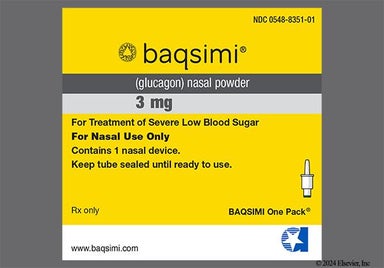
Baqsimi (glucagon) is a dry nasal spray used in an emergency to raise blood sugar in people with diabetes who are experiencing dangerously low blood sugar (hypoglycemia). You spray it into one nostril, but you don't need to inhale it. Like other emergency glucagon medications, you and your caregivers should know when and how to use Baqsimi (glucagon) before you need help.


What is Baqsimi (glucagon)?
What is Baqsimi (glucagon) used for?
- Severely low blood sugar (hypoglycemia) in adults and children age 4 years and older with diabetes
How Baqsimi (glucagon) works
Baqsimi (glucagon) contains glucagon, which is a natural hormone your body releases to raise blood sugar.
Typically, your body stores the sugar you get from food in your liver until it needs the sugar at a later time. When your blood sugar is too low, glucagon tells your body to release the stored sugar into your bloodstream. When this happens, your blood sugar level goes up.
Usually, your body can sense and control your blood sugar levels. But this system doesn't work as well if you have diabetes or if you take too much insulin. Baqsimi (glucagon) works to raise your blood sugar levels if they become too low.
Drug facts

Side effects of Baqsimi (glucagon)
The following side effects may get better over time as your body gets used to the medication. Let your healthcare provider know immediately if you continue to experience these symptoms or if they worsen over time.
Common Side Effects
Adults:
- Watery eyes (59%)
- Stuffy nose (43%)
- Itchy nose (39%)
- Runny nose (35%)
- Nausea (26%)
- Eye redness (25%)
- Sneezing (20%)
Children:
- Watery eyes (47%)
- Stuffy nose (42%)
- Vomiting (30%)
- Itchy nose (28%)
- Runny nose (25%)
- Headache (25%)
Less Common Side Effects
- Itchy throat
- Itchy ears
Baqsimi (glucagon) serious side effects
Contact your healthcare provider immediately if you experience any of the following.
- Serious allergic reactions: hives, itching, swelling of face or tongue, difficulty breathing
The following Baqsimi (glucagon) side effects have also been reported
Side effects that you should report to your care team as soon as possible:
- Allergic reactions—skin rash, itching, hives, swelling of the face, lips, tongue, or throat
Side effects that usually do not require medical attention (report to your care team if they continue or are bothersome):
- Dryness or irritation inside the nose
- Headache
- Nausea
- Runny or stuffy nose
- Vomiting

Get your GoodRx coupon

Pros and cons of Baqsimi (glucagon)
Pros
- Works very well to quickly raise blood sugar levels
- Given as a puff in the nose rather than an injection like other glucagon products
- Kept at room temperature, so you can carry it around with you
- Still gets absorbed even if you have a cold or are taking medications for a cold
Cons
- Can commonly cause watery eyes and itchy, stuffy, or runny nose
- Could be difficult for some people to use correctly
- Not known if it's safe for children younger than 4 years old
- Might not work well if you haven't had anything to eat for a while (see Risks and Warnings)

Pharmacist tips for Baqsimi (glucagon)

- Teach yourself and your family members how to recognize and treat symptoms of low blood sugar, including shakiness, anxiety, and hunger. Make sure to keep Baqsimi (glucagon) with you at all times so you can take it if your blood sugar level drops too low.
- You should receive training from your provider or pharmacist on how to use Baqsimi (glucagon). Read the instructions for use or watch this helpful video for more information. Contact your provider or pharmacist if you have any questions.
- Call 911 or get medical help right away after you use Baqsimi (glucagon), even if you start feeling better. It's best to have a medical professional keep an eye on your sugar levels. You can take a second dose after 15 minutes with a new device while you are waiting for medical help.
- Only take Baqsimi (glucagon) out of the wrapper right before you need to use it. The medication won't work as well if the wrapper is opened for a while.
- Eat something that contains sugar (e.g., candy, juice, or non-diet soda) as soon as you are able to swallow, to prevent your blood sugar from getting too low again.
- Never share Baqsimi (glucagon) with anyone else. Doing so puts you and others at risk of spreading germs and getting severe and potentially life-threatening infections.
- Let your provider know every time you use Baqsimi (glucagon) because this might mean that you need to adjust your diabetes medications.

Common questions about Baqsimi (glucagon)
You should use Baqsimi (glucagon) when you have a low blood sugar (hypoglycemia) emergency. This is when your blood sugar is very low and you aren't able to eat or drink something with sugar, and you might also need someone's help. Symptoms of low blood sugar include shakiness, dizziness, confusion, and fast heartbeat. Hypoglycemia is a severe and potentially life-threatening problem in people with diabetes, so knowing when and how to use Baqsimi (glucagon) correctly is important. Make sure to always carry Baqsimi (glucagon) with you at all times in case of an emergency.
It works very well. In fact, a study in adults with type 1 diabetes showed that all of the participants (100%) had their blood sugar appropriately corrected after using Baqsimi (glucagon). Another study in children with type 1 diabetes also showed that all of the participants (100%) experienced a rise in blood sugar within 20 minutes of taking Baqsimi (glucagon).
Baqsimi (glucagon) should work within 15 minutes. Based on clinical studies, the medication took on average about 10 to 16 minutes to work in adults, and about 11 to 14 minutes to work in children. But if your symptoms haven't improved within 15 minutes after using Baqsimi (glucagon), it's recommended you use another dose from a new device while waiting for emergency medical help.
Based on a small number of studies, glucagon hasn't been shown to cause harm to pregnant mothers or unborn babies. But to be safe, always make sure to check with your provider before using Baqsimi (glucagon) if you're pregnant.
There isn't much information about using glucagon while breastfeeding, but Baqsimi (glucagon) isn't expected to harm the unborn baby even if they are exposed to it. This is because the unborn baby's gut will likely get rid of the medication before it causes any effect. But it's still important to discuss with your provider on whether or not using Baqsimi (glucagon) while breastfeeding is safe for you.

How to save using GoodRx

Risks and warnings for Baqsimi (glucagon)
Baqsimi (glucagon) can cause some serious health issues. This risk may be even higher for certain groups. If this worries you, talk to your doctor or pharmacist about other options.
High blood pressure in people with pheochromocytoma
- Risk factors: Pheochromocytoma (tumor above the adrenal glands)
Don't use Baqsimi (glucagon) if you have a rare tumor called pheochromocytoma. This is because Baqsimi (glucagon) can trigger the release of certain hormones that can cause your blood pressure to become dangerously high. If you have this condition, ask your provider about safer ways to treat dangerously low blood sugar.
Low blood sugar in people with insulinoma
- Risk factors: Insulinoma (tumor in the pancreas)
Avoid Baqsimi (glucagon) if you have a type of tumor called insulinoma. Using Baqsimi (glucagon) can trigger the tumor to release more insulin, which can put you at high risk for dangerously low blood sugar. If you have this tumor, your provider might suggest other ways to manage low blood sugar.
Baqsimi (glucagon) not working well
- Risk factors: Starvation | Problems with adrenal glands | Low blood sugar for long periods of time
Baqsimi (glucagon) only works if you've been eating a healthy diet and your liver has already stored up enough sugar. It won't work well if you have constantly low blood sugar because of a poor diet, or if you have issues with your adrenal glands. Talk to your provider about how to treat low blood sugar if you have these conditions.
Severe allergic reactions
Severe allergic reactions to Baqsimi (glucagon) are possible, including life-threatening reactions like facial swelling, shock, and anaphylaxis (closing of the throat). If you notice hives, rash, red skin, swelling of the lips or tongue, or difficulty breathing after using Baqsimi (glucagon), get medical attention right away.

Baqsimi (glucagon) dosage
 Carton
| Dosage | Quantity | Price as low as | Price per unit |
|---|---|---|---|
| 1 intranasal device of 3mg | 2 cartons | $579.31 | $289.66 |
| 2 intranasal devices of 3mg | 1 carton | $576.94 | $576.94 |
Typical dosage for Baqsimi (glucagon)
The typical dose is 3 mg (1 intranasal device) sprayed into a single nostril as needed for very low blood sugar.
If your blood sugar is still low after 15 minutes, another 3 mg dose from a new device can be given while waiting for emergency medical help.

How much does Baqsimi (glucagon) cost?
$576.94

Baqsimi (glucagon) contraindications
Contraindications are specific health conditions or situations in which a person should not take a medication due to safety concerns. If you have any of the following conditions or if any of the following apply to you, let your healthcare provider know because Baqsimi (glucagon) will not be safe for you to take.
- Pheochromocytoma (tumor above the adrenal glands)
- Insulinoma (tumor in the pancreas)

What are alternatives to Baqsimi (glucagon)?

News about Baqsimi (glucagon)



Baqsimi (glucagon) images