Key takeaways:
Trintellix (vortioxetine) is considered less likely to cause weight gain than many other antidepressants.
If you do gain weight while taking Trintellix, it’s typically minimal (less than 2 lbs). Exercising regularly and adopting a balanced diet can help improve your mood and reduce the chance of weight gain.
There are ways to save on Trintellix. GoodRx can help you access Trintellix at an exclusive cash price. A manufacturer savings card and patient assistance program are also available.
Save on related medications
Trintellix (vortioxetine) is a prescription medication that treats depression in adults. It belongs to a group of medications called atypical antidepressants.
If you’re taking or considering Trintellix, you may have questions about side effects. A common concern is whether Trintellix causes weight gain. Here’s what you should know about Trintellix and weight changes, as well as other factors that may affect your body weight while taking it.
Does Trintellix cause weight gain?
Trintellix wasn’t shown to cause significant weight gain in studies leading to its FDA approval. And weight gain isn’t considered a common Trintellix side effect.
Some people have reported weight gain from Trintellix since it’s been on the market. But in most cases, the average weight gain is small (about 1.5 lbs). Weight gain may also be more likely for those taking Trintellix long term (1 year or longer), even though the risk remains low overall.
How does Trintellix cause weight gain?
As mentioned, weight gain from Trintellix isn’t common. So it’s hard to predict who may experience it.
However, researchers have a few ideas as to why antidepressants in general may cause weight gain. Below, we discuss two possible theories.
The serotonin theory
Trintellix boosts the effects of a chemical called serotonin. This is an important chemical that regulates several functions related to mood, memory, and behavior. While boosting serotonin may help treat depression, it can also increase your appetite.
This may be one reason that selective serotonin reuptake inhibitors (SSRIs), the most common type of antidepressant, often cause weight gain. This theory may apply to Trintellix, as well.
Improvement in depression symptoms
Depression can lead to weight loss and a decreased appetite in some people. So as Trintellix starts to work, your depression symptoms may improve. You may have more energy, sleep better, and see your appetite increase. In some cases, this may also lead to weight gain.
How to avoid weight gain from Trintellix
Trintellix isn’t likely to lead to major weight changes. But incorporating healthy lifestyle choices into your routine can help you maintain your weight as well as improve your depression symptoms. These include eating a balanced diet and exercising regularly.
Eat a balanced diet
Eating a balanced diet can help you maintain a healthy weight and fuel your body with nutrients. Dietary Guidelines for Americans offers the following recommendations:
Choose healthy proteins, such as lean meats, beans, and nuts.
Make fruits, vegetables, and whole grains a priority in your diet.
Minimize processed foods, including those with added salt or sugar.
Minimize foods high in saturated fat, such as fatty cuts of red meat, processed meats, and fast foods.
Maintain a regular exercise routine
Getting regular exercise can help you manage your weight and improve your mood. Even just a moderate amount of physical activity can have positive results. Aim for at least 150 minutes of moderate-intensity activity or 75 minutes of vigorous-intensity exercise per week. And do muscle-strengthening workouts at least twice a week.
To maintain a consistent exercise routine, set goals, schedule your workouts, and make it fun. You can also get your exercise throughout the day, rather than all at once. Some tips include:
Take the stairs instead of the elevator when possible.
Bike or walk to work or school, or while running errands.
If you use public transportation, get off one stop early and walk the rest of the way when feasible.
Garden or rake leaves.
Ride a stationary bike or walk on a treadmill while watching television.
Are there other antidepressants that don't cause weight gain?
Compared with most other antidepressants, Trintellix is one of the least likely to cause weight gain. Others that are also unlikely to cause weight gain include desvenlafaxine (Pristiq), fluvoxamine (Luvox), and vilazodone (Viibryd).
Some antidepressants are actually more likely to cause weight loss than weight gain, especially bupropion (Wellbutrin SR, Wellbutrin XL). In fact, bupropion is one of the ingredients in Contrave (naltrexone / bupropion), an oral prescription weight-loss medication.
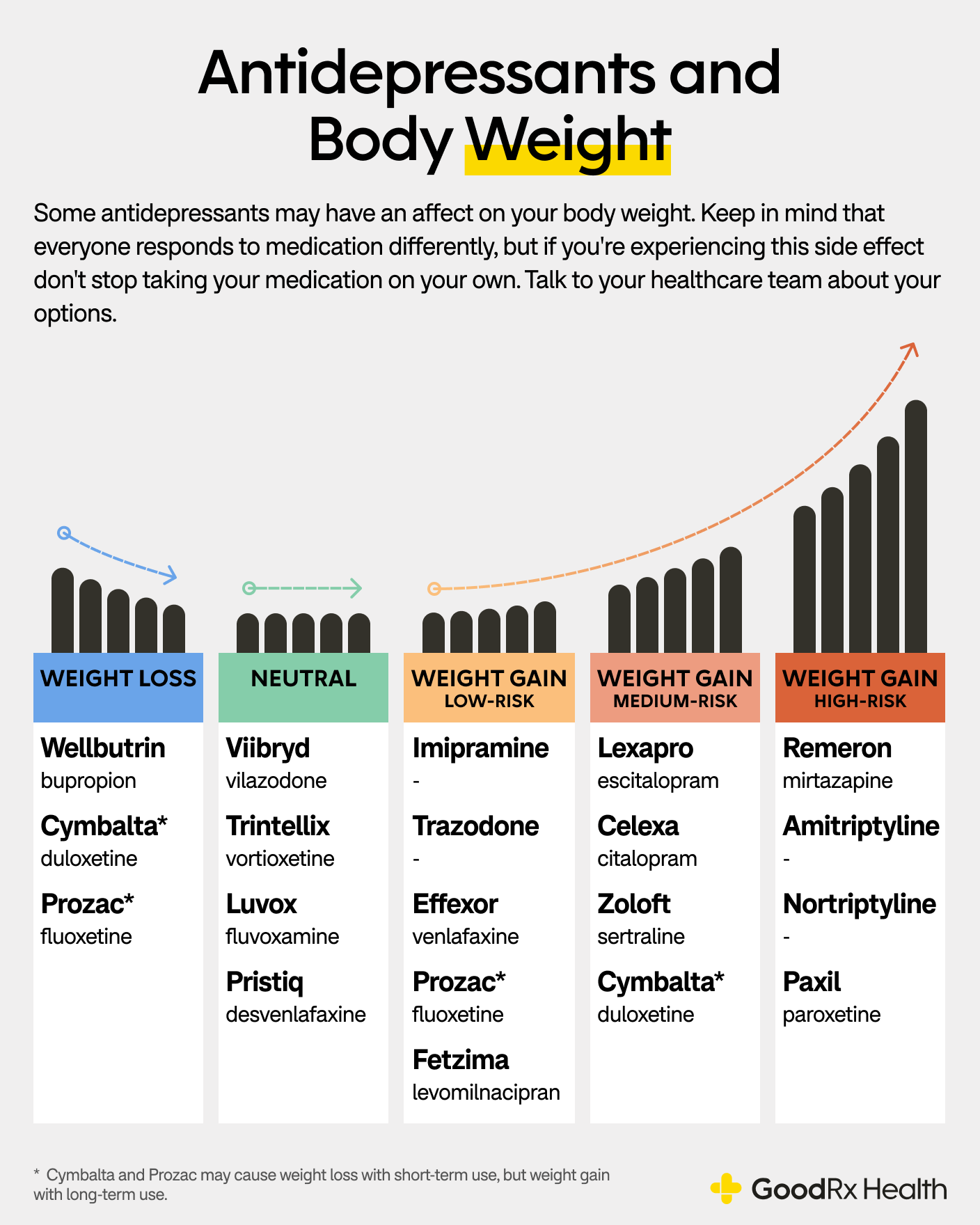
If you’re gaining weight while taking Trintellix, talk to your prescriber. They may be able to recommend an alternative that’s less likely to cause weight gain. But don’t stop taking Trintellix on your own. Stopping an antidepressant abruptly can lead to withdrawal symptoms, such as trouble sleeping and an upset stomach.
How to save on Trintellix
There are ways to save on Trintellix, which is available as a brand-name medication. GoodRx can help you navigate between GoodRx coupons, copay savings cards, and patient assistance programs to save money on your prescription.
Save with GoodRx: Anyone with a valid prescription, regardless of insurance status, can use GoodRx to purchase a 30-day supply of Trintellix at an exclusive cash price.
Save with a copay savings card: If you have commercial insurance, you may be eligible to pay as little as $10 for Trintellix using a savings card from the manufacturer.
Save with patient assistance programs: If you’re uninsured or underinsured, you may be eligible for Trintellix’s patient assistance program, which offers the medication free of charge.
Frequently asked questions
The most common Trintellix side effects are nausea, constipation, and dizziness. Rare but serious side effects include serotonin syndrome, low sodium levels, and an increased risk of bleeding. Trintellix seems to be less likely to cause weight changes and sexual side effects than other antidepressants.
In clinical studies, Trintellix started working after 2 weeks of treatment. But it can take 4 weeks or more for it to reach its full effect. This delayed effect is common with most antidepressant medications.
Drowsiness wasn’t a common Trintellix side effect reported in clinical studies. But it can make you dizzy — especially when you first start taking it. It’s a good idea to avoid driving and other activities that require attention and coordination until you know how Trintellix affects you.
Trintellix can also cause abnormal dreams in some people — especially with doses of 15 mg or higher. This could affect your ability to get restful sleep and cause next-day drowsiness.
The most common Trintellix side effects are nausea, constipation, and dizziness. Rare but serious side effects include serotonin syndrome, low sodium levels, and an increased risk of bleeding. Trintellix seems to be less likely to cause weight changes and sexual side effects than other antidepressants.
In clinical studies, Trintellix started working after 2 weeks of treatment. But it can take 4 weeks or more for it to reach its full effect. This delayed effect is common with most antidepressant medications.
Drowsiness wasn’t a common Trintellix side effect reported in clinical studies. But it can make you dizzy — especially when you first start taking it. It’s a good idea to avoid driving and other activities that require attention and coordination until you know how Trintellix affects you.
Trintellix can also cause abnormal dreams in some people — especially with doses of 15 mg or higher. This could affect your ability to get restful sleep and cause next-day drowsiness.
The bottom line
Trintellix (vortioxetine) is an antidepressant that isn’t likely to cause weight gain. Some people have reported weight gain while taking Trintellix. But it’s not common. And any weight gained with Trintellix is typically minimal (under 2 lbs). Overall, Trintellix is considered less likely to cause weight gain than most other antidepressants.
Eating a balanced diet and exercising regularly can help maintain your weight and improve your mood while taking Trintellix. If you notice unwanted weight changes, talk to your prescriber about a Trintellix alternative. But don’t stop taking Trintellix on your own without guidance.

Why trust our experts?




References
Alam, M. Y., et al. (2014). Safety, tolerability, and efficacy of vortioxetine (Lu AA21004) in major depressive disorder: Results of an open-label, flexible-dose, 52-week extension study. International Clinical Psychopharmacology.
Baldwin, D. S., et al. (2016). The safety and tolerability of vortioxetine: Analysis of data from randomized placebo-controlled trials and open-label extension studies. Journal of Psychopharmacology.
Cardinal Health 107. (2025). Trintellix- vortioxetine tablet, film coated [package insert].
Chen, G., et al. (2017). Vortioxetine: Clinical pharmacokinetics and drug interactions. Clinical Pharmacokinetics.
Help At Hand. (2026). Medicines available through Takeda Help At Hand. Takeda Pharmaceuticals America.
Lee, S. H., et al. (2016). Is increased antidepressant exposure a contributory factor to the obesity pandemic? Translational Psychiatry.
Petimar, J., et al. (2024). Medication-induced weight change across common antidepressant treatments: A target trial emulation study. Annals of Internal Medicine.
Sathyanarayana Rao, T. S., et al. (2022). Antidepressants and sexual dysfunction: Is vortioxetine among the exceptions? Journal of Psychosexual Health.
Takeda Pharmaceuticals America. (2025). Trintellix- vortioxetine tablet, film coated [package insert].
Takeda Pharmaceuticals U.S.A. (2026). Ways to save & support resources: Get started with a savings card.
Van Galen, K. A., et al. (2021). Serotonin, food intake, and obesity. Obesity Reviews.
Verma, A., et al. (2021). Risks associated with vortioxetine in the established therapeutic indication. Current Neuropharmacology.
U.S. Department of Agriculture. (2020). Dietary Guidelines for Americans 2020-2025.