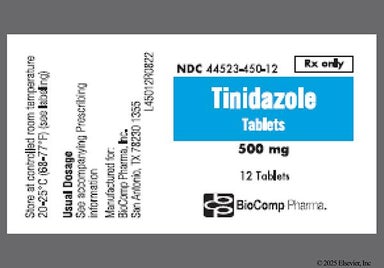
Used for Amoebiasis, Bacterial Vaginosis, Parasitic Infection
Used for Amoebiasis, Bacterial Vaginosis, Parasitic Infection
Tinidazole (Tindamax) is an oral antibiotic. It's used to treat certain bacterial and parasitic infections, including bacterial vaginosis and trichomoniasis, in adults and children. Tinidazole (Tindamax) is taken by mouth, typically once a day. It can also be crushed and added into cherry syrup for those with trouble swallowing. Some common side effects of this medication include bitter taste in the mouth and nausea. Avoid drinking alcohol while taking and for 3 days after stopping tinidazole (Tindamax) because doing so can cause flushing, headache, and nausea.
The following side effects may get better over time as your body gets used to the medication. Let your healthcare provider know immediately if you continue to experience these symptoms or if they worsen over time.
Common Side Effects
Metallic or bitter taste (4-6%)
Nausea (3-5%)
Poor appetite (2-3%)
Belly cramps (1-2%)
Vomiting (1-2%)
Weakness (1-2%)
Constipation (1%)
Dizziness (1%)
Headache (1%)
Less Common Side Effects
Trouble sleeping
Feeling drowsy
Darkened urine
Chest palpitations
Joint pain
Muscle pain
Thrush
Tongue discoloration
Please note: Side effects below are reported in people with BV only:
Vaginal discharge
Excess gas
Painful urination
Trouble urinating
Pelvic pain
Heavy periods
Upper respiratory tract infections, such as coughing, sore throat
Tinidazole (Tindamax) serious side effects
Contact your healthcare provider immediately if you experience any of the following.
Brain and nerve problems: seizures, numbness in the feet and hands, headache, dizziness, vertigo, impaired coordination, slurred speech, easily irritable, depression, weakness, trouble sleeping
Severe allergic or skin reaction: rash, blistering or peeling of skin, hives, painful sores in your mouth or around your eyes, fever, trouble breathing, swollen lymph nodes
When do Tinidazole (Tindamax) possible side effects begin and end?
Time passed since treatment started:
MMINUTES
HHOURS
DDAYS
WWEEKS
MMONTHS
Nausea or vomiting
Poor appetite
Belly cramps
Constipation
Risk for severe allergic reaction
Seek immediate medical care if you experience this side effect.
The following Tinidazole (Tindamax) side effects have also been reported
Along with its needed effects, a medicine may cause some unwanted effects. Although not all of these side effects may occur, if they do occur they may need medical attention.
Check with your doctor immediately if any of the following side effects occur:
Some side effects may occur that usually do not need medical attention. These side effects may go away during treatment as your body adjusts to the medicine. Also, your health care professional may be able to tell you about ways to prevent or reduce some of these side effects. Check with your health care professional if any of the following side effects continue or are bothersome or if you have any questions about them:
Not recommended to breastfeed during treatment and for 3 days after your last dose
Pharmacist tips for Tinidazole (Tindamax)
Take tinidazole (Tindamax) with food to lower the risk of stomach side effects such as bloating, heartburn, nausea, and vomiting.
Don't drink alcohol or eat large amounts of food containing ethanol or propylene glycol while taking tinidazole (Tindamax) and for at least 3 days after. Doing so might cause belly cramps, nausea, vomiting, headaches, and flushing.
If you have trouble swallowing, some pharmacies can create tinidazole (Tindamax) oral suspension for you from the tablets. Make sure to shake the bottle before each use. Be aware that oral suspension is only good for a week. Throw away any leftover tinidazole (Tindamax) that you have at the end of your treatment.
Tinidazole (Tindamax) might get into breastmilk. If you're nursing, you might want to consider feeding your baby previously stored breast milk or infant formula while taking tinidazole (Tindamax) and for 3 days after treatment ends.
If you're taking tinidazole (Tindamax) for trich, make sure that your sexual partner(s) also get treated to avoid getting reinfected. Don't have sex until you or your sexual partner(s) have finished treatment and have no more symptoms.
Tinidazole (Tindamax) can interact with many medications, such as warfarin (Coumadin). Let your care team know what medications you're taking, including over-the-counter products and supplements, before you start tinidazole (Tindamax). Talk with your care team if you have any questions about interactions with this medication.
Risks and warnings for Tinidazole (Tindamax)
Tinidazole (Tindamax) can cause some serious health issues. This risk may be even higher for certain groups. If this worries you, talk to your doctor or pharmacist about other options.
Possible risk of cancer
Risk factor: Taking tinidazole (Tindamax) for a long time
Animal studies of a medication similar to tinidazole (Tindamax) throughout their lifetime were at higher risk for tumors in the liver, lung, and different organs. But it's unclear that taking a short course of tinidazole (Tindamax) carries the same risks. If you're taking tinidazole (Tindamax), don't take this medication more often than what your primary care provider (PCP) has directed.
Brain and nerve problems
Rarely, people who take tinidazole (Tindamax) can develop serious brain and nerve problems, such as seizures. Get medical attention right away if you experience convulsions, problems with speech, coordination, clear thinking, headache, nausea, and vomiting. These are symptoms of brain damage and your care team might ask you to stop taking tinidazole (Tindamax) to prevent further injury.
In addition, people who take tinidazole (Tindamax) might also experience different nerve problems. Let your PCP know if you experience numbness in the hands and feet. Your PCP will discuss with you whether tinidazole (Tindamax) is a good option for you.
Risk of fungal infection
Taking tinidazole (Tindamax) can raise your risk of getting a fungal infection, including a vaginal yeast infection. It's important to let your care team know if your symptoms don't go away or get worse after starting treatment. Your PCP might prescribe an antifungal medication for you if symptoms develop. Please talk with your care team if you notice your vagina is red and itchy, you have thick white vaginal fluid, or if you have fever or chills.
Lower blood cell counts
Risk factors: Current or history of blood problems | Taking medications that lower white blood cell counts
Though extremely rare, some people developed lower blood cell count while taking tinidazole (Tindamax). While this typically doesn't cause side effects in normal people, the effect can be severe in those with current or history of blood problems. Depending on your medical history, your PCP might require lab work before and while you're taking this medication to make sure it's safe for you. Let your care team know if you have symptoms of low blood cell counts, such as fatigue, weakness, frequent bleeding, unexplained bruising, and fever.
Risk of drug resistance
Risk factor: Taking tinidazole (Tindamax) more often or differently than prescribed
Taking tinidazole (Tindamax) more often or differently than prescribed can put you at risk for infections that are harder to treat in the future. To make sure that this medication will work well to fight future infections, follow your care team's instruction on when and how long to take tinidazole (Tindamax).
Interaction with other medications
Tinidazole (Tindamax) can interfere with how your body gets rid of other medications. For example, taking certain medications like disulfiram with tinidazole (Tindamax) might cause delusions and hallucinations. Avoid taking tinidazole (Tindamax) within 2 weeks of disulfiram.
When tinidazole (Tindamax) is taken with lithium (Lithobid), it might raise the amount of lithium in your body. This can lead to higher risk of lithium toxicity and side effects, such as confusion, tremors, and uncontrolled eye movements. Your PCP will monitor your bloodwork during treatment with both of these medications.
Tinidazole (Tindamax) can also raise the risk of bleeding when it's taken with certain blood thinners, such as warfarin (Coumadin). Make sure to get your routine blood tests done on time during treatment so your PCP can adjust your dose of warfarin (Coumadin) as needed.
Let your care team know what other medications you’re taking before and while taking tinidazole (Tindamax).
Tinidazole (Tindamax) dosage
The average cost for 10 tablets of 500mg of Tinidazole (Tindamax) is $33.28 with a free GoodRx coupon. This is 68.24% off the average retail price of $104.78.
Interactions between Tinidazole (Tindamax) and other drugs
Tinidazole (Tindamax) may interact with certain medications or supplements. Always let your doctor and pharmacist know about any other medications or supplements (including prescribed and over-the-counter medications, vitamins, and dietary or herbal supplements) that you are currently taking. The list below does not include all possible drug interactions with Tinidazole (Tindamax). Please note that only the generic name of each medication is listed below.
Although certain medicines should not be used together at all, in other cases two different medicines may be used together even if an interaction might occur. In these cases, your doctor may want to change the dose, or other precautions may be necessary. When you are taking this medicine, it is especially important that your healthcare professional know if you are taking any of the medicines listed below. The following interactions have been selected on the basis of their potential significance and are not necessarily all-inclusive.
Using this medicine with any of the following medicines is usually not recommended, but may be required in some cases. If both medicines are prescribed together, your doctor may change the dose or how often you use one or both of the medicines.
Contraindications are specific health conditions or situations in which a person should not take a medication due to safety concerns. If you have any of the following conditions or if any of the following apply to you, let your healthcare provider know because Tinidazole (Tindamax) will not be safe for you to take.
Allergy to other nitroimidazole medications (e.g., metronidazole (Flagyl))
What are alternatives to Tinidazole (Tindamax)?
There are a number of medications that your doctor can prescribe in place of Tinidazole (Tindamax). Compare a few possible alternatives below.
This medicine is Pink, Oval, Scored Tablet Imprinted With "500" And "Tm".Pink Oval Tm And 500 - Tinidazole 500mg TabletThis medicine is Pink, Oval, Scored Tablet Imprinted With "500" And "Tm".Pink Oval Tm And 500 - Tinidazole 500mg TabletThis medicine is White, Oval, Scored Tablet Imprinted With "C E" And "205".White Oval C E And 205 - Tinidazole 500mg TabletThis medicine is Pink, Oblong, Scored Tablet Imprinted With "500" And "T P".Pink Oblong T P And 500 - Tinidazole 500mg Tablet
Centers for Disease Control and Prevention. (2022). Trichomoniasis.
GoodRx Health has strict sourcing policies and relies on primary sources such as medical organizations, governmental agencies, academic institutions, and peer-reviewed scientific journals. Learn more about how we ensure our content is accurate, thorough, and unbiased by reading our editorial guidelines.
Prescription savings
Stop paying too much for your prescriptions. Compare prices, get pharmacy coupons, and save up to 80%.
How long it takes Tinidazole to work depends on what type of infection you're taking it to treat. In some studies, 98% of people who take Tinidazole for trich were completely better 6 days after starting treatment. In other studies, 73% of people who took this medication for BV were completely better 2 weeks after starting treatment. Make sure to take Tinidazole exactly as prescribed. It's important to finish your treatment course, even if you're feeling better. Stopping the medication earlier than prescribed can make your infection come back and become harder to treat.
It can take between 2-3 days for most of Tinidazole to leave your body. Keep in mind that this time frame is estimated based on the half-life of Tinidazole. How long the medication stays in your system can also depend on your age and your health conditions, so it can be different for each individual person. Speak with your PCP first if you want to stop taking Tinidazole. Stopping the medication too soon can cause your infection to become worse and be harder to treat.
You can take Tinidazole at any time of the day, but it's best to to take this medication with food to prevent stomach-related side effects, such as belly cramps, nausea, and vomiting.
Tinidazole is available as both 250 mg and 500 mg tablets. How many tablets you take depends on your dose and which strength of Tinidazole tablet your healthcare team prescribes. For examples, if you need to take Tinidazole 2 grams by mouth daily and your HCP prescribes the 500-mg tablets, then you need to take 4 Tinidazole tablets by mouth at once for your dose. If you have trouble swallowing, some pharmacies can crush the tablets for you and add them into a cherry syrup. Speak to your local pharmacist for more information.
Tinidazole isn't FDA approved to treat UTIs. But it's used to treat bacterial vaginosis (BV), an infection that can cause similar symptoms as UTIs. If you experience symptoms such as pain or burning while urinating, talk to your PCP. They can help figure out whether you have an infection, what kind of infection it might be, and prescribe the right treatment for your condition.
Tinidazole and metronidazole (Flagyl) are both nitroimidazole antibiotics, but they're not the same. They can both be taken by mouth for amebiasis, BV, and trich. But according to CDC guidelines, metronidazole (Flagyl) is typically the first-choice treatment for BV and trich, while Tinidazole is an alternative treatment for both conditions. One difference between the two medications is how often you take them throughout the day. Tinidazole is typically taken by mouth once a day, while metronidazole (Flagyl) is taken up to 3 times daily. While both of these medications are different, you shouldn't take them together since they work similarly to treat certain infections. Talk to your PCP to see which medication is best for you.
You can take Tinidazole with food, including with milk, to lower your risk of stomach discomfort. But keep in mind that dairy products, like milk, are high in fat, which might cause some people to feel nauseous. This might worsen the side effects of Tinidazole.
Don't drink alcohol or eat foods containing large amounts of ethanol or propylene glycol (food additives), such as salad dressing, dried soup, or cake mix, during treatment with Tinidazole and for at least 3 days after taking Tinidazole. Doing so can lead to a serious interaction and cause symptoms such as nausea, flushing, and headache. Typically, you need to avoid drinking alcohol for at least 3 days after your last dose of Tinidazole to allow the medication to leave your system.





 Animal studies of a medication similar to tinidazole (Tindamax) throughout their lifetime were at higher risk for tumors in the liver, lung, and different organs. But it's unclear that taking a short course of tinidazole (Tindamax) carries the same risks. If you're taking tinidazole (Tindamax), don't take this medication more often than what your primary care provider (PCP) has directed.