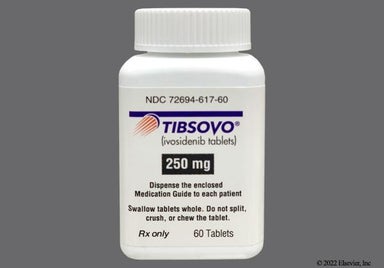
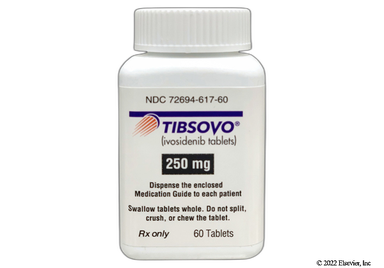
Tibsovo (ivosidenib) is a targeted therapy for cancer called an IDH1 inhibitor. It's used to treat adults with acute myeloid leukemia (AML), myelodysplastic syndrome (MDS), or bile duct cancer (cholangiocarcinoma). This medication is FDA approved only for people who have the IDH1 mutation in their cancer. Tibsovo (ivosidenib) is a tablet that you take by mouth once a day. But it can cause side effects like nausea, diarrhea, and tiredness. It can also cause a serious reaction called differentiation syndrome in people with AML or MDS.
Advanced or metastatic cholangiocarcinoma with an IDH1 mutation in adults who’ve been previously treated
How Tibsovo (ivosidenib) works
Tibsovo (ivosidenib) is an IDH1 inhibitor. It blocks the mutated version of the IDH1 protein from working.
For IDH1-mutated AML and MDS: Stopping mutated IDH1 from working helps prevent the body from making too many abnormal and immature white blood cells. This helps treat AML and MDS.
For IDH1-mutated bile duct cancer (cholangiocarcinoma): Blocking mutated IDH1 stops the cancer cells from growing and spreading. This helps treat bile duct cancer.
The following side effects may get better over time as your body gets used to the medication. Let your healthcare provider know immediately if you continue to experience these symptoms or if they worsen over time.
Fever, cough, dizziness, feeling faint or lightheaded, shortness of breath, bone pain, sudden weight gain, swelling of the ankles, hands, or feet, which may be signs of differentiation syndrome
Heart rhythm changes—fast or irregular heartbeat, dizziness, feeling faint or lightheaded, chest pain, trouble breathing
High white blood cell level—fever, fatigue, trouble breathing, night sweats, change in vision, weight loss
Pain, tingling, or numbness in the hands or feet, muscle weakness, change in vision, confusion or trouble speaking, loss of balance or coordination, trouble walking, seizures
Side effects that usually do not require medical attention (report these to your care team if they continue or are bothersome):
Interacts with several other medications, like hormonal birth control and certain antifungals
Pharmacist tips for Tibsovo (ivosidenib)
You can take Tibsovo (ivosidenib) with or without food. If you decide to take the medication with food, make sure it’s not with a high-fat meal. Taking Tibsovo (ivosidenib) with a high-fat meal can cause higher medication levels in your body and lead to worse side effects.
Swallow Tibsovo (ivosidenib) tablets whole with a glass of water. Don’t split, crush, or chew the tablets.
Take Tibsovo (ivosidenib) at about the same time every day. Choose a time that’s convenient and easy for you to remember. You can also use a reminder app on your phone to help you remember when to take your medication.
You might have some diarrhea while you’re taking Tibsovo (ivosidenib). Be sure to drink a lot of fluids to prevent dehydration. But avoid sugary sports drinks because they can make diarrhea worse. Speak with your oncology team for more recommendations for managing diarrhea, such as taking an over-the-counter medication like loperamide (Imodium A-D).
Your oncologist will recommend antiemetic medications that you can safely take to prevent and treat nausea since this is a common side effect of Tibsovo (ivosidenib). Avoid nausea medications like ondansetron (Zofran), though, because they can raise your risk for heart rhythm problems when they’re taken with Tibsovo (ivosidenib).
If you’re taking Tibsovo (ivosidenib) for AML or MDS, get medical help right away if you have fever, trouble breathing, cough, weight gain, chest pain, or very low blood pressure. These can be symptoms of differentiation syndrome, which is a serious immune reaction to the medication. You’ll need to get treated as soon as possible.
If you vomit after you take Tibsovo (ivosidenib), don’t take another dose to replace it. Just wait until the next day to take the medication at the usual dose and usual time.
If you forget to take Tibsovo (ivosidenib) at your usual time, take the medication as soon as you remember (as long as there’s at least 12 hours until your next dose). You can go back to your usual routine the next day. Don’t double up on your dose to make up for any missed doses.
If you’re able to become pregnant, be sure to talk to your oncologist about the risk of harm to an unborn baby while you're taking Tibsovo (ivosidenib). You might want to use nonhormonal birth control (such as condoms) during treatment if you're sexually active to prevent an unplanned pregnancy. This medication might make hormonal birth control work less well.
Tell your oncology team before you start any new medications while you’re taking Tibsovo (ivosidenib). They can check for drug interactions to keep you safe. Some medications might affect the level of Tibsovo (ivosidenib) in your body, which can affect how well the cancer medication works or raise your risk for side effects.
Risks and warnings for Tibsovo (ivosidenib)
Tibsovo (ivosidenib) can cause some serious health issues. This risk may be even higher for certain groups. If this worries you, talk to your doctor or pharmacist about other options.
Differentiation syndrome in people with AML or MDS
During clinical studies, some people with AML MDS who took Tibsovo (ivosidenib) had a serious reaction called differentiation syndrome. Differentiation syndrome is an immune reaction that happens when proteins in the body called cytokines become active. This causes too much inflammation in the body, which can lead to possibly life-threatening problems. In studies, this reaction happened as early as a few days and up to a few months after people started taking Tibsovo (ivosidenib).
Get medical help right away if you have any symptoms of differentiation syndrome, including fever, trouble breathing, cough, weight gain, swelling of the arms or legs, or low blood pressure. Differentiation syndrome is a medical emergency and must be treated as soon as possible. Most people can restart Tibsovo (ivosidenib) once they get treated for differentiation syndrome and once their symptoms get better.
Changes in heart rhythm
Risk factors: Personal or family history of long QT syndrome | Heart failure | Abnormal electrolyte levels | Taking medications that can cause abnormal heart rhythm
Tibsovo (ivosidenib) can make the heart take longer to recharge after each beat. This effect is known as QT prolongation and it can cause abnormal heart rhythm.
You’ll also need to get an electrocardiogram (EKG) before you start Tibsovo (ivosidenib) and also occasionally during treatment. You’ll need EKGs more often if you’re at higher risk for QT prolongation. If the EKG shows that you have changes in your heart rhythm, your oncologist might pause or stop your treatment with Tibsovo (ivosidenib).
Get medical help right away if you have any symptoms of an abnormal heart rhythm, such as irregular heartbeat, dizziness, or passing out.
Guillain-Barré syndrome
Rarely, people who took Tibsovo (ivosidenib) developed a condition that affects the nervous system called Guillain-Barré syndrome (GBS). It can cause weakness that starts in the legs, arms, or face and then progresses to other parts of the body. Symptoms can also include numbness and tingling, difficulty moving or walking, or trouble breathing.
Seek medical help right away if you have symptoms of GBS. You’ll need to stop taking Tibsovo (ivosidenib) permanently if you're diagnosed with GBS.
Tibsovo (ivosidenib) dosage
Typical dosage for Tibsovo (ivosidenib)
The typical dose is 500 mg by mouth once a day.
What are alternatives to Tibsovo (ivosidenib)?
There are a number of medications that your doctor can prescribe in place of Tibsovo (ivosidenib). Compare a few possible alternatives below.
GoodRx Health has strict sourcing policies and relies on primary sources such as medical organizations, governmental agencies, academic institutions, and peer-reviewed scientific journals. Learn more about how we ensure our content is accurate, thorough, and unbiased by reading our editorial guidelines.
Prescription savings
Stop paying too much for your prescriptions. Compare prices, get pharmacy coupons, and save up to 80%.
No, Tibsovo isn’t a traditional chemotherapy medication. Traditional chemotherapy works by attacking cells in the body that are growing quickly, such as cancer cells. Tibsovo works in a more specific way, so it’s considered a type of targeted therapy. Tibsovo is an IDH1 inhibitor. It finds and attaches to the mutated version of the IDH1 protein in certain cancer cells. This stops these cancer cells from growing and spreading as well.
No. Tibsovo works very specifically by blocking the IDH1 protein. So, the medication is recommended for use only in people whose cancer has an IDH1 mutation. Talk to your oncologist about other treatment options that are more appropriate for you (like chemotherapy) if you’ve been diagnosed with AML, MDS, or bile duct cancer without an IDH1 mutation.
Tibsovo can be used off-label for certain brain cancers that have an IDH1 mutation. The National Comprehensive Cancer Network (NCCN) lists Tibsovo as a treatment option for certain IDH1-mutated gliomas after other therapies (e.g., surgery). The NCCN recommendations are based on studies showing that some people with these types of brain cancers had clinical benefits with Tibsovo even though the medication isn’t FDA approved for this purpose. Talk with your oncologist about whether Tibsovo can be used for your specific cancer.
Yes, Tibsovo can cause joint pain. In studies, 36% of people with relapsed or refractory AML who took Tibsovo reported joint pain. This included back pain, neck pain, or stiffness. During treatment, it might help to keep a journal of any instances of pain, the type of pain, and anything that makes it better or worse. Then, you can talk with your oncologist about options for pain management.
Some people who take Tibsovo can have abnormal heart rhythm. This abnormal heart rhythm can be caused by a delay in the time it takes the heart to recharge after it beats (called QT prolongation). Before you start Tibsovo and also during treatment, your oncologist will check your risk for QT prolongation and abnormal heart rhythm through an electrocardiogram (EKG). Get medical help immediately if you have an irregular heartbeat, have chest pain, feel dizzy, or pass out. These can be signs of an abnormal heart rhythm.
Avoid taking other medications that can cause abnormal heart rhythm with Tibsovo. These medications include amiodarone (Pacerone) and levofloxacin, among others. Tibsovo can affect your heart rhythm and taking other medications that have a similar effect on the heart can raise your risk even more. In addition, don’t take certain seizure medications like carbamazepine (Tegretol) with Tibsovo because the cancer medication might work less well if they’re taken together. Also avoid other medications, like clarithromycin or diltiazem (Cardizem). They might put you at higher risk for side effects from the cancer medication. Share an up-to-date list of your medications with your prescribers and pharmacists. They can check for any dangerous drug interactions and give recommendations on any treatment changes to keep you safe.
It’s best not to drink alcohol while you’re taking Tibsovo. There aren’t any known interactions between Tibsovo and alcohol. But drinking alcohol could make side effects like tiredness more intense. Also, regularly drinking large amounts of alcohol could harm your liver. This could make it harder for your body to get rid of Tibsovo from your system, leading to a higher risk of side effects. Speak with your oncologist about your drinking habits.
How long you take Tibsovo depends on several things. In general, your oncologist will recommend that you keep taking Tibsovo as long as it’s working for you and as long as you don’t have bothersome or serious side effects from it. Your oncologist will check results from your blood tests, biopsies, and scans to see how well the medication is working to treat your cancer. For people with AML or MDS, it can sometimes take at least 6 months of treatment to see a noticeable improvement in your test results. Your oncology team will also ask about side effects during your regular visits. Tell your care team if you have severe side effects such as diarrhea, nausea, or weakness. Don’t stop taking Tibsovo without first discussing with your oncologist.




 During clinical studies, some people with AML MDS who took Tibsovo (ivosidenib) had a serious reaction called differentiation syndrome.
  Get medical help right away if you have any