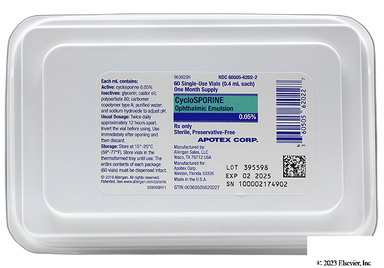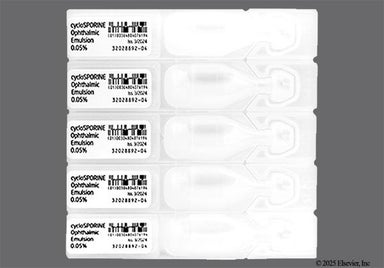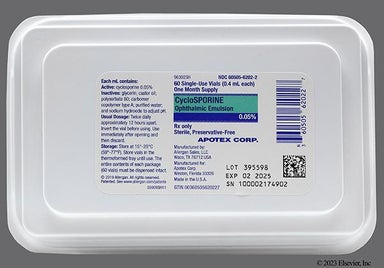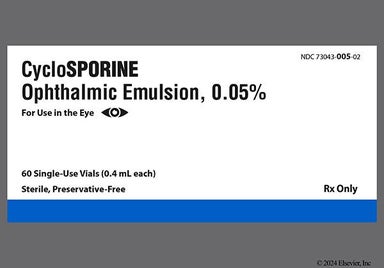

Cyclosporine Coupon - Cyclosporine 60 vials of 0.4ml package

cyclosporine

Generic Sandimmune
Used for Dry Eye, Organ Transplant

Unmodified cyclosporine (Sandimmune) belongs to a drug class called calcineurin inhibitors. It's used to prevent rejection after an organ transplant, usually along with corticosteroids. Typically, cyclosporine (Sandimmune) is taken by mouth once daily. Your provider will measure the level of cyclosporine (Sandimmune) in your blood to help determine your dose and minimize side effects. This medication is available as a brand-name version and lower-cost generic.

Reviewed by:Last reviewed on August 29, 2023
basics-icon

What is Cyclosporine (Sandimmune)?

What is Cyclosporine (Sandimmune) used for?

  • Prevention of heart, liver, and kidney transplant rejection
  • Treatment of chronic (long-term) rejection in heart, liver, and kidney transplant recipients previously treated with other immunosuppressive medications

How Cyclosporine (Sandimmune) works

Cyclosporine (Sandimmune) is a calcineurin inhibitor, which is an immunosuppressant that lowers the activity of your immune system. You need a suppressed (lowered) immune system after receiving an organ transplant so your body doesn't reject the new organ.

Drug facts

Common BrandsSandimmune
Drug ClassImmunosuppressant
Controlled Substance ClassificationNot a controlled medication
Generic StatusLower-cost generic available
AvailabilityPrescription only
side-effects-icon

Side effects of Cyclosporine (Sandimmune)

The following side effects may get better over time as your body gets used to the medication. Let your healthcare provider know immediately if you continue to experience these symptoms or if they worsen over time.

Common Side Effects

  • Tremor (21-55%)
  • High blood pressure (13-53%)
  • Hair growth on face, chest, and back in females (21-45%)
  • Kidney problems (25-38%)

Less Common Side Effects

  • Headache
  • Overgrowth of gums
  • Diarrhea
  • Nausea
  • Vomiting
  • Weakness

Cyclosporine (Sandimmune) serious side effects

Contact your healthcare provider immediately if you experience any of the following.

  • Seizures
  • Serious infections: fever, cough, chills, sore throat, runny or stuffy nose, body aches
  • Sudden kidney injury: feeling sick or weak, urinating less than usual, confusion, blood in urine, swelling in the legs, ankles, or feet
  • Liver damage: stomach pain, nausea, vomiting, clay-colored stools, yellowing of the skin or whites of the eyes
  • Nerve problems: seizures, tremors, headache, tingling sensation
  • Severe allergic reaction with injection form: hives, trouble breathing, swelling in the face or throat

Source: DailyMed

The following Cyclosporine (Sandimmune) side effects have also been reported

Side effects that you should report to your care team as soon as possible:

  • Allergic reactions—skin rash, itching, hives, swelling of the face, lips, tongue, or throat
  • Dizziness, loss of balance or coordination, confusion or trouble speaking
  • Hemolytic anemia—unusual weakness or fatigue, dizziness, headache, trouble breathing, dark urine, yellowing skin or eyes
  • High potassium level—muscle weakness, fast or irregular heartbeat
  • Increase in blood pressure
  • Infection—fever, chills, cough, sore throat, wounds that don't heal, pain or trouble when passing urine, general feeling of discomfort or being unwell
  • Kidney injury—decrease in the amount of urine, swelling of the ankles, hands, or feet
  • Liver injury—right upper belly pain, loss of appetite, nausea, light-colored stool, dark yellow or brown urine, yellowing skin or eyes, unusual weakness or fatigue
  • Pain, tingling, or numbness in the hands or feet, muscle weakness, change in vision, confusion or trouble speaking, loss of balance or coordination, trouble walking, seizures
  • Unusual bruising or bleeding

Side effects that usually do not require medical attention (report these to your care team if they continue or are bothersome):

prices-container

Get your GoodRx coupon

Avg retail price
$Infinity(Save 100.00%)
GoodRx discount
$17.73
See prices
pros-and-cons-icon

Pros and cons of Cyclosporine (Sandimmune)

Pros

  • Comes as a capsule, injection, and oral solution
  • Has been used safely in children age 6 months and older
  • Available as a lower-cost generic medication

Cons

  • Can raise blood pressure and blood sugar
  • Need to have regular lab draws to make sure this medication's levels are within a safe range
  • Interacts with grapefruit juice and a lot of medications
pharmacist-tips-icon

Pharmacist tips for Cyclosporine (Sandimmune)

pharmacist
  • Swallow cyclosporine (Sandimmune) capsules whole. Don't open, crush, or chew capsules. If you have a hard time swallowing them, ask your provider about the oral solution.
  • You'll need regular blood tests to make sure you're getting the right dose of cyclosporine (Sandimmune). These labs will be very frequent right after your transplant (usually once or twice a week), but should become less frequent with time.
  • It's very important you take your cyclosporine (Sandimmune) consistently at the same time every day. Let your transplant team know right away if you miss a dose.
  • Many medications can interact with and change the amount of cyclosporine (Sandimmune) in your body. Talk to your transplant provider or pharmacist before starting any medication or supplement.

Additional tips for the oral solution

  • The cyclosporine (Sandimmune) oral solution should come with a syringe so you can measure out the right dose. Never use household spoons because they can cause you to take the wrong dose.
  • To make cyclosporine (Sandimmune) oral solution taste better, put the solution in a glass of room temperature milk, chocolate milk, or orange juice (but try to be consistent each time). Mix and drink it all right away. To make sure you get the full dose, you can add more milk or juice to rinse the glass and drink the mixture.
  • Don't rinse the syringe with water or other cleaning agents before or after using it. This could affect your dose. If you need to clean the syringe, let it dry completely before using it again.
  • Store cyclosporine (Sandimmune) oral solution at room temperature. Don't put it in the fridge or freezer. Once opened, you can use it for up to 2 months. After this time, throw it away and get a refill.
faq-icon

Common questions about Cyclosporine (Sandimmune)

No, cyclosporine (Sandimmune) isn't a corticosteroid. Instead, it belongs in a drug class called calcineurin inhibitors. Corticosteroids are usually given along with cyclosporine (Sandimmune) to prevent transplant rejection.

No, cyclosporine (Sandimmune) isn't an antibiotic; it's a calcineurin inhibitor. Your provider might prescribe cyclosporine (Sandimmune) along with an antibiotic, such as sulfamethoxazole-trimethoprim (Bactrim) to protect you from certain infections since you'll have a weakened immune response after an organ transplant.

Although cyclosporine (Sandimmune) can stay in your body for several days (based on its half-life) after a dose, it's very important to take your cyclosporine (Sandimmune) regularly everyday because it has a narrow safety window. This means that missing one dose of cyclosporine (Sandimmune) can cause the drug level to drop and raise your risk for organ rejection. If you've missed a dose of cyclosporine (Sandimmune), let your transplant team know right away and they can give you further instructions.

If you've received a transplant, you should continue to take cyclosporine (Sandimmune) and your other anti-rejection medications until your transplant provider tells you to stop. You'll always need immunosuppressant medications, but the medications you take might change depending on how your body responds to the medication.

Avoid grapefruit, pomelo, and Seville oranges while taking cyclosporine (Sandimmune). These citrus fruits and their juices can interact with the cyclosporine (Sandimmune) and cause the levels to get too high in your body, which can cause you to have more side effects, such as high blood pressure and shakiness.

It's best to avoid drinking alcohol while taking cyclosporine (Sandimmune). While it isn't clear whether alcohol directly interacts with cyclosporine (Sandimmune), drinking alcohol can cause harm to your health. For example, drinking alcohol can cause liver, heart, and brain problems. The affects of alcohol can worsen some of cyclosporine (Sandimmune)'s side effects, such as nausea, vomiting, and trouble thinking clearly. If you drink alcohol regularly, ask your provider about resources to help you safely stop drinking or limit your cravings.

Cyclosporine unmodified (Sandimmune) and cyclosporine modified (Neoral) contain the active ingredient cyclosporine. But these two medications aren't the same and one can't be used in place of the other. Neoral's cyclosporine has been changed (modified) so your body can absorb it better and more consistently (e.g., with steady drug levels). Both medications can be used to prevent transplant rejection, but you'll need close monitoring and dose adjustments by your provider if they decide to switch you from one to the other.

educational-icon

How to save using GoodRx

Compare Prices
1. Compare PricesSpecify your dosage and quantity to find out exactly how much you can save.
Select your free coupon
2. Select your free couponYou can use the displayed coupon, or compare prices at other pharmacies near you.
Show coupon to your pharmacist
3. Show coupon to your pharmacistPresent your printed or electronic coupon when you pick up your prescription.
Get free couponLearn more
warnings-icon

Risks and warnings for Cyclosporine (Sandimmune)

Cyclosporine (Sandimmune) can cause some serious health issues. This risk may be even higher for certain groups. If this worries you, talk to your doctor or pharmacist about other options.

Medication absorption

Black Box WarningThe absorption of cyclosporine (Sandimmune) is hard to predict and can change over time. Your transplant team will monitor your blood levels of the medication to make sure it's within the proper range. Cyclosporine (Sandimmune) is absorbed differently than modified versions of the medication, such as Gengraf and Neoral. These forms of cyclosporine are not interchangeable, meaning you can't just switch from one to the other. Taking the wrong form of cyclosporine can lead to medication levels that are too high or too low, which can lead to side effects or transplant rejection, respectively.

Kidney damage

  • Risk factors: Taking other medications that can damage the kidneys | Taking medications that interact and raise the levels of cyclosporine (Sandimmune)

Cyclosporine (Sandimmune) can cause kidney damage. This is more likely to happen if the levels are too high or if you're taking other medications that interact with cyclosporine (Sandimmune). The best way to prevent this is to get your labs drawn regularly and talk with your transplant team before starting any medications. If your kidneys start to show signs of damage, your transplant provider might adjust your dose to see if it helps.

Liver problems

  • Risk factors: History of liver problems | Taking other medications that can damage the liver | Higher doses of cyclosporine (Sandimmune)

There have been reports of people having liver problems while taking cyclosporine (Sandimmune). It usually happens in people who already have liver problems or are taking other medication that can harm the liver. It's more likely to happen in the first month after your transplant, since this is when you're taking higher doses of cyclosporine (Sandimmune). It's important to get your labs drawn on time so your provider can monitor your medication levels and liver tests.

Possible risk of cancer

  • Risk factors: Taking cyclosporine (Sandimmune) long-term | Taking a higher dose of cyclosporine (Sandimmune)

Taking immunosuppressants, like cyclosporine (Sandimmune), might raise your risk of cancer, including skin cancer and lymphoma (a cancer of the immune system). Limit your exposure to sunlight and ultraviolet light, wear protective clothing, and use sunblock.

Serious infections

  • Risk factors: Taking other immunosuppressants

Cyclosporine (Sandimmune) can raise your risk of serious or life-threatening bacterial, fungal, and viral infections. Be sure to stay away from people who are sick. Wash your hands often. In some cases, infections can happen when an inactive virus in your body, like tuberculosis (TB) or hepatitis B virus (HBV), reactivates (makes you sick again). If you develop symptoms of fever, chills, muscle aches, change in appetite or weight loss, vomiting, or skin rash, tell your transplant provider right away.

Side effects affecting brain function, nerves, and movement

  • Risk factors: High blood pressure | Taking high-dose corticosteroids | Having high levels of cyclosporine in the blood | Having received a liver transplant There have been reports of people experiencing side effects affecting brain function, nerves, and movement. Let your provider know if you notice any side effects such as seizures, loss of consciousness, or vision problems. Also, let them know if you notice any changes in your behavior or thoughts. Your provider might adjust your dose of cyclosporine (Sandimmune) to see if the symptoms go away. Usually, the symptoms can ease or lessen when the dose of cyclosporine (Sandimmune) is lowered or when treatment is stopped.

High blood pressure

  • Risk factors: Taking other medications that can raise blood pressure

High blood pressure is a common side effect of cyclosporine (Sandimmune). It's usually mild to moderate, but in some cases can be severe. Your provider will monitor your blood pressure closely and might prescribe blood pressure-lowering medications if needed.

Vaccines

Transplant medications like cyclosporine (Sandimmune) can change the way your immune system responds to vaccines. Avoid live vaccines while taking this medication because they can make you sick. Also be sure to stay away from people who recently got a live vaccine, because they could make you sick. Always tell your provider or pharmacist that you're taking an immunosuppressant like cyclosporine (Sandimmune) before getting vaccinated and they can let you know if it's a live vaccine or not.

dosage-icon

Cyclosporine (Sandimmune) dosage

The average cost for 1 package of 60 vials of 0.4ml of Cyclosporine (Sandimmune) is $94.07 with a free GoodRx coupon. This is 86.52% off the average retail price of $698.07.
capsuleCapsule
DosageQuantityPrice as low asPrice per unit
25mg30 capsules$35.48$1.18
100mg30 capsules$112.35$3.75

Typical dosage for Cyclosporine (Sandimmune)

Your provider will calculate the starting dose of cyclosporine (Sandimmune) based on your body weight. You usually start taking it right before your transplant.

The dose will then be adjusted according to your lab values and will usually become lower as time goes on.

  • The typical maintenance dose of cyclosporine (Sandimmune) ranges from 5 mg/kg to 10 mg/kg by mouth daily.

Cyclosporine (Sandimmune) is also available as an intravenous infusion (IV) for people who can't take oral capsules or solutions. Your provider will switch you over to the oral form of this medication as soon as you're able to take it.

cost-icon

How much does Cyclosporine (Sandimmune) cost?

To access savings, use a GoodRx coupon and pay just a fraction of the retail price.
Cyclosporine (Sandimmune) (generic)
GoodRx lowest price

$17.73

(save 96.15%)
contraindications-icon

Cyclosporine (Sandimmune) contraindications

Contraindications are specific health conditions or situations in which a person should not take a medication due to safety concerns. If you have any of the following conditions or if any of the following apply to you, let your healthcare provider know because Cyclosporine (Sandimmune) will not be safe for you to take.

  • Allergy to polyoxyethylated castor oil
alternatives-icon

What are alternatives to Cyclosporine (Sandimmune)?

There are a number of medications that your doctor can prescribe in place of Cyclosporine (Sandimmune). Compare a few possible alternatives below.
Cyclosporine (Sandimmune)
Used for:
  • Prevention of heart, liver, and kidney transplant rejection
  • Treatment of chronic (long-term) rejection in heart, liver, and kidney transplant recipients previously treated with other immunosuppressive medications
$17.73Lowest GoodRx priceView prices
Used for:

Prevention of organ transplant rejection, including:

$18.99Lowest GoodRx priceView prices
Used for:
$61.43Lowest GoodRx priceView prices
latest-news-icon

News about Cyclosporine (Sandimmune)

Whether your psoriasis is moderate or severe, there are many treatment options. Browse over-the-counter medications, biologics, and other psoriasis treatments.
What Is the Best Psoriasis Treatment for You?
Whether your psoriasis is moderate or severe, there are many treatment options. Browse over-the-counter medications, biologics, and other psoriasis treatments.
What is scalp psoriasis? Here’s your guide to everything you need to know about scalp psoriasis causes, symptoms, treatment, and what it looks like.
What Is Scalp Psoriasis? Symptoms, Pictures, Causes, and Treatments
What is scalp psoriasis? Here’s your guide to everything you need to know about scalp psoriasis causes, symptoms, treatment, and what it looks like.
Restasis (cyclosporine) treatment can take 4 to 6 weeks to relieve symptoms of dry eye. Learn more about how Restasis works, how to use it, and how to save.
How Long It Takes Restasis to Work (Plus Answers to 7 More Restasis FAQs)
Restasis (cyclosporine) treatment can take 4 to 6 weeks to relieve symptoms of dry eye. Learn more about how Restasis works, how to use it, and how to save.
Physicians recommend one drop of Restasis in each eye twice a day, about 12 hours apart. Get info on Restasis (cyclosporine) dosing, including adjustments.
Restasis Dosages: Your GoodRx Guide
Physicians recommend one drop of Restasis in each eye twice a day, about 12 hours apart. Get info on Restasis (cyclosporine) dosing, including adjustments.
Restasis (cyclosporine) can cause itchiness, redness, and other forms of eye discomfort. See a full list of common and long-term Restasis side effects here.
Red Eyes, Blurry Vision, and More: 9 Restasis Side Effects to Know About
Restasis (cyclosporine) can cause itchiness, redness, and other forms of eye discomfort. See a full list of common and long-term Restasis side effects here.
Learn more about how much Restasis is without insurance and how to save with assistance programs, coupons, and more.
How Much Is Restasis Without Insurance?
Learn more about how much Restasis is without insurance and how to save with assistance programs, coupons, and more.
There are many treatment options for psoriatic arthritis, including surgery. Patients typically take medications and perform self-care to help manage symptoms.
How Do You Treat Psoriatic Arthritis?
There are many treatment options for psoriatic arthritis, including surgery. Patients typically take medications and perform self-care to help manage symptoms.
Cyclosporine is available in different formulations to aid absorption. Learn more about cyclosporine modified versus unmodified with this guide from GoodRx.
Cyclosporine Modified vs. Unmodified: Here’s What Sets Them Apart
Cyclosporine is available in different formulations to aid absorption. Learn more about cyclosporine modified versus unmodified with this guide from GoodRx.
Learn more about medications for psoriasis, including the different types available, how they work, and their potential side effects.
What’s Next When Creams for Psoriasis Aren’t Working?
Learn more about medications for psoriasis, including the different types available, how they work, and their potential side effects.
With narrow therapeutic index drugs, even small changes in dosage can be dangerous. Learn more about how to protect your safety if you’re taking one of these medications.
A GoodRx Guide to Narrow Therapeutic Index Drugs
With narrow therapeutic index drugs, even small changes in dosage can be dangerous. Learn more about how to protect your safety if you’re taking one of these medications.
images-icon

Cyclosporine (Sandimmune) images

white - Cyclosporine 0.05% Ophthalmic Emulsion
This medicine is White Package.white - Cyclosporine 0.05% Ophthalmic Emulsion
white - Cyclosporine 0.05% Ophthalmic Emulsion
This medicine is White Package.white - Cyclosporine 0.05% Ophthalmic Emulsion
white - Cyclosporine 0.05% Ophthalmic Emulsion
This medicine is White Package.white - Cyclosporine 0.05% Ophthalmic Emulsion

Get savings updates for Cyclosporine (Sandimmune)

Receive price alerts, news, and other messages from GoodRx about Cyclosporine (Sandimmune) and other healthcare topics and relevant savings offers.

By providing your email, you consent to receive marketing communications from GoodRx, which may include content and/or data related to men's health, women's health, reproductive care, or sexual health. You agree to the GoodRx Terms of Use and acknowledge the Privacy Policy. You can unsubscribe at any time.

References

Best studies we found

Crow, S. (n.d.). What you need to know post-transplant: Common nutrient and herbal interactions. National Kidney Foundation.

Grenier, J., et al. (2006). Pomelo juice, but not cranberry juice, affects the pharmacokinetics of cyclosporine in humans. Clinical Pharmacology and Therapeutics.

Nambiar, P., et al. (2018). Infection in kidney transplantation. Contemporary Kidney Transplantation.

GoodRx Health has strict sourcing policies and relies on primary sources such as medical organizations, governmental agencies, academic institutions, and peer-reviewed scientific journals. Learn more about how we ensure our content is accurate, thorough, and unbiased by reading our editorial guidelines.

Was this page helpful?