Onapgo
Onapgo (apomorphine) is used to treat motor fluctuations in adults with advanced Parkinson’s disease (PD). It works as a dopamine agonist, acting like dopamine in the brain. Onapgo (apomorphine) is a continuous infusion given under the skin using a small pump worn during the day while you're awake. Some people might need small “extra doses” from the pump for sudden "off" symptoms. Side effects can include lumps under the skin where the pump is placed, nausea, and sleepiness. Onapgo (apomorphine) can't be swapped with other apomorphine products that are taken as single, as‑needed doses.


What is Onapgo (apomorphine)?
What is Onapgo (apomorphine) used for?
- Motor fluctuations in adults with advanced Parkinson’s disease (PD)
How Onapgo (apomorphine) works
Onapgo (apomorphine) is a dopamine agonist. This means it acts like dopamine. It turns on dopamine receptors in the brain, which then helps control movement.
Onapgo (apomorphine) is given under the skin as a steady infusion. So, it helps control Parkinson's symptoms throughout the day. It's especially helpful to reduce "off" episodes, where your symptoms come back between doses of your other PD medications (like levodopa).
Drug facts
| Common Brands | Onapgo |
|---|---|
| Drug Class | Dopamine agonist |
| Controlled Substance Classification | Not a controlled medication |
| Generic Status | No lower-cost generic available |
| Availability | Prescription only |

Side effects of Onapgo (apomorphine)
The following side effects may get better over time as your body gets used to the medication. Let your healthcare provider know immediately if you continue to experience these symptoms or if they worsen over time.
Common Side Effects
- Lump or bump under the skin at the infusion site (44%)
- Nausea (22%)
- Drowsiness (22%)
- Redness at the infusion site (17%)
- Uncontrollable movements (15%)
- Headache (13%)
- Trouble sleeping (11%)
- Dizziness (9%)
Less Common Side Effects
- Low blood pressure
- Weakness
- Tiredness
- Constipation
- Vomiting
- Hallucinations (seeing or hearing things that aren't real)
- Psychotic thinking
- Racing heart
- Rash
- Itching at the infusion site
- Infection at the infusion site
Onapgo (apomorphine) serious side effects
Contact your healthcare provider immediately if you experience any of the following.
- Sudden sleep attacks: falling asleep without warning, very strong daytime sleepiness
- Severely low blood pressure: dizziness, passing out or fainting, feeling lightheaded when you stand up
- Hallucinations or unusual changes in behavior or thinking: seeing or hearing things that aren’t there, confusion, agitation, aggressive behavior, not fully aware of what's happening around you
- Heart problems: fast or irregular heartbeat, fainting, severe dizziness, chest pain, trouble breathing
- Anemia caused by breakdown of red blood cells: unusual tiredness, pale or yellow skin, shortness of breath, dark urine
- Compulsive urges that are hard to control: new strong urges to gamble, spend money, binge eat, or have sex
- Allergic reaction: hives; swelling of the face, lips, or tongue; trouble breathing
- Painful erection (priapism): erection lasting more than 4 hours
- Infection at the infusion site: spreading redness, warmth, swelling, drainage, fever
The following Onapgo (apomorphine) side effects have also been reported
Side effects that you should report to your care team as soon as possible:
- Allergic reactions or angioedema—skin rash, itching or hives, swelling of the face, eyes, lips, tongue, arms, or legs, trouble swallowing or breathing
- Chest pain (angina)—pain, pressure, or tightness in the chest, neck, back, or arms
- Falling asleep during daily activities
- Hallucinations
- Heart attack—pain or tightness in the chest, shoulders, arms, or jaw, nausea, shortness of breath, cold or clammy skin, feeling faint or lightheaded
- Heart rhythm changes—fast or irregular heartbeat, dizziness, feeling faint or lightheaded, chest pain, trouble breathing
- Hemolytic anemia—unusual weakness or fatigue, dizziness, headache, trouble breathing, dark urine, yellowing skin or eyes
- Low blood pressure—dizziness, feeling faint or lightheaded, blurry vision
- New or worsening uncontrolled and repetitive movements of the face, mouth, or upper body
- Prolonged or painful erection
- Unusual changes in behavior
- Urges to engage in impulsive behaviors such as gambling, binge eating, sexual activity, or shopping in ways that are unusual for you
Side effects that usually do not require medical attention (report these to your care team if they continue or are bothersome):

Pros and cons of Onapgo (apomorphine)
Pros
- Given as a continuous infusion during the day for ongoing symptom control
- Helps reduce "off" time during the day
- Can use extra doses from the pump to cover sudden "off" episodes
Cons
- Need to wear a pump during your waking hours and manage a pump and infusion set
- Can cause irritation where medication is infused, nausea, and low blood pressure
- Can interact with many medications, including some anti-nausea medications

Pharmacist tips for Onapgo (apomorphine)

- Use the Onapgo pump to infuse the medication. It's infused continuously over around 16 hours of the day while you're awake. The pump comes separately from the cartridges of medication. Be sure you have all the supplies you need for the infusion.
- Before starting Onapgo (apomorphine), your care team will teach you how to use and take care of your pump. Carefully read the Instructions for Use. Ask your prescriber or care team if you have any questions.
- You’ll usually start Onapgo (apomorphine) at a low infusion rate. Your prescriber will slowly adjust the rate to control your PD symptoms and reduce "off" time best. Slowly adjusting the rate also lowers the chance of side effects like nausea, dizziness, and low blood pressure.
- Onapgo (apomorphine) often causes nausea. Ask your care team about how to prevent and manage this before you start treatment. They might tell you to take trimethobenzamide (Tigan) starting 3 days before your first infusion to help.
- You can keep taking trimethobenzamide (Tigan) for nausea after you start Onapgo (apomorphine). But take it for the shortest time needed or for up to 2 months. This is because it can add to side effects like sleepiness and falls.
- Don't take ondansetron (Zofran) or similar anti‑nausea medications with Onapgo (apomorphine). Taking them together can cause very low blood pressure and fainting. Your prescriber can choose a safe medication for you to manage nausea.
- Onapgo (apomorphine) can make you very sleepy without warning. Until you know how the medication affects you, avoid driving or doing risky things. If you suddenly fall asleep in the middle of doing something or feel very sleepy, tell your care team. They can adjust your treatment plan.
- Your blood pressure can drop when you stand up while using Onapgo (apomorphine). This can make you feel dizzy or faint. Get up slowly, and sit or lie down if you feel dizzy. Avoid alcohol since it can drop your blood pressure more and put you at a risk of falls. Tell your care team if these side effects don't get better.
- Watch for skin reactions where you infuse Onapgo (apomorphine). Watch for itchiness, redness that spreads, or a lump under the skin. Also watch for warmth or drainage, which could be signs of infection. If you notice any of these signs, tell your care team so they can help manage it.
- Share a full list of your medications with your care team. Taking some medications with Onapgo (apomorphine) can raise your risk of side effects. This includes blood pressure medications, heart rhythm medications, and some antibiotics. Your care team can check that your medications are safe to take together.
- Don’t stop Onapgo (apomorphine) suddenly unless you have to. Fast dose cuts can make Parkinson’s symptoms worse. If you want to stop, talk to your care team so they can help you do this safely if it's the right choice for you.
- Store Onapgo (apomorphine) cartridges at room temperature (68°F to 77°F).
How to use the Onapgo (apomorphine) pump:
- Wash your hands and gather your supplies. This includes the Onapgo pump kit, a new glass cartridge of the medication, the plastic cartridge holder, and a new infusion set.
- Always use a new glass cartridge of Onapgo (apomorphine), cartridge holder, and infusion line each day. This helps prevent infection. Also choose a different spot for the infusion every day to prevent irritation.
- How to set up the Onapgo pump: Connect the infusion line to the plastic cartridge holder. Remove the flip cap of the glass cartridge and clean the top with an alcohol wipe. Then, place the cartridge holder over the glass cartridge and push down. Put the assembled cartridge into the pump. Then, prime the infusion line as your care team showed you to get rid of extra air.
- Where to infuse Onapgo (apomorphine): Pick a clean area on your lower stomach (at least 2 inches away from your belly button). You can also choose the top of your thigh, lower back, or upper back (if a caregiver helps). Avoid bruised, irritated, or bumpy areas of skin.
- How to start the Onapgo (apomorphine) infusion: Once you pick your infusion site, clean the skin with an alcohol swab and insert the cannula. Connect the primed infusion line to the cannula using the site connector. Then, follow your care team's instructions to start the infusion at your prescribed rate. Wear the pump throughout the day as directed.
- When to use “extra doses” of Onapgo (apomorphine): Use extra doses only as programmed by your prescriber to help control symptoms. This might be when you first start your infusion in the morning. You might also need one after taking a break from the infusion for 1 hour or longer, or for breakthrough "off" symptoms. Don't give extra doses any sooner than 3 hours apart, and don’t use more than 3 each day.
- After ending an Onapgo (apomorphine) infusion: Place the infusion line, glass cartridge, plastic cartridge holder, and cannula into a sharps container. This helps protect you and others from possible germs and sharp edges.
- If your Onapgo pump settings don’t match your prescription, call your care team. If you see repeated alarms from your pump, call Customer Support at 1-833-366-2746.

Risks and warnings for Onapgo (apomorphine)
Onapgo (apomorphine) can cause some serious health issues. This risk may be even higher for certain groups. If this worries you, talk to your doctor or pharmacist about other options.
Never infuse into a vein
Onapgo (apomorphine) is only for infusion under the skin. If it’s given into a vein, crystals of the medication can form. This can cause clots, which might travel to the lungs and be dangerous.
Only use the supplied pump and infusion sets for Onapgo (apomorphine), and never inject it into a vein. Get urgent help if you have sudden chest pain, shortness of breath, or cough up blood. These can be signs of a clot in the lung.
Severe nausea and vomiting
Nausea and vomiting are common with Onapgo (apomorphine) and can sometimes be severe. Your care team might start your infusions at a slow rate at first to help lower this risk.
Before your first infusion, your care team might give you trimethobenzamide (Tigan) to help prevent nausea. You can keep taking it during treatment. But it's best to take it for the shortest time needed, or up to 2 months after starting Onapgo (apomorphine). This is because it can raise the risk of other side effects.
Don't take ondansetron (Zofran) or other similar anti‑nausea medications with Onapgo (apomorphine). This combination can cause dangerously low blood pressure and fainting. Some other medications used for nausea might also worsen PD symptoms.
Tell your care team if your nausea or vomiting doesn’t get better or gets worse. Your prescriber can help decide what else you can try.
Sleepiness or falling asleep during activities
- Risk factors: History of drowsiness | History of sleep problems | Taking sedatives or medications that make you drowsy
Onapgo (apomorphine) can cause strong daytime sleepiness. Some people have also had “sleep attacks.” This is when you feel very sleepy or fall asleep suddenly without warning. It's happened while people have been eating, having conversations, or even driving, which can be dangerous. These effects can happen at any time, even after you've been using Onapgo (apomorphine) for a while.
Until you know how Onapgo (apomorphine) affects you, don’t drive or do anything risky. Tell your care team if you feel very sleepy or suddenly doze off.
Low blood pressure and fainting
- Risk factors: Standing quickly | Drinking alcohol | Taking medications that lower blood pressure | Raising the dose of Onapgo (apomorphine)
Onapgo (apomorphine) can sometimes cause a sudden drop in blood pressure when you stand up. This is called orthostatic hypotension. It can make you feel dizzy or make you faint. This can happen at any time but particularly when your dose gets raised.
Stand up slowly and stay hydrated as advised. Also avoid alcohol while using Onapgo (apomorphine). If you're taking other medications that lower blood pressure, your care team might check your blood pressure often and adjust your medications if needed. Tell your care team if you faint or feel dizzy often.
Falls
- Risk factors: Low blood pressure | Sleepiness | Movement problems | Taking other medications for Parkinson's disease
People with Parkinson's disease have a higher risk of falling because of problems with balance and movement. And Onapgo (apomorphine) can cause drowsiness, dizziness, and low blood pressure. These side effects can also raise the risk of falls.
Wear well-fitted shoes and use a cane if needed and review home safety. Be sure to tell your care team any falls so your treatment plan can be adjusted.
Infusion site reactions and infections
- Risk factors: Not rotating infusion sites | Not cleaning skin properly | Fragile skin
Onapgo (apomorphine) can cause skin reactions and infections where you insert the pump tubing under your skin. The area can become red, sore, swollen, bruised, or itchy. There could also be a rash, a lump under the skin, or some bleeding. Also watch for discolored skin, swelling, tenderness, chills, or a fever. These could be signs of an infection.
If your skin gets irritated or if you see other symptoms there, tell your care team. They can give you tips on how to relieve and manage these reactions. Ask your care team about other signs of infection so you know when to call them. If you get an infection, your care team might have you change where the infusion site is.
Hallucinations and changes in behavior and thoughts
- Risk factors: History of certain mental health conditions
Some people using Onapgo (apomorphine) have had hallucinations (seeing or hearing things that aren't there). Some also had changes in behavior and thinking. This can include paranoia, delusions, and aggressive behavior. It could also mean feeling confused, uneasy, or not being fully aware of what's happening around them.
Let your prescriber know if you have a history of mental health problems. Onapgo (apomorphine) might not be right for you since it can make these problems worse. Some mental health medications can also make PD symptoms worse or make Onapgo (apomorphine) work less well.
Tell your care team if you have hallucinations or unusual changes in behavior or thinking while using Onapgo (apomorphine).
Uncontrolled movements
Onapgo (apomorphine) can cause or worsen involuntary movements. Tell your care team if these movements affect your daily life. Your prescriber can slow your Onapgo (apomorphine) infusions to help. They can also help adjust your other PD medications.
Breakdown of red blood cells
Rarely, Onapgo (apomorphine) can cause your red blood cells to break down too fast. his can happen at any time, can sometimes be serious, and might need urgent care. It can lead to symptoms of anemia like tiredness, pale or yellow skin, and shortness of breath. It can also cause dark urine. This can sometimes be serious and need urgent care. If this happens while you're using Onapgo (apomorphine), tell your care team right away.
Trouble controlling impulsive behavior
Some people develop strong, unusual urges when taking Onapgo (apomorphine). This can include urges to gamble, spend money, or binge eat or more sexual urges. It can be hard to control these urges. If you or your loved ones notice any unusual urges, tell your care team right away. Dose changes or changing to a different treatment might help.
Risk of heart problems
- Risk factors: History of heart or blood flow problems | Slow heart beat | Low potassium or magnesium | History of long QT syndrome | Taking other QT-prolonging medications
In studies, a few people had heart problems while using Onapgo (apomorphine). Some had chest pain or a heart attack. Others had a racing heart or other abnormal heart rhythm. This can include the heart taking longer to recharge between beats. These heart problems can sometimes be serious and even life-threatening.
Get medical help if you ever have chest pain, dizziness, or shortness of breath while using Onapgo (apomorphine). Let your care team know if you ever feel an irregular heartbeat. Also tell them if you have any heart problems because this medication might not be right for you.
Serious allergic reaction
- Risk factors: Sulfite allergy
Severe allergic reactions can happen after taking Onapgo (apomorphine). This can include hives, itchiness, swelling, trouble breathing, or anaphylaxis.
If you have an allergy to sulfites, don’t use Onapgo (apomorphine). This is because it has a sulfite in it.
Get emergency help for symptoms of an allergic reaction. You shouldn't use Onapgo (apomorphine) again if you have an allergic reaction to it.
Painful erections
It's rare, but some men taking Onapgo (apomorphine) experienced priapism. This is a long, painful erection. Get medical help right away if you have an erection that lasts longer than 4 hours and it's painful.

Onapgo (apomorphine) dosage
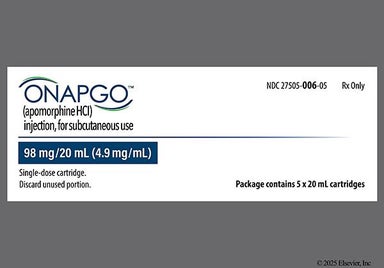
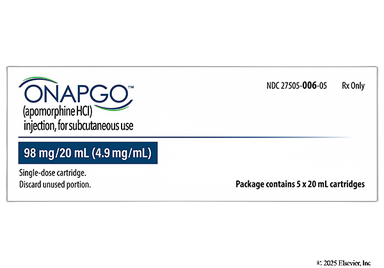
 Carton
| Dosage | Quantity | Price as low as | Price per unit |
|---|---|---|---|
| 5 cartridges of 98mg/20ml | 6 cartons | $0.00 | $0.00 |
Typical dosage for Onapgo (apomorphine)
Onapgo (apomorphine) is infused under the skin using a pump that you wear during the day.
The typical starting dose is 1 mg/hour infused under the skin continuously while you're awake during the day. Your prescriber might raise the dose in 0.5 mg/hour to 1 mg/hour steps as needed. The dose can be raised to up to 6 mg/hour.
You might need to use extra doses to help control symptoms better at certain times of the day. Extra doses are typically 0.5 mg to 2 mg. If needed, give these extra doses at least 3 hours apart and don't use more than 3 extra doses per day. Your extra doses might be different if you have kidney problems.
The typical total daily maximum, including any extra doses, is 98 mg over about 16 hours.

How much does Onapgo (apomorphine) cost?
$0.00

Onapgo (apomorphine) contraindications
Contraindications are specific health conditions or situations in which a person should not take a medication due to safety concerns. If you have any of the following conditions or if any of the following apply to you, let your healthcare provider know because Onapgo (apomorphine) will not be safe for you to take.
- Taking anti‑nausea medications like ondansetron (Zofran), granisetron, Anzemet (dolasetron), and palonosetron
- Taking alosetron (Lotronex)
- Allergy to apomorphine or any ingredient in Onapgo, including sulfites (sodium metabisulfite)

What are alternatives to Onapgo (apomorphine)?

Onapgo (apomorphine) images