



How Much Is Keytruda Without Insurance?
How much Keytruda costs without insurance varies from pharmacy to pharmacy. But without discounts or assistance, you may pay over $12,000 for a 3-week dose.
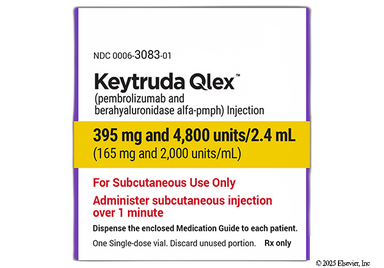
Keytruda Qlex (pembrolizumab / berahyaluronidase alfa) is an immunotherapy medication that’s given as an injection under the skin. It’s FDA approved to treat many types of cancer in some adults and children. These cancers include lung cancer, melanoma, and several others. Keytruda Qlex works as a PD-1 inhibitor to help your immune system fight cancer better. A healthcare professional will help inject it into the thigh or stomach area at a clinic every 3 or 6 weeks. Side effects include rash, tiredness, and diarrhea. Depending on your treatment plan, Keytruda Qlex can be given alone or with other cancer therapies.

Certain types of:
Keytruda Qlex has two active ingredients in it: pembrolizumab and berahyaluronidase alfa.
Pembrolizumab is an immunotherapy medication. In particular, it’s called a programmed death-1 inhibitor, or PD-1 inhibitor. It’s also called a checkpoint inhibitor.
Pembrolizumab works by blocking the programmed death-1 (PD-1) pathway. Some cancer cells use the PD-1 pathway to hide from the immune system. When this happens, the immune system can’t find and destroy the cancer cells as well. And so, the cancer can grow.
By blocking the PD-1 pathway, nivolumab helps the immune system find cancer cells and kill them better. This helps stop the cancer from growing.
Berahyaluronidase alfa is an enzyme. It breaks down a substance in your skin called hyaluronan. This helps your body absorb pembrolizumab better through the skin where it’s injected. This allows Keytruda Qlex to be conveniently given as an injection under the skin.
| Common Brands | Keytruda Qlex |
|---|---|
| Drug Class | PD-1 inhibitor |
| Controlled Substance Classification | Not a controlled medication |
| Generic Status | No lower-cost generic available |
| Availability | Prescription only |

The following side effects may get better over time as your body gets used to the medication. Let your healthcare provider know immediately if you continue to experience these symptoms or if they worsen over time.
Note: Side effects came from adults with lung cancer who were also taking chemotherapy. Side effects might differ for people taking Keytruda Qlex by itself or with other chemotherapy. They might be different for other types of cancer and for children.
Contact your healthcare provider immediately if you experience any of the following.
Side effects that you should report to your care team as soon as possible:
Side effects that usually do not require medical attention (report these to your care team if they continue or are bothersome):




Keytruda Qlex can cause some serious health issues. This risk may be even higher for certain groups. If this worries you, talk to your doctor or pharmacist about other options.
Immunotherapy medications such as Keytruda Qlex can cause immune-related adverse events (irAEs). These side effects happen when your immune system becomes too active. It causes your immune system to start attacking healthy cells, not just cancer cells.
These side effects can happen anywhere in your body and at any time while you're taking Keytruda Qlex. They can be mild or very serious.
Some side effects show up on your blood test results. These include liver or kidney problems. That's why it's important to get your blood work done on time, even if you feel fine. This helps your care team look for side effects that you might not notice on your own.
Other side effects can cause symptoms you can feel. Examples include diarrhea, rash, and trouble breathing. Let your care team know right away if you notice these symptoms or anything unusual.
Depending on how severe your symptoms are, you might need to stop Keytruda Qlex for a while and take a steroid to help you feel better. For severe side effects, you might need to stop Keytruda Qlex completely.
Some people might have a reaction while getting their Keytruda Qlex injection. These reactions can sometimes be severe or even life-threatening and include anaphylaxis.
Reactions can include shivering, chills, flushing, rash, itching, dizziness, or fever. Also watch for throat tightness, trouble breathing, wheezing, or swelling of the face. Tell your nurse right away if any of these symptoms happen during your injection.
If the reaction is mild or moderate, your nurse can pause your Keytruda Qlex injection until you feel better. But if it’s severe or life-threatening, you’ll need to stop Keytruda Qlex completely. Your care team will help treat and manage the reaction.
Some people who’ve taken immunotherapy medications like Keytruda Qlex and have had a stem cell transplant can have serious problems. This can include liver damage called veno-occlusive disease (VOD). It can also lead to graft-versus-host disease (GVHD).
Before starting Keytruda Qlex, tell your oncology care team if you’ve had a stem cell transplant before. Also let them know if you have one planned at any time after you're done with Keytruda Qlex. Your care team will check on you regularly for any signs of these problems.
Based on animal studies and the way Keytruda Qlex works, this medication might harm an unborn baby when it’s given during pregnancy.
If you can get pregnant, your oncologist might ask you to take a pregnancy test before you start treatment. This double checks you're not pregnant before starting Keytruda Qlex.
Then once you start Keytruda Qlex, use effective birth control if you're having sex. Keep using birth control for another 4 months after your last dose. Tell your care team right away if you become pregnant during treatment.

 Vial
Vial| Dosage | Quantity | Price as low as | Price per unit |
|---|---|---|---|
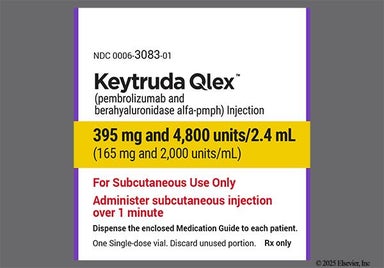
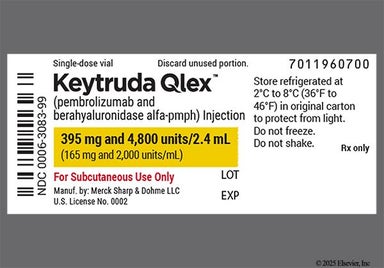
| 2.4ml of 395mg and 4800 units/2.4ml | 1 vial | $12,022.99 | $12,022.99 |
| 4.8ml of 790mg and 9600 units/4.8ml | 1 vial | $24,039.74 | $24,039.74 |
Keytruda Qlex is given as an injection by a healthcare professional. It’s injected under the skin of the thigh or stomach.
Keytruda Qlex is given either every 3 weeks or every 6 weeks. Your oncologist will help decide which dosing schedule is right for you.
Every 3-week dosing: The typical dose is 395 mg/4,800 units (pembrolizumab/berahyaluronidase). It’s given as 2.4 mL of Keytruda Qlex injected under the skin over 1 minute.
Every 6-week dosing: The typical dose is 790 mg/9,600 units (pembrolizumab/berahyaluronidase). It’s given as 4.8 mL of Keytruda Qlex injected under the skin over 2 minutes.
Depending on your treatment plan, you might take Keytruda Qlex by itself or with other cancer therapies.


Contraindications are specific health conditions or situations in which a person should not take a medication due to safety concerns. If you have any of the following conditions or if any of the following apply to you, let your healthcare provider know because Keytruda Qlex will not be safe for you to take.




Prescription savings
Stop paying too much for your prescriptions. Compare prices, get pharmacy coupons, and save up to 80%. Find expert answers to your health questions so you can make the best decisions for yourself and your family.
Health conditions
Medications & treatment
Access & affordability
Medication discounts


No, Keytruda Qlex isn’t a traditional chemotherapy medication. It doesn’t kill all fast-growing cells in the body, whether they’re normal or cancerous. Instead, Keytruda Qlex is a type of immunotherapy. Immunotherapy helps your immune system find and destroy cells in the body it sees as foreign, like cancer cells.
Some people might have a reaction at the injection site after getting Keytruda Qlex. Soreness, redness, or swelling there usually goes away in a day or two. How long other side effects, like rash, tiredness, or diarrhea, can last can be different for everyone. It depends on how severe the side effect is and how well your body responds to supportive treatment, like steroids. Tell your care team if any side effects bother you so they can find ways to help you feel better.
Hair loss isn’t a common side effect of immunotherapy medications like Keytruda Qlex. Keep in mind that some treatment plans include taking Keytruda Qlex with other chemotherapy. These traditional chemotherapy medications are more likely to cause hair loss. If you start to notice hair loss during treatment, talk to your care team about ways to manage this side effect.
When you stop Keytruda Qlex depends on a few things. This includes what type of cancer you have, how well the medication is working, and what side effects you have. Most times, people take Keytruda Qlex as long as it helps and side effects aren’t too serious. But some cancers do have a limit on how long treatment can last. Follow up with your oncologist about your progress with treatment. They’ll check your symptoms, lab tests, and scans to see how well Keytruda Qlex is working and to check for side effects. Also tell your care team about any side effects you have. Ask your oncologist how long you might need to take Keytruda Qlex.
Keytruda and Keytruda Qlex are closely related immunotherapy medications for cancer. They both contain pembrolizumab as the active ingredient. They’re both given by a healthcare professional every 3 or 6 weeks. But the biggest difference is how they’re given. Keytruda is an infusion through the vein that takes 30 minutes. Keytruda Qlex is an injection given under the skin that takes just up to 2 minutes. They treat many of the same cancers. But Keytruda is also approved for certain types of lymphoma (a blood cancer). Talk to your oncologist to compare and see which option is best for you.
The FDA first approved Keytruda Qlex in September 2025.
