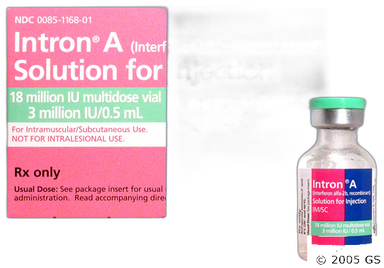
Intron A
Intron A (interferon alfa-2b) is an injectable medication that's used to treat various types of cancer and viral infections. Depending on the condition, this medication can be injected into the muscle, under the skin, into a vein, or into an area of skin growth. Intron A (interferon alfa-2b) has been discontinued by the manufacturer and is no longer available in the United States. Your healthcare provider will help guide you to other treatment options.


What is Intron A (interferon alfa-2b)?
What is Intron A (interferon alfa-2b) used for?
Certain cancers:
- Hairy cell leukemia
- Melanoma
- Follicular lymphoma
- Kaposi's sarcoma in people with AIDs (acquired immunodeficiency syndrome)
Certain viral infections:
- Genital warts
- Chronic (long-term) hepatitis B and C
Drug facts
| Common Brands | Intron A |
|---|---|
| Drug Class | Biologic |
| Controlled Substance Classification | Not a controlled medication |
| Generic Status | No lower-cost generic available |
| Availability | Discontinued |

Intron A (interferon alfa-2b) dosage
Typical dosage for Intron A (interferon alfa-2b)

Interactions between Intron A (interferon alfa-2b) and other drugs
Although certain medicines should not be used together at all, in other cases two different medicines may be used together even if an interaction might occur. In these cases, your doctor may want to change the dose, or other precautions may be necessary. When you are receiving this medicine, it is especially important that your healthcare professional know if you are taking any of the medicines listed below. The following interactions have been selected on the basis of their potential significance and are not necessarily all-inclusive.
Using this medicine with any of the following medicines is usually not recommended, but may be required in some cases. If both medicines are prescribed together, your doctor may change the dose or how often you use one or both of the medicines.
Using this medicine with any of the following medicines may cause an increased risk of certain side effects, but using both drugs may be the best treatment for you. If both medicines are prescribed together, your doctor may change the dose or how often you use one or both of the medicines.



