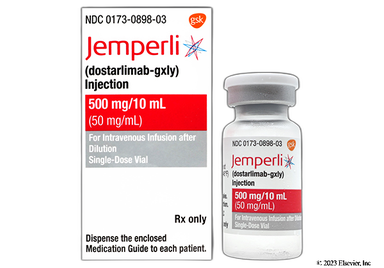
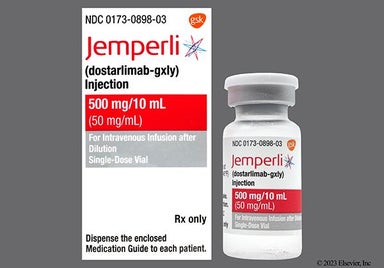
Jemperli (dostarlimab-gxly or dostarlimab) is FDA approved to treat adults with endometrial cancer, or uterine cancer. This medication can also treat certain types of cancers that have specific abnormalities called dMMR. Jemperli (dostarlimab) is an immunotherapy medication called a PD-1 inhibitor. It’s given as an infusion through the vein every 3 weeks at first and then every 6 weeks. Some side effects include fatigue, nausea, and rash.
Advanced or recurrent endometrial cancer, including those that are mismatch repair deficient (dMMR)
Advanced or recurrent dMMR solid tumors, when previous treatment no longer works and no other alternative options are available
How Jemperli (dostarlimab) works
In your body, the immune system acts as a defense system to protect you from harm. It uses a protein called PD-1 to tell apart normal cells from abnormal cells, like cancer cells. When it detects a normal cell, PD-1 acts like “brakes” and stops the immune system from attacking. And when the immune system detects an abnormal cell, it knows to attack the cell to get rid of it from the body.
But some cancer cells can hide from your immune system. They’re able to make your immune system think that they’re “normal.” When this happens, your immune system can’t find and attack the cancer cells as well. This allows the cancer to grow.
Jemperli (dostarlimab) is an immunotherapy medication that blocks PD-1. It’s called a PD-1 inhibitor, which is a type of immune checkpoint inhibitor. By blocking PD-1, Jemperli (dostarlimab) helps the immune system find, detect, and attack cancer cells better. This helps stop the cancer from growing.
The following side effects may get better over time as your body gets used to the medication. Let your healthcare provider know immediately if you continue to experience these symptoms or if they worsen over time.
Note: Side effects were reported by people with dMMR endometrial cancer who took Jemperli (dostarlimab) by itself. Side effects and percentages might differ for people with other types of cancer or for people who are following other treatment regimens.
Jemperli (dostarlimab) serious side effects
Contact your healthcare provider immediately if you experience any of the following.
Immune-related side effects: trouble breathing, cough, diarrhea, mucus or blood in the stool, stomach pain or cramps, rash
Reaction during the infusion: shortness of breath, itching, chills, flushing, upset stomach, chest discomfort
Dry cough, shortness of breath or trouble breathing
Eye pain, redness, irritation, or discharge with blurry or decreased vision
Heart muscle inflammation—unusual weakness or fatigue, shortness of breath, chest pain, fast or irregular heartbeat, dizziness, swelling of the ankles, feet, or hands
Hormone gland problems—headache, sensitivity to light, unusual weakness or fatigue, dizziness, fast or irregular heartbeat, increased sensitivity to cold or heat, excessive sweating, constipation, hair loss, increased thirst or amount of urine, tremors or shaking, irritability
Infusion reactions—chest pain, shortness of breath or trouble breathing, feeling faint or lightheaded
Kidney injury (glomerulonephritis)—decrease in the amount of urine, red or dark brown urine, foamy or bubbly urine, swelling of the ankles, hands, or feet
Liver injury—right upper belly pain, loss of appetite, nausea, light-colored stool, dark yellow or brown urine, yellowing skin or eyes, unusual weakness or fatigue
Pain, tingling, or numbness in the hands or feet, muscle weakness, change in vision, confusion or trouble speaking, loss of balance or coordination, trouble walking, seizures
During your treatment with Jemperli (dostarlimab), keep track of how you’re feeling and tell your care team if you feel anything out of the ordinary, such as shortness of breath, rash, or diarrhea. It could be a sign of an immune-related side effect. These side effects can happen when the medication makes your immune system become too active. You might need additional treatment for these side effects.
Your care team will help manage any immune-related side effects you might have from Jemperli (dostarlimab). They’ll probably recommend steroids for you to take to relieve your symptoms and to calm down the immune system. For more severe immune-related side effects, you might need to take a break from your Jemperli (dostarlimab) infusions or stop treatment altogether.
In addition to keeping your care team aware of how you’re feeling, it’s important to get blood tests done as instructed. These blood tests help your care team check for possible immune-related side effects that you might not feel, such as liver, kidney, or thyroid problems.
Tell your care team right away if you feel short of breath, itchy, feverish, chilly, nauseous, or flushed during your Jemperli (dostarlimab) infusion. Although rare, it’s possible to have an allergic reaction to the infusion (called infusion-related reactions).
Talk with your oncologist before you start Jemperli (dostarlimab) if you’re pregnant or if you’re planning to become pregnant. This medication can potentially harm an unborn baby if it’s given during pregnancy. If you’re able to become pregnant, be sure to use effective birth control to prevent pregnancy while you’re taking Jemperli (dostarlimab) and for 4 months after your last dose. Contact your care team right away if you become pregnant during treatment.
Don’t breastfeed while you’re taking Jemperli (dostarlimab) and for 4 months after your last dose. Although it’s not known, it’s possible for the medication to cause serious side effects in a breastfed baby. Speak with a healthcare professional about safer ways to feed your baby.
Risks and warnings for Jemperli (dostarlimab)
Jemperli (dostarlimab) can cause some serious health issues. This risk may be even higher for certain groups. If this worries you, talk to your doctor or pharmacist about other options.
Immune-related side effects
Jemperli (dostarlimab) works by taking the “brakes” off the immune system to help the immune system attack cancer cells better. But sometimes, the immune system becomes too active, leading to immune-related side effects. These side effects can happen at any time during Jemperli (dostarlimab) treatment and sometimes even after you stop the medication. Immune-related side effects can range from being mild to very serious.
In studies, these immune reactions happen most often in the lungs, digestive system, liver, and skin. But the reactions can happen anywhere in the body. Some of these immune-related side effects, like liver or kidney problems, don’t cause noticeable symptoms but are instead found on your lab test results. So be sure to get your blood work done when instructed so your care team can check for side effects. Tell your care team if you notice any new or worsening shortness of breath, diarrhea, or rash. These could be symptoms of more noticeable immune-related side effects.
Getting treatment for immune-related side effects quickly is key to preventing serious or irreversible damage. Your oncologist will probably pause additional treatment with Jemperli (dostarlimab) to manage the side effects. Your oncologist might also prescribe medications like steroids to lower inflammation in the body caused by the overactive immune system.
Infusion-related reactions
Some people can have reactions to the Jemperli (dostarlimab) infusion. In rare situations, these reactions can be severe or life-threatening. Your care team will watch for signs and symptoms of an infusion reaction during your infusion. Be sure to also let your care team know right away if you notice new chills, flushing, trouble breathing, itching, or dizziness during your infusion.
Most of the time, your care team will pause the infusion to help manage your symptoms. Once your symptoms get better, your team might restart your infusion at a slower speed to lower the risk of reactions. But for more severe reactions, your care team might stop treatment altogether.
Complications from stem cell transplants
Risk factors: People who’ve had an allogeneic stem cell transplant before or after starting Jemperli (dostarlimab) treatment
It’s possible for serious and sometimes fatal complications to happen if you get a stem cell transplant from a stem cell donor (allogeneic stem cell transplant) before or after treatment with an immunotherapy medication like Jemperli (dostarlimab). These complications can include graft-versus-host disease, veno-occlusive disease, and fevers that aren’t caused by infection.
Before you start Jemperli (dostarlimab), talk with your oncology care team if you’ve had a stem cell transplant before or are considering getting one. Also tell them if you have a stem cell transplant planned at any time after you’ve completed treatment. Because of the risk for serious complications, your care team will discuss with you about the safest treatment options for you. They’ll also follow up with you very closely to check for signs and symptoms of complications.
Harm to an unborn baby
Jemperli (dostarlimab) hasn’t been studied in human pregnancy. But based on results from animal studies, there’s a risk that the medication can cause harm to an unborn baby or cause pregnancy loss if it’s given during pregnancy.
If you’re able to become pregnant, your oncologist will ask for you to take a pregnancy test before you start your treatment with Jemperli (dostarlimab). Then, use birth control during treatment and for 4 months after you stop taking the medication. This helps lower your risk for pregnancy and potential harm to the unborn baby. Let your oncology care team know right away if you become pregnant while you’re taking Jemperli (dostarlimab).
Jemperli (dostarlimab) dosage
Typical dosage for Jemperli (dostarlimab)
Jemperli (dostarlimab) is given by a healthcare professional as an infusion through the vein (IV) over a 30-minute period. The dose depends on your cancer and your specific treatment regimen.
Endometrial cancer that’s not mismatch repair deficient (dMMR): The typical dose of Jemperli (dostarlimab) is 500 mg IV every 3 weeks for the first 6 doses, given together with carboplatin and paclitaxel. After that, the typical dose of Jemperli (dostarlimab) is 1,000 mg IV every 6 weeks.
dMMR endometrial cancer or dMMR solid tumor: The typical dose of Jemperli (dostarlimab) is 500 mg IV every 3 weeks for the first 4 doses, then 1,000 mg IV every 6 weeks.
GoodRx Health has strict sourcing policies and relies on primary sources such as medical organizations, governmental agencies, academic institutions, and peer-reviewed scientific journals. Learn more about how we ensure our content is accurate, thorough, and unbiased by reading our editorial guidelines.
Prescription savings
Stop paying too much for your prescriptions. Compare prices, get pharmacy coupons, and save up to 80%.
Yes, Jemperli is an immunotherapy medication. Immunotherapy works by using your own immune system to attack and kill cancer cells. More specifically, Jemperli is a type of immune checkpoint inhibitor called a PD-1 inhibitor. It works by boosting your immune system’s ability to recognize and kill cancer cells. This helps fight cancer.
For people with most types of endometrial cancer, Jemperli is given with other chemotherapy (carboplatin and paclitaxel). But when you have mismatch repair deficient (dMMR) endometrial cancer or other solid tumor, Jemperli is given by itself, typically when previous therapies no longer work and there aren’t any alternative options available. Speak with your oncologist to learn more about whether your treatment plan consists of taking Jemperli by itself or with other chemotherapy.
Discuss with your oncologist about whether Jemperli is right for you. This medication is approved for treating endometrial cancer. It’s also specifically approved for treating certain cancers that are mismatch repair deficient (dMMR). Your oncologist will take a sample of your tumor (a biopsy) to test it for dMMR. Having a cancer that’s mismatch repair deficient means that damaged DNA in the cells can’t get fixed, leading to a higher risk for mutations. Knowing whether your cancer is mismatch repair deficient helps your oncologist plan treatment and predict how well medication might work to treat your cancer. Jemperli might be a treatment option for you if your biopsy results show that you have a dMMR cancer.
In clinical studies, people with endometrial cancer who took Jemperli, carboplatin, and paclitaxel together lived longer without their cancer getting worse than those who took carboplatin and paclitaxel only. Another study showed that the overall response rate was almost 45% in people with dMMR cancers who took Jemperli by itself. This means that almost 45% of people who took Jemperli by itself had results showing that their tumor shrunk or disappeared after up to 3 years of treatment. Keep in mind that each person’s experience with Jemperli can be different. So it’s important to continue to have regular discussions with your oncologist about your treatment progress.
Discuss with your oncologist about how long you should get treated with Jemperli. In general, it depends on your treatment regimen, how well the medication is working to fight against your cancer, and whether you have side effects from the medication. Usually, you’ll keep taking Jemperli for as long as the medication keeps your cancer from growing or spreading. But for endometrial cancer that’s treated with Jemperli together with other chemotherapy, the treatment regimen can only be taken for up to 3 years. You also might have to stop Jemperli if you have severe side effects, like gut or lung problems. Regularly check in with your oncology care team about your treatment progress and any side effects you might have from Jemperli.
Jemperli and Keytruda (pembrolizumab) are both immune checkpoint inhibitors and are considered immunotherapy. They’re both given as an infusion through the vein (IV) once every 3 or 6 weeks. And the two medications share some possible side effects, like rash, diarrhea, and shortness of breath. In general, Keytruda is approved for more cancers than Jemperli. Jemperli is mainly FDA approved for endometrial cancers and other solid tumors that have a high mutation rate. Speak with your oncologist to learn more about comparing between Jemperli and Keytruda.