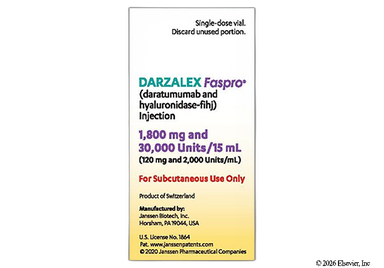
Darzalex Faspro (daratumumab / hyaluronidase-fihj) is a combination medication that contains an anti-CD38 monoclonal antibody and an endoglycosidase. Darzalex Faspro (daratumumab / hyaluronidase) is prescribed to treat multiple myeloma and light chain amyloidosis in adults. A trained professional on your oncology team will inject this medication under the skin, typically every week or every few weeks, depending on where you are in the treatment process. Darzalex Faspro (daratumumab / hyaluronidase) might cause certain side effects such as hypersensitivity reaction, higher risk of infections, and feeling tired.
Adults newly diagnosed with MM and able to receive stem cell transplant (in combination with other anticancer medications)
Adults with advanced MM who've already received but didn’t respond well to at least one prior anticancer treatment (in combination with other anticancer medications)
Adults with advanced MM who've already received but didn’t respond well to at least three prior anticancer treatments (given alone)
How Darzalex Faspro (daratumumab / hyaluronidase) works
Darzalex Faspro is a combination of 2 different medications:
Daratumumab is an anti-CD38 monoclonal antibody. It treats multiple myeloma and light chain amyloidosis by targeting a specific protein called CD38 on the plasma cells’ surface. By binding to this protein, daratumumab attacks and kills the abnormal cells, and also signals to the immune system to do the same.
Hyaluronidase is an endoglycosidase. It works by helping the active medication (daratumumab) get absorbed under the skin.
Side effects of Darzalex Faspro (daratumumab / hyaluronidase)
The following side effects may get better over time as your body gets used to the medication. Let your healthcare provider know immediately if you continue to experience these symptoms or if they worsen over time.
Common Side Effects
Decreased red blood cell counts
Tiredness
Trouble sleeping
Headache
Fever
Cough
Shortness of breath
Nausea, vomiting
Rash
Muscle spasms
Back pain
High blood pressure
Muscle, bone, and joint pain
Cold-like symptoms (upper respiratory infection)
Nerve damage causing tingling, numbness, or pain
Constipation or diarrhea
Lung infection (pneumonia)
Swollen hands, ankles, or feet
Less Common Side Effects
Injection site reactions such as redness and swelling
Changes in blood tests
Darzalex Faspro (daratumumab / hyaluronidase) serious side effects
Contact your healthcare provider immediately if you experience any of the following.
Serious reaction during infusion: shortness of breath or trouble breathing, dizziness or lightheadedness, cough, wheezing, heart beating faster than usual, throat tightness or irritation, runny or stuffy nose, headache, itching, high blood pressure, eye pain, nausea, vomiting, chills, fever, chest pain, blurred vision
Serious infections (from low white blood cell levels): fever, headache, sore throat, cough, body aches, chills, weakness, tiredness
Serious bleeds (from low platelet count): bruising that won't go away or bleeding that's difficult to stop
Heart problems (in people with amyloidosis): feeling faint, trouble breathing, swollen legs, chest pain, abnormal heart rhythm
Works in a more specific, targeted way than traditional chemotherapy
Cons
Might cause hypersensitivity reactions, which can be serious
Given as an injection, so not ideal for people who don't like needles
Can cause tiredness and diarrhea as side effects
Pharmacist tips for Darzalex Faspro (daratumumab / hyaluronidase)
If you have cancer and are taking certain medications like Darzalex Faspro (daratumumab / hyaluronidase), your immune system might not work as well. Your healthcare team might recommend you take an antiviral medication such as acyclovir (Zovirax) to prevent an infection with herpes zoster, the virus that causes shingles, while you’re taking Darzalex Faspro (daratumumab / hyaluronidase) and for 3 months after the last dose.
Darzalex Faspro (daratumumab / hyaluronidase) treatment might lead to lower platelet counts in your body. Platelets are the cells in your blood that form blood clots and prevent bleeding. When platelet levels are low, your body can’t stop bleeding as well. Contact your healthcare team right away if you have bruising that won't go away, nose bleeds, or blood in the stool or urine.
Your healthcare team might recommend you take a corticosteroid, such as methylprednisolone, for 1 or 2 days after your Darzalex Faspro (daratumumab / hyaluronidase) injection. This helps prevent a delayed hypersensitivity reaction. If you experience a fever, chills, or trouble breathing, seek medical attention right away.
Darzalex Faspro (daratumumab / hyaluronidase) is often given along with other medications to treat multiple myeloma and amyloidosis, and it can be difficult to keep track of the treatment schedule. Talk to your healthcare team about using a treatment calendar so all your doses and infusion appointments are written down, or consider using an app on your phone to help you remember.
Taking Darzalex Faspro (daratumumab / hyaluronidase) can raise your risk of an infection. Check your body temperature regularly, especially when you don't feel well. Call your healthcare team immediately if you have a fever, which is a temperature of 100.4 degrees Fahrenheit or higher. Sometimes, a fever might be the only sign that you’re sick.
People who received Darzalex Faspro (daratumumab / hyaluronidase) for light chain amyloidosis have reported serious and sometimes life-threatening heart problems. Your healthcare team will check in with you regularly to monitor your heart health. Get medical help right away if you notice symptoms of heart problems, such as chest pain, feeling faint, and swollen legs.
If you need blood transfusions, let your healthcare team know that you've been receiving Darzalex Faspro (daratumumab / hyaluronidase). This medication can affect the results of blood tests to match your blood type. These changes can last for up to 6 months after your final dose. Your healthcare team will do blood tests to match your blood type before you start Darzalex Faspro (daratumumab / hyaluronidase) treatment.
Risks and warnings for Darzalex Faspro (daratumumab / hyaluronidase)
Darzalex Faspro (daratumumab / hyaluronidase) can cause some serious health issues. This risk may be even higher for certain groups. If this worries you, talk to your doctor or pharmacist about other options.
Serious allergic or injection reactions
Some people taking Darzalex Faspro (daratumumab / hyaluronidase) have experienced serious, sometimes life-threatening, injection-related reactions. These reactions are most common after the first injection. They typically happen within 3 hours after an injection, though some have been reported up to 3 days later. Your healthcare team will give you medications (e.g. antihistamines, corticosteroids) before and after the Darzalex Faspro (daratumumab / hyaluronidase) injection to prevent a reaction.
Injection-site reaction can appear within a few minutes of the injection. If you experience symptoms at the injection site, such as redness and swelling, your care team will monitor you for more serious reactions.
Let your care team know right away if you have symptoms of a more serious reaction, such as stuffy nose, cough, chills, nausea, trouble breathing, fever, and vision changes. If you experience these symptoms, your healthcare team might need to stop Darzalex Faspro (daratumumab / hyaluronidase) and talk with you about other medication options.
Heart problems (in people with light chain amyloidosis)
Risk factors: Amyloidosis that affects the heart | Heart failure
Some people taking Darzalex Faspro (daratumumab / hyaluronidase) to treat amyloidosis have developed heart problems, such as heart failure. Amyloidosis is a condition that causes build up of abnormal proteins in certain organs in your body. For some people, these proteins can build up in the heart, which can cause heart problems such as heart failure. People who already have heart problems related to their amyloidosis might be at higher risk for this side effect. Your healthcare team will monitor you closely for heart problems throughout Darzalex Faspro (daratumumab / hyaluronidase) treatment. Contact your healthcare team right away if you have trouble breathing, swelling in your legs, or chest pain. If you have severe heart failure you may not be able to take Darzalex Faspro (daratumumab / hyaluronidase).
Lower white blood cell counts (risk of infection)
People who take Darzalex Faspro (daratumumab / hyaluronidase) often have low blood cell counts, particularly low white blood cells (neutropenia). White blood cells are an important part of your immune system, so when they’re low you might have a higher risk of serious infections. Your healthcare team will regularly monitor your blood cell counts while you’re taking Darzalex Faspro (daratumumab / hyaluronidase), and they might prescribe other medications such as antibiotics or antivirals to protect you from serious infections. You can lower your risk of getting sick by washing your hands often and avoiding crowds. Check your temperature regularly, and call your healthcare team right away if your temperature is 100.4 degrees Fahrenheit or higher.
Lower platelet counts (risk of bleeding)
Some people who take Darzalex Faspro (daratumumab / hyaluronidase) might have lower platelet counts in their body. Platelets are the cells in your blood that form blood clots and prevent bleeding. So, when their levels are low, your body has a hard time forming clots when you’ve an injury. Your healthcare team will monitor your blood cell counts while you’re taking Darzalex Faspro (daratumumab / hyaluronidase). If you have signs of low platelets such as bruising, nose bleeds, or blood in stool or urine, contact your healthcare team right away.
Changes in lab test results for blood transfusions
Risk factors: Blood transfusion
Darzalex Faspro (daratumumab / hyaluronidase) can affect the results of blood tests to match your blood type. These changes can last for up to 6 months after your final dose of Darzalex Faspro (daratumumab / hyaluronidase). Your healthcare team will do blood tests to match your blood type before you start treatment with Darzalex Faspro (daratumumab / hyaluronidase). Tell all healthcare professionals (HCPs) on your care team that you're being treated with Darzalex Faspro (daratumumab / hyaluronidase) before receiving blood transfusions.
Changes in test results for treatment response
Darzalex Faspro (daratumumab / hyaluronidase) might cause abnormal results on certain lab tests that are used to monitor how well your multiple myeloma is responding to treatment. Talk to your healthcare team about how they monitor your multiple myeloma and response to treatment.
Harm to unborn baby
Darzalex Faspro (daratumumab / hyaluronidase) hasn’t been studied in human pregnancy, but based on the way the medication works it can cause harm to an unborn baby. Females who can get pregnant should use effective birth control while taking Darzalex Faspro (daratumumab / hyaluronidase) and for 3 months after the last dose.
In addition, many of the other medications you take along with Darzalex Faspro (daratumumab / hyaluronidase) for multiple myeloma can also harm an unborn baby. Whether you’re a male or female, if you’re taking Darzalex Faspro (daratumumab / hyaluronidase) together other anticancer medications, such as lenalidomide (Revlimid) or Pomalyst (pomalidomide), your healthcare team will give you information about specific requirements for birth control and pregnancy tests (for females).
Typical dosage for Darzalex Faspro (daratumumab / hyaluronidase)
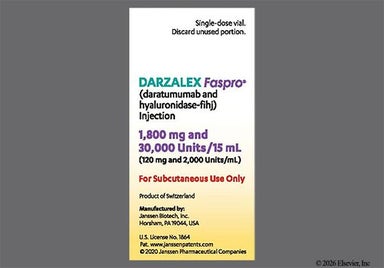
Each 15 mL of Darzalex Faspro (daratumumab / hyaluronidase) contains 1,800 mg of daratumumab and 30,000 units of hyaluronidase.
Adults: A trained professional on your healthcare team will inject Darzalex Faspro under your skin in the stomach area over 3 to 5 minutes. Your care team will decide the timing between doses as well as how many treatments you will receive.
Your care team will give you medications before and after each dose of Darzalex Faspro to lower the risk of infusion-related reactions. If you miss any appointments, call your care team as soon as possible to reschedule your appointment.
What are alternatives to Darzalex Faspro (daratumumab / hyaluronidase)?
There are a number of medications that your doctor can prescribe in place of Darzalex Faspro (daratumumab / hyaluronidase). Compare a few possible alternatives below.
Adults newly diagnosed with MM and able to receive stem cell transplant (in combination with other anticancer medications)
Adults with advanced MM who've already received but didn’t respond well to at least one prior anticancer treatment (in combination with other anticancer medications)
Adults with advanced MM who've already received but didn’t respond well to at least three prior anticancer treatments (given alone)
GoodRx Health has strict sourcing policies and relies on primary sources such as medical organizations, governmental agencies, academic institutions, and peer-reviewed scientific journals. Learn more about how we ensure our content is accurate, thorough, and unbiased by reading our editorial guidelines.
Prescription savings
Stop paying too much for your prescriptions. Compare prices, get pharmacy coupons, and save up to 80%.
No, Darzalex Faspro isn’t chemotherapy. Instead, it’s a targeted therapy. Chemotherapy works by killing cells that divide quickly in the body, which includes cancer cells. Darzalex Faspro works differently from chemotherapy in that it doesn’t kill all fast-growing cells. Instead, this medication works by attacking cells that have a specific protein called CD38 on its surface, such as multiple myeloma cells.
Yes, Darzalex Faspro can cause hypersensitivity (allergic reactions) reactions. Sometimes, the reactions only involve local symptoms, such as redness and swelling at the injection site. These typically happen within a few minutes after the injection. Other times, the reactions are whole-body reactions with more serious symptoms, such as trouble breathing, cough, and fever. These more often happen hours or even days after an injection. Your healthcare team will give you medications, such as diphenhydramine (Benadryl), acetaminophen (Tylenol), and corticosteroids, before and after each Darzalex Faspro injection to try to prevent or limit the seriousness of these reactions. If you have symptoms of a hypersensitivity reaction, let your care team know right away.
Darzalex Faspro can cause nausea, but it’s usually mild. If you experience nausea, let your healthcare team know. If appropriate, they might recommend an oral medication to help manage your symptoms, such as ondansetron (Zofran) or prochlorperazine (Compazine). Contact your healthcare team if you’re experiencing nausea that’s severe or won’t go away.
Typically, people who take Darzalex Faspro don’t report hair loss as a side effect. If you notice any hair loss during treatment, talk to your healthcare team because there can be other causes of hair loss.
Your healthcare team will decide the time between doses as well as how many Darzalex Faspro treatments you will receive. The length of treatment might depend several factors, including what medical condition you have, how well Darzalex Faspro os working, and if you’re having any side effects. Your healthcare team will monitor how well Darzalex Faspro is working based on lab and scan results. Don’t stop taking Darzalex Faspro without first talking to your care team.