Dihydroergotamine works well to treat migraines and cluster headaches, but can't be used to prevent them. It can be used as a nasal spray or an injection.
Dihydroergotamine is an ergot medication that binds to specific receptors (proteins involved with signaling) in the brain, including alpha, serotonin, and dopamine receptors. It tightens blood vessels and prevents the release of inflammatory chemicals in the brain, which relieves your headache.
The following side effects may get better over time as your body gets used to the medication. Let your healthcare provider know immediately if you continue to experience these symptoms or if they worsen over time.
Common Side Effects
Note: Side effects listed below for nasal sprays only.
Nose, throat, or sinus irritation (52%, Trudhesa; 6%, Migranal)
Runny nose (26%)
Nausea (10%)
Change in taste (8%)
Less Common Side Effects
Vomiting
Diarrhea
Dizziness
Sleepiness
Tingling
Anxiety
Shortness of breath
Flushing
Sweating
Rash
Dihydroergotamine serious side effects
Contact your healthcare provider immediately if you experience any of the following.
Poor blood flow: pain, numbness, coldness, pale color in the hands or feet
Heart attack: chest pain or tightness, pain in the jaw, neck, or back, shortness of breath
Stroke: sudden dizziness, trouble walking or speaking, loss of balance, confusion, weakness on one side of your body in your face, arm, or leg
The following Dihydroergotamine side effects have also been reported
Along with its needed effects, a medicine may cause some unwanted effects. Although not all of these side effects may occur, if they do occur they may need medical attention.
Check with your doctor as soon as possible if any of the following side effects occur:
Some side effects may occur that usually do not need medical attention. These side effects may go away during treatment as your body adjusts to the medicine. Also, your health care professional may be able to tell you about ways to prevent or reduce some of these side effects. Check with your health care professional if any of the following side effects continue or are bothersome or if you have any questions about them:
More common
Burning or tingling sensation, dryness, soreness, or pain in the nose
Trudhesa nasal spray can start working as soon as 15 minutes to relieve pain from migraine attack
Available as a nasal spray and injection
Some forms are available as a lower-cost generic (Migranal, D.H.E. 45)
Better tolerated by people experiencing nausea or vomiting with migraine attack
Cons
Not for long-term use
Nasal spray (Migranal, Trudhesa) can cause changes in taste as a side effect
Can cause stroke or heart attack
Can't be used with many medical conditions, during pregnancy, or while breastfeeding
Unknown if safe or works well in children
Pharmacist tips for Dihydroergotamine
Take dihydroergotamine as soon as you feel a cluster headache or migraine coming on. Since these attacks can happen anywhere, it's a good idea to carry this medication with you at all times.
Take dihydroergotamine only when needed. Don't take it too often since this can lead to more side effects, including worse headaches.
Dihydroergotamine is known to cause birth defects. Don't take this medication if you're pregnant or think you might be pregnant. If necessary, use a good form of birth control to prevent accidental pregnancy.
If you're breastfeeding, don't take dihydroergotamine. It can affect your child if it gets into breastmilk, including diarrhea, vomiting, and unstable blood pressure. The medication can also make it harder for you to make milk.
Certain medications can raise your risk of side effects from dihydroergotamine. Make sure your provider and pharmacist know all of the medications that you take, so they can help you watch out for dangerous interactions.
Dihydroergotamine works similarly to triptan medications like sumatriptan (Imitrex) or rizatriptan (Maxalt), and also has very similar side effects. Taking them at the same time as dihydroergotamine can lead to dangerously high blood pressure and other serious side effects. Don't take these medications together or within 24 hours of each other.
Nasal spray
Before using the nasal spray for the first time, you'll want to activate or "prime" it by pumping it 4 times away from your face. This makes sure that you get a full dose of medication.
After opening the nasal spray, it's only good for 8 hours, so you'll want to throw it away afterwards (even if there's still medication left inside). Make sure to discard it someplace out of the reach of children or pets.
Don't tilt your head back or inhale deeply through your nose when spraying Migranal into your nose or right afterwards. It's important for the medication to stay inside of your nose so that it can be absorbed into your bloodstream.
Injection
Before using dihydroergotamine injection, make sure that you've reviewed the instructions with your provider and pharmacist. You'll want to have your technique down so that you're prepared to take the medication safely. This medication is usually injected under the skin (subcutaneously) in the middle of your thigh.
Risks and warnings for Dihydroergotamine
Dihydroergotamine can cause some serious health issues. This risk may be even higher for certain groups. If this worries you, talk to your doctor or pharmacist about other options.
Low blood flow, including from interactions with other medications
Risk factors: Taking certain medications that interact with dihydroergotamine | Taking more dihydroergotamine than prescribed
Some medications can raise the levels of dihydroergotamine in the body. This is dangerous because it can make your blood vessels too tight and affect bloodflow to the brain (which can cause stroke) or hands or feet (which can cause tissue or muscle damage). Don't take dihydroergotamine with protease inhibitors (usually used for human immunodeficiency virus (HIV)) or macrolide antibiotics (e.g., erythromycin, clarithromycin). Some other medications may not have as strong of an effect, but you should still be careful taking them with dihydroergotamine. Make sure your provider and pharmacist know all of the medications that you take, so they can help you watch out for dangerous interactions.
Problems from low blood flow have been reported with dihydroergotamine, even without any interactions with other medications. Let your provider know if you experience muscle pains, coldness, numbness, pale skin color, or blue- or gray-colored fingers or toes, since these are signs of poor circulation (low blood flow). Call 911 if you think you're having a stroke.
Heart attack or injury
Risk factors: High blood pressure | High cholesterol | Smoking | Obesity | Diabetes | Personal history or family history of heart problems | Postmenopausal females | Males over 40 years of age
Dihydroergotamine can cause tight blood vessels in the heart, which can lead to life-threatening heart attacks or irregular heartbeats. Don't use this medication if you have heart disease or risk of heart disease. In case the medication causes any problems, you might need to take your first dose of dihydroergotamine in a healthcare provider's office so you can get immediate care if needed. If you're taking this medication long term, make sure to follow up with your provider regularly to monitor your heart health. Call 911 or get medical help right away if you experience chest pain or tightness after using a dose of dihydroergotamine.
Stroke
Dihydroergotamine has caused stroke, bleeding in the brain, and other brain damage. Only use dihydroergotamine for migraine symptoms and as instructed by your provider, since this medication might raise your risk for stroke and other brain damage. If you experience sudden dizziness, trouble walking or speaking, loss of balance, confusion, or weakness on one side of your body in your face, arm, or leg, seek medical help right away.
High blood presure
Dihydroergotamine can raise your blood pressure, even if you don't have a history of blood pressure problems. Don't take this medication if you have high blood pressure that isn't controlled with medications.
Rebound headaches
Risk factors: Taking certain headache medications on 10 or more days per month
Many headache medications, including dihydroergotamine, can cause "medication overuse headaches" when they're taken too often. This can cause worse headaches or cause them to occur more often. Avoid using headache medications for more than 10 days per month unless told otherwise by your provider. Some other medications that can lead to rebound headaches include non-steroidal anti-inflammatory drugs (NSAIDS), triptans, opioids, and caffeine. If your headaches gets worse or you get headaches more often than usual, let your provider know.
Preterm labor and harm to unborn babies
It's not recommended to take dihydroergotamine during pregnancy, because it can cause harm to you or your unborn baby. It might also cause you to go into labor too early. In animals, dihydroergotamine has caused low weight and bone problems in unborn babies. This is likely due to poor blood flow from pregnant mothers to their babies caused by dihydroergotamine.
Fibrosis (scarring)
Risk factors: Taking dihydroergotamine daily or long term
In some rare cases, people who took dihydroergotamine have experienced fibrosis (scarring) in their stomach, lungs, or heart. Take dihydroergotamine only as needed. If you feel like you need to take this medication every day, talk to your provider about your options for preventing headaches from happening.
Irritation from nasal spray
About one-third of people who use Migranal nasal spray and about half of people who use Trudhesa nasal spray experience nasal irritation. This includes stuffy or runny nose, burning, dryness, taste changes, tingling, bloody nose, pain, sinus discomfort, or soreness. For most people, these side effects should resolve within 4 hours. Contact your provider if these side effects are too bothersome for you or if they don't go away.
Dihydroergotamine dosage
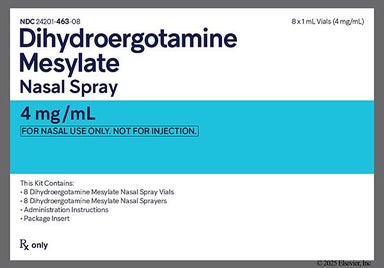
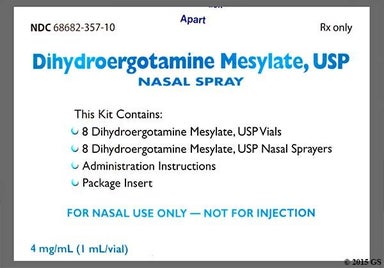
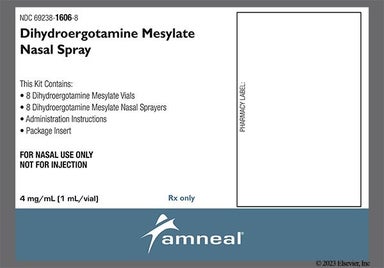
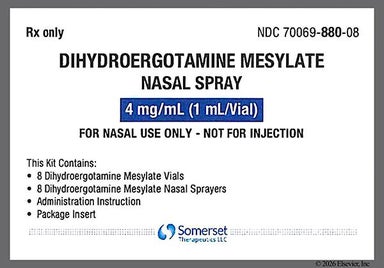
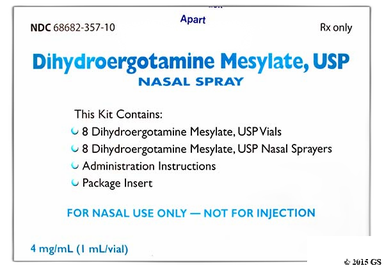
The average cost for 1 nasal spray of 8 vials of 4mg/ml of Dihydroergotamine is $248.33 with a free GoodRx coupon. This is 94.12% off the average retail price of $4,222.26.
Interactions between Dihydroergotamine and other drugs
Dihydroergotamine may interact with certain medications or supplements. Always let your doctor and pharmacist know about any other medications or supplements (including prescribed and over-the-counter medications, vitamins, and dietary or herbal supplements) that you are currently taking. The list below does not include all possible drug interactions with Dihydroergotamine. Please note that only the generic name of each medication is listed below.
Although certain medicines should not be used together at all, in other cases two different medicines may be used together even if an interaction might occur. In these cases, your doctor may want to change the dose, or other precautions may be necessary. When you are taking this medicine, it is especially important that your healthcare professional know if you are taking any of the medicines listed below. The following interactions have been selected on the basis of their potential significance and are not necessarily all-inclusive.
Using this medicine with any of the following medicines is not recommended. Your doctor may decide not to treat you with this medication or change some of the other medicines you take.
Using this medicine with any of the following medicines is usually not recommended, but may be required in some cases. If both medicines are prescribed together, your doctor may change the dose or how often you use one or both of the medicines.
Using this medicine with any of the following medicines may cause an increased risk of certain side effects, but using both drugs may be the best treatment for you. If both medicines are prescribed together, your doctor may change the dose or how often you use one or both of the medicines.
Contraindications are specific health conditions or situations in which a person should not take a medication due to safety concerns. If you have any of the following conditions or if any of the following apply to you, let your healthcare provider know because Dihydroergotamine will not be safe for you to take.
Take certain medications, such as macrolide antibiotics or protease inhibitors
Take other medications that tighten blood vessels
Take other ergot medications or triptans (also used for migraine) within 24 hours
Heart conditions, heart-related chest pain, or history of heart attack
This medicine is Yellow Nasal Spray.Yellow Not applicable - Dihydroergotamine Mesylate 4mg/mL Nasal SprayThis medicine is Yellow Nasal Spray.Yellow Not applicable - Dihydroergotamine Mesylate 4mg/mL Nasal SprayThis medicine is Yellow Nasal Spray.Yellow Not applicable - Dihydroergotamine Mesylate 4mg/mL Nasal SprayThis medicine is Yellow Nasal Spray.Yellow Not applicable - Dihydroergotamine Mesylate 4mg/mL Nasal Spray
Prescription savings
Stop paying too much for your prescriptions. Compare prices, get pharmacy coupons, and save up to 80%.
Plans start at $9.99/mo. (when paid yearly). Terms apply.
Common questions about Dihydroergotamine Mesylate
Dihydroergotamine Mesylate is an ergot medication, not a triptan like sumatriptan (Imitrex) or rizatriptan (Maxalt). However, ergot medications work very similarly to triptans. They're used to treat the same conditions (migraines and cluster headaches), and have some similar side effects. Don't take Dihydroergotamine Mesylate and triptan medications within 24 hours of each other, since this can lead to dangerously high blood pressure and other serious side effects.
This depends on which form of Dihydroergotamine Mesylate you're using. Trudhesa nasal spray can work as soon as 15 minutes for some people. Both Trudhesa and Migranal nasal sprays lower pain within 2 hours in about 2 out of 3 people. The injection form of Dihydroergotamine Mesylate (D.H.E. 45) is absorbed faster than the nasal forms, and might start to work faster to relieve your pain. Discuss the best option with your provider.
If used correctly, Dihydroergotamine Mesylate doesn't typically cause rebound headaches (also known as "medication-overuse headaches"). If Dihydroergotamine Mesylate has worked to stop your headache, the effect tends to last longer than most medications so you're less likely to have another headache again soon afterwards. Take this medication exactly as prescribed, and talk to your provider if it doesn't work or if you're using this medication more than usual.
Both Migranal and Trudhesa are nasal sprays and they both contain the same medication, Dihydroergotamine Mesylate. Trudhesa is a newer form of Dihydroergotamine Mesylate that became available in 2021. It's made in a special way that helps the medication reach your bloodstream more quickly by being absorbed better through your nose. Trudhesa seems to cause nose, throat, and sinus irritation in more people (about 50%) compared to Migranal (up to about 30%). In addition, while there are generic forms of Migranal available, Trudhesa is currently brand only.
Dihydroergotamine Mesylate doesn't commonly make people feel drowsy or sleepy. In studies, about 3% of people who took the nasal spray form of this medication experienced drowsiness. Dihydroergotamine Mesylate can also cause fatigue or general weakness, but these effects are pretty rare as well.


 Some medications can raise the levels of dihydroergotamine in the body. This is dangerous because it can make your blood vessels too tight and affect bloodflow to the brain (which can cause stroke) or hands or feet (which can cause tissue or muscle damage). Don't take dihydroergotamine with
 Problems from low blood flow have been reported with dihydroergotamine, even without any interactions with other medications. Let your provider know if you experience muscle pains, coldness, numbness, pale skin color, or blue- or gray-colored fingers or toes, since these are signs of poor circulation (low blood flow). Call 911 if you think you're having a stroke.