Key takeaways:
Eyebrow hair loss (madarosis) can be caused by medical conditions, over-plucking, and nutritional deficiencies. Eyebrow thinning can also happen naturally as you get older.
Minoxidil is FDA-approved to treat scalp hair loss. It can be used off-label to help with eyebrow growth.
Using minoxidil on your eyebrows can lead to side effects like unwanted facial hair and skin irritation. It has also been linked to serious eye conditions.
Save on related medications
Full, well-shaped eyebrows have become a beauty staple. But thinning brows are surprisingly common — whether from overplucking, aging, hormonal changes, or medical conditions.
Treating eyebrow loss and thinning isn’t always easy. There are no FDA-approved treatments for eyebrow thinning (eyebrow hypotrichosis) or eyebrow hair loss (madarosis).
As a result, people turn to unexpected solutions, like topical minoxidil. Topical minoxidil is an over-the-counter (OTC) medication that’s approved by the FDA to treat certain types of scalp hair loss. But does it actually work on eyebrows? And is it safe to use so close to your eyes?
Search and compare options
Before trying this approach, here’s what to know about what the science says, the potential risks, and the results you can expect.
Does minoxidil work for eyebrow growth?
Minoxidil may help some people regrow their eyebrows. According to Dr. Prasanthi Kandula, a board-certified dermatologist at Precision Skin Care Dermatology, topical minoxidil can stimulate eyebrow hair growth. It does this by increasing blood flow to hair follicles and helping hairs stay in the growth phase longer.
In one study, people who used 2% minoxidil lotion experienced significantly more eyebrow growth after 16 weeks compared to those who used a placebo. Another study found that 2% minoxidil gel and bimatoprost (Latisse) both led to longer, fuller eyebrows after 16 weeks of use.
Researchers have also studied oral minoxidil, a prescription-only medication, in people with frontal fibrosing alopecia — a type of hair loss that often affects the outer edges of your eyebrows. Several studies found that oral minoxidil helped improve eyebrow and eyelash regrowth in people with this condition.
That said, it’s important to know that minoxidil isn’t FDA-approved to treat eyebrow thinning or eyebrow hair loss. This means it hasn’t been studied as extensively for eyebrows as it has for scalp hair loss. There’s also no standard dose or application method for eyebrows. This can make it harder to know how to use it safely and effectively.
Some researchers also point out that there are differences between the hair follicles in your scalp and eyebrows. These differences mean that eyebrow hair follicles may not respond as well to minoxidil. Without more research, it’s hard to know if minoxidil will work for most people.
Overall, minoxidil appears to be a promising off-label option for eyebrow growth. Working with a healthcare professional can help you use minoxidil safely for your eyebrows.
How long will it take to grow your eyebrows with minoxidil?
Minoxidil takes time to work. In clinical studies, researchers saw improvements in eyebrow length and thickness in about 16 weeks. But Dr. Kandula noted that for many people, noticeable results can take 3 to 6 months of consistent use.
There are several reasons why real-world results may look different from those seen in research studies.
Minoxidil formulation
In studies of eyebrow growth, researchers often used minoxidil lotions or gels that were specifically compounded for the studies. These options aren’t available OTC or by prescription at retail pharmacies. The formulation matters because lotions and gels tend to stay in place better, which may improve their effectiveness.
OTC minoxidil products come as a foam or liquid solution. It’s not clear how well these formulations work for eyebrow growth, since studies didn’t test them. It’s also not clear which option is best to use. Solutions may spread more easily but can run, while foams may be easier to control but don’t always coat the area evenly.
Your healthcare team can help you decide which option may work best for eyebrow use.
Minoxidil strength
Studies on eyebrow growth have mostly used 2% minoxidil. OTC topical minoxidil is available as a 2% solution and a 5% foam. Higher strengths may work better for some people. But they can also increase the risk of side effects like skin irritation. Your healthcare team can help you choose the right strength.
How often you apply it
There’s no standard dose schedule for using minoxidil on eyebrows. In studies, people used minoxidil once or twice a day. It’s not clear which works better. But Dr. Kandula emphasized that in order to see improvement, you need to use it consistently over time.
How do you use minoxidil for your eyebrows?
There’s no recommended way to use minoxidil for your eyebrows. Your healthcare team can help you choose the right formulation, strength, and routine.
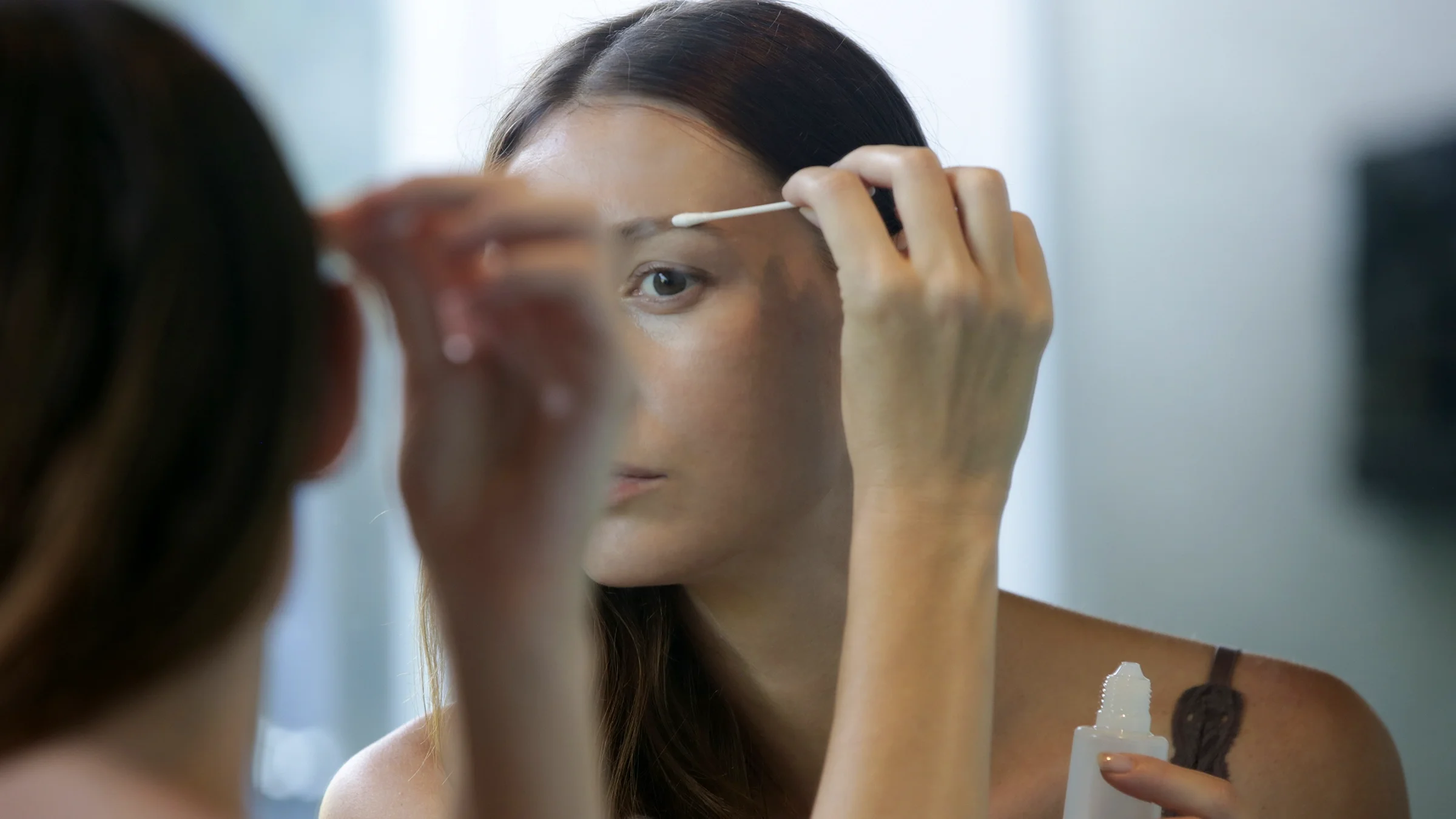
When applying topical minoxidil, Dr. Kandula recommended using a clean spoolie or cotton swab to apply minoxidil to your eyebrows. Dab a small amount of minoxidil on areas where your eyebrows are sparse or thinning. Let it dry completely before applying any skin care products or cosmetics.
Dr. Kadula also recommends applying minoxidil in the morning or during the day. It’s best not to use it before bedtime, since the product can move to other parts of your face while you lie down.
Try to avoid getting minoxidil on other parts of your face. This can lead to unwanted facial hair growth in those areas. If the product drips onto other areas, wash it off with a mild face cleanser and water.
Minoxidil is an eye irritant. If it gets in your eyes, flush them immediately with cool, running water for 10 minutes. Then contact Poison Control for next steps at 1-800-222-1222.
What are the side effects of minoxidil for eyebrows?
Minoxidil can cause some side effects, like:
Skin irritation: Minoxidil can cause redness, itching, flaking, or dryness around your eyebrows. Applying a thin layer of petroleum jelly (like Vaseline) to the skin around your eyebrows may help reduce irritation. Contact your healthcare team if you develop severe skin irritation or if it doesn’t get better within a few days.
Unwanted hair growth: Minoxidil can cause unwanted facial hair growth. This happens because topical minoxidil can spread or shift before it dries. This can also happen if you accidentally touch your face before washing your hands. Apply a small amount carefully and wash your hands after use to help prevent this.
Vision changes (rare): In rare cases, people using minoxidil for eyebrow growth have developed central serous chorioretinopathy, a serious eye condition that can affect vision. Seek medical care right away If you notice vision changes, blurred vision, or eye pain while using minoxidil.
Will your eyebrows shed if you use minoxidil?
You may notice eyebrow shedding when you first start using minoxidil. While this side effect hasn’t been well studied specifically for eyebrows, research on scalp hair loss offers helpful insight.
People using minoxidil for scalp hair loss typically notice increased hair shedding within 2 weeks. Shedding can last up to 6 weeks. Shedding is temporary and a sign that the medication is working.
This happens because your hair follicles shed old hair as they move from a resting phase to a growth phase.
What happens if you stop using minoxidil on your eyebrows?
Minoxidil doesn’t cure hair loss or stop it permanently. If you stop using minoxidil, your eyebrows will go back to their usual growth pattern. Areas of patchiness or thinning will come back once you stop using minoxidil. It can take several weeks to see these effects.
The bottom line
Topical minoxidil may help improve eyebrow thickness and fullness for some people, but it’s not FDA-approved for eyebrow hair loss. Small studies suggest that eyebrow growth may appear around 16 weeks, though noticeable results often take 3 to 6 months of consistent use. Because eyebrow hair follicles are different from scalp hair follicles, results can vary and aren’t guaranteed. Possible side effects include skin irritation and unwanted facial hair growth. If you stop using minoxidil, any eyebrow regrowth you gained will gradually be lost.

Why trust our experts?



References
Alvarez, J. M. C., et al. (2025). Minoxidil and bilateral central serous chorioretinopathy in an adolescent girl: relationship or causality? Romanian Journal of Ophthalmology.
DermNet. (n.d.). Madarosis.
Lee, S., et al. (2014). Minoxidil 2% lotion for eyebrow enhancement: a randomized, double-blind, placebo-controlled, spilt-face comparative study. The Journal of Dermatology.
Mehta, N., et al. (2024). Comparison of minoxidil sulfotransferase activity between scalp hair, eyebrows, and eyelashes: Implication for minoxidil efficacy for off-label use. Journal of Cosmetic Dermatology.
Melián-Olivera, A., et al. (2025). Frontal fibrosing alopecia in men: A review of the literature. Journal of Clinical Medicine.
Pindado-Ortega, C., et al. (2025). [Translated article] Low-dose oral minoxidil for frontal fibrosing alopecia: A 122-patient case series. Actas Dermo-sifiliograficas.
Pirmez, R., et al. (2021). Eyebrow regrowth in patients with frontal fibrosing alopecia treated with low-dose oral minoxidil. Skin Appendage Disorders.
Zaky, M. S., et al. (2023). Comparative study of the efficacy and safety of topical minoxidil 2% versus topical bimatoprost 0.01% versus topical bimatoprost 0.03% in treatment of eyebrow hypotrichosis: a randomized controlled trial. Archives of Dermatological Research.