Key takeaways:
Toenail fungus (onychomycosis) is a common nail infection among adults.
Oral medications work better than topical treatments for toenail fungus, especially for severe cases. But they can have side effects and interact with other medications.
Treatments for toenail fungus tend to work slowly, so patience is key.
Save on related medications
If you’ve noticed yellowing and thickening of your toenail, it’s possible that you have toenail fungus. And you’re not alone: Toenail fungus (onychomycosis) is a very common infection for many adults. The good news is, there are good treatments for toenail fungus out there.
Toenail fungus treatment works slowly, so you’ll need to be patient. Improvement can even continue after you stop treating the nail fungus.
Let’s take a closer look at the best toenail fungus treatments that will help clear up your toenails for good.
What causes toenail fungus?
Toenail fungal infections happen when a fungus comes in contact with the nails and invades them, causing yellowing and thickening of the nails. This can be caused by:
Walking barefoot in a public area, like a pool
Using an infected nail clipper
Having athlete’s foot or touching someone else’s skin who does
It’s important to note that fungus can also affect the fingernails, but this is less common.
Who is most at risk for toenail fungus?
Anyone can get toenail fungus, but it’s much more common in men. It’s also more common as people age. However, it’s possible for people of all ages to get toenail fungus, including children.
There are certain risk factors that can make it more likely for you to develop toenail fungus like:
Having moist feet or excessive sweating
Having a weakened immune system
Smoking
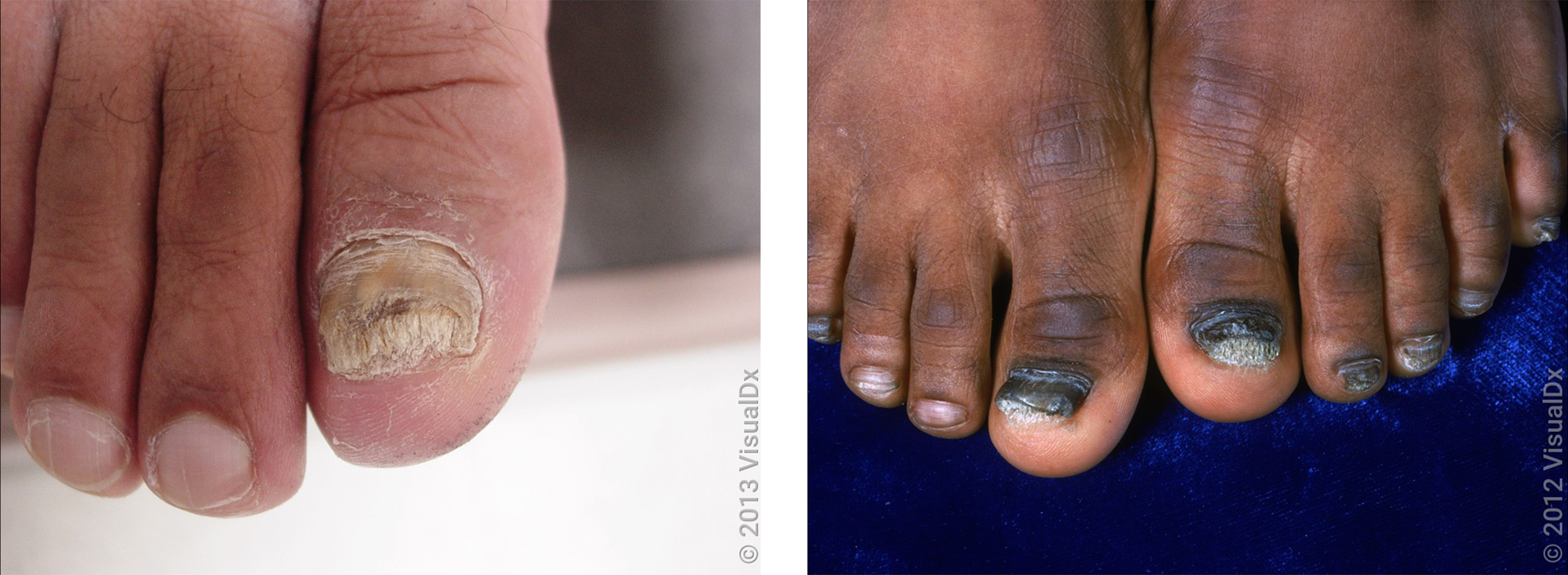
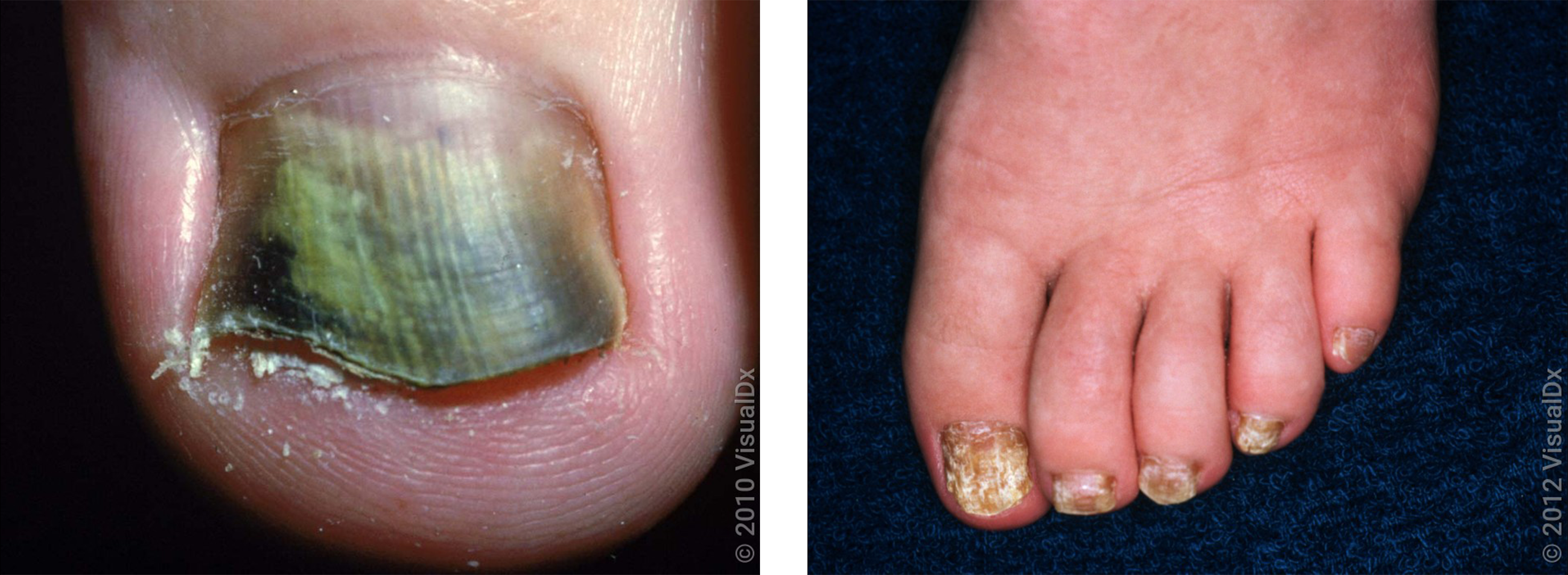
Images of what toenail fungus looks like
When a fungal infection affects your toenails, it can cause changes in nail color, shape, and length, such as:
Yellow, green, brown, or black discoloration
Nail thickening
Broken off or misshapen nails
Here are some photos to help you see what toenail fungus can look like.

Types of toenail fungus
Different types of fungus can cause different changes to the nail. Here are the different types of toenail fungus. Keep in mind that it’s possible to have several types at once:
Distal lateral subungual onychomycosis: This is the most common type. It appears as yellow or brown discoloration at the corner of the toenail that grows inward.
White superficial onychomycosis: This type of toenail fungus appears as white dots or spots on the nail that can be scraped off.
Proximal subungual onychomycosis: It appears as white or yellow patches near the cuticle.
Endonyx onychomycosis: This type of fungus appears as milky white patches inside the nail.
Pills to treat toenail fungus
Oral medications (medications you take by mouth) generally work faster for toenail fungus than topical medications that you apply to the toenail. They have higher cure rates, and the overall treatment time is typically shorter.
That said, it can still take 9 to 12 months to see full results. And you’ll need a prescription for these pills.
Here are the best toenail fungus medications.
Terbinafine
The best pill for toenail fungus is terbinafine (Lamisil). Evidence suggests it works better than the alternatives and has the fewest side effects. Terbinafine resolves toenail fungus almost 90% of the time.
Side effects: Common side effects of terbinafine include headaches, skin rash, and vomiting.
Dosage: You usually take terbinafine once a day for 6 to 12 weeks.
Itraconazole
Another good treatment is itraconazole (Sporanox). Itraconazole cures toenail fungus about 65% of the time.
Here’s what to know about side effects and dosage:
Side effects: Itraconazole side effects may include headaches, stomach upset, and respiratory infection.
Dosage: You usually take itraconazole once a day for 6 to 12 weeks.
Fluconazole
Oral fluconazole (Diflucan, Celozole) is another pill that’s sometimes used off-label to treat toenail fungus. It’s commonly used to treat yeast infections. However, the FDA hasn’t approved it to treat toenail fungus. And it doesn’t work as well compared to other treatments.
Here’s what to know about side effects and dosage:
Side effects: Fluconazole side effects may include headache, nausea, and stomach pain.
Dosage: You usually take fluconazole once a week for at least 3 to 6 months.
Posaconazole
Posaconazole (Noxafil) is a newer medication used to treat toenail fungus. It’s available as a pill and as a liquid suspension.
Posaconazole is usually used to treat serious fungal infections, but it can be used off-label as a toenail fungus treatment. Studies show that posaconazole is effective against toenail fungus. However, there are other more effective and more affordable options.
Here’s what to know about side effects and dosage:
Side effects: Side effects of posaconazole may include diarrhea, fever, and nausea.
Dosage: It’s usually taken once a day for 3 to 6 months.
Creams and topical treatments for toenail fungus
Prescription nail polishes are an option to treat toenail fungus. They take a long time to work though. Also, they aren’t as effective as pills for severe cases. That’s because they don’t penetrate the nail very well.
That said, they’re still a good option for people with mild cases of toenail fungus or for those who can’t take the oral medications.
Examples include:
Efinaconazole (Jublia, Clenafin) — 10% nail solution
Tavaborole (Kerydin) — 5% nail solution
Ciclopirox (Ciclodan, Penlac, Loprox) — 8% nail solution
Side effects are usually minor and include redness or burning at the area where you apply it.
Over-the-counter and natural treatments for toenail fungus
You have some options if you’d rather try over-the-counter (OTC) treatments first. Keep in mind that these treatments are usually used for fungal skin infections, and they don’t work as well in the nail. Having said that, here are some of the best OTC toenail fungus treatments:
Terbinafine (Lamisil)
Tolnaftate (Tinactin)
Clotrimazole (Mycelex)
Natural treatments and home remedies for toenail fungus may be another option. Early studies suggest that these treatments may be effective, but more research needs to be done to see how well they work.
Here are some natural treatments that may help:
Tea tree oil
Vicks VapoRub
Propolis extract (honeybee resin)
Spirulina (a type of algae)
Other treatments for toenail fungus infections
When medications don’t help and only one nail is affected, removing the nail partially or completely is an option. Researchers are also studying light therapy and lasers as possible toenail fungus treatments. More research needs to be done to see how effective these treatments are.
What to watch for when taking oral medication for toenail fungus treatment
All of the pills for toenail fungus can cause liver toxicity. This is rare, though, and it’s reversible after you stop the medication. To prevent this complication, your primary care provider or dermatologist will run your liver function blood tests before you start treatment and then midway through your treatment.
These pills can also interact with other medications you’re taking — including supplements. Your healthcare team will look at your medication list to make sure there aren’t any drug interactions before starting a new treatment.
Frequently asked questions
Some lab studies show that hydrogen peroxide may be effective in treating different types of fungus. But so far, there’s no proof that hydrogen peroxide can get rid of toenail fungus. For best results, it’s best to stick to proven treatments.
The same factors that increase your risk of getting toenail fungus can contribute to making it worse. Here are some examples:
Not keeping your feet clean and dry
Not trimming your nails
Having a weakened immune system
Having certain conditions, like diabetes and psoriasis
You may be able to scrape off a little bit from underneath or around your nail. But it’s not possible to scrape out all the fungus, since it’s inside your nail. So, scraping your nails isn’t an effective treatment.
If toenail fungus isn’t treated and grows for too long, it can lead to a few different problems, including:
Permanent nail damage
Spreading of infection to other nails or to the skin (athlete’s foot)
Increased pain or discomfort
Trouble fitting into shoes
This is why it’s best to treat toenail fungus early, when it’s easier to treat and less likely to cause additional problems.
Some lab studies show that hydrogen peroxide may be effective in treating different types of fungus. But so far, there’s no proof that hydrogen peroxide can get rid of toenail fungus. For best results, it’s best to stick to proven treatments.
The same factors that increase your risk of getting toenail fungus can contribute to making it worse. Here are some examples:
Not keeping your feet clean and dry
Not trimming your nails
Having a weakened immune system
Having certain conditions, like diabetes and psoriasis
You may be able to scrape off a little bit from underneath or around your nail. But it’s not possible to scrape out all the fungus, since it’s inside your nail. So, scraping your nails isn’t an effective treatment.
If toenail fungus isn’t treated and grows for too long, it can lead to a few different problems, including:
Permanent nail damage
Spreading of infection to other nails or to the skin (athlete’s foot)
Increased pain or discomfort
Trouble fitting into shoes
This is why it’s best to treat toenail fungus early, when it’s easier to treat and less likely to cause additional problems.
The bottom line
As frustrating as toenail fungus can be, there are a wide range of treatment options. But you’ll have to be patient. Prescriptions for toenail fungus, specifically antifungal pills, give the best results and may help you get rid of the infection faster. Over-the-counter (OTC) medications and natural treatments may be an option. But these generally aren’t as effective and can take longer to work.

Why trust our experts?



Images used with permission from VisualDx (www.visualdx.com).
References
American Academy of Dermatology Association. (n.d.). Nail fungus: Who gets and causes.
Axler, E., et al. (2024). Antifungal selection for the treatment of onychomycosis: Patient considerations and outcomes. Infection and Drug Resistance.
Elewski, B., et al. (2012). A randomized, placebo- and active-controlled, parallel-group, multicentre, investigator-blinded study of four treatment regimens of posaconazole in adults with toenail onychomycosis. British Journal of Dermatology.
Frazier, W. T., et al. (2021). Onychomycosis: Rapid evidence review. American Family Physician.
Gupta, A. K. (2012). Pharmacoeconomic analysis of oral antifungal therapies used to treat dermatophyte onychomycosis of the toenails. PharmacoEconomics.
Gupta, A. K., et al. (2013). Therapies for the treatment of onychomycosis. Clinics in Dermatology.
Gupta, A. K., et al. (2019). Recent advances in therapies for onychomycosis and its management. F1000Research.
Kreijkamp-Kaspers, S., et al. (2017). Oral antifungal medication for toenail onychomycosis. Cochrane Database of Systematic Reviews.
Leung, A. K. C., et al. (2020). Onychomycosis: An updated review. Recent Patents on Inflammation & Allergy Drug Discovery.
Pajaziti, L., et al. (2015). Treatment of onychomycosis – a clinical study. Medical Archives.
Wiederhold, N. P., et al. (2022). The antifungal and anti-pneumocystis activities of the novel compound A3IS (Mycosinate). Antimicrobial Agents and Chemotherapy.
Yadav, P., et al. (2015). Comparative efficacy of continuous and pulse dose terbinafine regimes in toenail dermatophytosis: A randomized double-blind trial. Indian Journal of Dermatology, Venereology, and Leprology.