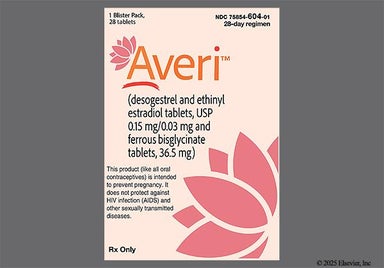
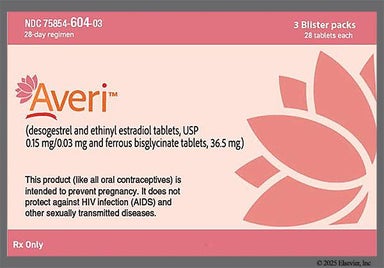
Averi is a birth control used to help prevent pregnancy. Each 28‑day pack contains 21 active tablets with the hormones desogestrel and ethinyl estradiol, followed by 7 reminder tablets that contain iron. You take one tablet by mouth every day at around the same time each day. Common side effects include nausea, headache, and breast tenderness.
Averi (desogestrel / ethinyl estradiol) contains two hormones: desogestrel (a progestin) and ethinyl estradiol (an estrogen). The hormones work together to help prevent pregnancy by:
Stopping ovulation, which is the release of an egg from the ovary.
Thickening cervical mucus, making it harder for sperm to reach an egg.
Thinning the lining of the uterus, making it less likely for a fertilized egg to implant.
The 7 reminder tablets contain iron (ferrous bisglycinate) as an iron supplement during the period week. They don’t contain hormones or provide birth control protection.
Side effects of Averi (desogestrel / ethinyl estradiol)
The following side effects may get better over time as your body gets used to the medication. Let your healthcare provider know immediately if you continue to experience these symptoms or if they worsen over time.
Stroke: sudden numbness or weakness in one arm or leg, numbness or weakness on one side of the face, severe headache, confusion, trouble seeing, trouble walking
Deep vein thrombosis (blood clot in the leg): leg cramp, swelling, or pain; muscle tightness
Pulmonary embolism (blood clot in the lung): cough, chest pain, trouble breathing, racing heart
Serious liver problems: yellowing of the skin or the whites of the eyes, tiredness, stomach pain
Liver injury—right upper belly pain, loss of appetite, nausea, light-colored stool, dark yellow or brown urine, yellowing skin or eyes, unusual weakness or fatigue
Stroke—sudden numbness or weakness of the face, arm, or leg, trouble speaking, confusion, trouble walking, loss of balance or coordination, dizziness, severe headache, change in vision
Can make periods lighter, more regular, and less painful
7 reminder pills can help keep your daily habit during the period week
Comes in an easy-to-follow blister pack
Taken once a day
Cons
Not for people who smoke and are 35 or older
Can raise the risk of blood clots, stroke, or heart attack
Can cause irregular bleeding, nausea, or headaches
Doesn’t protect against HIV or other STIs
Missing pills can affect how well it works
Pharmacist tips for Averi (desogestrel / ethinyl estradiol)
Take Averi (desogestrel / ethinyl estradiol) at the same time every day. Setting an alarm or pairing it with a daily routine can help you remember.
Averi (desogestrel / ethinyl estradiol) works best when you take it every day and don't miss doses. If you miss a pill, follow the instructions on the package or contact your prescriber for advice.
Vomiting or diarrhea can make Averi (desogestrel / ethinyl estradiol) work less well. Use a back-up birth control method (like condoms) until you can check with your prescriber.
Averi (desogestrel / ethinyl estradiol) can interact with some medications and supplements. Tell your prescriber and pharmacist about everything you take, since some products can make your birth control work less well.
Stop taking Averi (desogestrel / ethinyl estradiol) and get medical help right away if you have leg swelling, chest pain, sudden shortness of breath, or a severe headache. These can be signs of a blood clot or stroke.
Don’t smoke while taking Averi (desogestrel / ethinyl estradiol). Smoking raises your chance of serious side effects, including blood clots, heart attack, and stroke. This risk is even higher if you're older than 35.
Ask your prescriber if you should stop Averi (desogestrel / ethinyl estradiol) before major surgery or a long period of limited movement. These situations can raise your risk of blood clots.
If you miss two periods in a row or think you might be pregnant while taking Averi (desogestrel / ethinyl estradiol), take a pregnancy test and contact your prescriber.
If you've recently had a baby and aren't breastfeeding, you can usually start Averi (desogestrel / ethinyl estradiol) 4 weeks after delivery. If you're breastfeeding, talk with your prescriber about your birth control options.
You don’t need a pelvic exam to start Averi (desogestrel / ethinyl estradiol). But regular checkups are still important to make sure it remains a safe option for you.
Upset stomach and spotting can happen when you first start Averi (desogestrel / ethinyl estradiol). These side effects often improve over time.
Remember to use condoms while having sex, even if you're taking Averi (desogestrel / ethinyl estradiol). This medication doesn't protect you and your partner against sexually transmitted infections (STIs).
Storage: Keep Averi (desogestrel / ethinyl estradiol) in the original blister at room temperature and out of reach of children.
How to start Averi (desogestrel / ethinyl estradiol):
You can start Averi (desogestrel / ethinyl estradiol) using either the Day 1 Start or Sunday Start method. For both methods, begin with the first active pill in the pack.
Day 1 Start: Take your first Averi (desogestrel / ethinyl estradiol) pill within the first 24 hours of your period. You don't need to use a back-up birth control method.
Sunday Start: Take your first Averi (desogestrel / ethinyl estradiol) pill on the first Sunday after your period begins, even if you're still bleeding. Use a backup birth control method for the first 7 days.
Risks and warnings for Averi (desogestrel / ethinyl estradiol)
Averi (desogestrel / ethinyl estradiol) can cause some serious health issues. This risk may be even higher for certain groups. If this worries you, talk to your doctor or pharmacist about other options.
Cigarette smoking and serious heart problems
Risk factors: Over 35 years old and smoke cigarettes
If you smoke cigarettes, taking combined oral contraceptives (COCs) like Averi (desogestrel / ethinyl estradiol) can raise your risk of serious health problems. These include blood clots, stroke, heart attacks. The risk is higher if you're 35 years or older and increases with the number of cigarettes you smoke. If you smoke, talk with your OB-GYN provider about safer birth control options.
Risk for blood clots and related complications
Risk factors: Over 35 years old and smoke | Over 40 years old who don't smoke | Recent surgery with a long period of bedrest | Starting Averi (desogestrel / ethinyl estradiol) less than a month after childbirth | People identified as obese | High blood pressure | High cholesterol | Diabetes | Higher dose of estrogen
Averi (desogestrel / ethinyl estradiol) raises your risk of blood clots, though the overall risk is low. These clots can occur anywhere in your body. Blood clots can form in your legs or lungs and can sometimes lead to serious problems such as a stroke or heart attack.
Get emergency help right away if you have any signs of a blood clot or its complications.
Brain (stroke): weakness or numbness on one side of the body, weakness or numbness on one side of the face, trouble speaking, blurred vision, dizziness, loss of balance, trouble walking, or confusion
Eyes (retinal vein occlusion, RVO): trouble seeing, bulging eye, double vision, or vision loss
Heart (heart attack): chest pain, sweating, nausea, or dizziness
If you have surgery planned, tell your prescriber that you're taking Averi (desogestrel / ethinyl estradiol). They might have you stop the medication before and after surgery to help lower your risk of blood clots.
Breast and cervical cancer
Risk factors: History of breast cancer | Taking COCs for a long time
Averi (desogestrel / ethinyl estradiol) might raise your risk of breast and cervical cancer, although study results have been mixed. Don't take Averi (desogestrel / ethinyl estradiol) if you have breast cancer, since the estrogen in this medication can cause some breast cancers to grow faster.
Check your breasts regularly and get breast exams as recommended by your OB-GYN provider. Tell your care team if you notice a lump, pain, swelling, or other changes in your breasts. Also get medical help if you have unusual vaginal bleeding, unusual discharge, or pain during sex, since these can be signs of cervical cancer.
Liver problems
Risk factors: History of liver problems | Taking COCs for more than 8 years Taking certain hepatitis C medications
Although rare, birth control pills like Averi (desogestrel / ethinyl estradiol) can cause liver problems, including liver damage or noncancerous liver tumors. This risk is lower with newer birth control pills like Averi (desogestrel / ethinyl estradiol) that contain lower doses of estrogen, but it can still happen.
Tell your care team right away if you have symptoms of liver problems, such as unusual tiredness, stomach pain, loss of appetite, or yellowing of your skin or eyes. These symptoms should be checked as soon as possible.
Gallbladder problems
Birth control pills like Averi (desogestrel / ethinyl estradiol) might raise your risk of gallbladder problems, although the risk appears to be low.
Tell your care team if you develop symptoms of gallbladder problems, such as severe pain in the upper right side of your stomach, nausea, vomiting, fever, or yellowing of your skin or eyes. These symptoms may need medical attention.
High blood sugar and triglycerides
Risk factors: Prediabetes or diabetes | Personal or family history of high triglycerides
Averi (desogestrel / ethinyl estradiol) can affect how your body handles sugar and fats. If you have diabetes or prediabetes, your prescriber might want to monitor your blood sugar more closely while you're taking this medication.
In some people, Averi (desogestrel / ethinyl estradiol) can also raise triglyceride levels, a type of fat in the blood. Tell your prescriber if you have a history of high triglycerides, diabetes, or other conditions so they can decide whether extra monitoring is needed.
High blood pressure
Risk factors: High blood pressure | Older age | Using COCs for a long time | Kidney problems
Averi (desogestrel / ethinyl estradiol) can raise your blood pressure. This side effect is more likely if you already have high blood pressure or have been taking hormonal birth control for a long time.
Your prescriber might recommend having you check your blood pressure regularly while you're taking this medication. If your blood pressure becomes too high, you might need to stop treatment and switch to a different birth control method.
Headache
Averi (desogestrel / ethinyl estradiol) can sometimes cause new headaches or make existing headaches and migraines worse. Tell your care team if you develop a new type of headache, headaches that happen more often, or headaches that become severe.
Get medical attention right away if you have a sudden, severe headache or a migraine with vision changes, weakness, or trouble speaking. These can be signs of a serious medical problem. Your prescriber might have you stop taking Averi (desogestrel / ethinyl estradiol) while they figure out the cause.
Irregular bleeding
It's common to have spotting or breakthrough bleeding while taking Averi (desogestrel / ethinyl estradiol), especially during the first few months of treatment. This usually improves over time as your body adjusts to the medication.
Tell your prescriber if the bleeding is heavy, lasts a long time, or happens after you've been taking Averi (desogestrel / ethinyl estradiol) for several months. Some people might also miss periods while taking birth control pills. If you miss a period and think you could be pregnant, take a pregnancy test and contact your care team.
Depression
Risk factors: History of depression
Let your care team know if you have symptoms of depression or worsening depression while taking Averi (desogestrel / ethinyl estradiol). In cases of serious depression, your prescriber might tell you to stop taking this medication.
Interactions with other medications
Averi (desogestrel / ethinyl estradiol) can interact with many medications and supplements. Some medications can make Averi (desogestrel / ethinyl estradiol) less effective and raise your risk of pregnancy. Examples include certain seizure medications, rifampin, topiramate, and St. John’s wort. If you take one of these medications, use a backup birth control method and continue it for 28 days after stopping the interacting medication.
Other medications can raise Averi (desogestrel / ethinyl estradiol) levels and increase side effects. Averi (desogestrel / ethinyl estradiol) can also affect how some medications work, including lamotrigine, certain HIV medications, cyclosporine, and thyroid hormone replacement medications. Tell your prescriber and pharmacist about all medications, vitamins, and supplements you take so they can check for interactions.
Averi (desogestrel / ethinyl estradiol) dosage
The average cost for 3 packages of 28 tablets of 0.15mg/0.03mg of Averi (desogestrel / ethinyl estradiol) is $603.65 with a free GoodRx coupon. This is 17.98% off the average retail price of $735.98.
Typical dosage for Averi (desogestrel / ethinyl estradiol)
Averi (desogestrel / ethinyl estradiol) comes in a 28-day pack. Take the tablets as instructed by your prescriber.
There are 21 active tablets that each contain 0.15 mg desogestrel and 30 mcg ethinyl estradiol. There are also 7 reminder tablets that contain iron.
In general, the typical dose is 1 active tablet by mouth daily for 21 days, followed by 1 iron tablet daily for the next 7 days. Repeat this dosing schedule for each pack.
How much does Averi (desogestrel / ethinyl estradiol) cost?
To access savings, use a GoodRx coupon and pay just a fraction of the retail price.
Contraindications are specific health conditions or situations in which a person should not take a medication due to safety concerns. If you have any of the following conditions or if any of the following apply to you, let your healthcare provider know because Averi (desogestrel / ethinyl estradiol) will not be safe for you to take.
Smoking over the age of 35
Medical conditions that raise the risk for blood clots
Currently have or have had a blood clot (DVT or PE)
Taking hepatitis C medication containing ombitasvir/paritaprevir/ritonavir, with or without dasabuvir
What are alternatives to Averi (desogestrel / ethinyl estradiol)?
There are a number of medications that your doctor can prescribe in place of Averi (desogestrel / ethinyl estradiol). Compare a few possible alternatives below.
This medicine is Blue, Round Package Imprinted With "F1".Blue Round F1 - Averi 28-Day 0.15mg-0.03mg/36.5mg TabletThis medicine is Blue, Round Package Imprinted With "F1".Blue Round F1 - Averi 28-Day 0.15mg-0.03mg/36.5mg Tablet
IARC Working Group on the Evaluation of Carcinogenic Risks to Humans. (2012). Combined estrogen-progestogen contraceptives. Pharmaceuticals. International Agency for Research on Cancer.
GoodRx Health has strict sourcing policies and relies on primary sources such as medical organizations, governmental agencies, academic institutions, and peer-reviewed scientific journals. Learn more about how we ensure our content is accurate, thorough, and unbiased by reading our editorial guidelines.
Prescription savings
Stop paying too much for your prescriptions. Compare prices, get pharmacy coupons, and save up to 80%.
Plans start at $9.99/mo. (when paid yearly). Terms apply.
Common questions about Averi
No. Low-dose birth control is a combined oral contraceptive (COC) that contains 20 mcg of ethinyl estradiol (estrogen) or less. Averi isn't a low-dose birth control because the active pills contain 30 mcg of ethinyl estradiol.
Some people taking combined oral contraceptives (COCs) like Averi report weight gain, but it isn't clear whether birth control is the cause. If weight changes happen, they’re more likely related to water retention than an increase in body fat. Not everyone gains weight, and some people may even lose weight. If you're concerned about weight changes while taking Averi, talk with your prescriber.
When taken correctly, birth control pills like Averi are very effective at preventing pregnancy. With perfect use, they are more than 99% effective, meaning fewer than 1 out of 100 people become pregnant in a year. With typical use, which includes occasionally missing pills or taking them late, they are about 93% effective. Taking your dose at the same time every day helps it work as well as possible.
It's possible for Averi to stop your period. Changes in menstrual bleeding patterns, including lighter periods or skipped periods, are common with birth control pills. But a missed period can also be a sign of pregnancy. If you miss a period, consider taking a pregnancy test and contact your prescriber if you have concerns.
Some people taking birth control pills like Averi have reported acne as a side effect. But it's less common with Averi. This is because the medication contains a newer type of progestin that generally has a lower risk of causing acne. If you notice new or worsening acne during treatment, talk with your prescriber about ways to manage it.



 If you smoke cigarettes, taking combined oral contraceptives (COCs) like Averi (desogestrel / ethinyl estradiol) can raise your risk of