



How Long Does Voquezna Take to Work?
Voquezna starts working quickly to reduce stomach acid. Read on to learn more about how to get the most from this acid-reducing medication.
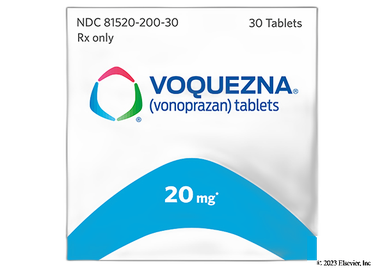
Voquezna (vonoprazan) is a potassium-competitive acid blocker (PCAB). It relieves heartburn from erosive esophagitis and non-erosive gastroesophageal reflux disease (GERD). It can also treat H. pylori infections, in combination with certain antibiotics. Voquezna (vonoprazan) received FDA approval in late 2023 for adults and is available as a tablet that's taken by mouth once per day. Side effects aren't common, but can include stomach pain and indigestion. Voquezna (vonoprazan) is typically taken short-term to prevent more serious side effects, like bone fractures and infectious diarrhea.

Voquezna (vonoprazan) is a potassium-competitive acid blocker (PCAB). It blocks a protein to stop stomach acid from being made and released into your stomach. This prevents stomach acid from irritating your stomach.
| Common Brands | Voquezna |
|---|---|
| Drug Class | Potassium-competitive acid blocker (PCAB) |
| Controlled Substance Classification | Not a controlled medication |
| Generic Status | No lower-cost generic available |
| Availability | Prescription only |

The following side effects may get better over time as your body gets used to the medication. Let your healthcare provider know immediately if you continue to experience these symptoms or if they worsen over time.
Contact your healthcare provider immediately if you experience any of the following.
Side effects that you should report to your care team as soon as possible:
Side effects that usually do not require medical attention (report these to your care team if they continue or are bothersome):




Voquezna (vonoprazan) can cause some serious health issues. This risk may be even higher for certain groups. If this worries you, talk to your doctor or pharmacist about other options.
In some rare cases, heartburn can be warning signs of a more serious stomach problem or cancer. Sometimes, taking heartburn medications, like Voquezna (vonoprazan), can mask these warning signs. If your heartburn symptoms don't go away after you've completed treatment with Voquezna (vonoprazan), contact your provider. You might need to undergo testing to see if you have a more serious problem like stomach cancer.
Some people reported inflammation in the kidneys after starting Voquezna (vonoprazan). Let your provider know if you notice changes to how much or how often you urinate, if you have blood in your urine, or are feeling unwell.
Risk factor: Taking Voquezna (vonoprazan) for a long time | Recent or current hospital stays | Taking antibiotics at the same time
Voquezna (vonoprazan) might raise your risk of infectious diarrhea from a bacteria called Clostridioides difficile (C. diff), which can be serious. It's important to recognize the difference between diarrhea as a side effect of Voquezna (vonoprazan) and this type of infectious diarrhea. Let your provider know if you experience diarrhea that doesn't get better over time, or is accompanied by fever, stomach cramps, and tiredness.
Voquezna (vonoprazan) might weaken your bones and raise your risk of getting bone fractures. Your risk might be higher if you take Voquezna (vonoprazan) for a long time. Use Voquezna (vonoprazan) at the lowest dose and for the shortest amount of time possible for your condition.
Some people have reported severe skin reactions, such as Stevens-Johnson syndrome (SJS) and toxic epidermal necrolysis (TEN), after starting Voquezna (vonoprazan). These reactions can be life-threatening, but occur very rarely with Voquezna (vonoprazan). If you experience flu-like symptoms or a painful rash, get medical help as soon as possible.
Taking Voquezna (vonoprazan) for a long time can cause low vitamin B12 levels. Your risk is higher if you're taking other medications that can do the same, such as metformin (Glucophage). Let your provider know if you feel symptoms of low vitamin B12 include low energy, headaches, and tiredness.
Voquezna (vonoprazan) can also lower magnesium levels, especially if you're taking other medication that can do the same, such as water pills or digoxin (Lanoxin). Talk to your provider if you notice any signs or symptoms of low magnesium (e.g., weakness or fatigue, muscle cramps, numbness).
Let your provider know you're taking Voquezna (vonoprazan) before you receive lab tests for neuroendocrine tumors. This medication can cause a rise in serum chromogranin A (CgA) level, which suggests you have a certain type of tumor when you don't. If you need to take a test for CgA level, you must wait at least 2 weeks after you're finished with Voquezna (vonoprazan) treatment.

Your dose will differ if you have kidney or liver problems.


Contraindications are specific health conditions or situations in which a person should not take a medication due to safety concerns. If you have any of the following conditions or if any of the following apply to you, let your healthcare provider know because Voquezna (vonoprazan) will not be safe for you to take.
Taking rilpivirine (Edurant)






Prescription savings
Stop paying too much for your prescriptions. Compare prices, get pharmacy coupons, and save up to 80%. Find expert answers to your health questions so you can make the best decisions for yourself and your family.
Health conditions
Medications & treatment
Access & affordability
 Our monthly healthcare membership can help you save thousands on your prescription costs.
Resources

It takes about 2 to 3 hours for Voquezna to lower the amount of acid in your stomach. The effects of Voquezna tend to last all day.
Yes, Voquezna is approved by the FDA and available in the US. But because it was approved fairly recently, not all pharmacies have it in stock. It's best to call your local pharmacy and ask if they have or can help you order Voquezna.
Yes, the FDA approved Voquezna in November 2023 for the treatment heartburn relief from erosive esophagitis and treatment of H. pylori. In July 2024, Voquezna received FDA-approval to help with heartburn from non-erosive GERD.
No, Voquezna isn't an antibiotic; it's a potassium-competitive acid blocker (PCAB) that lowers the amount of acid in your stomach. But sometimes providers prescribe Voquezna with certain antibiotics (e.g., amoxicillin, clarithromycin) to treat a stomach infection caused by the bacteria H. pylori. The combination treatment also comes as easy-to-use dosing packs (e.g., Voquezna Dual Pak, Voquezna Triple Pak).
Voquezna is taken by mouth with or without food. But if it's hurting your stomach, taking it with food could help. Swallow Voquezna tablets whole; don't chew or crush the tablet.
Voquezna might not be appropriate for everyone. For example, it should be avoided by people who previously had an allergic reaction to it. It also must be avoided by people who are taking an antiviral medication called rilpivirine (Edurant) that needs stomach acid to become activated and work. Ask your provider if you're not sure whether Voquezna is a good option for you.
