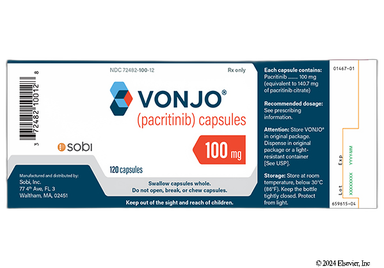
Vonjo (pacritinib) is a type of targeted therapy called a JAK inhibitor. It’s used to treat adults with a rare blood cancer called myelofibrosis (MF). This medication specifically helps people with MF who have very low platelet counts. Vonjo (pacritinib) is a capsule that you take by mouth twice a day. The medication might cause side effects like diarrhea, nausea, and swelling. It might also raise the risk of easy bleeding or bruising.
Vonjo (pacritinib) is a type of targeted therapy known as JAK inhibitor. This means it blocks JAK2 proteins. JAK2 proteins usually send signals that tell blood cells to grow and divide. The medication can also block the protein IRAK1, which does something similar.
People with MF have abnormal JAK2 proteins that work out of control. By blocking these abnormal JAK2 proteins, Vonjo (pacritinib) helps stop abnormal blood cells from growing too much in people with MF.
The following side effects may get better over time as your body gets used to the medication. Let your healthcare provider know immediately if you continue to experience these symptoms or if they worsen over time.
Bleeding—bloody or black, tar-like stools, vomiting blood or brown material that looks like coffee grounds, red or dark brown urine, small red or purple spots on skin, unusual bruising or bleeding
Blood clot—pain, swelling, or warmth in the leg, shortness of breath, chest pain
Heart attack—pain or tightness in the chest, shoulders, arms, or jaw, nausea, shortness of breath, cold or clammy skin, feeling faint or lightheaded
Heart rhythm changes—fast or irregular heartbeat, dizziness, feeling faint or lightheaded, chest pain, trouble breathing
Infection—fever, chills, cough, sore throat, wounds that don't heal, pain or trouble when passing urine, general feeling of discomfort or being unwell
Stroke—sudden numbness or weakness of the face, arm, or leg, trouble speaking, confusion, trouble walking, loss of balance or coordination, dizziness, severe headache, change in vision
Might cause side effects like bleeding and diarrhea
Might not be safe to take with certain medications because of drug interactions
Pharmacist tips for Vonjo (pacritinib)
Take Vonjo (pacritinib) twice a day, with or without food. Set up reminders on your phone to help you remember when to take the medication. Taking it around the same times each day can also help make it a part of your daily routine.
Tell your prescriber if you have any surgeries, procedures, or dental work planned. Also let your other care teams know you’re taking Vonjo (pacritinib). This medication can raise your risk of bleeding, so you might need to stop taking it a few days before. Only start taking it again when your prescriber says it’s safe. Always follow your care team’s instructions.
It’s common to have diarrhea while taking Vonjo (pacritinib). Be sure to drink plenty of fluids so you don’t get dehydrated if you have a lot of diarrhea. Your oncologist or hematologist might tell you to have medications for diarrhea, like loperamide (Imodium A-D), on hand. If diarrhea doesn’t get better with medication, call your healthcare team.
Vonjo (pacritinib) can sometimes cause nausea or vomiting. If your stomach feels upset, try eating smaller, more frequent meals during the day. You can ask your oncologist or hematologist about getting antiemetic medications to help with these side effects.
If you miss a dose of Vonjo (pacritinib), skip it and wait to take the medication at the next usual time and dose. Don’t take extra capsules to make up for a missed dose.
Ask your oncology team about the best way to handle and throw away Vonjo (pacritinib) safely. Anticancer medications can be harmful to people who handle or come in contact with them. Keep Vonjo (pacritinib) up and away, so children, pets, and others can’t reach it.
If you want to have children in the future, talk to your oncologist or hematologist about ways to preserve fertility. Vonjo (pacritinib) might affect fertility in males.
Risks and warnings for Vonjo (pacritinib)
Vonjo (pacritinib) can cause some serious health issues. This risk may be even higher for certain groups. If this worries you, talk to your doctor or pharmacist about other options.
Hemorrhage (bleeding)
Some people taking Vonjo (pacritinib) can have bleeding. Sometimes, it can sometimes be serious and, in rare cases, even life-threatening. Serious bleeding can happen in people with low platelets (below 50,000/µL).
Your care team will check your platelet levels with blood tests while you’re taking Vonjo (pacritinib). If your levels are too low, your prescriber might tell you stop the medication for a while or take a lower dose. This helps lower the risk of bleeding.
Tell your oncology or hematology team if you have any surgeries, medical procedures, or dental work planned. Because of the risk of bleeding, your prescriber will probably tell you to stop taking Vonjo (pacritinib) 7 days before the procedure to keep you safe. Follow their instructions on when you can start taking it again.
Call your care team right away if you have any unusual bleeding or bruising while taking Vonjo (pacritinib). Watch for things like unexplained bruising, nosebleeds that won’t stop, bloody urine, or blood in your stool.
Diarrhea
Diarrhea is a common side effect of Vonjo (pacritinib). In studies, people had diarrhea generally within the first 2 months of treatment. It got better over a couple weeks to a few months. Sometimes, diarrhea can even be serious.
If you have diarrhea while taking Vonjo (pacritinib), make sure to stay hydrated. Drink plenty of fluids like water or Pedialyte. Avoid sugary sports drinks such as Gatorade, as these can make diarrhea worse.
Also tell your care team if you have watery stools or more stools than usual while taking Vonjo (pacritinib). It’s important to treat diarrhea right when it begins. Your prescriber can help decide the best way to treat it. They might lower your dose of Vonjo (pacritinib) or suggest medications to help with the diarrhea.
Low platelet count (thrombocytopenia)
Most people with myelofibrosis have platelet levels that are lower than normal (also called thrombocytopenia). But it’s possible for Vonjo (pacritinib) to make the platelet count drop even more. Platelets help clot blood. So when they’re low, this puts you at risk of bleeding.
Your clinical care team will check your platelet counts often with lab tests. If your platelets get too low, you might need to take a break from Vonjo (pacritinib) to help. Your prescriber might then lower your dose when you can restart the medication.
Changes in heart rhythm
Risk factors: Long QT syndrome | Low potassium levels | Taking other medications that can cause long QT syndrome
Vonjo (pacritinib) can make the heart take longer to recharge between beats. This is called QT prolongation. It can sometimes cause dangerous changes to heart rhythm, though this hasn’t been reported with Vonjo (pacritinib) so far.
To help keep you safe, your oncologist or hematologist will check your heart rhythm while you’re taking Vonjo (pacritinib). You’ll need to get tests called electrocardiograms (EKGs) to do this. If your heart rhythm isn’t normal, you might need to take a break from Vonjo (pacritinib) for a while.
Your care team will also check your potassium levels during treatment. Having low potassium can put you at greater risk of heart rhythm problems. If your potassium is low, you might need to take a potassium pill or get potassium as an infusion through the vein.
Risk of serious heart-related or blood-flow problems (e.g., heart attack, stroke)
Risk factors: At risk of heart disease | Currently smoke | Have smoked in the past
Talk to your oncology or hematology team about your risk of serious health problems like heart attack or stroke while taking Vonjo (pacritinib). Make sure to tell them about all your medical conditions and if you’ve ever smoked. This helps them check your risk.
This warning comes from experiences of people with RA who took a medication like Vonjo (pacritinib). They had a higher risk of heart attack or stroke than those who took a different kind of medication called TNF blockers. These events could be life-threatening. Vonjo (pacritinib) isn’t approved for RA. But it works in a similar way as that other medication so it could have the same risk.
Get medical help right away if you have signs of a heart attack, like sudden chest pain, trouble breathing, sweating, or nausea.
Also call for medical help if you have signs of a stroke. These can include numbness on one side of the body, a drooping face, severe headache, or trouble speaking or walking.
Blood clots
It’s possible that there could be a risk of blood clots with Vonjo (pacritinib). People with RA who took a similar medication to Vonjo (pacritinib) have had blood clots. This includes deep vein thrombosis (DVT) and pulmonary embolism (PE). Although Vonjo (pacritinib) isn’t approved for RA, it works the same way as that medication.
To be safe, watch for signs of a blood clot. They include swelling in one arm or one leg, sudden chest pain, and sudden trouble breathing. Get medical help right away if this happens while taking Vonjo (pacritinib).
Risk of new cancers
Risk factors: Known cancer (besides non-melanoma skin cancer) | Currently smoke | Have smoked in the past
Talk to your oncology or hematology care team about the risk of getting a new cancer while taking Vonjo (pacritinib). They can review the risks and benefits of treatment.
This risk is based on findings that people with RA who took a similar medication had a higher chance of getting new cancers, like lymphoma, than those who took TNF blockers. Vonjo (pacritinib) isn’t approved for RA. But it’s still important to know about this risk to stay safe.
Higher risk of infection
It’s possible for Vonjo (pacritinib) to raise your risk of serious infection. This includes bacterial, viral, and fungal infections.
Before you start taking Vonjo (pacritinib), tell your oncology care team about any health problems you have. If you have an infection, you should wait until it goes away before starting the medication.
Call your oncologist or hematologist right away if you think you might have an infection. Signs to watch for include a fever (a temperature over 100.4ºF), body aches, chills, tiredness, trouble breathing, or a cough.
Drug interactions
Tell your care teams about the medications you take or plan to take. Vonjo (pacritinib) can interact with other medications and can sometimes be harmful. Your care team and pharmacist can check your medication list for interactions to make sure everything is safe to take together. Remember to update them if your medications change.
You can’t take Vonjo (pacritinib) if you take certain medications known as CYP3A4 inhibitors and CYP3A4 inducers. Inhibitors can make the levels of Vonjo (pacritinib) too high in your body. This can raise the risk of serious side effects. Examples of strong inhibitors include antibiotics like clarithromycin, heart medications like diltiazem (Cardizem), and antifungals like itraconazole (Sporanox). Inducers, like carbamazepine (Tegretol), can make the levels of Vonjo (pacritinib) in your body too low. This might make it not work well to treat MF.
In addition, some medications can raise your risk of heart rhythm problems like Vonjo (pacritinib) can. These medications include ciprofloxacin, antipsychotics like aripiprazole (Abilify), and some antidepressants, among others. Taking these medication with Vonjo (pacritinib) can make your risk of heart rhythm problems even higher.
Vonjo (pacritinib) dosage
The average cost for 120 capsules of 100mg of Vonjo (pacritinib) is $25,672.33 with a free GoodRx coupon. This is 11.35% off the average retail price of $28,958.17.
Contraindications are specific health conditions or situations in which a person should not take a medication due to safety concerns. If you have any of the following conditions or if any of the following apply to you, let your healthcare provider know because Vonjo (pacritinib) will not be safe for you to take.
GoodRx Health has strict sourcing policies and relies on primary sources such as medical organizations, governmental agencies, academic institutions, and peer-reviewed scientific journals. Learn more about how we ensure our content is accurate, thorough, and unbiased by reading our editorial guidelines.
Prescription savings
Stop paying too much for your prescriptions. Compare prices, get pharmacy coupons, and save up to 80%.
No, Vonjo isn’t a traditional chemotherapy medication. Regular chemotherapy works by killing cells that grow quickly. This includes cancer cells, blood cells, and even some healthy cells. But Vonjo is different. It’s a targeted therapy that blocks a specific protein called JAK2. People with myelofibrosis (MF) usually have abnormal JAK2 proteins. By blocking JAK2, this helps stop signals that tell abnormal blood cells to grow too much in people with MF.
The most common side effect of Vonjo is diarrhea. Most times, diarrhea can happen in the first 2 months of treatment and then gets better in a few weeks. If you have diarrhea, drink enough fluids to stay hydrated. But avoid sugary drinks because they can make diarrhea worse. Be sure to tell your oncologist or hematologist if you have diarrhea so they can help you manage this side effect. They might lower your dose of Vonjo. They also might recommend medications like loperamide (Imodium A-D) to help with diarrhea.
There are some medications you shouldn’t take with Vonjo because they interact and might not be safe. These medications are called strong CYP3A4 inhibitors and inducers. They affect the levels of Vonjo in your body. Strong inhibitors, like clarithromycin and ketoconazole, can raise the levels of Vonjo in your body. This can lead to more side effects. And strong inducers, like carbamazepine (Tegretol), can lower the amount of Vonjo in your body. This can make it not work as well. Other medications can also interact with Vonjo, but you might still be able to take them with careful monitoring. Make sure your care team and pharmacist have a full list of your medications. Also let them know if you start or stop any medications. They can check for drug interactions to make sure you’re safe.
People with myelofibrosis often have low platelets. This can make it easier to bleed. Vonjo can lower platelet counts even more, which raises the risk of bleeding more. Call your care team or 911 right away if you have bruising that happens easily, bleeding that won’t stop, blood in your urine or stool, or other signs of serious bleeding. They can check what’s going on and help treat the bleeding.
No. As of 2025, Vonjo is only available as a brand-name medication. There’s no generic version yet. Ask your oncology care team or pharmacist if you have questions about availability.
The FDA gave Vonjo an accelerated approval in March 2022. This accelerated process helps bring medications to people sooner when there aren’t many good treatment options. In this case, people who have immediate or high-risk myelofibrosis with a very low platelet count don’t have many options. This is where Vonjo can possibly help. But more studies are needed to prove it has a clinical benefit before the FDA can give full approval.
Vonjo and Jakafi (ruxolitinib) are both pills that are taken twice a day to treat myelofibrosis (MF). But they’re used in different ways. Vonjo is for people with MF who have very low platelet counts (below 50,000 µL). But Jakafi usually isn’t a good choice for people with platelets that low. In addition, Jakafi can also treat another blood condition called polycythemia vera (PV). It’s also used for a condition called graft-versus-host disease (GVHD) in some people. What’s more, Vonjo and Jakafi cause different side effects. In studies, common side effects of Vonjo were diarrhea, nausea, and low platelets. For Jakafi, the most common side effects were bruising and feeling dizzy. Talk to your oncologist or hematologist to compare the medications.