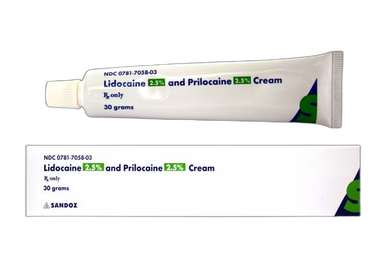
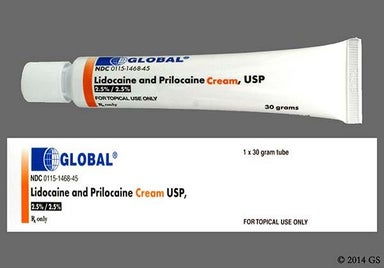
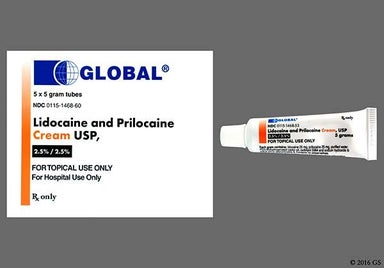
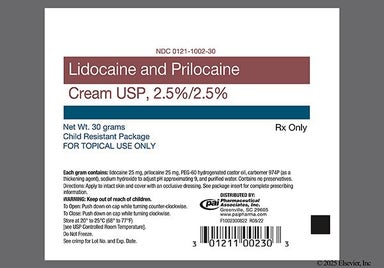
Lidocaine/prilocaine is a numbing cream that contains two medications. It's sometimes written as lidocaine 2.5% and prilocaine 2.5% cream. It's used in adults and children to temporarily numb the skin and help prevent local pain from procedures or injections. It can be applied to unbroken skin or the genital area before certain minor procedures. Side effects are usually mild and temporary and can include redness and swelling where the cream is applied.
Numbing the genital area before certain minor procedures or injections
How Lidocaine/prilocaine works
Lidocaine/prilocaine contains two medications that are classified as local anesthetics. They work by blocking pain signals from the nerves in your skin. This temporarily numbs the area where you apply the cream, so you feel less pain there.
When does Lidocaine/prilocaine start working?Time passed since treatment started:
MINUTES
Initial effect
HOURS
Full effect
DAYS
WEEKS
MONTHS
Drug facts
Common Brands
Emla(brand name no longer available)
Drug Class
Local anesthetic
Controlled Substance Classification
Not a controlled medication
Generic Status
Lower-cost generic available
Availability
Prescription only
Side effects of Lidocaine/prilocaine
The following side effects may get better over time as your body gets used to the medication. Let your healthcare provider know immediately if you continue to experience these symptoms or if they worsen over time.
The following Lidocaine/prilocaine side effects have also been reported
Along with its needed effects, a medicine may cause some unwanted effects. Although not all of these side effects may occur, if they do occur they may need medical attention.
Check with your doctor immediately if any of the following side effects occur:
Some side effects may occur that usually do not need medical attention. These side effects may go away during treatment as your body adjusts to the medicine. Also, your health care professional may be able to tell you about ways to prevent or reduce some of these side effects. Check with your health care professional if any of the following side effects continue or are bothersome or if you have any questions about them:
More common
Burning, swelling, itching, or skin rash at application site
white or red skin at the application site
Other side effects not listed may also occur in some patients. If you notice any other effects, check with your healthcare professional.
Call your doctor for medical advice about side effects. You may report side effects to the FDA at 1-800-FDA-1088.
Helps reduce pain from certain procedures and injections
Applied directly to the affected area of skin
Can be used in adults and children
Cons
Must be applied ahead of time to allow the skin to become numb
Not recommended for use on open wounds
Can cause mild redness, swelling, or other skin reactions where it's applied
Pharmacist tips for Lidocaine/prilocaine
How to apply lidocaine/prilocaine cream:
Use lidocaine/prilocaine exactly as your prescriber tells you to. They'll tell you how much to use, when to apply, and how long to leave it on before your procedure. Follow the dosing diagram in the instructions to measure the right amount. Using too much, using it too often, or leaving it on too long can cause serious side effects.
Wash your hands before and after applying lidocaine/prilocaine.
Apply lidocaine/prilocaine to clean, unbroken skin. Don't apply it to open cuts or wounds unless your prescriber tells you to. This can raise the risk of side effects.
Apply a thick layer of lidocaine/prilocaine cream without rubbing it in. If instructed, cover the area with an airtight dressing (bandage) to help keep the cream in place.
Leave the lidocaine/prilocaine cream on for as long as your prescriber tells you to so it can work to numb the area. For many skin procedures, this is at least 1 to 2 hours. Remove the dressing and wipe off the cream when your care team tells you to.
General tips:
Avoid touching your eyes after using lidocaine/prilocaine. It can cause eye irritation. If the cream gets into your eyes, rinse them right away with water or saline. Protect your eyes until they feel better.
Avoid scratching or rubbing the treated area until the numbness wears off. Also keep the area away from very hot or cold temperatures. You might not feel it if you hurt or burn yourself.
For use on children: Watch your child closely if you're using lidocaine/prilocaine on their skin. Keep them from touching or swallowing the cream or getting it into their eyes. If your child becomes very sleepy, dizzy, or has blue or gray lips or skin, remove the cream and get medical help right away. These can be signs of serious side effects from the medication.
Some lidocaine/prilocaine products come in kits with other wound care supplies. Follow your prescriber’s instructions on how to use each item in the kit.
If you're pregnant or plan to become pregnant: Talk to your prescriber. There's limited information about using lidocaine/prilocaine during pregnancy. Your prescriber can help decide if it's safe for you to use.
If you plan to breastfeed: Lidocaine can pass into breast milk, but side effects in breastfed babies aren't expected with usual use. To be safe, ask your prescriber if lidocaine/prilocaine is right for you.
Risks and warnings for Lidocaine/prilocaine
Lidocaine/prilocaine can cause some serious health issues. This risk may be even higher for certain groups. If this worries you, talk to your doctor or pharmacist about other options.
Risk of too much medication in the body
Risk factors: Applying the cream to broken skin | Using the cream on large areas of your body | Leaving the cream on longer than recommended | Very weak or ill | Older age | Severe liver problems
Using lidocaine/prilocaine on too much skin or leaving it on too long can cause too much medication to get absorbed into your body. If you have severe liver problems, the medication can also build up since your body can't get rid of it as well.
Too much lidocaine/prilocaine can lead to serious side effects, such as seizures or trouble breathing. Older adults and people who are very weak or ill might be more sensitive to these effects. Because of these risks, only use lidocaine/prilocaine as directed by your prescriber.
Interactions with certain heart rhythm medications
Risk factors: Taking antiarrhythmic medications, such as amiodarone (Pacerone), dofetilide (Tikosyn), or sotalol (Betapace)
Even though lidocaine/prilocaine is applied to your skin, it can possibly add to the effects of certain heart rhythm medications. This can include amiodarone (Pacerone) and sotalol (Betapace)). This might raise your risk of changes in your heart rate or rhythm. Tell your prescriber if you take any heart medications before using lidocaine/prilocaine. They can decide if you need extra monitoring.
Methemoglobinemia (a blood condition)
Risk factors: Glucose-6-phosphate dehydrogenase (G6PD) deficiency | Lung problems | Heart problems | Methemoglobinemia | Infants under 6 months of age | Taking medications like benzocaine or dapsone (Aczone)
Local anesthetics like lidocaine/prilocaine have been linked to methemoglobinemia. This is a serious blood condition that can make it harder for your blood to deliver oxygen to your body.
Your risk might be higher if you have a genetic condition called G6PD deficiency. Heart or lung problems can also make this condition more dangerous. Taking certain medications, such as benzocaine or dapsone (Aczone), can raise your risk as well. Tell your prescriber about your conditons and medications before using lidocaine/prilocaine.
Signs of methemoglobinemia can appear right away or hours after using lidocaine/prilocaine. These can include pale, blue, or gray skin, headaches, dizziness, tiredness, a fast heartbeat, or trouble breathing. These can be early signs of methemoglobinemia. Get medical help right away if you notice these symptoms.
Not recommended for use in the ears
Don't apply lidocaine/prilocaine cream inside your ears unless your prescriber tells you to. Animal studies have shown that the cream can harm the middle ear (the area behind your eardrum). Only use lidocaine/prilocaine as directed by your prescriber.
Lidocaine/prilocaine dosage
The average cost for 1 tube of 30g of 2.5%/2.5% of Lidocaine/prilocaine is $19.50 with a free GoodRx coupon. This is 57.94% off the average retail price of $46.36.
Interactions between Lidocaine/prilocaine and other drugs
Lidocaine/prilocaine may interact with certain medications or supplements. Always let your doctor and pharmacist know about any other medications or supplements (including prescribed and over-the-counter medications, vitamins, and dietary or herbal supplements) that you are currently taking. The list below does not include all possible drug interactions with Lidocaine/prilocaine. Please note that only the generic name of each medication is listed below.
Although certain medicines should not be used together at all, in other cases two different medicines may be used together even if an interaction might occur. In these cases, your doctor may want to change the dose, or other precautions may be necessary. When you are taking this medicine, it is especially important that your healthcare professional know if you are taking any of the medicines listed below. The following interactions have been selected on the basis of their potential significance and are not necessarily all-inclusive.
Using this medicine with any of the following medicines is not recommended. Your doctor may decide not to treat you with this medication or change some of the other medicines you take.
Dihydroergotamine
Dronedarone
Saquinavir
Vernakalant
Using this medicine with any of the following medicines is usually not recommended, but may be required in some cases. If both medicines are prescribed together, your doctor may change the dose or how often you use one or both of the medicines.
Using this medicine with any of the following medicines may cause an increased risk of certain side effects, but using both drugs may be the best treatment for you. If both medicines are prescribed together, your doctor may change the dose or how often you use one or both of the medicines.
Contraindications are specific health conditions or situations in which a person should not take a medication due to safety concerns. If you have any of the following conditions or if any of the following apply to you, let your healthcare provider know because Lidocaine/prilocaine will not be safe for you to take.
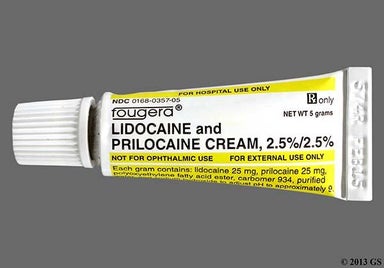
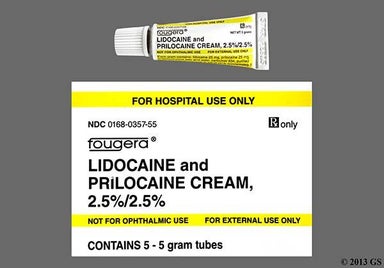
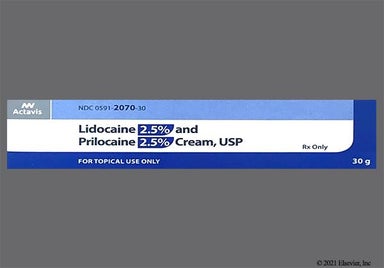
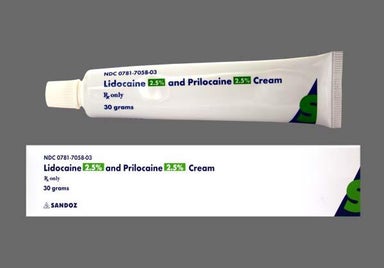
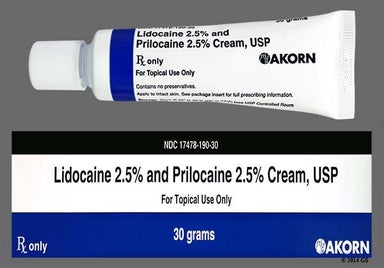
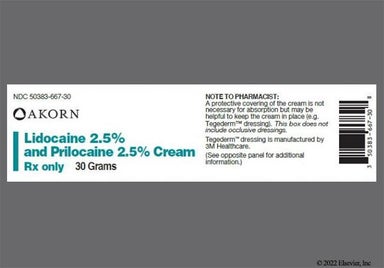
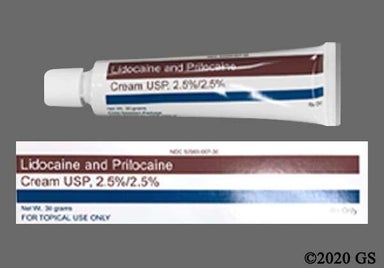
This medicine is White Tube Of Cream.White Not applicable - Lidocaine/Prilocaine 2.5%-2.5% Topical CreamThis medicine is White Tube Of Cream.White Not applicable - Lidocaine/Prilocaine 2.5%-2.5% Topical CreamThis medicine is White Tube Of Cream.White Not applicable - Lidocaine/Prilocaine 2.5%-2.5% Topical CreamThis medicine is White Tube Of Cream.White Not applicable - Lidocaine/Prilocaine 2.5%-2.5% Topical CreamThis medicine is White Tube Of Cream.White Not applicable - Lidocaine/Prilocaine 2.5%-2.5% Topical CreamThis medicine is White Tube Of Cream.White Not applicable - Lidocaine/Prilocaine 2.5%-2.5% Topical CreamThis medicine is White Tube Of Cream.White Not applicable - Lidocaine/Prilocaine 2.5%-2.5% Topical CreamThis medicine is Colorless Tube Of Cream.Not applicable - Lidocaine/Prilocaine 2.5%-2.5% Topical CreamThis medicine is Colorless Tube Of Cream.Not applicable - Lidocaine/Prilocaine 2.5%-2.5% Topical CreamThis medicine is White Tube Of Cream.White Not applicable - Lidocaine/Prilocaine 2.5%-2.5% Topical CreamThis medicine is Colorless Tube Of Cream.Not applicable - Lidocaine/Prilocaine 2.5%-2.5% Topical CreamThis medicine is White Tube Of Cream.White Not applicable - Lidocaine/Prilocaine 2.5%-2.5% Topical CreamThis medicine is White Tube Of Cream.White Not applicable - Lidocaine/Prilocaine 2.5%-2.5% Topical CreamThis medicine is White Tube Of Cream.White Not applicable - Lidocaine/Prilocaine 2.5%-2.5% Topical Cream
GoodRx Health has strict sourcing policies and relies on primary sources such as medical organizations, governmental agencies, academic institutions, and peer-reviewed scientific journals. Learn more about how we ensure our content is accurate, thorough, and unbiased by reading our editorial guidelines.
Prescription savings
Stop paying too much for your prescriptions. Compare prices, get pharmacy coupons, and save up to 80%.
Plans start at $9.99/mo. (when paid yearly). Terms apply.
Common questions about Lidocaine/Prilocaine
No. The Lidocaine/Prilocaine cream isn't available over the counter. You need a prescription from a healthcare professional to get it.
How long it takes the Lidocaine/Prilocaine cream to numb the area can depend on where it's applied. On unbroken skin, it typically takes 1 hour for the area to start becoming numb. It can take another hour or so for the full numbing effect. On genitals, Lidocaine/Prilocaine might work faster (5 to 10 minutes).
The numbing effect of Lidocaine/Prilocaine usually lasts for about 1 to 2 hours after the cream is removed from unbroken skin. The numbing effect might go away faster when it's used on the genital area. In general, the numbness slowly wears off and feeling returns to the area.
Apply a thick layer of the Lidocaine/Prilocaine cream to the area of skin your prescriber tells you to treat. Use only the amount prescribed, and don't rub it in. If needed, cover the area with an airtight bandage to keep the cream in place. Leave the cream on for as long as your prescriber tells you to. When it's time, remove the bandage and gently wipe off the cream. Ask your prescriber or care team if you have questions about how to apply the Lidocaine/Prilocaine cream.
No. Lidocaine/Prilocaine isn't FDA approved or usually recommended to treat hemorrhoids. But some studies have looked at using it to help manage pain after hemorrhoid surgery. This is an off-label use, and more research is needed to know how well it works for this purpose. Talk to a healthcare professional about the best way to treat your hemorrhoids.