


Imbruvica and Beyond: 4 Chronic Graft-vs.-Host Disease Medications Worth Considering
Learn what medications are FDA approved for chronic graft-vs.-host disease, plus other treatment options that are available.
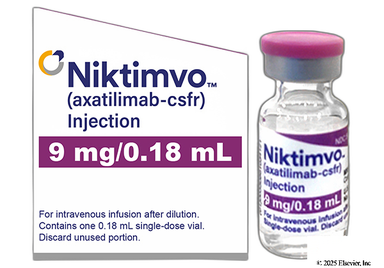
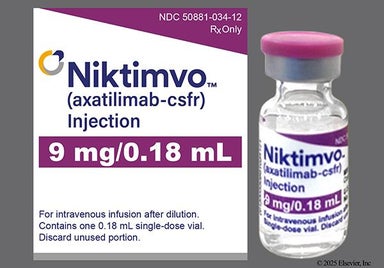
Niktimvo (axatilimab-csfr or axatilimab) is a type of medication called a CSF-1R-blocking antibody. It's used to treat chronic graft-versus-host disease (cGVHD) in adults and children who weigh at least 88 lbs (40 kg). cGVHD can happen after a stem cell or bone marrow transplant. Niktimvo (axatilimab) is used when 2 or more other treatments haven't worked well enough. Niktimvo (axatilimab) is given by a healthcare professional as an infusion into the vein once every 2 weeks. Common side effects include infections, muscle or joint pain, and low energy.

Niktimvo (axatilimab) is a colony stimulating factor-1 receptor (CSF-1R)-blocking antibody. CSF-1R is a protein found on some immune cells. In chronic graft-versus-host disease (cGVHD), these cells can stay too active and cause inflammation and scarring.
Niktimvo (axatilimab) works by blocking CSF-1R. This helps calm these immune cells and can improve symptoms over time.
| Common Brands | Niktimvo |
|---|---|
| Drug Class | CSF-1R-blocking antibody |
| Controlled Substance Classification | Not a controlled medication |
| Generic Status | No lower-cost generic available |
| Availability | Prescription only |

The following side effects may get better over time as your body gets used to the medication. Let your healthcare provider know immediately if you continue to experience these symptoms or if they worsen over time.
Contact your healthcare provider immediately if you experience any of the following.
Side effects that you should report to your care team as soon as possible:
Side effects that usually do not require medical attention (report these to your care team if they continue or are bothersome):




Niktimvo (axatilimab) can cause some serious health issues. This risk may be even higher for certain groups. If this worries you, talk to your doctor or pharmacist about other options.
Niktimvo (axatilimab) can cause infusion-related reactions. These reactions usually happen while the medication is going into your vein or shortly after. Rarely, they can be serious. Your care team will watch you closely during the infusion so they can help relieve symptoms fast.
Watch for infusion reactions during your Niktimvo (axatilimab) infusion. This can include a fever, chills, rash, flushing, nausea, trouble breathing, chest pain, or headache. Some people might also have signs of a severe allergic reaction, such as hives or swelling. If symptoms start during the infusion, tell your nurse right away. They can slow or stop the infusion and give you treatment if needed.
If you have an infusion reaction, your care team might give you medication before your next Niktimvo (axatilimab) infusions. This helps lower the chance of another reaction. If you have a severe reaction, your prescriber might decide that Niktimvo (axatilimab) isn't right for you.
Based on how Niktimvo (axatilimab) works, it can harm an unborn baby. If you can become pregnant, your care team should have you take a pregnancy test before you start treatment.
Use effective birth control while taking Niktimvo (axatilimab) and for 30 days after your last dose. Even if you don't plan to become pregnant, an unexpected pregnancy can still happen. Your care team can help you choose a birth control method that's right for you. If become pregnant during treatment, tell your prescriber right away.

Your prescriber will choose the dose based on your body weight. A healthcare professional will give Niktimvo (axatilimab) as an infusion into a vein at a medical center or infusion center.
The typical dose is 0.3 mg/kg once every 2 weeks. The maximum dose is 35 mg.
Your prescriber might adjust the dose if you have side effects.


Prescription savings
Stop paying too much for your prescriptions. Compare prices, get pharmacy coupons, and save up to 80%. Find expert answers to your health questions so you can make the best decisions for yourself and your family.
Health conditions
Medications & treatment
Access & affordability
Medication discounts

You usually can't pick up Niktimvo at a regular pharmacy. Instead, a healthcare professional gives it as an intravenous (IV) infusion. You can receive your infusion at a bone marrow transplant center or a local infusion center. Some people might also be able to receive Niktimvo at home with the help from a trained healthcare professional. Your prescriber will decide which option is best for you and help arrange your treatment.
A Niktimvo infusion usually takes about 30 minutes. Your visit can take longer though. This is because you might need more time to check in. Your care team also might need time getting the infusion ready and monitoring for infusion reactions. Plan to spend extra time at your appointment, and bring something to keep you busy during your visit.
Some people might start to feel better about 1 to 2 months after starting Niktimvo. In a study, some people had improved cGVHD symptoms after about 1.7 months. But some people felt better sooner, while others took several months. Keep going to your infusion appointments on schedule. Talk to your prescriber if you have questions about how well Niktimvo is working for you.
The FDA approved Niktimvo in August 2024. It's used to treat chronic graft-versus-host disease (cGVHD) when 2 or more other treatments haven't worked well enough.
Yes, Niktimvo is a biologic medication. More specifically, it's a type of monoclonal antibody. Biologics are proteins made by living cells instead of traditional chemicals.
Niktimvo might not be safe during pregnancy because it might harm an unborn baby. There haven't been studies about how safe Niktimvo is during pregnancy. But this risk is based on how the medication works. If you're pregnant or planning to become pregnant, talk to your prescriber about the risks and benefits of treatment. If you can become pregnant, use effective birth control during treatment and for 30 days after your last dose. If you're already pregnant or thinking of becoming pregnant, tell your care team right away.
