Iwilfin
Iwilfin (eflornithine) is a prescription medication used to help lower the risk of relapse in a rare cancer called high-risk neuroblastoma. It’s approved for children and adults who have responded to other treatments. The medication comes as a tablet that is taken twice a day, with or without food. Common side effects are hearing loss, ear infections, and fever.


What is Iwilfin (eflornithine)?
What is Iwilfin (eflornithine) used for?
- Reduce the risk of relapse in children and adults with high-risk neuroblastoma that has some response to previous treatment
How Iwilfin (eflornithine) works
Iwilfin (eflornithine) is an ornithine decarboxylase (ODC) inhibitor, meaning it blocks a protein called ODC. ODC is a protein in the body that makes substances called polyamines, which are needed for cancer cells to grow and develop.
By blocking ODC, Iwilfin (eflornithine) lowers the amount of polyamines in your body. This helps slow down or stop cancer cells from growing and spreading.
Drug facts
| Common Brands | Iwilfin |
|---|---|
| Drug Class | Ornithine decarboxylase inhibitor |
| Controlled Substance Classification | Not a controlled medication |
| Generic Status | No lower-cost generic available |
| Availability | Prescription only |

Side effects of Iwilfin (eflornithine)
The following side effects may get better over time as your body gets used to the medication. Let your healthcare provider know immediately if you continue to experience these symptoms or if they worsen over time.
Common Side Effects
- Ear infections (32%)
- Diarrhea (15%)
- Cough (15%)
- Sinus infections (13%)
- Pneumonia (12%)
- Allergies (11%)
- Fever (11%)
- Vomiting (11%)
- Pink eye (11%)
Less Common Side Effects
- Skin infection
- Urinary tract infection
- Hearing loss
- Rise in liver enzymes
- Lower blood cell count
Iwilfin (eflornithine) serious side effects
Contact your healthcare provider immediately if you experience any of the following.
- Lower blood cell counts: fever, chills, feeling very tired, unusual bleeding or bruising, blood in urine or stools, shortness of breath
- Liver problems: pain in the right side of the stomach, yellowing of the eyes or skin, dark or brown urine, light-colored stools, nausea, vomiting, bruising or bleeding, loss of appetite
- Hearing loss: ringing in the ears, new or worsening hearing loss
The following Iwilfin (eflornithine) side effects have also been reported
Side effects that you should report to your care team as soon as possible:
- Allergic reactions—skin rash, itching, hives, swelling of the face, lips, tongue, or throat
- Diarrhea, nausea, vomiting
- Hearing loss
- Infection—fever, chills, cough, sore throat, wounds that don't heal, pain or trouble when passing urine, general feeling of discomfort or being unwell
- Liver injury—right upper belly pain, loss of appetite, nausea, light-colored stool, dark yellow or brown urine, yellowing skin or eyes, unusual weakness or fatigue
- Low red blood cell level—unusual weakness or fatigue, dizziness, headache, trouble breathing
- Unusual bruising or bleeding
Side effects that usually do not require medical attention (report these to your care team if they continue or are bothersome):
- Cough
- Eye redness
- Runny or stuffy nose

Get your GoodRx coupon

Pros and cons of Iwilfin (eflornithine)
Pros
- Pill taken by mouth twice a day
- Helps reduce risk of cancer relapse
- Can be swallowed whole, chewed, or crushed
Cons
- Can cause hearing loss and liver problems
- Can lower blood cell counts
- Requires ongoing monitoring

Pharmacist tips for Iwilfin (eflornithine)

- Iwilfin (eflornithine) can be swallowed whole, chewed, or crushed. If you crush it, mix it with 2 tablespoons (30 mL) of soft food or liquid before your child takes it. Then add another 2 tablespoons of liquid to the same container and have your child take it to make sure they get the full dose, all within 1 hour.
- If your child misses a dose of Iwilfin (eflornithine), give it as soon as you remember. If the next dose is due in 7 hours or less, skip the missed dose and give the next one at the usual time. Don’t give two doses at once.
- If your child throws up after a dose of Iwilfin (eflornithine), don’t give another dose to make up. Instead, just give the next dose at the regular time.
- Iwilfin (eflornithine) can sometimes cause hearing loss. Your child will have a hearing test before starting and during treatment. Tell the oncologist right away if you notice any hearing changes.
- Iwilfin (eflornithine) can affect blood counts and liver health. Your child will need blood tests before and during treatment to check for side effects. Their oncologist might adjust treatment if needed.
- Lower white blood cell counts from taking Iwilfin (eflornithine) could raise your child’s risk for infections. Call your care team right away if your child has a fever.
- Pregnancy: Iwilfin (eflornithine) can harm an unborn baby. Use effective birth control during treatment and for 1 week after the last dose. This applies to people who can become pregnant and also those with partners who can become pregnant.
- Breastfeeding: Don’t breastfeed during treatment with Iwilfin (eflornithine) and for 1 week after the last dose. It’s not known if the medication passes into breast milk.

Risks and warnings for Iwilfin (eflornithine)
Iwilfin (eflornithine) can cause some serious health issues. This risk may be even higher for certain groups. If this worries you, talk to your doctor or pharmacist about other options.
Low blood cell counts
Iwilfin (eflornithine) can lower your child’s red blood cells, white blood cells, and platelets. When these are low, it can raise the risk of anemia, infections, and bleeding or bruising. Your care team will check blood counts regularly with lab tests during treatment.
Contact the care team right away if your child has extreme tiredness, fast breathing, fever, chills, or bleeding and bruising that doesn’t stop. The care team might lower the dose or pause Iwilfin (eflornithine) if blood counts get too low.
Liver problems
Iwilfin (eflornithine) can sometimes damage your child’s liver. Tell the care team right away if your child has pain on the right side of their stomach, yellowing of the skin or eyes, or dark urine.
Sometimes liver problems don’t cause symptoms, so your child will need regular blood tests during treatment. These are usually done every month for the first 6 months, then every 3 months after that. If the care team sees signs of liver damage, they may pause or adjust Iwilfin (eflornithine).
Hearing loss
Iwilfin (eflornithine) can cause hearing loss or make it worse. Some people may notice changes in hearing, such as trouble hearing sounds or ringing in the ears. In some cases, this might require lowering the dose, pausing, or stopping the medication.
Your child will have a hearing test (audiogram) before starting Iwilfin (eflornithine) and about every 6 months during treatment. The care team might check more often if needed. Tell the care team right away if you notice any changes in your child’s hearing.
Harm to unborn babies
Based on animal studies and how it works, Iwilfin (eflornithine) might harm an unborn baby. If your child is sexually active, they should use reliable birth control while taking this medication and for at least 1 week after the last dose.

Iwilfin (eflornithine) dosage
 Tablet
| Dosage | Quantity | Price as low as | Price per unit |
|---|---|---|---|
| 192mg | 180 tablets | $17,562.73 | $97.57 |
Typical dosage for Iwilfin (eflornithine)
Iwilfin (eflornithine) is taken by mouth twice a day for up to 2 years. The specific dose depends on body surface area (BSA), which takes into account your child’s height and weight:
- BSA greater than 1.5 m²: 768 mg (4 tablets)
- BSA 0.75 to 1.5 m²: 576 mg (3 tablets)
- BSA 0.5 to less than 0.75 m²: 384 mg (2 tablets)
- BSA 0.25 to less than 0.5 m²: 192 mg (1 tablet)
The dose might differ if your child has severe kidney problems or experiences side effects to the medication.
Your oncologist will check your child’s height and weight every 3 months and adjust the dose if needed.

How much does Iwilfin (eflornithine) cost?
$17,562.73

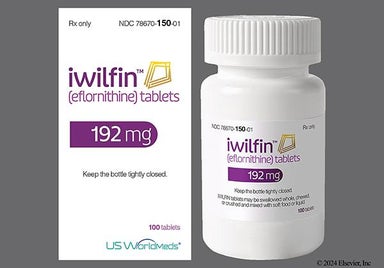
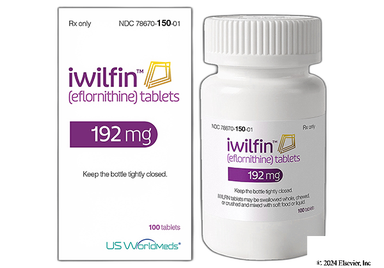
Iwilfin (eflornithine) images