Key takeaways:
White and red swirls on your tongue are a sign of geographic tongue (benign migratory glossitis).
Tongue inflammation and damage to the tongue surface causes geographic tongue.
Though it may look (and sound) scary, geographic tongue isn’t usually bothersome and goes away on its own.
You might not spend a lot of time thinking about your tongue. But changes in how your tongue looks will probably stop you in your tracks. Geographic tongue, also called benign migratory glossitis, causes red patches on the surface of your tongue.
This condition has puzzled people for years, and its exact cause is still a mystery. But despite its strange appearance, geographic tongue is harmless. Let’s take a closer look at this unique tongue condition.
What is geographic tongue?
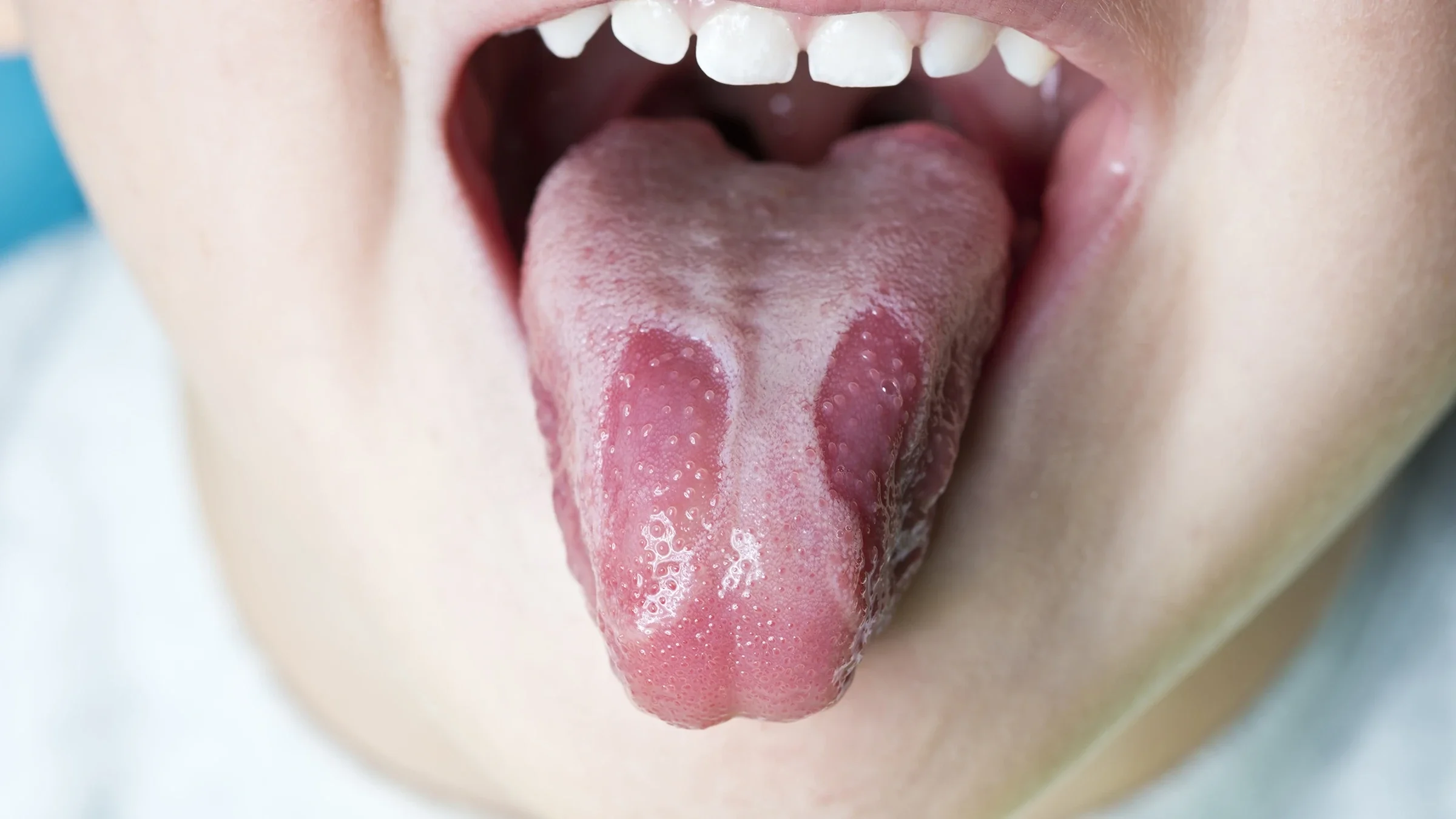
Geographic tongue is a harmless inflammatory condition that leads to red patches on the top or sides of your tongue. You may also develop cracks or fissures over the surface of your tongue.
Search and compare options
The patches and lines can move over time. Interestingly, the red patches may disappear after a few weeks, only to show up in a different spot later on.
Given the name, you may assume that the spots show up only on your tongue. But the condition can also affect other parts of your mouth, including the:
Inside part of your cheeks
Inside of your lips
Floor and roof of your mouth
What does geographic tongue look like?
Geographic tongue looks quite unique. You’ll notice smooth, red patches over the top of your tongue. The patches can be different shapes and sizes. And they’re usually outlined with white wavy lines. This combination makes the tongue look like the outline of a world map. That’s how the condition got the name “geographic tongue.”
Keep in mind that the patches may move and also show up on the sides of your tongue and other parts of your mouth and lips.
What causes geographic tongue?
Scientists don’t know the exact cause of geographic tongue. It develops when there’s inflammation on the tongue's surface. This inflammation damages the filiform papillae. The filiform papillae are the cone-shaped structures that give your tongue its textured look. When they’re damaged, you can see the lining of the tongue, underneath which looks red and smooth.
Geographic tongue may be related to:
Genetics: You’re more likely to develop geographic tongue if someone in your family has it too. There’s some evidence that people who are genetically more likely to develop psoriasis are more likely to develop geographic tongue.
Stress: Stress may increase your chances of developing geographic tongue. This includes physical, emotional, and mental stress.
Medications: There have been reports of people developing geographic tongue after taking birth control pills and certain types of cancer medications.
Vitamin deficiencies: Certain types of vitamin deficiencies have been linked to geographic tongue, including deficiencies in vitamin D, vitamin B6, vitamin B12, folic acid, iron, and zinc.
Age: Children and young adults are more likely to develop geographic tongue. While up to 15% of all children develop geographic tongue, less than 2% of adults over age 30 experience it.
Does geographic tongue cause any symptoms?
Even though a geographic tongue can look strange, it doesn’t usually cause any symptoms. Most people don’t even know they have it until they see it in the mirror.

Read more like this
Explore these related articles, suggested for readers like you.



Sometimes people experience symptoms, like:
Burning over the top of the tongue
Tongue sensitivity to hot, spicy, or sour food
A burning sensation in your mouth
Changes in taste (dysgeusia), which makes food taste metallic, sweet, or sour
Can geographic tongue be a sign of another health condition?
Sometimes. About 8% of people who develop geographic tongue have a Candida infection, like thrush. Some people also develop geographic tongue after mouth trauma from dental procedures or accidents. Medication reactions have also been linked to geographic tongue.
Geographic tongue has been linked to conditions, like:
Allergic rhinitis (hay fever)
Psoriasis
If you think you have geographic tongue, your dentist or primary care provider can check to make sure you don’t have a Candida infection or signs of another medical condition.
Your primary care provider can also confirm that your tongue changes are from geographic tongue and not another condition that can change your tongue’s appearance.
How is geographic tongue diagnosed?
Since geographic tongue has such a unique appearance, a healthcare professional can often make the diagnosis just by examining your tongue. Sometimes, it can be confused with other conditions, like oral candidiasis, lupus, or herpes. A biopsy can confirm the diagnosis if there’s any doubt.
What are the best geographic tongue treatment options?
You may not need treatment for geographic tongue. But if you experience bothersome symptoms or are dealing with another condition, there are some options that may help.
Medicated mouthwashes
If your geographic tongue is causing burning, pain, or other symptoms, there are medicated mouthwashes that can help relieve your symptoms. A healthcare professional or dentist can prescribe these mouthwashes for you.
Avoiding common irritants
It can also help to avoid things that can irritate your mouth, like:
Alcohol
Hot foods and drinks
Spicy or sour foods
Acidic fruits and beverages
Medications for fungal infections
If you have a Candida infection, medications that fight off the infection can help clear up your geographic tongue. This might include oral medications or mouthwashes.
Keep in mind: Even after your fungal infection is gone, it will take time for your tongue to go back to normal. That’s because the filiform papillae need to grow back. And this takes time.
Treating underlying conditions
If your geographic tongue is from another medical condition, starting treatment for that condition will bring down the inflammation on your tongue. This will let your tongue heal so that your filiform papillae can grow back.
If you’re like most people with a geographic tongue and you don’t know what’s causing it, there’s no way to quickly stop the inflammation. It can be frustrating, but the only option is a “wait-it-out” approach. The inflammation will go away on its own, your filiform papillae will grow back, and your tongue will look like its usual self again.
When to see a doctor for geographic tongue
Geographic tongue is generally harmless. That said, changes to your tongue or mouth can be concerning. So it’s best to visit a healthcare professional to confirm the diagnosis and rule out other conditions.
While geographic tongue usually doesn't cause symptoms, you should always get medical attention right away if you have trouble swallowing or breathing.
Frequently asked questions
No, geographic tongue isn’t contagious. So you can’t pass it on — or get it from somebody else.
Geographic tongue can last anywhere from days to months or even years. Frustratingly, it can also go away and then come back.
No specific food is known to cause geographic tongue. In fact, scientists still don’t fully understand the cause of this condition. But some foods and drinks may be irritating if you already have geographic tongue. It’s best to avoid alcohol. Also, avoid hot foods and drinks, spicy or sour foods, and acidic products.
No, geographic tongue isn’t contagious. So you can’t pass it on — or get it from somebody else.
Geographic tongue can last anywhere from days to months or even years. Frustratingly, it can also go away and then come back.
No specific food is known to cause geographic tongue. In fact, scientists still don’t fully understand the cause of this condition. But some foods and drinks may be irritating if you already have geographic tongue. It’s best to avoid alcohol. Also, avoid hot foods and drinks, spicy or sour foods, and acidic products.
The bottom line
Geographic tongue is inflammation of the top of the tongue that causes damage to the filiform papillae. Geographic tongue looks like smooth, red patches surrounded by white, wavy lines. Geographic tongue isn’t harmful and doesn’t often cause any symptoms. It usually goes away on its own, but it can come back.
Sometimes, it can be a sign of a fungal infection or another medical condition. If you have tongue pain or burning, talk to your primary care provider or dentist about starting treatment for geographic tongue.

Why trust our experts?



References
Assimakopoulos, D., et al. (2002). Benign migratory glossitis or geographic tongue: an enigmatic oral lesion. The American Journal of Medicine.
Department of Oral & Maxillofacial Surgery. (2022). Geographic tongue. Royal Berkshire NHS Foundation Trust.
González-Álvarez, L., et al. (2018). Geographic tongue: Predisposing factors, diagnosis and treatment. A systematic review. Revista Clínica Española.
Humphries, K. (n.d.). Figure, geographic tongue. Contributed by Katherine Humphries. StatPearls.
Picciani, B. L. S., et al. (2016). Geographic tongue and psoriasis: clinical, histopathological, immunohistochemical and genetic correlation – A literature review. Anais Brasileiros de Dermatologia.
Shareef, S., et al. (2022). Geographic tongue. StatPearls.