Key takeaways:
Multiple sclerosis (MS) is chronic autoimmune disease of the central nervous system. The disease affects people differently. For Rhead Kelly, walking is difficult, and brain lesions created memory loss and other mental impairments.
Lindsay Kelly knew her husband had MS when she married him at age 20. She expected physical problems as he aged, but she never expected it to affect his mind in his early 40s.
Despite his physical and mental challenges, the couple maintain a loving relationship that Lindsay showcases on social media to help others struggling with MS and their caregivers.
Lindsay and Rhead Kelly’s love story doesn’t have a happily-ever-after ending, but it is a love story nonetheless. In fact, it speaks more to the power of true love than most.
Rhead (pronounced reed) was diagnosed with relapsing-remitting multiple sclerosis (MS) at age 17. Twenty-one years of marriage and six children later, the 44-year-old lives in an assisted living facility near Salt Lake City, and Lindsay visits him daily.

Rhead, once a charismatic, loving husband and father, now has difficulty walking. His memory is impaired. He’s become childlike. Lindsay, 41, has shifted her mindset from spouse to caregiver.
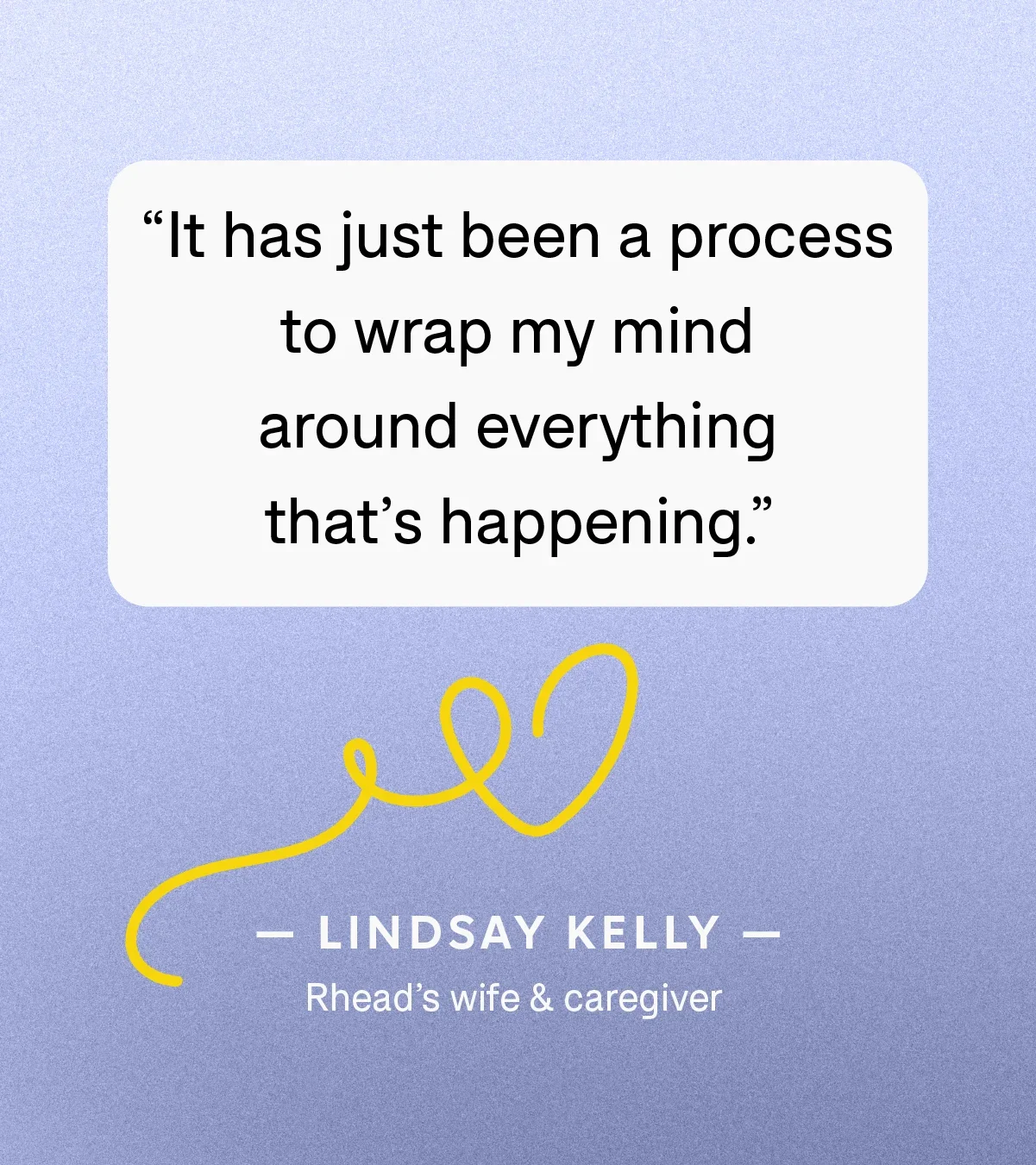
“I love my husband so much,” she says. “We have always been such good friends. But there have been moments where it has been really hard. It has just been a process to wrap my mind around everything that’s happening.”
Diagnosed with MS before they met
Rhead and Lindsay grew up in the same area, attending the same high school. They didn’t know each other, but family members on both sides were connected. Lindsay remembers her brother coming home from school one day, saying “Rhead Kelly has MS.”
They later started dating. Multiple sclerosis didn’t come up right away, but Rhead eventually told her about his first symptoms. He described vibrations shooting down his body when he would bend his head. When playing the piano, one of his eyes would move too slowly down the keyboard.
Lindsay, a social media influencer who has posted dozens of videos about their MS journey, shared one in which he described the initial symptoms.
Lindsay’s only experience with MS was her friendship with a neighbor whose MS confined him to a wheelchair.
“So when my husband and I got married, that was kind of what was on the forefront of my mind,” she says. “OK, at some point my husband will be in a wheelchair.”
Noticing the first MS symptoms
During their courtship and initial year of marriage, Rhead’s symptoms were minimal. Right before their first child was born, he developed numbness in his feet and, eventually, a limp.

“I was in the hospital delivering our first baby, and I remember the nurse handing our baby over to my husband to walk down the hall to go bathe the baby,” she says. “And he said, ‘I can’t walk with my baby.’ And I remember the nurse looking at him like, ‘Why the heck can’t you walk with your baby?’ It was kind of heartbreaking to watch my husband and the nurse walk out the door.”
Lindsay thought their first child would be their only child. But Rhead’s MS went into remission, and five more children came along. They now range in age from 9 to 19.

Read more like this
Explore these related articles, suggested for readers like you.




While pregnant with her fifth child, Lindsay noticed a change in Rhead. But this wasn’t physical. It was mental.
“He’d get really upset, and it was really out of character for him,” Lindsay says. “I thought maybe he was going through a midlife crisis.”
By the time baby No. 6 came along in 2015, Rhead’s mood swings were more frequent. He would bounce between anxious, angry, and depressed. Lindsay even took him to the hospital a couple of times because of panic attacks.
“He was getting really difficult to be around, and I was walking on eggshells,” she says.
The principal at the school where Rhead taught noticed them too.
“His boss was like, ‘What is going on with his health?’” she says. “I remember [the principal] asking me, ‘Are you noticing these things at home?’ I said yes. I was kind of embarrassed about it when he asked me.”
Searching for a diagnosis
For years, the couple went from doctor to doctor trying to determine what was wrong.

“The neurologists would say, ‘Oh, his memory’s fine,’ and ‘No, there’s nothing wrong. We can’t see anything wrong,’” she says.
Meanwhile, Rhead was increasingly forgetful. He regularly raged at the kids, Lindsay remembers. At other times, he was severely depressed.
“This was not his personality,” she says. “He was so loving, so charismatic, so outgoing, and we had a healthy marriage. I think marriage takes work in general, but we had a really healthy marriage. We loved each other. We were doing life together. We loved going on date nights together. So this was kind of like a pretty drastic change.”
Eventually, she assumed all his chores at home, such as mowing the lawn. Some days, Lindsay would even teach his classes. She was exhausted from managing the house and taking care of the kids and Rhead. When she’d try to talk to him about it, he’d get defensive.
“In my mind, I’m sitting there even being a little bit resentful,” she says. “Like, why can’t he get up and help me? I’m running myself ragged trying to do everything.”
She also grieved the loss of companionship. “My emotions were all over the place,” she says.
She calls it living in “emergency mode,” and she eventually turned to her parents for help.
“My parents were in shock because I had never told them about any of it,” she says. “I never told anybody. I was just a mess. I had it all bottled up, and I just exploded and said, ‘I need help.’”
A diagnosis of progressive MS brings relief — and fear
The roller coaster culminated with Rhead checking into a hospital for help with his mental health in 2019.
“They kept him there for 15 days,” Lindsay says. “That was the first time that I felt like, ‘Oh my gosh, these people understand the memory loss. And they’re seeing the mood swings and they’re seeing this. They’re just seeing everything that I’m seeing.’”
After an MRI and a consultation with a neurologist, Rhead was diagnosed with progressive MS. He has scarring on his temporal lobe and prefrontal cortex, affecting his memory. The neurologists did not find any active brain lesions, but with MS, the scarring on your brain from old lesions can do just as much, or more, damage, Lindsay says.
“I walked into my room, and I shut my bedroom door, and I knelt down on my knees. And I didn't even know what to pray for,” she says. “I just remember having this feeling of shock. What just happened to my life?”
She struggled to accept the diagnosis as permanent.
“I remember his boss saying, ‘We need to get him on disability,” she says. “And I remember thinking, ‘What if he gets better?’ In my mind, I’m thinking he might get better. I had to wrap my mind around him not getting better.”
The toll of MS on loved ones
Rhead’s diagnosis provided the opportunity for Lindsay to seek help. She found solace in a support group for people with mental health conditions.
“When people have a broken arm or a broken leg or even cancer, people are so sympathetic towards it,” she says. “But when it comes to a mental issue, you can’t see it. So people have a hard time wrapping their minds around it.”
She took a 12-week course through the National Alliance on Mental Illness to understand mental illness.
“It helped me to have knowledge and understand what he was going through,” she says. “He had a metaphorical broken arm, but it was in his head. And although he was still going to the gym and all that, it didn’t mean he was mentally stable or that he was right in the head. And that opened up my mind to being compassionate and doing a mental shift of, ‘I’m OK taking over all of the roles of the house now that I understand what he’s dealing with.’”
Making difficult decisions
While Lindsay found some relief, Rhead’s condition deteriorated. He had periodically experienced MS “hugs” — an uncomfortable, sometimes painful feeling of tightness or pressure, usually around the stomach or chest. In January 2022, they became frequent.
“He was having MS hugs, and they weren’t going away for a few days,” Lindsay says. “It was like he was having contractions for three days straight.”
After a hospital stay, he was discharged to a skilled nursing facility. He received great care, and he qualified for long-term assisted living. Lindsay says. She made the difficult decision to move him into the facility.
“It fell into our lap,” she says. “It’s been a huge blessing because he is actually really close to my house, and it’s a really nice facility. It doesn’t take long, and it is on my way everywhere, so I stop by there all the time. My kids stop by there and pick him up and bring him home, so it’s really convenient to just go hang out with him or do whatever he’s feeling up to.”
Keeping the faith
Lindsay’s younger children don’t really remember what their dad was like before he was sick. They rely on the older kids to tell them.
“I remember my parents saying, ‘You may not be going through this just for yourself. You might be going through this because there’s something your kids need to learn,’” she says. “I believe God has all of us go through things we learn from, and it may be my kids needing to know or learn some of these things. I have watched my kids grow and become so independent.”
Rhead is declining mentally. Lindsay is unsure of the future.
“His MS is affecting him like somebody who has dementia,” she says. “But there really is no prognosis. I mean, my husband could live until he’s 80.”
Telling her story of being married to someone with MS
Their love remains strong. You can see it in Lindsay’s social media posts.
The response to her social media posts about their journey was immediate and overwhelming. She sometimes gets hundreds of messages a week. Recently, a young woman messaged her.
“She said, ‘I just want to tell you that I saw your video on your husband explaining his symptoms. I took your video to my doctor, and my doctor scheduled me for three MRIs and he just diagnosed me with MS,’” Lindsay says.
She decided to start a support group. From there, her work has grown to selling courses online and helping coach caregivers and others living with autoimmune diseases.
“I don’t want anyone to think this has been an easy process, because I went from having what I thought was a pretty perfect marriage to spending a long time healing from things and wrapping my mind around all of this,” she says.
One course she offers deals with shifting your mindset from spouse to caregiver.
“When you shift your mind from spouse to caregiver, your expectations are lower, and then you’re not resenting everything,” she says. “You move to a more compassionate spot where you’re in a more compassionate and understanding spot.”
Her takeaways on living with someone who has MS
Lindsay says she’s learned a lot from her experience and what she hears from others online and during coaching.
Mostly, it is about giving grace, to yourself and others.
“It’s OK to feel negative emotions,” she says. “It’s OK to feel angry. It’s OK that you have to weigh out in your own mind what you’re going to do. And it’s OK if you make a decision that’s different than my decision. I think God shows all of us what we need to do in our own life.”
Frequently asked questions
Caring for a partner with multiple sclerosis (MS) requires patience, understanding, and support. Communicating, assisting with daily tasks, and being emotionally supportive are just part of it. Caregivers of those with MS say it involves adapting to changing needs and finding a community to back you up.
When you can no longer care for a loved one safely at home, it may be time to talk to them and your extended family about the possibility of assisted living. Here are ways to prepare for the conversation.
To start your search for a caregiver support group, contact your healthcare or mental health professional, or a local hospital, clinic, or community agency. These sources may have information regarding online or local support group gatherings.
Caring for a partner with multiple sclerosis (MS) requires patience, understanding, and support. Communicating, assisting with daily tasks, and being emotionally supportive are just part of it. Caregivers of those with MS say it involves adapting to changing needs and finding a community to back you up.
When you can no longer care for a loved one safely at home, it may be time to talk to them and your extended family about the possibility of assisted living. Here are ways to prepare for the conversation.
To start your search for a caregiver support group, contact your healthcare or mental health professional, or a local hospital, clinic, or community agency. These sources may have information regarding online or local support group gatherings.
The bottom line

Why trust our experts?




If your spouse or a loved one has a condition that makes you the primary caregiver, you don’t have to go it alone. For people like Lindsay Kelly, the solution was in finding support and an assisted living facility to help her manage her husband’s deteriorating condition.