Key takeaways:
When Samantha Salvaggio was in college, she woke up one day with symptoms she thought were from a stroke. But it turned out that she had multiple sclerosis (MS).
It took years to understand how food, exercise, sleep, and stress management could help her manage her condition.
Now, she acts as an advocate helping others with MS live more empowered lives.
One day in 2005, when Samantha Salvaggio was a college student at Ohio State University, she and some friends went to a football game. It was a cold November day, and she was wearing just jeans and a T-shirt. But she sweated so much that, by the end of the game, her clothes were soaked through. She thought she might be getting the flu and went home to sleep.
Twenty hours later, she woke up with double vision. She was unable to walk normally or use her dominant hand or arm, and she couldn’t feel all of her face. “I was like, ‘This is a stroke. I had a stroke,’” Samantha recalls.
But it wasn’t a stroke. A friend drove her to the emergency department, where an MRI showed she had brain lesions. Doctors told her they suspected she had multiple sclerosis (MS).
MS is an autoimmune condition that affects the brain and spinal cord. With MS, the immune system mistakenly attacks the protective covering of nerve fibers. That causes communication problems between the brain and body. It can result in symptoms such as fatigue, difficulty walking, and numbness or weakness in the limbs. But the symptoms can vary greatly from person to person.
MS can disrupt daily life
Samantha, now 38, married, and living in Hillsborough, North Carolina, took an incomplete for that school quarter and went home to her parents’ house because she couldn’t care for herself. That’s when she was officially diagnosed with MS.
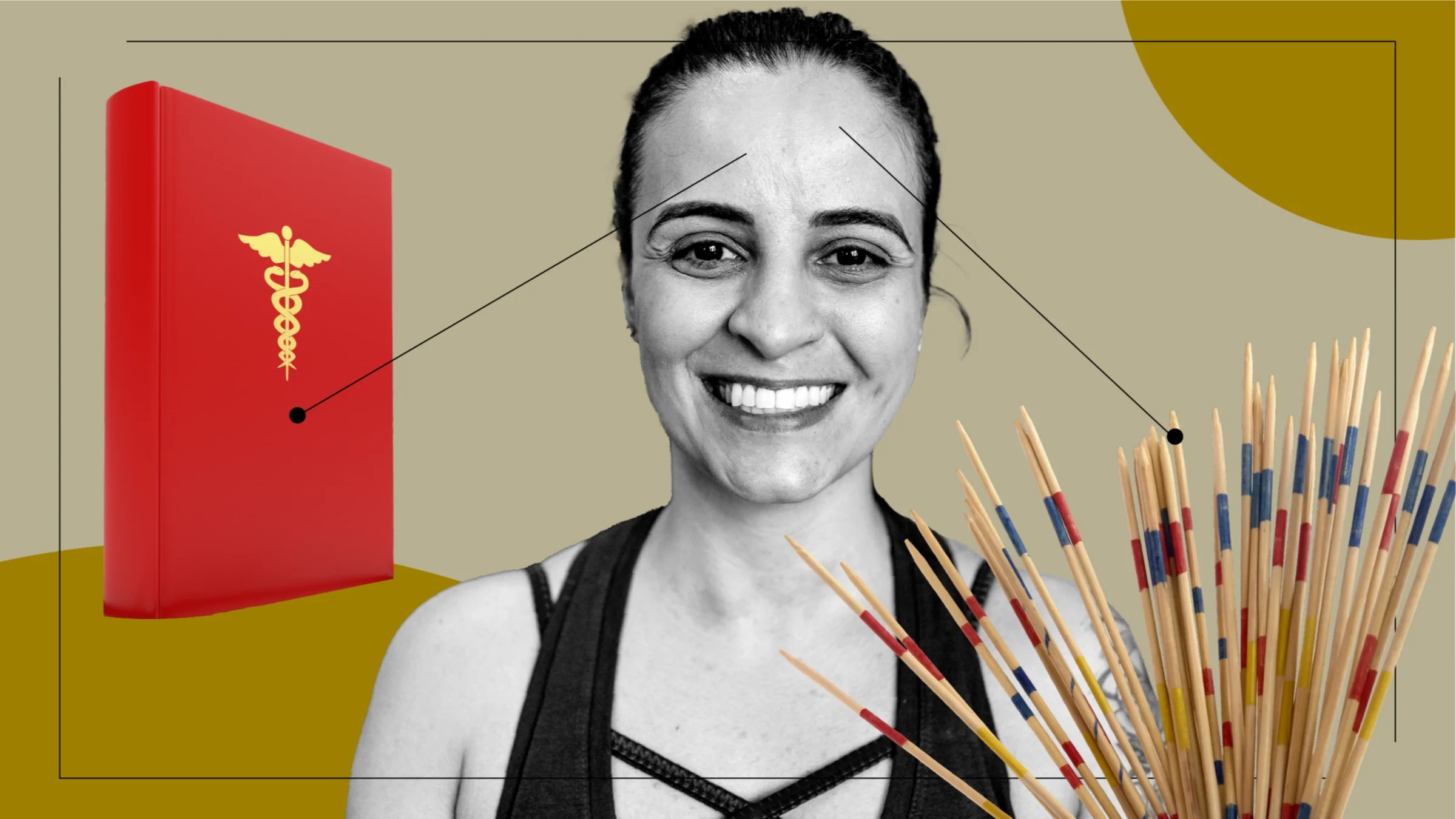
“I did a lot of physical therapy and different exercises,” Samantha says. “I remember playing a lot of pick-up sticks because I couldn’t do anything with my hands, and that helped me practice coordination. My vision came back on Christmas, so I could see things normally and not in double.”
The following quarter, Samantha returned to school, where she was studying pharmaceutical sciences. “I thank God that I did that degree,” she says. “It helped me understand medical language so much more — and the healthcare system in general and how to read clinical papers.”
When she was diagnosed, she says, there were only four options in terms of medication for MS, but research has progressed to the point that there are now more than 20.
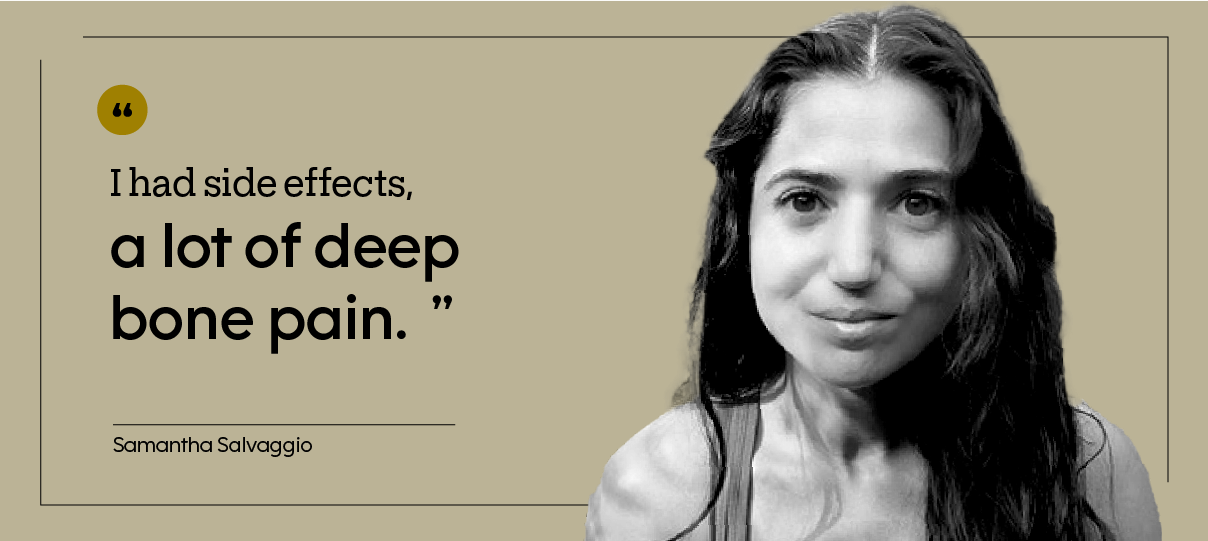
“I started with Rebif,” Samantha says. “It was an injection three times a week, and you would feel like you had the flu. I remember being really tired and worn down those days after the injections. And I had side effects, a lot of deep bone pain. So that just made it hard, like, trying to walk to classes.”
When you have MS, not everyone will understand your illness
Samantha realized her peers didn’t understand what was going on with her, which took a toll on her mental health. She started taking an antidepressant and also sought therapy through the university’s counseling center.
“That helped a lot, just to have someone outside of my world helping me process that stuff — my peers not understanding and that type of thing,” she says
While working through some of the mental health challenges of her diagnosis, she was also dealing with fatigue.
“It’s like a deep, heavy tiredness where you can’t even imagine getting up, let alone doing something. Just complete exhaustion,” Samantha says. “I remember always going home early and crying because I was so upset I couldn’t hang out with my friends how I used to.”
How you eat and move your body can affect how you feel
After Samantha graduated, she and her boyfriend moved to North Carolina.

“I started eating healthier, basically limiting processed foods, and I felt so much better from a fatigue standpoint and just in general,” Samantha says. She decided to return to school to get a master’s degree in nutrition, because she realized how powerful food was in helping her feel better.
But by the time her 10th anniversary of being diagnosed rolled around, she again wasn’t feeling well. She was depressed and almost 50 lbs overweight.
She decided to do one thing every day to help herself feel better, starting with a return to healthier eating. Next, she started exercising.
“I really focused on sleep, stress management, activity, what I was eating, and hydration,” she says.
An online community helps her thrive
It took around 5 years, but eventually Samantha started feeling much better. In 2021, she started an online business as what she calls “the no BS chronic illness guide.” As part of her business, she helps people understand the realities of living with MS.
“I think, when you’re diagnosed, everything just kind of goes out the window,” she says. “It’s just like, ‘Oh, I have this chronic illness. Now, I’m going to be disabled. I’m not going to be able to do anything. I’m going to be housebound. I’m not going to be able to work.’”

Samantha says she wants to share her story so other people who are newly diagnosed and confused or overwhelmed “can see that it’s possible to live a life that doesn’t suck all the time.”
She has a website, blog, and shop with apparel and accessories “to remind you of how you’re empowered — but in a fun, more fashionable way that makes you feel good.” She also posts about MS on TikTok as part of her mission to help people living with chronic illness thrive.
“I try really hard to present science-based, factual information in a way that’s easy to understand and that acknowledges the good and the bad of things,” she says. “I don’t share a lot about symptoms and different medicines and stuff like that. I stay in my lane, because I’m not a doctor. But I’m also aware that I have this education and background in pharmaceutical sciences that is really helpful.”
With a chronic condition, it’s important ‘to be nice to yourself’
Samantha also writes about mindset, radical acceptance, learning to accept one’s reality, and the fact that “worrying about the future is a waste of time.” In her writing, she suggests that people focus on what they can control.
Samantha says she would tell newly diagnosed people how important it is to track your sleep, diet, hydration levels, and activity, along with your symptoms — how they ebb and flow and their intensity.
“Then you can look back after a couple of weeks and notice patterns and empower yourself to shift things,” she says. “That gives you power.”
She also recommends finding a community of people who also have MS. “Instead of fighting to be understood by others that may never understand, it’s great — and easier — to find people that just get it because they’re also living with it,” she says.
Samantha stresses that the journey is truly what you make it — that it’s up to each person.
Having MS “can be a lot, and it can be really overwhelming,” Samantha says. “But you’re really the one in charge of your journey with a chronic illness, and you can make your thoughts and behaviors and actions work for you or against you. It’s your choice, but choose wisely. And be nice to yourself.”

Why trust our experts?