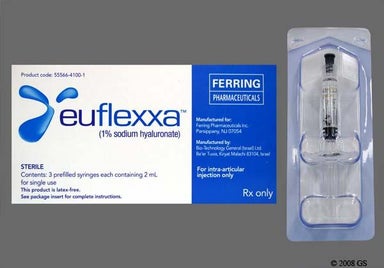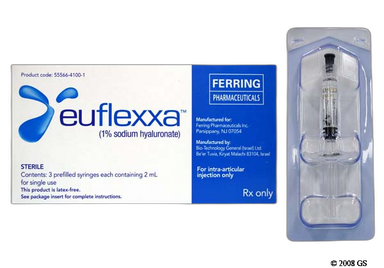
Euflexxa
Euflexxa (sodium hyaluronate) is a viscosupplement. It's a gel-like lubricant that's injected into the knee joint to ease pain from osteoarthritis (OA) in adults. It's typically prescribed for people who continue to have pain despite having tried certain treatments, such as exercise and physical therapy. Euflexxa (sodium hyaluronate) is injected by a healthcare professional once a week for 3 weeks. Some common side effects of this medication include joint pain, muscle pain, and back pain.


What is Euflexxa (sodium hyaluronate)?
What is Euflexxa (sodium hyaluronate) used for?
- Pain due to osteoarthritis (OA) of the knee
How Euflexxa (sodium hyaluronate) works
Euflexxa (sodium hyaluronate) is a viscosupplement. It's similar to hyaluronic acid, a substance that's naturally found in the connective tissues in your body. When Euflexxa (sodium hyaluronate) is injected into the knee, it helps lubricate the knee joint so that you can move it smoothly. This can ease pain from osteoarthritis in the knee.
Drug facts

Side effects of Euflexxa (sodium hyaluronate)
The following side effects may get better over time as your body gets used to the medication. Let your healthcare provider know immediately if you continue to experience these symptoms or if they worsen over time.
Common Side Effects
- Joint pain (9%)
- Back pain (5%)
- Diarrhea (4%)
- High blood pressure (4%)
- Upper respiratory tract infection (4%)
Less Common Side Effects
- Headache
- Cough
- Nausea
- Muscle and bone pain
- Joint swelling
The following Euflexxa (sodium hyaluronate) side effects have also been reported
Along with its needed effects, a medicine may cause some unwanted effects. Although not all of these side effects may occur, if they do occur they may need medical attention.
Check with your doctor immediately if any of the following side effects occur:
Some side effects may occur that usually do not need medical attention. These side effects may go away during treatment as your body adjusts to the medicine. Also, your health care professional may be able to tell you about ways to prevent or reduce some of these side effects. Check with your health care professional if any of the following side effects continue or are bothersome or if you have any questions about them:
Other side effects not listed may also occur in some patients. If you notice any other effects, check with your healthcare professional.
Call your doctor for medical advice about side effects. You may report side effects to the FDA at 1-800-FDA-1088.

Get your GoodRx coupon

Pros and cons of Euflexxa (sodium hyaluronate)
Pros
- Pain relief might last longer than corticosteroids
- Good option for people who've tried other treatments that didn't work well
- Only need three injections
- Well-tolerated, with not many side effects
Cons
- Might need to wait a few weeks to experience maximum pain relief
- Not a first-choice treatment for OA
- Must be given by a healthcare professional
- Can cause temporary pain and swelling where it's injected

Pharmacist tips for Euflexxa (sodium hyaluronate)

- Mark your appointments to get your Euflexxa (sodium hyaluronate) injections on your calendar so you don't miss any doses.
- Your prescriber might have you avoid physical activity after receiving Euflexxa (sodium hyaluronate). In general, take things easy for the first 48 hours right after your injection. You should avoid strenuous activities such as running, jumping, swimming, biking or standing on your feet for more than 1 hour at a time. Ask your prescriber when you can continue these physical activities again.
- You can expect to experience temporary pain and swelling in the knee where Euflexxa (sodium hyaluronate) was injected. This is typically mild and should go away after 1 to 3 days. But if it doesn't, contact your prescriber.
- If you're pregnant or breastfeeding, talk to your prescriber about the risks and benefits of receiving Euflexxa (sodium hyaluronate). There isn't enough information to know if it's safe for you or your baby.

Common questions about Euflexxa (sodium hyaluronate)
No, Euflexxa (sodium hyaluronate) isn't a steroid. It contains sodium hyaluronate, which is a gel-like substance that helps lubricate the joints and helps absorb shock from movements. There are other knee injections used to treat osteoarthritis that do contain a steroid.
No, Euflexxa (sodium hyaluronate) isn't made from rooster combs, the red comb-like structure on top of a rooster's head. Some knee injections that contain sodium hyaluronate are made using rooster comb, which also contains the same gel-like substance that's in our knee joints. But Euflexxa (sodium hyaluronate) is made from bacterial cells instead, and not with animal products.
Based on results in clinical studies, some people might feel less pain as soon as 1 week after the Euflexxa (sodium hyaluronate) injection. But others might not experience a more noticeable pain relief until after the third injection in week 3. In general, people tend to see an improvement in their condition by about 2 to 3 months after a viscosupplement injection. Because everyone responds differently, it might take more or less time for you to notice a change in your pain symptoms. Talk with your healthcare team if you're not sure what to expect with Euflexxa (sodium hyaluronate).
A study looked at how well Euflexxa (sodium hyaluronate) worked to ease pain in people with OA by looking at their pain levels after a 50-foot walk test. About 6 months after the initial injections, people who received Euflexxa (sodium hyaluronate) experienced more significant improvement in their pain compared those who received placebo. Talk with your healthcare team if you have more questions about how well Euflexxa (sodium hyaluronate) works.
How long your pain relief lasts might differ depending on your condition and how your body responds to Euflexxa (sodium hyaluronate). Research has shown that pain relief can last for 6 months if you receive three weekly injections of Euflexxa (sodium hyaluronate). Ask your prescriber about how long you might expect your pain relief to last.
One cycle of Euflexxa (sodium hyaluronate) treatment is made up of 3 once-weekly injections and should provide pain relief for up to 6 months. Study shows you can receive another cycle Euflexxa (sodium hyaluronate) after this time, which can help ease pain for an additional 6 months. Follow up with your prescriber about how often you should receive treatment with this medication.
Weight gain wasn't a side effect reported by people taking Euflexxa (sodium hyaluronate) during clinical studies. If you have concerns about your weight, contact your primary care provider.
Injections like Euflexxa (sodium hyaluronate) can cause pain and swelling at the injection site. But it's typically mild and should go away 1 to 3 days after the injection. If you're concerned about pain, ask your healthcare professional about a numbing medication before getting your injection. It's normal to experience some pain temporarily after you get your injection. But if it persists, contact your care team.

How to save using GoodRx




Euflexxa (sodium hyaluronate) dosage
 Syringe
| Dosage | Quantity | Price as low as | Price per unit |
|---|---|---|---|
| 2ml of 10mg/ml | 3 syringes | $1,044.86 | $348.29 |
Typical dosage for Euflexxa (sodium hyaluronate)
Each Euflexxa injection contains 20 mg of sodium hyaluronate.
Adults: The typical dose is one injection given into the knee joint by a healthcare professional (HCP) once a week for 3 weeks.

Interactions between Euflexxa (sodium hyaluronate) and other drugs
Although certain medicines should not be used together at all, in other cases two different medicines may be used together even if an interaction might occur. In these cases, your doctor may want to change the dose, or other precautions may be necessary. Tell your healthcare professional if you are taking any other prescription or nonprescription (over-the-counter [OTC]) medicine.

How much does Euflexxa (sodium hyaluronate) cost?
$1,044.86

Euflexxa (sodium hyaluronate) contraindications
Contraindications are specific health conditions or situations in which a person should not take a medication due to safety concerns. If you have any of the following conditions or if any of the following apply to you, let your healthcare provider know because Euflexxa (sodium hyaluronate) will not be safe for you to take.
- Current infection or skin problems in area of injection
- Known allergy to hyaluronate products

What are alternatives to Euflexxa (sodium hyaluronate)?
This medication is used for many different conditions. Generally, it's used for autoimmune problems, conditions related to swelling, or cancer. Some examples include:

News about Euflexxa (sodium hyaluronate)


Euflexxa (sodium hyaluronate) images