Key takeaways:
Treatment of knee pain starts with physical therapy, weight loss, and exercise. Medications might also help.
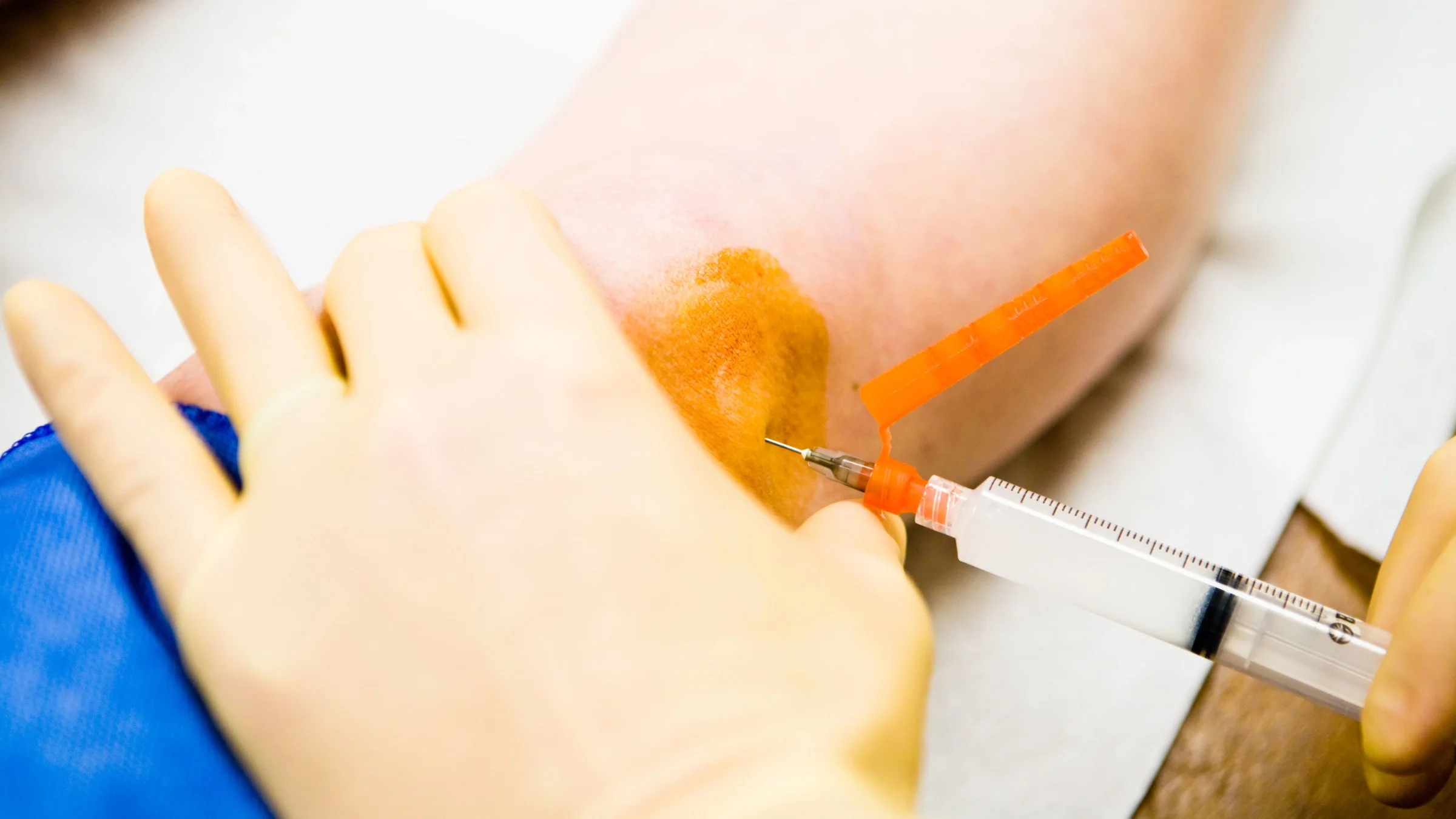
When standard treatments have failed, knee injections may provide short-term pain relief for some people.
Experts may recommend occasional steroid injections, but there’s limited data to support the use of other types of injections.
Save on related medications
Osteoarthritis (OA) — also known as degenerative joint disease — is the most common form of arthritis. You might think of joints like cars. They wear out over time, just like any machine. Cars that have been in a few accidents are more likely to wear out faster, but even cars in the best condition need new parts over time. The same goes for joints.
Wear and tear — whether from prior injuries or aging — adds up. The cushioning between the bones in the joints (cartilage) begins to wear away — just like seals and parts in a car engine. OA is what happens when cartilage wears down.
OA is more common as you get older, and it can cause severe and debilitating pain. Scientists are working hard to find a medicine that cures OA or stops it from progressing. The research isn’t quite there yet. But there are treatments that can help, including medications, exercises, and even surgery.
Search and compare options
When should you consider knee injections?
Knee injections aren’t the first-choice treatment for OA. Providers usually recommend other treatments for knee OA, including:
Weight loss (if needed)
Physical therapy to build strength in the legs and core
Exercise to prevent stiffness
Mind-body techniques to develop tools to better cope with pain
Anti-inflammatory creams (like Voltaren)
Nonsteroidal anti-inflammatory medications (NSAIDs), like naproxen or celecoxib
Acetaminophen (Tylenol) for those who can’t take NSAIDs
Knee injections may also be an option, but the evidence to support their use isn’t strong. That’s why you should only consider them if better treatment options have failed to provide enough relief.
What are the different types of knee injections?
There are several different types of injections to treat knee OA. But the American Academy of Orthopaedic Surgeons and the American College of Rheumatology only recommend occasional steroid injections. That’s because there isn’t much proof that other types of injections are helpful. Recommendations may change in the future when more data is available. Here’s the lowdown on what we know now.
Steroid injections (cortisone shots)
Steroid injections can provide short-term pain relief. When injected directly into the knee joint, steroids rapidly decrease inflammation, with fewer side effects than steroid pills. A numbing agent (lidocaine) mixed in with the steroid also helps relieve pain.
Steroid injections relieve pain for one to several weeks, though effects may be longer or shorter for some people. Some people may not benefit at all. Steroid injections may be given at most every 3 months. But experts don’t recommend injecting the joints every 3 months like clockwork since repeat steroid injections can actually speed up cartilage loss over time (worsening OA). It’s less risky to get one or two injections a year — especially before a big event for which you want to feel your best.
Steroid injections come in short-acting (triamcinolone acetonide) and extended-release (Zilretta) forms. Zilretta may provide longer lasting relief than other options (3 months), but more studies are needed to confirm this.
Hyaluronic acid gel injections (viscosupplementation)
Hyaluronic acid is a natural lubricant and shock absorber inside of the joints. But the shocks wear out over time. Viscosupplementation injects hyaluronic acid gel into the joint to replace what has been lost. Examples include Hyalgan, Synvisc, and Euflexxa.
Insurance companies typically require the provider to complete extra paperwork (prior authorization) to request coverage for viscosupplementation. A provider injects three to five doses (once a week) into the knee. The number of injections depends on the brand. It takes several weeks for viscosupplementation to help (and it may not). If helpful, you may repeat viscosupplementation every 6 months.
Unfortunately, studies show that viscosupplementation isn’t very effective for knee OA symptoms. The data simply isn’t good enough for experts to recommend it routinely. But viscosupplementation has fewer side effects than steroid injections and may provide a bit of relief to some people. Talk to your provider to decide if viscosupplementation is worth trying for you.
Platelet-rich plasma injections
Plasma is the liquid part of blood. Platelets are the tiny blood cells that stop bleeding after a cut and contain growth factors to promote healing. Platelet-rich plasma (PRP) is plasma with more platelets.
To prepare PRP, your provider draws some of your blood and spins it in the lab to increase the concentration of platelets. Then they inject the PRP into the knee joint.
The idea behind PRP is interesting, but studies have shown mixed results. Some studies showed improvement in pain and function for people with mild to moderate OA. Another study showed no difference. PRP worked best for those whose OA wasn’t severe. So experts don’t routinely recommend PRP injections, especially since they’re expensive and insurance often doesn’t cover them.
Autologous conditioned serum injections
Autologous conditioned serum (ACS) is another type of injection made from your own blood with increased anti-inflammatory molecules. It’s not FDA approved, and it isn’t widely available in the U.S. A few small studies have shown benefits in knee OA, but experts don’t recommend ACS due to the limited data. It’s more expensive than PRP, and health insurance doesn’t cover it.
Stem cell injections
Stem cells are the body’s building blocks. New cells and tissues come from stem cells, so there’s hope that stem cells might rebuild healthy joints. But more studies are needed to confirm that stem cells are effective and/or safe for the treatment of knee OA. Experts don’t recommend stem cell injections. The FDA also issued a warning about stem cell therapies given concerns about their safety and efficacy.
Side effects of knee injections
Like all procedures, knee injections come with potential risks. These include:
Infection
Bleeding
Pain or burning when medication is injected into the joint
Temporary worsening of knee pain (especially 48 hours after steroid injections)
Icing the knee after a joint injection can help reduce pain and swelling.
How long do knee injections last?
It depends on the person and the type of injection. Some people feel better for weeks to months. Injections can sometimes help people delay replacement surgery in this way. But others will see no benefit at all.
What is the best injection for knee pain?
At this time, occasional steroid injections are the only type experts recommend. Other types of injections may help some people, but scientific proof is limited. Believe it or not, injecting saltwater (a placebo with no medical benefits) into the knee joint has been shown to improve pain and function in people with knee OA. That’s why it’s so important to have larger studies that confirm injections are effective, safe, and worth the cost.
What if injections don’t help?
If injections don’t help, and your osteoarthritis is severe, the next step might be knee replacement surgery. Talk to an orthopedic surgeon to figure out if surgery might be a safe and helpful option for you. It’s important to understand the risks of surgery and the rehabilitation and recovery process afterward.
The bottom line
When other options have failed, steroid injections may provide short-term pain relief from osteoarthritis. Other types of injections may help some people. But experts don’t recommend them since the data to support their use isn’t strong enough at this time. Talk to your healthcare provider about your options. Together, you’ll find a way to improve your pain and get you moving better.

Why trust our experts?



References
Alaia, M. J., et al. (2020). Platelet-rich plasma. OrthoInfo.
Anil, U., et al. (2021). The efficacy of intra-articular injections in the treatment of knee osteoarthritis: A network meta-analysis of randomized controlled trials. Knee.
Arthritis Foundation (n.d.). Corticosteroids.
Arthritis Society of Canada. (2021). Osteoarthritis self-management.
Bennell, K. L., et al. (2021). Effect of intra-articular platelet-rich plasma vs placebo injection on pain and medial tibial cartilage volume in patients with knee osteoarthritis. Journal of the American Medical Association.
Brophy, R. H., et al. (2022). AAOS clinical practice guideline summary: Management of osteoarthritis of the knee (nonarthroplasty), third edition. Journal of the American Academy of Orthopaedic Surgeons.
Centers for Disease Control and Prevention. (2021). Weight loss for adults with arthritis.
Foran, J. R. H. (2021). Viscosupplementation treatment for knee osteoarthritis. OrthoInfo.
Frisbie, D. D., et al. (2015). Autologous-conditioned serum: Evidence for use in the knee. Journal of Knee Surgery.
Godman, H. (2020). 5 ways to ease pain using the mind-body connection. Harvard Health Letter.
Kolasinski, S. L., et al. (2019). 2019 American College of Rheumatology/Arthritis Foundation guideline for the management of osteoarthritis of the hand, hip, and knee. Arthritis & Rheumatology.
McAlindon, T. E., et al. (2017). Effect of intra-articular triamcinolone vs saline on knee cartilage volume and pain in patients with knee osteoarthritis: A randomized clinical trial. Journal of the American Medical Association.
Meheux, C. J., et al. (2016). Efficacy of intra-articular platelet-rich plasma injections in knee osteoarthritis: A systematic review. Arthroscopy.
Paik, J., et al. (2019). Triamcinolone acetonide extended-release: A review in osteoarthritis pain of the knee. Drugs.
Rutjes, A. W. S., et al. (2012). Viscosupplementation for osteoarthritis of the knee: A systematic review and meta-analysis. Annals of Internal Medicine.
Saltzman, B. M., et al. (2017). The therapeutic effect of intra-articular normal saline injections for knee osteoarthritis: A meta-analysis of evidence level 1 studies. American Journal of Sports Medicine.
U. S. Food & Drug Administration. (2024). Consumer alert on regenerative medicine products including stem cells and exosomes.
Zhu, C., et al. (2021). Mesenchymal stem cells in osteoarthritis therapy: A review. American Journal of Translational Research.