

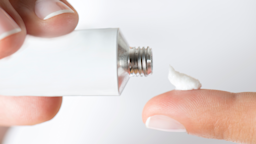
Is It OK to Use Hemorrhoid Cream Under My Eyes and for My Face?
Learn whether hemorrhoid cream can help with eye bags and fine lines, and what the potential side effects can look like, according to a pharmacist.
Benzocaine topical is a local anesthetic. It temporarily eases minor skin irritations and pain by blocking pain signals. Benzocaine topical is applied to the skin, typically 3 to 4 times a day; most products can be used by adults and children ages 2 years and older. You can find it over-the-counter (OTC) in many dosage forms, including spray, gel, and cream. Benzocaine topical might cause some mild burning or stinging as side effects.

Temporary relief of pain and itching from minor skin irritations, including:
Benzocaine topical is a local anesthetic. It works by blocking sodium channels in the skin, which prevents sending pain signals to the brain and feeling pain.
| Common Brands | Boil Ease, Americaine, Chiggerex |
|---|---|
| Drug Class | Local anesthetic |
| Controlled Substance Classification | Not a controlled medication |
| Generic Status | Lower-cost generic available |
| Availability | Over-the-counter |

The following side effects may get better over time as your body gets used to the medication. Let your healthcare provider know immediately if you continue to experience these symptoms or if they worsen over time.
Contact your healthcare provider immediately if you experience any of the following.
Along with its needed effects, a medicine may cause some unwanted effects. Although not all of these side effects may occur, if they do occur they may need medical attention.
Check with your doctor immediately if any of the following side effects occur:
Rare
Bluish color of the fingernails, lips, skin, palms, or nail beds
Incidence not known
Blistering, burning, crusting, dryness, or flaking of the skin
cracking, itching, redness, or stinging of the skin
dark urine
difficulty with breathing
difficulty with walking
dizziness or lightheadedness
fainting
headache
inability to feel hands and feet
irritability
irritation of the nose
itching, scaling, severe redness, soreness, or swelling of the skin
pale skin
rapid heart rate
red, sore eyes
shortness of breath
unusual bleeding or bruising
unusual drowsiness, dullness, tiredness, weakness, or feeling of sluggishness
unusual tiredness or weakness
Other side effects not listed may also occur in some patients. If you notice any other effects, check with your healthcare professional.
Call your doctor for medical advice about side effects. You may report side effects to the FDA at 1-800-FDA-1088.




Benzocaine topical can cause some serious health issues. This risk may be even higher for certain groups. If this worries you, talk to your doctor or pharmacist about other options.
Benzocaine topical can cause a rare, but serious, condition known as methemoglobinemia where your blood can't get enough oxygen to your body. The signs of this reaction are headaches, dizziness, trouble breathing, fast heart rate, feeling tired, and pale, gray- or blue-colored skin, lips, and nail beds. The risk is higher in young children, older adults, and people with heart or breathing problems. Signs of methemoglobinemia can happen within minutes to one or two hours after using benzocaine topical. This reaction can develop after using the medication for the first time or even if you've used it previously. Contact your provider right away if you notice any of these symptoms after using benzocaine topical.
Don't take benzocaine topical if you have a history of allergy to topical pain medications, such as procaine, bupivacaine, topical lidocaine. Watch out for signs and symptoms of allergic reactions, such as hives, trouble breathing, swelling of your face, lips, or throat. Please get medical attention right away if you have these signs and symptoms.

 Tube of ointment
| Dosage | Quantity | Price as low as | Price per unit |
|---|---|---|---|
| 28g of 20% | 1 tube | $7.85 | $7.85 |

Although certain medicines should not be used together at all, in other cases two different medicines may be used together even if an interaction might occur. In these cases, your doctor may want to change the dose, or other precautions may be necessary. When you are taking this medicine, it is especially important that your healthcare professional know if you are taking any of the medicines listed below. The following interactions have been selected on the basis of their potential significance and are not necessarily all-inclusive.
Using this medicine with any of the following medicines is usually not recommended, but may be required in some cases. If both medicines are prescribed together, your doctor may change the dose or how often you use one or both of the medicines.


Contraindications are specific health conditions or situations in which a person should not take a medication due to safety concerns. If you have any of the following conditions or if any of the following apply to you, let your healthcare provider know because Benzocaine topical will not be safe for you to take.

Temporary relief of pain and itching from minor skin irritations, including:
Topical lidocaine products come in many forms and strengths. Each can be used for different conditions.
In general, they're used for temporary relief of pain, itching, burning, or discomfort from:

Prescription savings
Stop paying too much for your prescriptions. Compare prices, get pharmacy coupons, and save up to 80%. Find expert answers to your health questions so you can make the best decisions for yourself and your family.
Health conditions
Medications & treatment
Access & affordability
 Our monthly healthcare membership can help you save thousands on your prescription costs.
Resources

You should only apply a small amount of Benzocaine to relieve minor skin irritation or pain. Most people don't experience many side effects from using Benzocaine as directed. But rarely, people have reported a dangerous side effect called methemoglobinemia, typically from using oral benzocaine, especially among younger children. Don't use Benzocaine in large quantities, or apply it to skin areas that are blistering or damaged, because doing so might cause you to absorb too much benzocaine. Also, avoid putting Benzocaine in your eyes or mouths. If you have Benzocaine at home, store it out of reach of children and pets.
There's limited research about whether Benzocaine is safe to use during pregnancy. But existing information suggests that only a small amount of benzocaine get absorbed in to the bloodstream and this amount is unlikely to cause harm to the baby. To be safe, if you're pregnant, ask your provider if Benzocaine is right for you.
Topical benzocaine and topical lidocaine are local anesthetics that are similar to each other, but they're not the same. Both medications are available in many different forms and strengths, and can help temporarily ease pain, itching, burning, or discomfort on the skin. Because Benzocaine and topical lidocaine can cause similar side effects, including a rare but serious condition called methemoglobinemia, don't use both medications together unless directed by your provider.
You can apply Benzocaine to minor cuts, burns, sunburns, skin irritations, insect bites or stings, and boils on the skin. Don't apply it to deep puncture wounds or blistered or open skin. Avoid getting the medication in or around your eyes, mouth, or genital area, since this can lead to irritation. And don't use it on large areas of the body, because this could lead to more side effects from the medication.
It takes less than 1 minute for Benzocaine to start working. The effects of the medication last for about 5 to 10 minutes. But keep in mind there are several different forms of benzocaine, so depending on your specific benzocaine product and what you're using it for, it might last for a shorter or longer amount of time. Talk to your provider if you're concerned with how long Benzocaine is lasting for you.
Benzocaine is only meant to provide temporarily relief from minor skin irritations. In general, you shouldn't need to use this medication for longer than 7 days. If your symptoms don't go away after 7 days, talk to your healthcare provider to see if you need more medical attention. Also, you should stop Benzocaine and check in with your provider if your condition worsens or if there's redness or swelling on your skin.
Don't apply Benzocaine for skin irritations into the mouth. There are other benzocaine products (e.g., benzocaine (Hurricaine) oral spray, benzocaine (Orajel) gel) that are used specifically for different types of mouth pain. It's very important to closely read the medication label to make sure you're using a skin product versus an oral (mouth) product. Talk to your provider or pharmacist if you're unsure where the product can be used.
