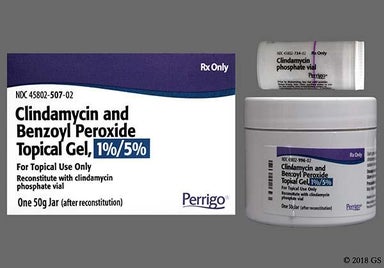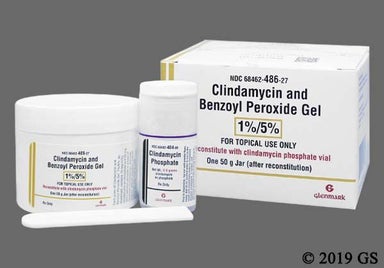
clindamycin / benzoyl peroxide
Clindamycin/benzoyl peroxide is a combination topical gel used to treat acne in people ages 12 years and older. It contains a lincosamide antibiotic (clindamycin) and an antiseptic (benzoyl peroxide) that kills acne-causing bacteria and easing skin inflammation. Clindamycin/benzoyl peroxide is applied to the face once or twice per day, depending on the strength. Side effects include skin redness and itching. This medication is available as both brand name (e.g., Neuac, Acanya) and generic versions.


What is Clindamycin/benzoyl peroxide?
What is Clindamycin/benzoyl peroxide used for?
- Treatment of inflammatory acne on the face in people ages 12 years and older
How Clindamycin/benzoyl peroxide works
Clindamycin/benzoyl peroxide is a combination of two medications that work together to treat acne.
- Clindamycin is a lincosamide antibiotic. It works by stopping bacteria from making their own proteins. This prevents the bacteria that cause acne from growing and spreading.
- Benzoyl peroxide is an antiseptic. It works by killing the bacteria on the skin that cause acne. It also helps improve the skin texture by shedding damaged or flaking skin and reducing inflammation.
Drug facts
| Common Brands | Acanya, Neuac |
|---|---|
| Drug Class | Topical antibiotic |
| Controlled Substance Classification | Not a controlled medication |
| Generic Status | Lower-cost generic available |
| Availability | Prescription only |

Side effects of Clindamycin/benzoyl peroxide
The following side effects may get better over time as your body gets used to the medication. Let your healthcare provider know immediately if you continue to experience these symptoms or if they worsen over time.
Common Side Effects
Neuac:
- Mild skin redness (26%)
- Mild skin peeling (17%)
- Mild skin dryness (15%)
- Mild skin burning (5%)
Acanya:
- Mild skin redness (25%)
- Mild skin scaling (18%)
- Mild skin itching (15%)
- Mild skin burning (8%)
Clindamycin 1% / benzoyl peroxide 5%:
- Dryness (12%)
Less Common Side Effects
- Stinging
- Sunburn
Clindamycin/benzoyl peroxide serious side effects
Contact your healthcare provider immediately if you experience any of the following.
- Inflammation of your large intestine: diarrhea that doesn't go away (especially if it's bloody), severe stomach cramps
- Serious allergic reaction: hives; trouble breathing; itching; swelling of your face, eyes, lips, tongue, or throat
The following Clindamycin/benzoyl peroxide side effects have also been reported
Along with its needed effects, a medicine may cause some unwanted effects. Although not all of these side effects may occur, if they do occur they may need medical attention.
Check with your doctor immediately if any of the following side effects occur:
More common
Less common
Burning, itching, redness, skin rash, swelling, or soreness at the application site
flushing or redness of the skin
peeling
sunburn
unusually warm skin
Other side effects not listed may also occur in some patients. If you notice any other effects, check with your healthcare professional.
Call your doctor for medical advice about side effects. You may report side effects to the FDA at 1-800-FDA-1088.

Pros and cons of Clindamycin/benzoyl peroxide
Pros
- Applied to the skin
- Available in different strengths, depending on your needs
- Causes fewer side effects compared to oral acne medications
Cons
- Can bleach your hair and clothes
- Can take up to 3 months to see full effects
- Makes your skin more sensitive to light

Pharmacist tips for Clindamycin/benzoyl peroxide

- Use a mild cleanser to clean the affected area(s) where you'll be applying clindamycin/benzoyl peroxide. Make sure your skin is completely dry before using clindamycin/benzoyl peroxide.
- Apply a thin layer of clindamycin/benzoyl peroxide on the affected area(s) of the skin on the face once or twice a day, depending on the instructions from your prescriber. Make sure to apply enough to cover the skin with a thin layer of medication.
- Avoid applying clindamycin/benzoyl peroxide to the eyes, mouth, lips, mouth, vagina, or areas of skin that are broken.
- Start using a mild moisturizer as often as needed to help prevent your skin from becoming too dry or irritated. Also, use sunscreen and wear protective clothing (e.g., hats) when going outside because clindamycin/benzoyl peroxide can make your skin more sensitive to light.
- Let your care team know if you're using other acne medications, such as Benzamycin (erythromycin / benzoyl peroxide) or dapsone (Aczone). You might need to stop using these before starting clindamycin/benzoyl peroxide.
- Store clindamycin/benzoyl peroxide at room temperature (up to 77 degrees F). Keep the container tightly closed and out of reach from children.
- Neuac is good for 60 days, Acanya is good for 10 weeks, and clindamycin 1% /benzoyl peroxide 5% is good for 3 months after opening. Write the expiration date on your product, if not already there, and throw it away after this date.

Risks and warnings for Clindamycin/benzoyl peroxide
Clindamycin/benzoyl peroxide can cause some serious health issues. This risk may be even higher for certain groups. If this worries you, talk to your doctor or pharmacist about other options.
Serious gut problem (colitis)
- Risk factors: Applying clindamycin/benzoyl peroxide to mouth, eyes, or broken skin | Using clindamycin/benzoyl peroxide for a long time | Taking opioids or Lomotil (diphenoxylate / atropine) with clindamycin/benzoyl peroxide
Although rare, there have been reports of clindamycin getting absorbed from the skin and into the body, and causing a potentially life-threatening condition called colitis. Colitis is inflammation of your large intestine (the colon). People who take opioid pain medications (e.g., Norco (hydrocodone / acetaminophen), oxycodone, etc.) or Lomotil (diphenoxylate / atropine) might be at risk for prolonged or worsening colitis.
If you experience diarrhea that doesn't go away, especially if it's bloody and causes severe stomach cramps, stop using clindamycin/benzoyl peroxide and seek medical help. In some people, these symptoms might not happen until a few weeks after stopping the medication.
Sunburn
Your skin can become more sensitive to ultraviolet (UV) light while using clindamycin/benzoyl peroxide. Too much exposure to UV light can even cause severe sunburn. Minimize your exposure to sunlight, sun lamps, and tanning beds during and immediately following treatment with clindamycin/benzoyl peroxide. If possible, limit your time out in the sun or seek shade when you're outside. If you plan on spending time in the sun, ask your dermatologist about using sunscreen and wearing protective clothing (e.g., hats, long-sleeved shirts).
Skin irritations
Using other topical acne medications along with clindamycin/benzoyl peroxide can cause skin irritation, such as peeling and flakey skin. If this happens, your dermatologist might ask you to temporarily stop treatment or use the medications less often until the skin irritation gets better. But if you experience severe skin irritation, your dermatologist will likely ask you to stop treatment and consider other options.

Clindamycin/benzoyl peroxide dosage
 Gel pump
| Dosage | Quantity | Price as low as | Price per unit |
|---|---|---|---|
| 50g of 1%/5% | 1 pump | $39.70 | $39.70 |
| 35g of 1%/5% | 1 pump | $40.07 | $40.07 |
| 50g of 1.2%/2.5% | 1 pump | $51.42 | $51.42 |
| 50g of 1.2%/3.75% | 1 pump | $69.00 | $69.00 |
 Jar of gel
| Dosage | Quantity | Price as low as | Price per unit |
|---|---|---|---|
| 50g of 1%/5% | 1 jar | $39.70 | $39.70 |
| 25g of 1%/5% | 1 jar | $28.49 | $28.49 |
| 35g of 1%/5% | 1 jar | $36.29 | $36.29 |
 Tube of gel
| Dosage | Quantity | Price as low as | Price per unit |
|---|---|---|---|
| 45g of 1.2%/5% | 1 tube | $28.39 | $28.39 |

Interactions between Clindamycin/benzoyl peroxide and other drugs
Although certain medicines should not be used together at all, in other cases two different medicines may be used together even if an interaction might occur. In these cases, your doctor may want to change the dose, or other precautions may be necessary. When you are taking this medicine, it is especially important that your healthcare professional know if you are taking any of the medicines listed below. The following interactions have been selected on the basis of their potential significance and are not necessarily all-inclusive.
Using this medicine with any of the following medicines is usually not recommended, but may be required in some cases. If both medicines are prescribed together, your doctor may change the dose or how often you use one or both of the medicines.
Using this medicine with any of the following medicines may cause an increased risk of certain side effects, but using both drugs may be the best treatment for you. If both medicines are prescribed together, your doctor may change the dose or how often you use one or both of the medicines.
- Atracurium
- Metocurine
- Tubocurarine

How much does Clindamycin/benzoyl peroxide cost?

Clindamycin/benzoyl peroxide contraindications
Contraindications are specific health conditions or situations in which a person should not take a medication due to safety concerns. If you have any of the following conditions or if any of the following apply to you, let your healthcare provider know because Clindamycin/benzoyl peroxide will not be safe for you to take.
- Allergy lincomycin
- History of certain inflammatory gut problems (e.g., ulcerative colitis, antibiotic-associated colitis, or regional enteritis)

What are alternatives to Clindamycin/benzoyl peroxide?

Clindamycin/benzoyl peroxide images