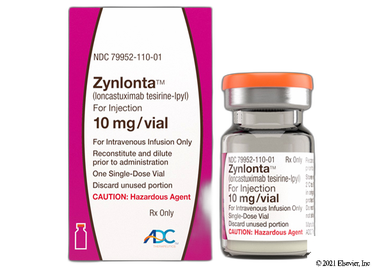
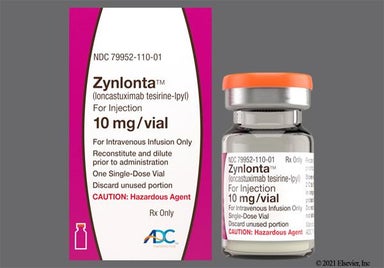
Zynlonta (loncastuximab tesirine or loncastuximab tesirine-lpyl) is used to treat adults with certain types of non-Hodgkin lymphoma (NHL), such as diffuse large B-cell lymphoma (DLBCL). It’s typically used after people have already tried other treatments. Zynlonta (loncastuximab tesirine) is a type of cancer medication called an antibody-drug conjugate. It’s given as an injection into the vein every 3 weeks at an infusion clinic or medical office. Side effects can include tiredness, low blood cell counts, and swelling from fluid buildup in the body.
What is Zynlonta (loncastuximab tesirine) used for?
Advanced large B-cell lymphoma, including diffuse large B-cell lymphoma; given after at least two previous therapies
How Zynlonta (loncastuximab tesirine) works
Zynlonta (loncastuximab tesirine) is an antibody-drug conjugate. It’s made up of a few parts that work together to find and kill lymphoma cells in the body. It contains a monoclonal antibody and a chemotherapy medication.
The monoclonal antibody works to guide the medication to lymphoma cells. It finds and attaches to a specific protein found on lymphoma cells called CD19.
The chemotherapy part of Zynlonta (loncastuximab tesirine) starts to work once the medication reaches the lymphoma cell and gets pulled into the cancer cell. The chemotherapy damages the cell’s DNA, which usually kills the cancer cell.
The following side effects may get better over time as your body gets used to the medication. Let your healthcare provider know immediately if you continue to experience these symptoms or if they worsen over time.
Capillary leak syndrome—stomach or muscle pain, unusual weakness or fatigue, feeling faint or lightheaded, decrease in the amount of urine, swelling of the ankles, hands, or feet, trouble breathing
Fast or irregular heartbeat, feeling faint or lightheaded, trouble breathing, sharp pain in the chest, back, shoulder, or stomach
Infection—fever, chills, cough, sore throat, wounds that don't heal, pain or trouble when passing urine, general feeling of discomfort or being unwell
Liver injury—right upper belly pain, loss of appetite, nausea, light-colored stool, dark yellow or brown urine, yellowing skin or eyes, unusual weakness or fatigue
Low red blood cell level—unusual weakness or fatigue, dizziness, headache, trouble breathing
Skin reactions on sun-exposed areas
Swelling of the ankles, hands, or feet, shortness of breath or trouble breathing, sudden weight gain
Pros and cons of Zynlonta (loncastuximab tesirine)
Pros
Only given once every 3 weeks
Works in a targeted, specific way than traditional chemotherapy
Less likely to cause hair loss than other treatments
Cons
Given as an injection into the vein
Might raise your risk for infection
Not safe to take if you’re pregnant
Pharmacist tips for Zynlonta (loncastuximab tesirine)
Zynlonta (loncastuximab tesirine) is given as an infusion through the vein once every 3 weeks at an infusion or medical center. Add your infusion appointments onto your calendar so you remember to get your infusions on time.
Your oncologist might prescribe dexamethasone for you to take by mouth the day before, the day of, and the day after each Zynlonta (loncastuximab tesirine) infusion. This helps lower the risk of side effects from the medication like swelling (edema).
Zynlonta (loncastuximab tesirine) infusions take about 30 minutes. It might be a good idea to bring a book or an electronic device with you to the infusion clinic or medical office to help pass the time.
It might be easier for you to get a sunburn while you’re taking Zynlonta (loncastuximab tesirine) because the medication can make your skin more sensitive to sunlight. Try to minimize the amount of time your skin is exposed to the sun. Wear sunscreen with an SPF of at least 30 and clothes that protect your skin. Let your care team know if you get a sunburn or have painful skin during treatment.
Prevent getting sick by washing your hands often, avoiding crowds, and washing raw fruits and vegetables thoroughly before eating them. It might be hard for your body to protect and fight against infections during treatment since Zynlonta (loncastuximab tesirine) can lower your white blood cell count.
Check your temperature regularly, for example once a day. Call your care team as soon as possible if you have a fever (a body temperature of 100.4 degrees Fahrenheit or higher). It’s important for your care team to know if you get sick so you can get treated. Sometimes, a fever can be the only sign that you’re sick.
If you can become pregnant and are sexually active, be sure to use effective birth control while you’re taking Zynlonta (loncastuximab tesirine) and for 10 months after your last dose. This medication might cause harm to an unborn baby if it’s given during pregnancy. Call your oncology team as soon as possible if you become pregnant during treatment.
If you’re a male and you’re sexually active with a partner who can become pregnant, you should use birth control, such as condoms, during treatment with Zynlonta (loncastuximab tesirine) and for 7 months after your last dose. Let your oncology care team know if your partner becomes pregnant because this medication can harm an unborn baby.
Risks and warnings for Zynlonta (loncastuximab tesirine)
Zynlonta (loncastuximab tesirine) can cause some serious health issues. This risk may be even higher for certain groups. If this worries you, talk to your doctor or pharmacist about other options.
Swelling and fluid buildup
Although uncommon, some people who were treated with Zynlonta (loncastuximab tesirine) developed swelling due to fluid buildup in the body. This swelling happened most commonly in the arms, legs, and belly. But other people had fluid around their lungs or heart, leading to chest pain and trouble breathing.
Your care team will monitor you during treatment for fluid buildup. Contact them right away if you notice symptoms like trouble breathing, chest pain, swollen ankles, or a swollen belly.
Low blood cell counts
Zynlonta (loncastuximab tesirine) can cause you to have low blood cell counts. This means that your white blood cell counts, red blood cell counts, and platelet levels can drop while you're taking the medication.
You might get sick easier when you don’t have enough white blood cells since they’re important for helping your body fight infection. You’re also at risk for tiredness and anemia when you have low red blood cells. In addition, you’re at risk for bleeding when your platelets are low since there might not be enough platelets to help clot blood.
Your prescriber will check your blood counts with lab tests throughout your treatment with Zynlonta (loncastuximab tesirine). If your blood count is too low, your prescriber might pause your treatment or lower your dose. Sometimes, you might have to stop taking the medication altogether.
Risk for infection
Some people who took Zynlonta (loncastuximab tesirine) developed infections, including opportunistic infections that typically only occur in people with weak immune systems. Some infections were serious and life-threatening.
You shouldn’t receive Zynlonta (loncastuximab tesirine) if you have an active infection, especially if it becomes serious. Contact your oncology team right away if you have signs or symptoms of an infection such as chills, severe tiredness, weakness, cough, or a fever of 100.4 degrees Fahrenheit or higher. You might have to wait until your infection goes away until you can get your Zynlonta (loncastuximab tesirine) dose.
Serious skin reactions
Zynlonta (loncastuximab tesirine) might cause skin reactions, such as a rash that can be painful or spread across the body and skin redness. It can also make your skin more sensitive to sunlight, making it easier for sunburns to happen.
Let your oncology care team know if you have new or worsening skin reactions, have pain on your skin, or get a sunburn while you’re taking Zynlonta (loncastuximab tesirine). You might need to stop taking the medication while your oncologist checks out what’s going on.
Harm to an unborn baby
Risk factors: Pregnancy
Based on the way Zynlonta (loncastuximab tesirine) works, the medication could cause harm to an unborn baby if it’s given during pregnancy.
If you’re able to become pregnant, you should use effective birth control while you’re taking Zynlonta (loncastuximab tesirine) and for 10 months after the last dose. If you’re male who’s sexually active with a partner who can become pregnant, you should use appropriate birth control, for example condoms, during your treatment with Zynlonta (loncastuximab tesirine) and for 7 months after the last dose.
Contact your oncology care team right away if you or your partner gets pregnant while you’re taking Zynlonta (loncastuximab tesirine).
Zynlonta (loncastuximab tesirine) dosage
Typical dosage for Zynlonta (loncastuximab tesirine)
Zynlonta (loncastuximab tesirine) is an intravenous (IV) infusion, meaning that it’s given through the vein. It’s given once every 3 weeks at an infusion clinic or medical office.
Each of your doses will be based on your weight.
Dose 1 and 2: The recommended dose is 0.15 mg/kg IV every 3 weeks.
Dose 3 and onward: The recommended dose is 0.075 mg/kg IV every 3 weeks.
What are alternatives to Zynlonta (loncastuximab tesirine)?
There are a number of medications that your doctor can prescribe in place of Zynlonta (loncastuximab tesirine). Compare a few possible alternatives below.
Zynlonta (loncastuximab tesirine)
Used for:
Advanced large B-cell lymphoma, including diffuse large B-cell lymphoma; given after at least two previous therapies
GoodRx Health has strict sourcing policies and relies on primary sources such as medical organizations, governmental agencies, academic institutions, and peer-reviewed scientific journals. Learn more about how we ensure our content is accurate, thorough, and unbiased by reading our editorial guidelines.
Prescription savings
Stop paying too much for your prescriptions. Compare prices, get pharmacy coupons, and save up to 80%.
Not exactly. Zynlonta is an antibody-drug conjugate, which is made up of a targeted therapy and a chemotherapy that’s linked together. The targeted therapy part of Zynlonta guides the medication specifically to lymphoma cells. Then, the chemotherapy part of the medication can damage that cell’s DNA and kills the lymphoma cell. This is different from traditional chemotherapy, which attacks and kills any cell in the body that grows quickly. This can include not only cancer cells, but also healthy hair cells and cells in the digestive tract. Targeting only lymphoma cells helps lower the risk for some side effects that are common with traditional chemotherapy, such as hair loss and nausea.
The most common side effect of Zynlonta is a low blood cell count. This medication can cause your white blood cells, red blood cells, and platelets to drop. This means that you might get sick more easily, since your white blood cells help your body fight infection. You also might feel more tired or develop anemia from having lower red blood cell counts than usual. And, you might be at risk for easy bleeding since you have fewer platelets in your body to help stop any bleeding. Your oncologist will monitor your blood cell counts very closely while you’re taking Zynlonta. Call your care team if you have a fever, feel very tired, or have any unexpected bruising or bleeding at any time during treatment.
Yes. There aren’t any restrictions for people with liver problems that the manufacturer of Zynlonta lists. But keep in mind that it’s possible for people with liver problems to be at higher risk for side effects from the medication. In addition, some people can develop higher liver enzyme levels (a possible sign of irritation to the liver) while they’re taking Zynlonta. Let your oncologist know if you have liver problems before you start treatment with Zynlonta so they know to monitor you for side effects more closely. Talk with your oncologist if you have concerns about taking Zynlonta if you have liver problems.
It’s possible that you might feel nauseous while you’re taking Zynlonta. During clinical studies, almost 1 in 4 people who took Zynlonta experienced nausea, but it wasn’t severe. Your oncologist might prescribe antiemetic medications, like ondansetron (Zofran) or prochlorperazine (Compazine). These medications can help ease nausea or upset stomach. Contact your care team if you have nausea or vomiting that’s severe or won’t go away while you’re getting treated with Zynlonta.
You should take Zynlonta for as long as it’s recommended by your oncologist. Typically, this medication is given every 3 weeks as long as it’s working to treat your cancer. Your treatment will also probably continue as long as you’re not experiencing any serious or bothersome side effects. Your oncologist will monitor how well Zynlonta is working for you based on your symptoms, scan results, and lab tests. They’ll also monitor you for side effects. Don’t stop taking Zynlonta without first talking with your oncologist.
Based on the way Zynlonta works, it’s possible for the medication to cause harm to an unborn baby if it’s given during pregnancy. Contact your oncologist right away if you or your partner might be pregnant while you’re taking Zynlonta.
Avoid breastfeeding while you’re taking Zynlonta and for 3 months after your last dose of the medication. We don’t know whether Zynlonta passes into human breast milk. And we don’t know what the effects the medication has on your milk supply or whether it can cause harm to a nursing baby. But there’s potential for your baby to have serious side effects if breastfed during treatment. Speak with your care team about ways to safely feed your baby while you’re taking Zynlonta, such as using baby formula.
In April 2021, the FDA granted Zynlonta an accelerated approval for certain adults with advanced large B-cell lymphoma, including diffuse large B-cell lymphoma. This accelerated approval was based on a study measuring the medication’s overall response rate, or the percentage of people whose cancer shrank or went away, with up to 1 year of treatment. The FDA will require the manufacturer to conduct additional studies to confirm whether Zynlonta has a clear clinical benefit for people with advanced large B-cell lymphoma.